
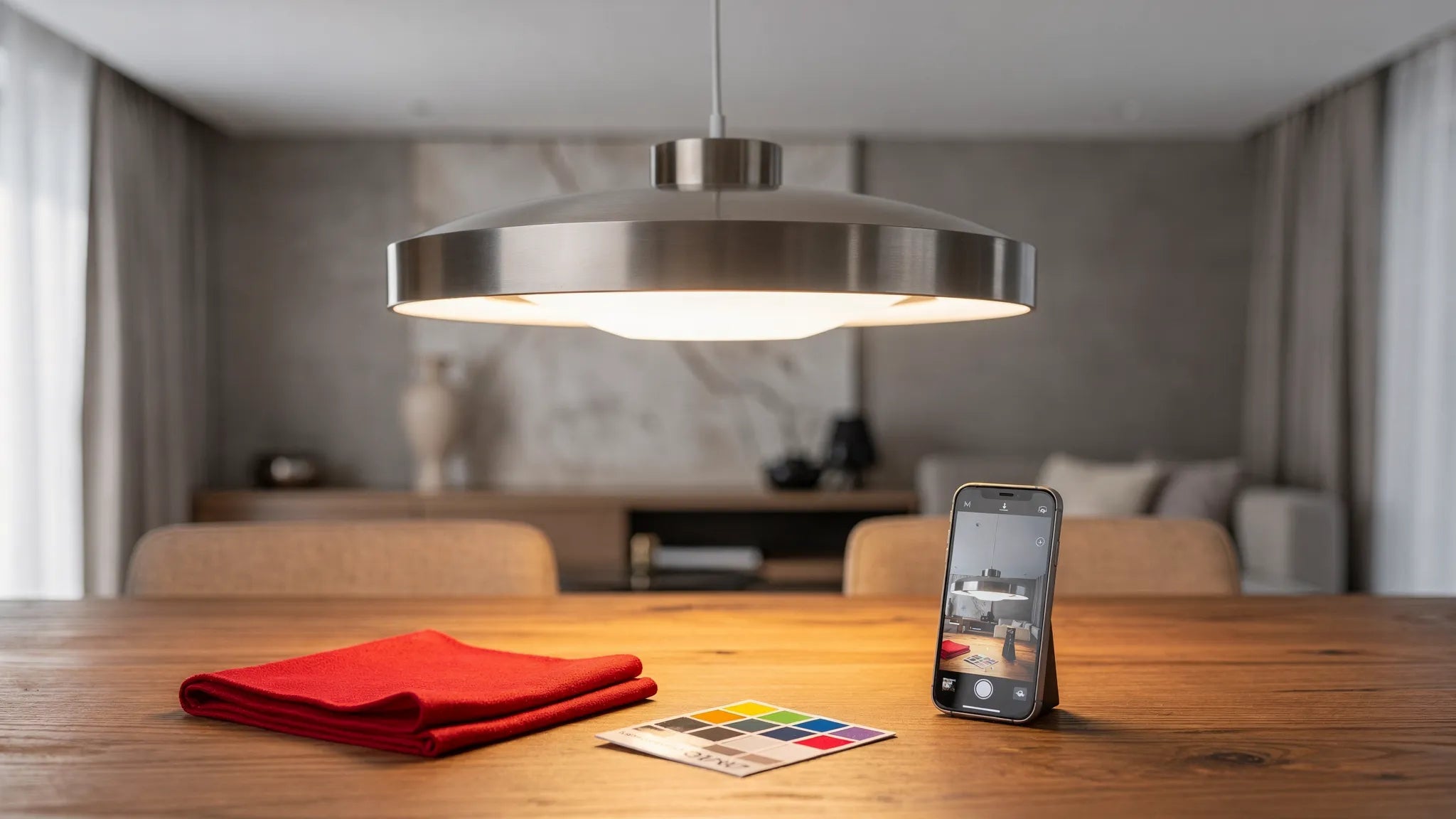
Design lamp LED: CRI, drivers & processing checked quickly
One Design lamp LED Today we have to do much more than “just look nice”. It should reproduce colors naturally, dim reliably (without flickering or humming) and remain cleanly manufactured for years, even if it is used daily. This is exactly where many bad purchases fail: from the outside the lamp appears to be of high quality, but in practice gray skin tones, unsteady light or a wobbly suspension are annoying.
In this guide you will check CRI, drivers and processing in just a few minutes, whether in the showroom, after unpacking or based on online data.
The 3-minute quality check: What really counts
When it comes to LED design lights, the quality is decided in three places:
- Light quality (CRI and color consistency): Does your home appear warm and “real”, or rather flat and slightly greenish?
- Electronics (drivers and dimming behavior): Stable operation, no flickering, no failures.
- Processing (material, details, thermals): Clean edges, resilient suspension, good heat dissipation.
If you check two to three points in each area, you will identify 90 percent of the problem cases.
1) CRI quickly assessed: How to avoid “gray” colors
What is CRI and why is “80” often not enough?
The CRI (Color Rendering Index, often given as Ra) describes how natural colors appear under a light source compared to a reference light. The classic CRI is defined in the CIE standard (CIE 13.3). A good, everyday source for this is the website International Commission on Illumination (CIE).
Important for practice:
- CRI 80 is standard in the mass market and can suffice in hallways or side rooms.
- CRI 90+ usually appears visibly more pleasant in living areas (materials, wood, textiles, skin tones).
- Some LEDs achieve a high Ra value, but have weaknesses saturated red (R9). This is particularly noticeable with skin, wood, brick, leather or warm fabrics.
If a manufacturer mentions CRI, but R9 or doesn't specify a more modern color rendering measure, it's worth asking.
The “R9 Moment”: The simple reality check at home
If you already have a light or can test it, place under the light:
- a red napkin or a red piece of clothing,
- a wooden board or parquet pattern,
- a photo with faces.
If red appears brownish or muted and skin is slightly pale, the light quality is often just “okay” but not premium.
TM-30 (Short): Why planners love it
For projects (architecture, interior, demanding renovation) TM-30, a standard from the Illuminating Engineering Society (IES), is often also used. It describes color rendering in a more differentiated way than the classic CRI.
The following is often used as a rough guide for high-quality residential and commercial lighting:
- RF (Fidelity) as high as possible (often goal: 90+)
- Rg (Gamut) close to 100 (around 98 to 102) so that colors neither appear too “gray” nor artificially oversaturated
Not every designer light lists TM-30 values. If they are present, it is usually a good sign of reputable light data.
Recommended values according to use (practical)
| Area/Usage | Meaningful CRI (Ra) | Why this is important |
|---|---|---|
| Living room, dining area | 90+ | Wood, textiles and skin tones appear much more natural |
| Kitchen (work surfaces) | 90+ | Ingredients and cooking levels are viewed more realistically |
| Bathroom, mirror area | 90+ | Make-up, shaving, skin tones without “gray haze” |
| Hallway, storage room | 80+ | Functional, usually sufficient |
| Art, materials, showroom effect | 95+ (if possible) | Maximum color fidelity and detail effect |
2) Driver tested: The “invisible” component that determines comfort
The LED driver (Driver) is the power supply or electronics that turns 230 V into a suitable supply for the LEDs. In practice he decides on:
- Flicker (Flicker) and therefore visual comfort
- Dimmability and dimming range (from “very bright” to “really comfortable”)
- Lifespan (overheating, component stress)
- noises (Humming with certain dimmers)
The most common driver problems and how to recognize them immediately
| Symptom | Typical trigger | What you can do |
|---|---|---|
| Light flickers when dimming | Dimmer and driver incompatible (e.g. leading edge/leading edge) | Check dimmer type, if necessary use LED universal dimmer or approved model |
| Light pulsates “restlessly” | Flicker due to driver design or control | If possible, choose a different driver or different dimming method |
| Light hums | Magnetic components in the driver, dimmer frequency, mechanical decoupling are missing | Replace dimmer, check driver position, retighten assembly |
| The luminaire becomes noticeably warm on the canopy | Driver sits awkwardly, poor heat dissipation | Have installation checked (if unsure, have an electrician check) |
| Light goes out sporadically | Overload, temperature shutdown, contact problem | Check connections, compare loads and driver specifications |
Dimmable is not the same as dimmable
“Dimmable” on the product text is just the beginning. The details are crucial:
- Which dimming technology? is supported (leading edge, trailing edge, 0-10 V, DALI, controller systems)?
- How deep Can it be dimmed (only up to 30 percent or up to 1 to 5 percent)?
- The light color remains stable or does it get warmer (dim-to-warm) if desired?
If you want a deep, cozy evening atmosphere, a large dimming range is more important than “a few more lumens”.
Check flicker in 20 seconds (without laboratory)
A quick practical check:
- Open your smartphone camera and point it at the light.
- If noticeable dark bands move or the image appears strongly “stroboscopic,” flicker may be present.
Important: This test is only an indication, not absolute. Cameras react differently depending on the sensor and exposure time.
If you want to go deeper: Flicker and health recommendations are included, among other things. in the surroundings of IEEE Std 1789 discussed.
3) Processing & materials: This is how you recognize premium without specialist knowledge
Design often looks perfect in photos Build quality but shows up in details.
Check the housing: edges, gaps, surfaces
Pay attention (especially with metal and glass):
- Clean edges without sharp burrs
- Even coating (no cloud picture, no noses)
- Coherent transitions between shade, frame, arms, canopy
If something feels “light” or rickety when you unpack it, it will rarely stay nice for long in everyday life.
Suspension & Canopy: This is where most everyday annoyances happen
These points are crucial for pendant lights and chandeliers:
- Is he sitting? canopy flat on the ceiling and does it cover the outlet cleanly?
- Does it work? Strain relief stable (no “wobbling” on the cable)?
- Is that Cable length Suitable, without tangled cables or too short a suspension?
Especially in old buildings or where ceiling heights differ, the right suspension is not a luxury, but rather a prerequisite for a designer lamp to really appear “finished planned”.
Heat means durability: Why heavy materials are often a good sign
LEDs don't like heat. Good lights solve this Heat dissipation (Thermal Management): Metal body, sufficient material thickness, sensibly placed drivers.
A simple indicator:
- Very light luminaires with a lot of plastic in the technical area are more often trimmed for cost efficiency.
- High-quality models often use metal (e.g. aluminum) as a heat sink (visible or integrated).
That doesn't mean that "heavy" is automatically "good", but extremely "light" is a warning sign with powerful LEDs.

Checked online: What information a good LED design lamp should provide
When you buy online, images and data must replace feel. A reputable product page mentions (at least) these points:
- Luminous flux (lumens) and ideally a rough recommendation for room size
- Color temperature (Kelvin)
- CRI (Ra), with Premium also R9 or TM-30
- Dimming info (dimmable yes/no, if possible with dimming method)
- Materials and dimensions (also canopy dimensions)
- IP protection rating in the bathroom, outside, over kitchen islands in damp areas
If such data is missing, it is not automatically bad, but the risk increases.
Tip: This is also worth it for the basics (lumens, Kelvin, CRI, flicker). BUYnBLUE-Guide: Understanding LED light: Kelvin, CRI and flicker briefly explained.
Mini checklist: 7 points for a better purchasing decision
- CRI suitable for the room choose (living and dining area usually 90+).
- For warm interiors: after R9 or high-quality color reproduction.
- Clarify dimming request (just “a little” or really atmospheric to very low).
- Check whether dimmer and light compatible (especially with an existing installation).
- For clues low-flicker operation pay attention (or ask).
- Canopy, cable, suspension Check based on measurements and detailed images.
- Check returns and support so that adjustments or exchanges can be made without stress.

When customization is the difference between “okay” and “perfect”.
Many designer lights fail not because of the design, but because of the space: incorrect suspension, unsuitable canopy, color does not match the interior. This is exactly where an adjustment helps before installation is even carried out.
BUYnBLUE offers one for selected chandeliers and pendant lights free customization on, for example:
- Cable length to your ceiling height
- Canopy solution matching the outlet
- Color variant to match the material mix and room concept
Come to this free shipping worldwide, 14 day return policy and support if you want to compare data or photos in advance. You can find out more about this directly at BUYnBLUE.
For a more comprehensive purchase decision (bulbs vs. integrated module, beam angle, IP protection), the following also fits: Buy an LED lamp: This is how you find the right model.
Conclusion
One Design lamp LED can be recognized not only by the look, but also by measurable and tangible quality features: CRI (and ideally R9/TM-30), a cleanly tuned driver and good workmanship around suspension, canopy and heat dissipation. If these three points are correct, light not only appears “bright”, but also high-quality, calm and homely.
Frequently Asked Questions
Which CRI makes sense for living spaces? In the living room, dining area, kitchen and bathroom, CRI 90+ usually appears visibly more natural. CRI 80 may be sufficient for adjoining rooms.
What does R9 mean in LED lamps? R9 describes the reproduction of saturated red tones. A high CRI can still have a weak R9, making skin and wood appear less vibrant.
Why does an LED flicker when dimming? Dimmers and drivers are often not compatible or the LED can only be dimmed to a limited extent. A suitable type of dimmer or a driver designed for this can often help.
Is the smartphone test for flicker reliable? It's a quick tip, but not 100 percent certain because cameras react differently. If you are sensitive, it is worth asking specifically about “low-flicker” and dimming technology.
Which is better: replaceable light source or integrated LED module? Interchangeable bulbs offer flexibility (e.g. different Kelvin/CRI later). Integrated modules often enable slimmer designs, which makes driver quality and service even more important.
Find the right LED design lamp (without guesswork)
If you are looking for a designer lamp that not only looks good, but also... CRI, drivers and processing convinced, take a look at the curated selection BUYnBLUE to. With many pendant and chandelier models, you can have the light adapted to your room situation free of charge (cable length, canopy, color) so that the result is truly harmonious after installation.
%20and%20remain%20cleanly%20manufactured%20for%20years...)