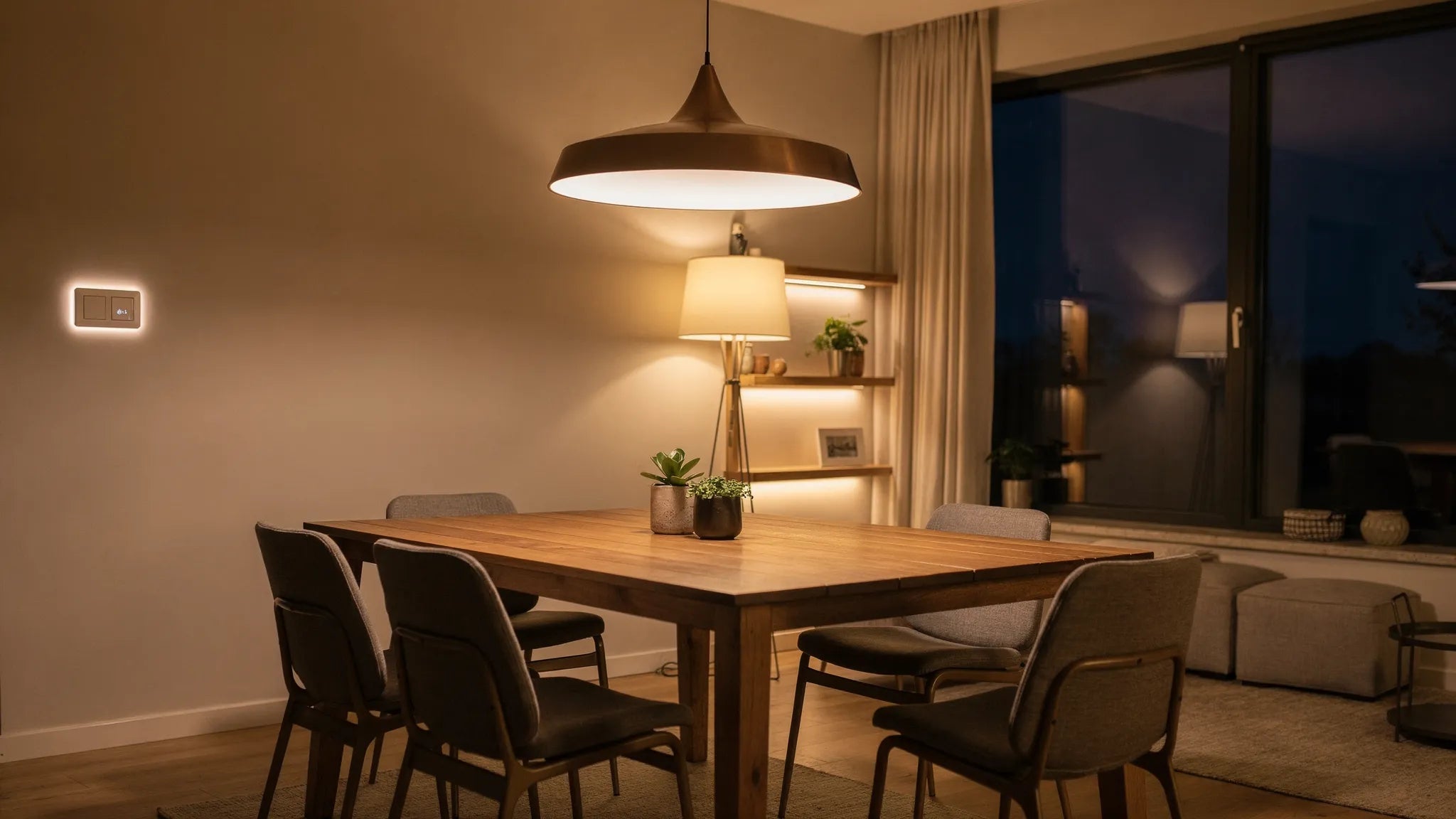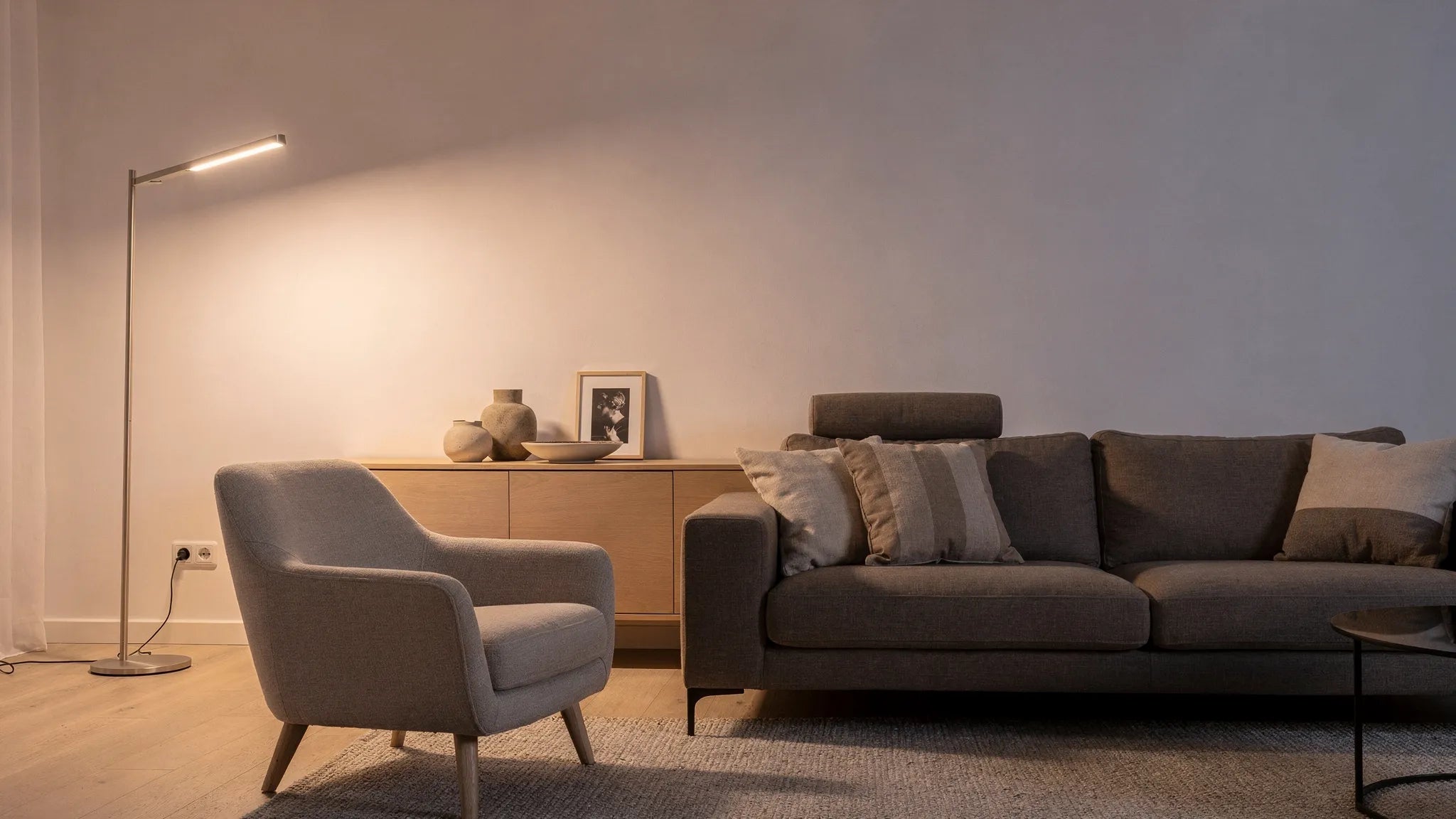
Dimmable bedside lamp: Choose warm light for the evening
A good bedside lamp does more than just light up the room in the evening. It helps you wind down, provides enough light for reading and ensures that the path to bed does not become a tripping hazard. It's not just the design that's important, but rather the combination warm light color, low brightness and fine dimmability.
Light has a more direct effect, especially in the bedroom, than in many other rooms. Light that is too bright or too cool can make you awake, while warm, dimmed light creates a calm atmosphere. If you choose a dimmable bedside lamp, you should not only pay attention to “dimmable” as a product feature, but also to Kelvin, lumen, glare protection, operation and the right size for your bed.

Why warm light at the bed is so important
Evening light has a different task than work light. During the day, lighting can activate, concentrate and make details visible. In the evening, however, it should provide orientation without putting the body unnecessarily into alert mode.
Light influences the circadian rhythm, i.e. the internal clock. Short-wave, bluish light in particular can disrupt the release of melatonin in the evening. Harvard Health points out that blue light can have a particularly strong effect on the sleep-wake rhythm in the evening. Those too Sleep Foundation emphasizes that darker, warmer light environments are more beneficial before sleep than bright, cool light.
This does not mean that every bedside lamp has medicinal properties. But for residential practice the direction is clear: Warm white, glare-free and dimmable lights are usually the better choice for bedsides as bright, cold white light sources.
The right light color: 2200 to 2700 Kelvin for the evening
The light color is given in Kelvin. The lower the value, the warmer the light appears. For a dimmable bedside lamp, a range of approx 2200 to 2700 K ideal. 2700 K corresponds to classic warm white and is good for reading or relaxing. 2200 K seems even warmer, almost candle-like, and is particularly suitable for the last hour before bed.
Neutral white light from around 3500 K can quickly appear too matter-of-fact in the bedroom. Cool white light above 4000K is usually too activating for bedside tables, unless it is for specific functional uses that are not part of the evening routine.
| Bedside use | Recommended light color | Typical brightness per luminaire | Effect |
|---|---|---|---|
| Sleep routine | 1800 to 2200 K | very low, about 5 to 50 lm | calm, orienting, very warm |
| Relax | 2200 to 2700 K | about 80 to 200 lm | cozy and soft |
| Reading in bed | 2700K, maximum 3000K | about 250 to 450 lm | sufficiently bright, but homely |
| Getting dressed or tidying up | 2700 to 3000 K | higher, depending on the size of the room | functional but still pleasant |
The values are guidelines. What matters is how much light actually falls on the book, bed and room. A dark lampshade absorbs more light than opal glass or a light textile shade. That's why dimmability is so important: it gives you leeway instead of committing to a fixed brightness.
Lumens instead of watts: How bright should a bedside lamp be?
In the past, brightness was often estimated in terms of watts. This no longer works reliably with LED lights because watts only describe the power consumption. The luminous flux in lumens is more meaningful. If you want to go deeper into the difference, you can find it in BUYnBLUE-Guide Watt and lumen, what's the difference? a detailed explanation.
The following applies to the bedroom: A single bedside lamp rarely has to illuminate the entire room. Rather, it should create a pleasant island of light by the bed. For pure mood, low values are often enough. Anyone who regularly reads in bed, on the other hand, needs a little more light, preferably targeted and glare-free.
With a dimmable light, not only the maximum brightness is important, but also the lowest level. A good bedside lamp can be dimmed so low that it doesn't disturb you in the evening. Models or lamps that do not jump abruptly from “too dark” to “too bright” but allow for subtle intermediate steps are particularly pleasant.
What “dimmable” really means when it comes to bedside lamps
Not every dimmable light dims equally well. Some models have three fixed brightness levels, others can be adjusted continuously. Still others need a suitable dimmable light source. With integrated LEDs, the quality depends heavily on the installed driver and control.
Four things are particularly relevant for everyday bedside use: easy operation, low-flicker light, a sufficiently low dimming range and compatibility between the lamp, bulb and dimmer.
| Dimmer type | Advantages | What you should pay attention to |
|---|---|---|
| Touch dimmer | convenient in the dark, usually right on the base | Depending on the model, it is sensitive to touch |
| Rotary or slider control | very intuitive, finely dosed | should be easily accessible |
| Cable dimmer | practical with classic table lamps | Check the position on the cable beforehand |
| App or remote control | many scenes and schedules possible | should also be operable without a smartphone |
| 3 level dimmer | simple and robust | less flexible than continuous dimming |
A particularly pleasant extra Dim to warm. When dimmed down, the light not only becomes darker, but also warmer. This is similar to the behavior of classic light bulbs and goes very well with the evening atmosphere. If you are interested in the technical side, it is also worth taking a look BUYnBLUE-Contribution to dimmable lights and low-flicker dimmer types.
Anti-glare: The underestimated comfort factor
A bedside lamp can have the perfect light color and still be unpleasant if it is blinding. Especially in bed, you often lie or sit at eye level with the light bulb. An openly visible LED chip or a very bright light bulb can be more disturbing than the actual brightness suggests.
Therefore, make sure you have a lampshade that shields the light source. Textile shades create a soft, homely light. Opal glass diffuses light evenly and looks modern. Metal or ceramic shades are good if they direct the light downwards and don't hit the eyes directly.
Glare protection is particularly important for double beds. One person may still want to read while the other wants to sleep. Directional reading lamps, asymmetrical shades or two separately dimmable lights help here.
Size and placement: This is how the lamp appears proportional
The most beautiful lamp loses its effect if it is too big, too small or incorrectly positioned. A bedside lamp should match the bed, the mattress height and the size of the bedside table. As a rough guide, a lamp height of around 35 to 60 cm works for many beds. Low platform beds tend to tolerate lower lights, while high box spring beds often tolerate slightly higher models.
When reading, the light emission should be approximately such that the book is well lit without the light source shining directly into the eye. It is practical if the switch or dimmer can be reached from the lying position. A beautiful lamp that you have to get up for every time quickly becomes impractical in everyday life.
A slim base is helpful for small bedside tables. Alternatively, wall lights or small pendant lights next to the bed can keep the area free. If you decide on pendant lights for your bed, the exact hanging height is particularly important. BUYnBLUE offers a free customization service for pendants and chandeliers, for example for cable length, ceiling rose or color. This is particularly helpful with unusual ceiling heights or symmetrical bedroom concepts.
Material and shade: Warm light is not only created by Kelvin
The perceived warmth of a lamp does not just depend on the light source. Materials, surfaces and shade shapes significantly change the lighting effect. A warm white lamp behind clear glass appears more brilliant and has greater contrast. The same light source behind opal glass appears softer. A dark shade makes the light more intimate, but also reduces the usable brightness.
Materials that gently refract or reflect light are particularly suitable for a quiet bedroom. These include textile, frosted glass, warm-toned glass, wood, ceramic and matt metal surfaces. Shiny chrome or mirror surfaces can look elegant, but should be used in such a way that no harsh reflections appear in the field of vision.
The furnishing style also plays a role. In modern bedrooms, clear shapes and opal glass balls appear timeless. Natural materials, reduced lines and warm, diffuse light work particularly well in Japandi interiors. You can find more inspiration here BUYnBLUE-Article about Japandi lamps. If you want to consciously add character, you can also combine a vintage table lamp in a modern way, as in the guide Combine vintage table lamps correctly described.
One or two bedside lamps?
For a single bed, one light is usually enough. With a double bed, two bedside lamps that can be controlled separately are more comfortable. They give both sides their own control and create visual balance. But that doesn't mean that both lamps have to be identical. Two identical models appear calm and hotel-like. Two different but stylistically related lights appear more individual.
It is important that the light color and brightness match. If one side emits 2200 K and the other 4000 K, the bedroom will appear restless. Different shade materials can also visibly change the light color. For couples, it is therefore worthwhile to plan the lights together and not just choose them based on their appearance.
Smart bedside lamp or classic dimmer?
Smart lights can be very practical in the bedroom. You can save scenes, use timers or slowly reduce the brightness. This is pleasant when the technology works reliably and is not more complicated than the light switch.
However, a simple rule applies to the bedside lamp: the most important function must be accessible when you are half asleep. A touch field, a rotary control or a clear switch is often more suitable for everyday use than pure app control. A combination of smart control and manual operation is ideal.
With smart lamps, you should also make sure not to dim them using an unsuitable wall or cable dimmer. Many smart LEDs are dimmed via an app or remote control and should be permanently supplied with electrical power. Otherwise, flickering, malfunctions or lost settings may occur.
Common mistakes when buying a dimmable bedside lamp
The most common mistake is a light color that is too cool. Many lights look elegant in the product image, but look uncomfortable in the bedroom if the light is neutral white or cold white. For evenings, warm white is almost always the safer choice.
The second mistake is too much brightness without a usable lower dimming range. A lamp with a high maximum output can be useful if it can be easily dimmed down. Without a low setting, however, it remains too dominant for the sleep routine.
Another classic is the false umbrella. A decorative lamp made of clear glass can look beautiful, but quickly dazzles on the bed. Anyone who looks directly at the light source while lying down will use the lamp less often or unconsciously avoid it.
The operation is also often underestimated. If the switch is too far back on the cable, disappears between the wall and the bedside table or is difficult to find in the dark, the lamp loses a lot of convenience.
Mini pre-purchase checklist
Before you choose a dimmable bedside lamp, check these points:
- Light color for evening: ideally 2200 to 2700 K.
- Brightness: enough for reading, but dimmable enough for night time.
- Dimmer: continuously or with usefully graduated brightness levels.
- Anti-glare protection: shade, opal glass or directed light emission instead of visible LED chips.
- Operation: Switch or dimmer accessible from bed.
- Size: suitable for bed, bedside table and room proportions.
- Stability: stable base, especially for narrow bedside tables.
- Light quality: CRI at least 80, preferably higher for particularly natural colors.
- Style: Material and shape should match the bedroom design.
- Pair solution: for double beds, it can be controlled separately if possible and is visually harmonious.
If you are still fundamentally weighing up between LED bulbs, integrated LEDs and various technical values, this will help you BUYnBLUE-Guide Buy an LED lamp: This is how you find the right model further.
Conclusion: The best bedside lamp is warm, quiet and flexible
A dimmable bedside lamp should not only look beautiful, but also create just the right mood in the evening. Warm light between 2200 and 2700 K, a low dimming range, glare-free light distribution and convenient operation are more important than maximum brightness.
Directional light is also important for readers. Soft scattering is crucial for relaxation. For a harmonious bedroom, the size, material and light color should match. This means that the bedside lamp not only becomes a practical light source, but also an integral part of your evening routine.
At BUYnBLUE you will find a curated selection of modern designer lights made from high-quality materials. If you are planning your bedroom holistically, it is also worth taking a look at suitable table, wall and pendant lights so that function, atmosphere and design come together to create a harmonious lighting concept.
Frequently asked questions
What color light is best for a dimmable bedside lamp? For the evening, 2200 to 2700 K is ideal. 2700 K is good for reading and relaxing, while 2200 K is particularly warm and calm.
How bright should a bedside lamp be? 80 to 200 lumens per light are often enough for mood. Depending on the screen and distance, around 250 to 450 lumens are useful for reading. It is important that the lamp can be dimmed down far enough.
Is a dimmable bedside lamp better for sleep? It can support a sleep-friendly evening routine because you can reduce the brightness and lighting mood. Warm light, low intensity and as little glare as possible are crucial.
Which is better: touch dimmer, app or classic switch? Direct operation is particularly practical for the bed. Touch dimmers or rotary controls are often more convenient in everyday life than pure app control. Smart functions are a good extra, but should not be the only operating option.
Can I just use a dimmable LED bulb? Yes, if the socket, power and dimmer are compatible. Make sure that the lamp is expressly marked as dimmable and fits the dimmer you are using.
Are two bedside lamps necessary in a double bed? Not mandatory, but highly recommended. Two separately controllable lights give both people their own control and ensure a balanced lighting effect in the bedroom.