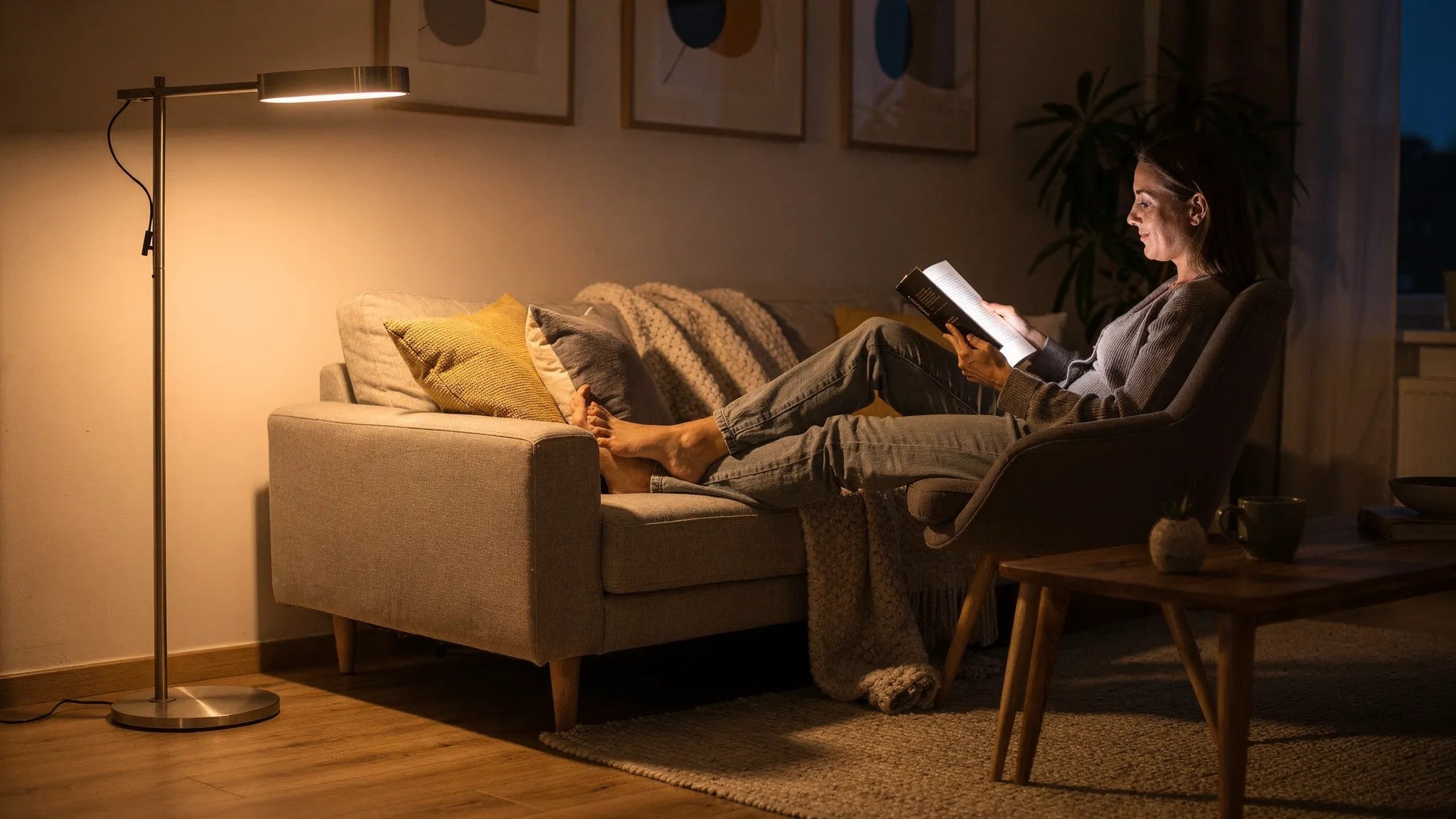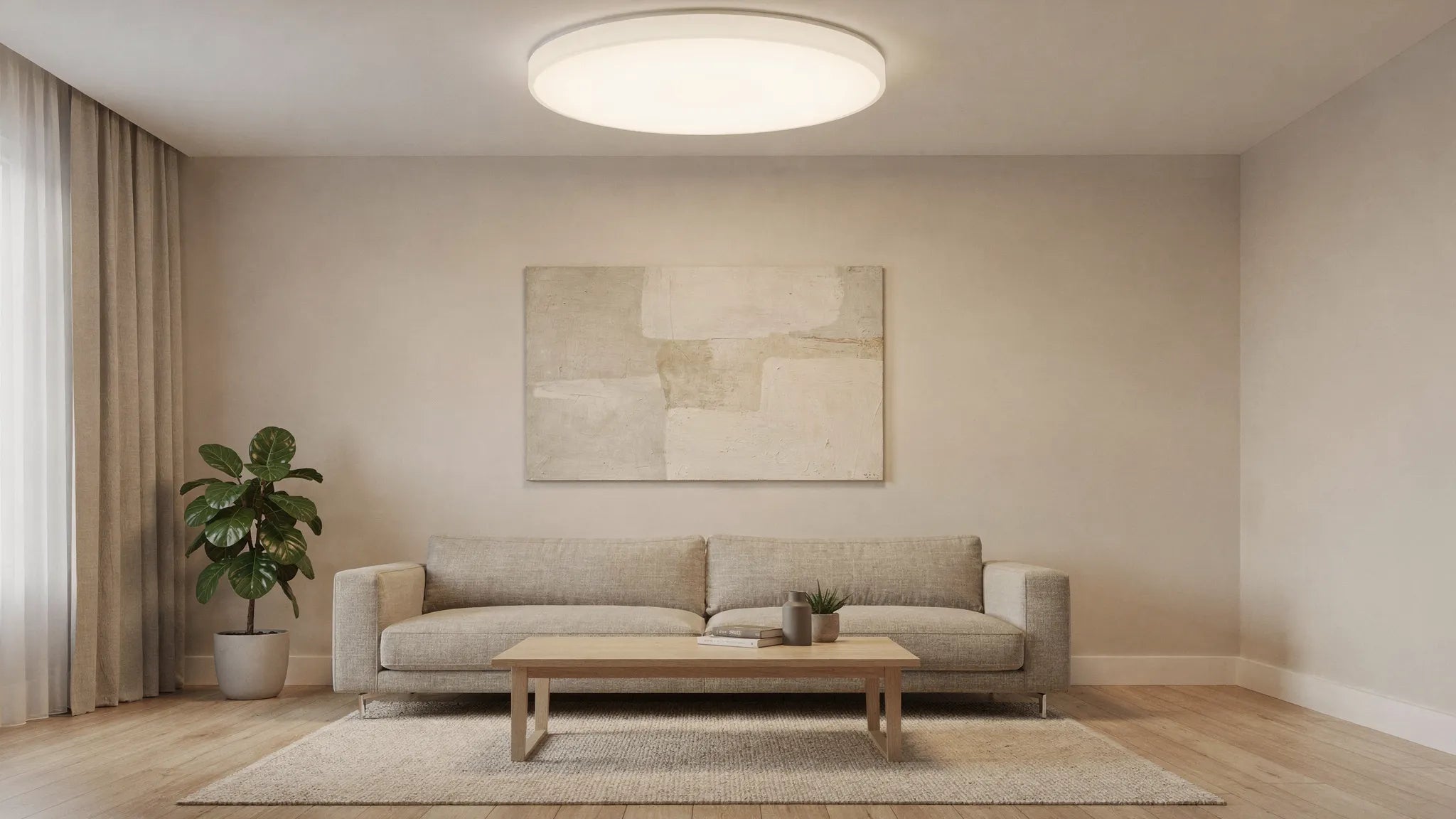
LED ceiling lamps: Modern designs that make rooms appear quieter
When a room feels “restless,” it’s often not the furniture but the lighting: harsh shadows, visible points of light, cold white, or a bright spot right above your head. LED ceiling lights can have the opposite effect, namely visual calm, uniform brightness and an atmosphere in which you automatically slow down.
In this guide you will find design and technology principles that modern LED ceiling lights can use to make rooms appear calmer, plus specific selection aids for the living room, bedroom, hallway and home office.

What does “calm light” even mean?
“Quiet” is not a measurement, but a Perceptual effect. In lighting planning, peace and well-being usually depend on four adjusting screws:
- Low glare: No point-shaped LEDs in the field of vision, no reflective surfaces, no “light cone” directly at eye level.
- Soft contrasts: Transitions between light and dark appear smoother, shadows are less harsh.
- Matching light color: Warm light (usually 2,700 to 3,000 K) has a more relaxing effect in the evening than neutral or cold white.
- Stable light quality: Low-flicker light and good color rendering reduce “visual friction”.
This is particularly important with ceiling lights because they dominate the largest area of the room “from above”.
7 design features of LED ceiling lamps that make rooms appear quieter
1) Large, glowing areas instead of visible points of light
One diffuse light surface (Panel, opal disc, textile diffuser) appears quieter than many visible LED points or exposed filaments. The eye has to “work” less because the brightness distribution is more even.
2) Opal diffuser and deep light emission (anti-glare)
Make sure the light source hidden is. Good ceiling lights combine opal glass or acrylic with a structure that blocks the view of the LEDs. This reduces direct glare, especially when sitting.
3) Indirect part: “emit” light onto the ceiling and wall
Quiet rooms rarely only have “downlights”. It looks very harmonious when the ceiling light provides part of the light upwards or sideways scattered so that the ceiling and walls are slightly brightened. This reduces harsh contrasts.
If you would like to specifically enhance this effect, it is also worth taking a look at the guide to indirect lighting in the living room: Indirect lighting in the living room.
4) Reduced geometry: circle, flat disk, quiet lines
Shapes influence perception more than you think. Round or very clear, flat shapes often appear “quieter” than complex, highly structured designs. This is not a must, but it is a reliable style lever in minimalist and modern interiors.
5) Matt surfaces and few “glossy edges”
High gloss can be beautiful, but it quickly creates reflections and hotspots. For a calm overall picture matt metals, satin glass and opal plastics usually the better choice.
6) Dimmable (and ideally “warm dimming”)
Quiet lighting is rarely just a fixed value. If the ceiling light is dimmable, you can lower the brightness in the evening and thus smooth out contrasts.
It becomes even more pleasant when the light color becomes warmer when dimming (often called “dim-to-warm”). This means the light remains comfortable even at low brightness.
7) Fewer “islands of light” from above, more uniform basic brightness
Many spots can look great, but they also quickly make rooms “nervous” because small bright areas appear everywhere. A ceiling light is ideal for peace and quiet a good basic brightness evenly distributed and accents later added via wall or floor lamps.
Which designs are particularly calming in which room?
Not every quiet light has to look the same. What is crucial is whether the shape, light emission and brightness suit the use.
| LED ceiling light design | Why it seems calm | Particularly suitable for | What to pay attention to? |
|---|---|---|---|
| Flat LED panel/flat disc | Very even light, few shadows, “visually clean” | Hallway, kitchen, office, low ceilings | Avoid glare, better with a diffuser instead of visible LEDs |
| Round opal ceiling light | Soft light distribution, harmonious geometry | Bedroom, living room, children's room | Choose warm white, dimmable is ideal |
| Indirect ceiling light (uplight portion) | Ceiling is brightened, contrasts decrease | Living room, bedroom, high ceilings | Plan for enough lumens so that it doesn't become “too soft”. |
| Linear ceiling light (minimalist) | Calm lines, good for clear floor plans | Kitchen, dining area, home office | Positioning is important, otherwise hard shadows will appear |
| Ceiling light with textile or microprism diffuser | Very gentle, low-glare light image | Bedroom, living area | Pay attention to cleaning and material quality |
If you are specifically looking for a space-saving solution, this article will be helpful as a supplement: Flat LED ceiling lights: modern, efficient, versatile.
Technology that makes peace noticeable (without sinking into data sheets)
Light color (Kelvin): warm beats “clean”
For rooms that are intended to relax Warm white usually the best basis. As a rough guide:
- Living room, bedroom: often 2,700 to 3,000 K
- Kitchen, bathroom, work areas: often more neutral, depending on the style and daylight
If you want a quick refresher on Kelvin logic: What is Kelvin and what does this number mean?
Color rendering (CRI): less “gray”, more natural
Good color rendering makes materials appear calmer and of higher quality (wood, skin tones, textiles). There is one in the living area high CRI a real comfort factor.
Flicker: underrated but important
Depending on the person, flickering can be subconsciously stressful (and visible in videos). Look for high-quality LED drivers and clean dimming compatibility.
If you would like to delve deeper into the topic of dimming and flickering, this article will be helpful: Dimmable Floor lamps: Which types of dimmers are really flicker-free.
Brightness (lumens) and uniformity: peace needs “enough”, not “maximum”
Too little light doesn't automatically make rooms quieter, it often just makes them more difficult to use. One thing is crucial sufficient basic brightness without hard hotspots.
For a clean calculation by square meter: LED lighting: This is how you calculate lumens per m² correctly.
Quick check: How to choose a quiet LED ceiling lamp for each room
Living room
The ceiling light should usually be in the living room Basic light deliver without dominating the mood.
- Prefer diffused light (opal, panel, indirect), dimmable.
- Add “quiet zones” via wall or floor lamps instead of solving everything via the ceiling.
- If you are unsure which zones make sense: Living room lamps: These light zones make the room cozy.
bedroom
Here “quiet” is the main goal.
- Warm white, low-glare, ideally dimmable.
- No visible LED dots above the bed.
- Prefer soft surfaces and indirect parts.
hallway
Hallways benefit from uniform, clear basic brightness, so that the room does not appear stained.
- Flat LED ceiling lights are often ideal because they take up little space.
- Avoid glare, especially if the ceiling is low.
- Optional: sensor control if it suits the usage.
Home office
Calm here means: concentrated, not “tired”. You need uniformity, good color rendering and little glare.
- A more neutral light color may make sense, depending on the daylight.
- Make sure that the ceiling light minimizes monitor reflections.
More about this: The perfect lighting for the home office - so you avoid headaches and fatigue.
Common Mistakes That Instantly Make Rooms Unruly (and How to Avoid Them)
A single, very bright center
A single ceiling light in the middle, set very brightly, often creates harsh shadows and “stage lighting”. Solution: choose dimmable, diffuse cover, additional light sources on the side.
Too cold in the living area
Cold white has a technical effect and emphasizes contrasts. Warm white is usually the quieter choice in living rooms and bedrooms.
Visible LED dots or clear shades
It looks modern, but can be very blinding. If “quiet” is your goal, opal covers and anti-glare constructions are often better.
Too many spots without a concept
Many spots produce multiple, hard beams of light. Solution: Either consciously accentuate (few, targeted spots) or use flat ceiling lights for basic lighting.

Quiet rooms sometimes need tailor-made work, not just an “off-the-shelf model”
Especially in old buildings, with high ceilings or unusual floor plans, peace and quiet often fails due to details such as proportions, suspension height or light distribution.
BUYnBLUE offers a curated selection of designer lights made from high-quality materials. Particularly practical if you are planning a pendant light or chandelier instead of a classic ceiling lamp: These lights can... BUYnBLUE can be adjusted free of charge, for example the cable length, canopy or color, so that the luminaire fits exactly to the ceiling height and layout. Customers also benefit from free shipping worldwide, 14 day return policy, Order tracking and 24/7 support.
FAQ: LED ceiling lamps and a “calm” spatial effect
Which LED ceiling lights are the least dazzling? Models with an opal diffuser, a concealed light source and the largest possible luminous surface are the ones with the lowest glare. Visible LED points often appear less restless.
Which color of light makes rooms appear calmer? In living rooms and bedrooms, warm white (often 2,700 to 3,000 Kelvin) usually appears calmer because contrasts appear softer and the atmosphere is more relaxed.
Does dimmable light really make a room cozier? Often yes, because you can adjust brightness and contrast to suit the time of day and mood. Especially in the evening, less light is often “calmer” for the eyes.
How bright should a ceiling light be so that it doesn't appear “harsh”? It's not just the number of lumens that counts, but the distribution. A diffuse, uniform light can appear significantly calmer than a point light with the same brightness.
Are LED panels too “office-like” for living spaces? They can be so if they shine in a very cold white or are very dazzling. In warm white, dimmable and with good coverage, flat panels also work very harmoniously in the living area.
Live more quietly with modern ceiling lighting BUYnBLUE
If you are looking for LED ceiling lamps that look modern and noticeably calm rooms, it is worth taking a look at the curated selection of BUYnBLUE. And if your space calls for a pendant light or chandelier, the free customization service will help you configure the length, canopy or color to match your ceiling and floor plan.