Plan dimmable LED ceiling spotlights for insulated ceilings
Anyone looking for “dimmable LED ceiling spots” usually first looks at the light output, design and the right dimmer. However, with an insulated ceiling, the structure determines whether recessed spots make sense at all. Insulation material, airtightness level and available cavity must match the luminaire. Otherwise heat build-up, leaky connections or complex rework can occur.
The most important rule: A dimmable LED is not automatically suitable for installation in insulation. The decisive factors are the installation specifications for the specific luminaire, its operating device and, if necessary, a tested installation housing. This guide shows what information you need before purchasing and when a central ceiling light can be a better solution.
“LED ceiling spots dimmable”: First check the ceiling structure
An insulated ceiling can be constructed in very different ways. There is often thermal insulation and an airtightness layer under a roof surface, which can also have a vapor barrier function. A suspended ceiling between heated floors, on the other hand, can primarily provide sound insulation or an installation space.
The visible plasterboard is not the only thing that counts when planning. Use construction documents or a professional inventory inspection to clarify which layers lie above. Support profiles, beams and cables that have already been laid also limit possible installation positions.
| Ceiling situation | Central test question | Sensible planning approach |
|---|---|---|
| Insulated roof surface or top floor ceiling | Where is the airtightness level? | If possible, place the spots underneath at a sufficiently deep installation level |
| Suspended ceiling between heated rooms | Which insulation, cables and profiles are in the cavity? | Check installation height, heat dissipation and accessibility |
| Ceiling with specified fire resistance | Are openings and installations in the ceiling system permitted? | Request proof of the specific system and installation details |
| Unknown inventory structure | Which layers are touched during the cutout? | Clarify the structure professionally before selecting the product and drilling |
A luminaire should only be selected once these questions have been answered. A small ceiling cutout says little about how much space is actually needed behind it.
Heat dissipation: LED does not mean heat-free
LEDs efficiently convert electrical energy into light, but still generate heat. This occurs both at the light source and at the electronics. If it is not sufficiently dissipated, components can be subjected to greater stress and fail earlier.
If LED ceiling spots are designed to be dimmable, the thermal test at full power remains crucial. Later use with reduced brightness does not replace a suitable installation situation. Non-combustible mineral wool insulation can also hinder heat release.
Differentiate between contact with insulation material and complete coverage
Please check the assembly instructions specifically to see whether insulation material can touch the luminaire and whether covering it with insulation material is permitted. Contact and full coverage are not the same thing. A release for the light does not automatically apply to a separately connected driver.
If there is no clear information, suitability may not be derived from product photos or general statements such as “for suspended ceilings”. The IP protection rating does not answer this question either: it describes the protection against foreign bodies and water, not the thermal suitability under insulation material.
Built-in housings are not a universal solution
A suitable housing can create a defined installation space and keep insulation material away from the luminaire. However, it must fit the specific application. Any protective cover does not automatically make an unsuitable spot safe.
The specifications of the luminaire and housing manufacturer are decisive. This includes permissible power, dimensions, distances and installation conditions. In the case of a fire protection ceiling, the suitability within the complete ceiling system must also be clarified. A thermal protective hood is not necessarily a fire protection solution.
Maintain airtightness and vapor barrier
Under insulated roof surfaces, a hole cut out is more than an opening for light. If the airtight layer is damaged, warm room air can reach colder areas of the structure. Moisture can accumulate there. It is therefore not just the insulation material that is crucial, but rather the consistently tight layer.
The importance of a permanently airtight building envelope is also described Section 13 of the Building Energy Act. For the specific implementation, the existing construction and the suitable connection details must be taken into account.
A separate installation level is often helpful so that dimmable LED ceiling spotlights can be installed without unnecessarily penetrating this level. Lights and cables are located on the room side below the airtight layer. The space required for this must already be planned for in the substructure.
If cables or housings still have to penetrate the level, suitable, permanently sealed connections are required. Construction foam or a loosely placed housing are not a blanket replacement for a coordinated sealing system. The details should be determined jointly by drywall construction, an electrical contractor and, if necessary, the building physics planning.
Simply cutting out insulation so that the spot fits in is also not a reliable solution. This can cause local thermal insulation to deteriorate and the intended ceiling structure to be changed.
Calculate the installation depth correctly: More than the height of the spot
The specified luminaire height is only part of the space required. In addition, there may be connection space, cable movement space, a separate operating device and the prescribed free spaces. Recessed housings may also require more depth than the spot itself.
Several dimensions are therefore required for the decision: the ceiling cutout, the permissible thickness of the ceiling cladding and the total required installation height including the prescribed distances. This information is product specific. There is no generally valid minimum distance for all LED spots.
If you are planning dimmable LED ceiling spots, the floor plan should also be aligned with the substructure. A visually uniform grid can meet support profiles or beams precisely. Load-bearing components may not be changed in favor of a desired spot position.
The light distribution is then built up on these possible positions. Information on the beam angle and arrangement can be found in the additional instructions Planning dimmable LED spots on the ceiling and wall. However, for insulated ceilings, structural feasibility remains the first planning step.
Select driver and dimmer as a related system
The word “dimmable” does not describe how the brightness is controlled. Depending on the luminaire, phase control, phase control or digital control such as DALI are possible. These procedures are not interchangeable.
For lights with a separate driver, the design essentially determines which control is suitable. For replaceable LED lamps, their electronics must match the dimmer. Therefore, check the compatibility information for the actual combination, not just the general name “LED dimmer”.
Check load range and dimming behavior
Even if LED ceiling spotlights are offered dimmable, flickering, noise or a limited control range can occur with an unsuitable dimmer. The permissible number of connected lights cannot always be determined from the sum of their wattages alone. Inrush currents and the LED-specific details of the dimmer also play a role.
For larger groups, it makes sense to test the intended combination before complete installation. These include low brightness, maximum brightness and turning back on. The in-depth guide to dimmable LED ceiling lights and matching controls explains these connections in more detail.
Make the driver accessible and convenient
A separate driver should be installed according to the manufacturer's specifications and remain accessible for maintenance or replacement. Allowing it to disappear loosely under insulation is not a suitable standard solution.
Depending on the device, permissible ambient temperatures and a maximum housing temperature are specified at the marked measuring point. Whether these conditions are met must be assessed professionally. A short functional test with an open ceiling does not fully reflect later operation in a closed structure.

Planning example: New spots under an insulated roof area
Suppose a living space under the roof receives a new suspended ceiling. The existing insulation and airtightness level should remain unchanged. What is desired are several spots for basic lighting and a dimmed setting in the evening.
First, determine how much space is available below the airtight level. We then look for lights and, if necessary, housings that fit the entire space required. The spot grid is only created on this basis. In this way, planning prevents a light that has already been purchased from subsequently forcing interventions into the insulation.
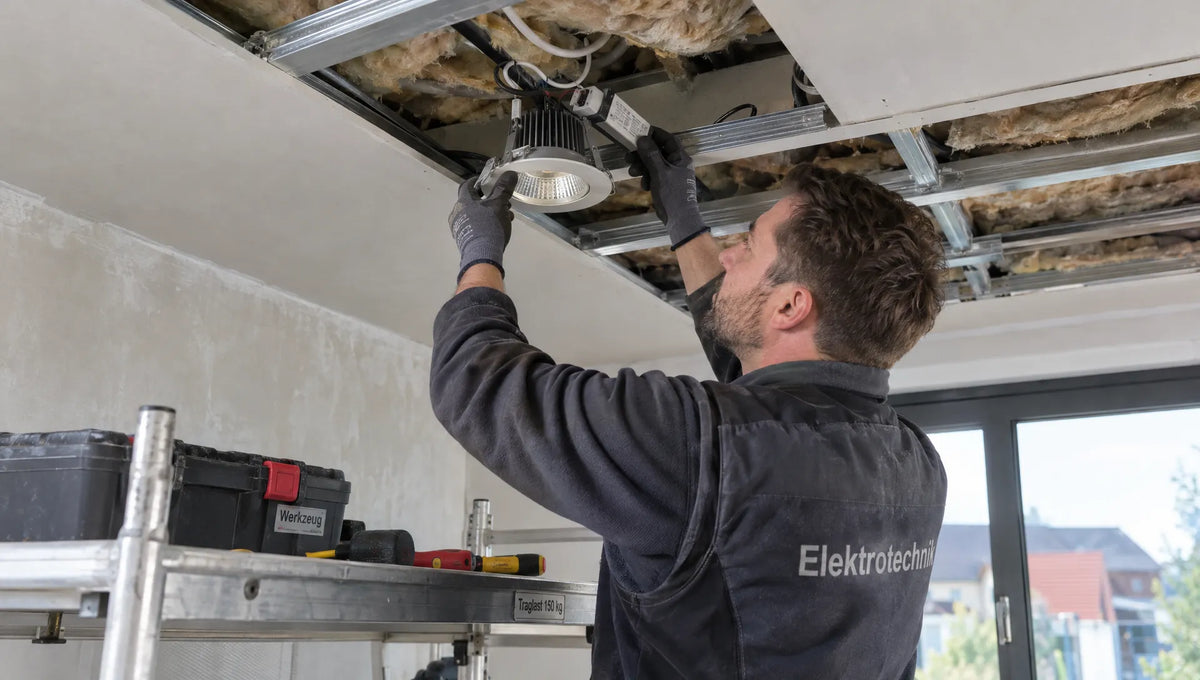
To ensure that LED ceiling spots remain dimmable and maintainable, the positions of the operating devices are planned at the same time. The electrician then coordinates the control, load range and cable routing. Before closing the ceiling, the installation conditions and connections are checked.
If the required installation height does not fit into the available space, the concept is changed. A lower suspended ceiling, suitable surface-mounted lights or a central light are possible. A cavity that is too tight will not fit by compressing the insulation material or leaving out a prescribed clearance.
These documents should be available before the ceiling cutout
Good planning doesn’t end with a product name. Short, shared documentation is helpful for owners, interior designers and craft businesses. It prevents everyone involved from assuming different installation conditions.
Before executing, note at least the following points:
- Ceiling structure: Location of insulation, airtightness level, substructure and existing pipes.
- Luminaire data: Cutout dimensions, installation depth, permissible ceiling thickness and all prescribed clearances.
- Insulating material contact: Clear manufacturer information on contact and coverage for the light and driver.
- Protection requirements: Required IP protection class, fire protection certificates if necessary and suitable installation housings.
- Dimming and maintenance: Shared control, permitted group size and access to replaceable components.
For ceilings with fire or sound insulation requirements, the intended penetrations should also be coordinated with the responsible specialist planner or system provider. A visually clean section does not prove that the original properties of the ceiling are retained.
Work on the fixed electrical installation should be carried out by a specialist electrician. Coordination with the drywall should take place before closing the ceiling, not just when connecting the lights.
When a central ceiling light makes more sense
A grid of recessed spotlights is not worthwhile in every room. If the installation height is low, there is a sensitive airtightness level or an unknown existing structure, a central light can reduce the need for intervention. The prerequisite here is also a professionally executed connection and suitable fastening.
If you prefer a simple central design instead of lots of light points, you can, for example Simplicity LED ceiling lamp Include in the selection for the living room or bedroom. Whether your assembly conditions and technical properties suit the specific project should be checked using the product documents. A general approval for insulation material contact or a specific dimming process cannot be derived from this.
If dimmable LED ceiling spotlights could only be implemented with significant changes to the ceiling structure, this comparison would be particularly useful. The desired lighting effect can often be achieved with a central light and additional wall or floor light.
Frequently asked questions about spots in insulated ceilings
Can LED spots be covered directly with mineral wool? Only if the manufacturer expressly allows this installation situation. The non-combustibility of the insulation material alone is not enough because the heat dissipation of the luminaire and its operating device must also be correct.
Is a protective cover over the spot enough? Not automatically. The hood must match the luminaire, the insulation and the intended ceiling structure. If there are fire protection requirements, a separate appropriate system certificate is required.
Can I cut open the vapor barrier for installation? Not without a planned connection detail. A penetration must be permanently and professionally sealed. A sufficiently dimensioned installation level below the airtight layer can often avoid such interventions.
Does strong dimming help against an installation space that is too narrow? No. The installation must be suitable for permitted operation including full power. Reduced brightness does not replace prescribed distances or approval for contact with insulation material.
How do drivers remain accessible later? This is determined before installation, for example via a suitable inspection option or an opening expressly intended for this purpose. Whether the driver can be reached through the spot cutout depends on its dimensions and construction.
First clarify the structure, then select the lamp
Have the ceiling structure, available installation space and desired control checked before ordering lights. With this information you can BUYnBLUE Select the right lights for your living concept and coordinate the assembly conditions with the specialist company carrying out the work. This means that the design remains based on the technical possibilities of the ceiling.