Properly plan a dimmable LED panel with remote control
At first glance, a dimmable LED panel with a remote control seems like the simplest solution for modern room lighting: mount it flat, switch it on, adjust the brightness, and you're done. In practice, however, the planning determines whether the light is pleasant, functional and satisfactory in the long term.
Precisely because LED panels light very evenly, planning is less forgiving of errors than with decorative lights. A panel that is too small makes the room uncomfortable despite the high wattage. The wrong light color makes living areas appear cool. A poorly thought-out remote control quickly becomes a weak point in everyday life.
If an LED panel is to be dimmable with a remote control, it is not just about technology. It's about spatial effect, ease of use, installation, dimming quality and the question of whether a flat panel really fits the furnishings.
First understand the room: What should the panel do?
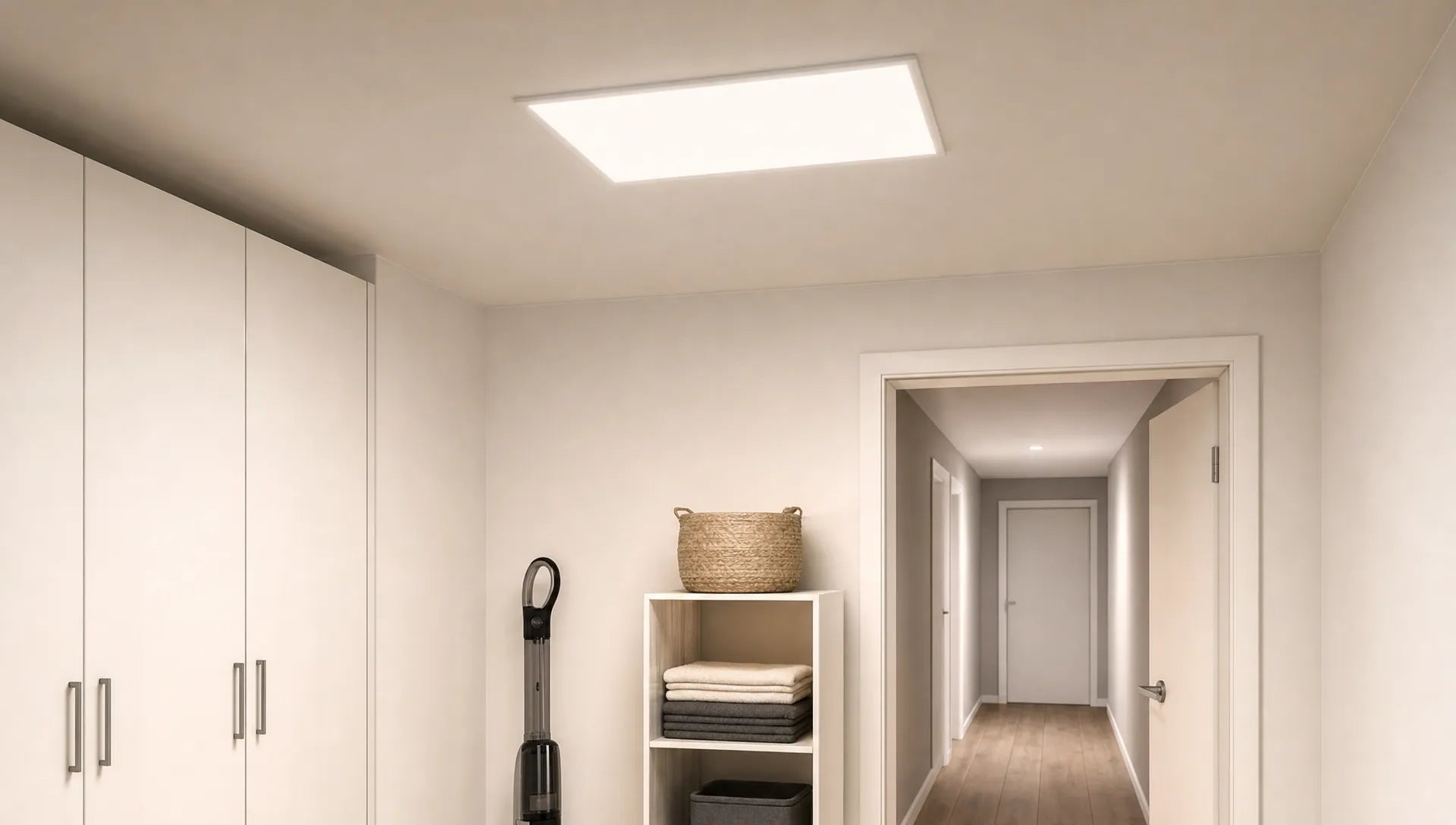
An LED panel is particularly strong when it comes to widespread ambient light. It distributes light over a large area, has a visually restrained effect and is particularly suitable where a clear, calm ceiling is desired. Typical places of use are the kitchen, hallway, study, utility room, bathroom or minimalist living rooms.
The lighting task is important. Should the panel illuminate the entire room, support a work area or just create a flexible basic brightness? In a living room, a panel alone can quickly appear functional. In combination with floor, table or wall lamps, however, more depth is created. In the kitchen, the panel should be positioned so that it does not cast shadows on work surfaces.
If you first want to deal with brightness, format and even light distribution, a more in-depth look at choosing one will help Dimmable LED panels for even room lighting.
| room or zone | Useful lighting task | Orientation for illuminance | Planning note |
|---|---|---|---|
| Living room | Flexible basic brightness | approx. 100 to 200 lx | Plan low dimming levels for TV and evening atmosphere |
| Dining area | Pleasant light at the table | approx. 200 to 300 lx | Warm white usually looks more homely than neutral white |
| Kitchen | Bright work light | approx. 300 to 500 lx | Complete the panel with under-cabinet or work surface light |
| Home office | Concentration and visual comfort | approx. 500 lx at the workplace | Check glare and shadows particularly carefully |
| hallway | Orientation | approx. 100 to 150 lx | Uniformity is more important than maximum brightness |
| bathroom | Basic light plus mirror light | approx. 200 to 300 lx | Observe IP protection and protection areas |
These values are guidelines, not rigid rules. Dark walls, high ceilings and matt surfaces absorb more light. Light walls and reflective surfaces make the same luminous flux appear stronger.
Don’t just plan brightness based on watts
With LED panels, the wattage says little about the actual effect. The decisive factor is the luminous flux in lumens and how evenly it arrives in the room. As a simple rough calculation:
Desired illuminance in lux times room area in square meters gives the rough lumen requirement.
An 18 m² living room that is planned with around 150 lx basic brightness requires around 2,700 lumens. Since luminaire position, ceiling height, cover and room colors cause light loss, a reserve makes sense. A dimmable panel can therefore have more maximum power as long as it can be dimmed down properly.
This is exactly where the advantage of dimming lies. You're not just buying a fixed brightness, you're buying a range. During the day, the panel can be bright enough for cleaning, reading or working. In the evening a significantly lower setting is sufficient. For living spaces, a good low dimming level is often more important than pure maximum brightness.
Light color: Use the remote control sensibly
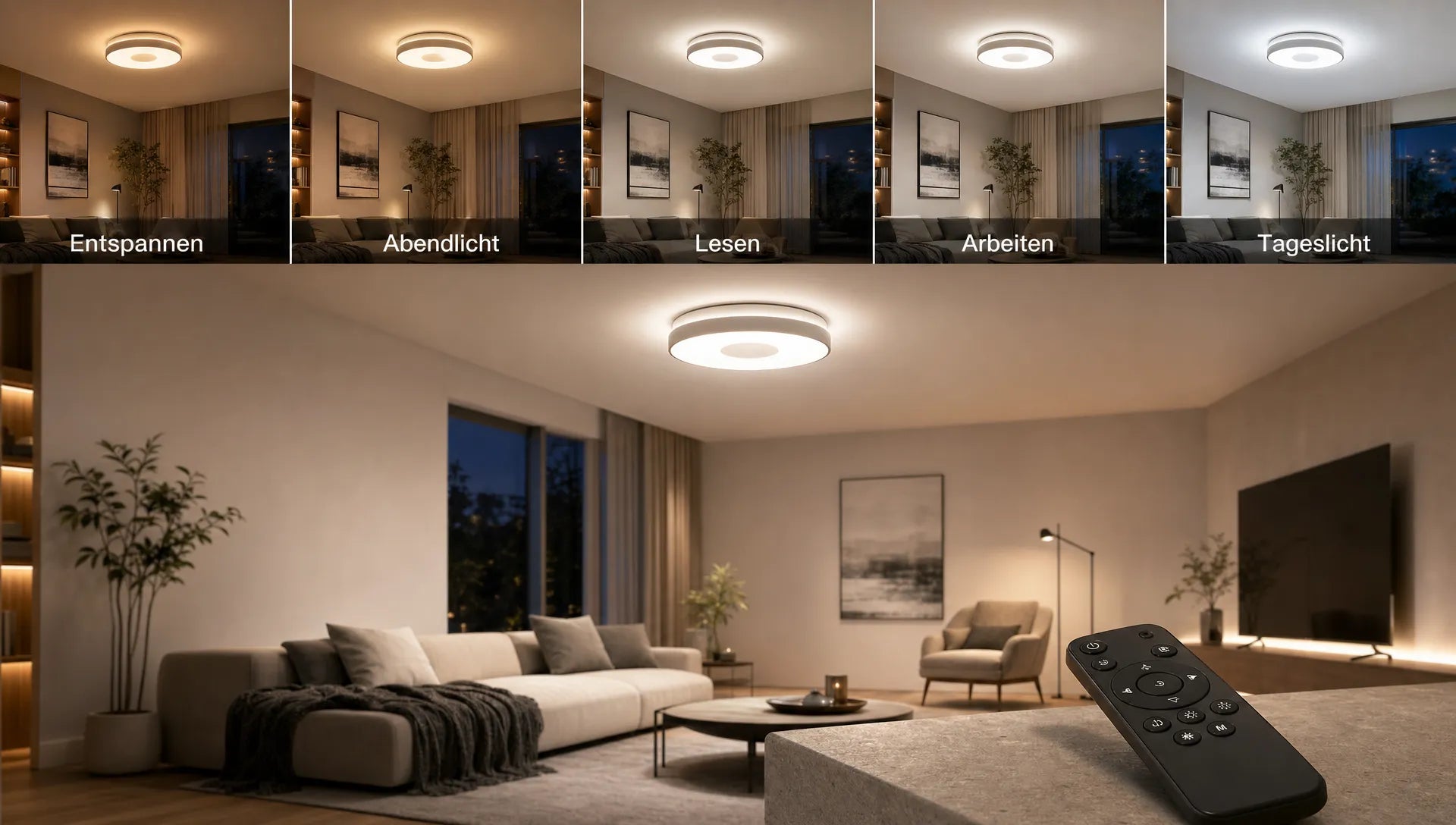
Many LED panels with remote control not only offer dimming, but also an adjustable light color. That sounds practical, but it should be planned consciously. If you can constantly switch between very warm and very cold light, you still need a basic setting that suits the room.
Warm white light around 2,700 to 3,000 Kelvin looks homely and relaxed. Neutral white light around 3,500 to 4,000 Kelvin is well suited for kitchens, hallways, bathrooms or work areas. Very cool light from around 5,000 Kelvin can appear concentrated, but is often too harsh in living rooms in the evening.
Also pay attention to color reproduction. The value is often given as Ra or CRI. Ra 80 is common for many everyday areas. In rooms where colors are important, such as the kitchen, dressing room, bathroom mirror or living areas with art and materials, a higher value is more pleasant.
A common mistake is to only see the adjustable light color and ignore the quality of each level. A panel can range from warm to cool on paper, but still appear flat or grayish at low brightness. If possible, check product images, technical information and customer information about the lighting effect.
Plan the remote control as part of the operating concept
A remote control makes sense when it makes real everyday situations easier. In the bedroom, the light can be dimmed from the bed. In the living room you can switch between bright basic lighting and a relaxed evening atmosphere. In an open living area, a remote control can help control different lighting zones more conveniently.
Nevertheless, it should not be the only thought in the planning. Ask yourself how the light is operated from the entrance, where the remote control is located and whether the light saves the last setting after being switched off using the wall switch. You can also find more background information on suitability for everyday use in the guide LED lamps with remote control.
| Period | What you should pay attention to | Why it matters |
|---|---|---|
| Range | Radio is usually more flexible than infrared | The remote control does not have to point exactly at the light |
| Memory function | The last brightness and light color are retained | The light doesn't start out too bright or too cold every time |
| grouping | Several lights can be controlled separately or together | Practical for open floor plans or long hallways |
| Wall mount | Fixed place for the remote control | Prevents long searches in everyday life |
| Wall switch | Basic function must remain logical | Guests and family members usually use the counter first |
Control is particularly important with multiple panels. Two visually identical lights can be annoying if they do not dim synchronously or show different shades of white. Therefore, if possible, plan with related series or clearly compatible controls.

Clarify the type of installation and ceiling structure early on
Depending on the model, an LED panel can be planned as a surface-mounted panel, built-in panel or suspended solution. Which variant makes sense depends on the ceiling. A concrete ceiling requires different fixings than a suspended plasterboard ceiling. There must be enough cavity for built-in panels. For surface-mounted panels, the visible frame height is crucial for the appearance.
Before purchasing, clarify these points:
- Where is the power outlet and does it fit into the desired position?
- Is there enough space for drivers, connection terminals and possible control units?
- Is the ceiling strong enough and what fastening material is needed?
- Does the panel have to be installed in a damp room?
- Should the panel remain accessible later if the drivers or controls need to be checked?
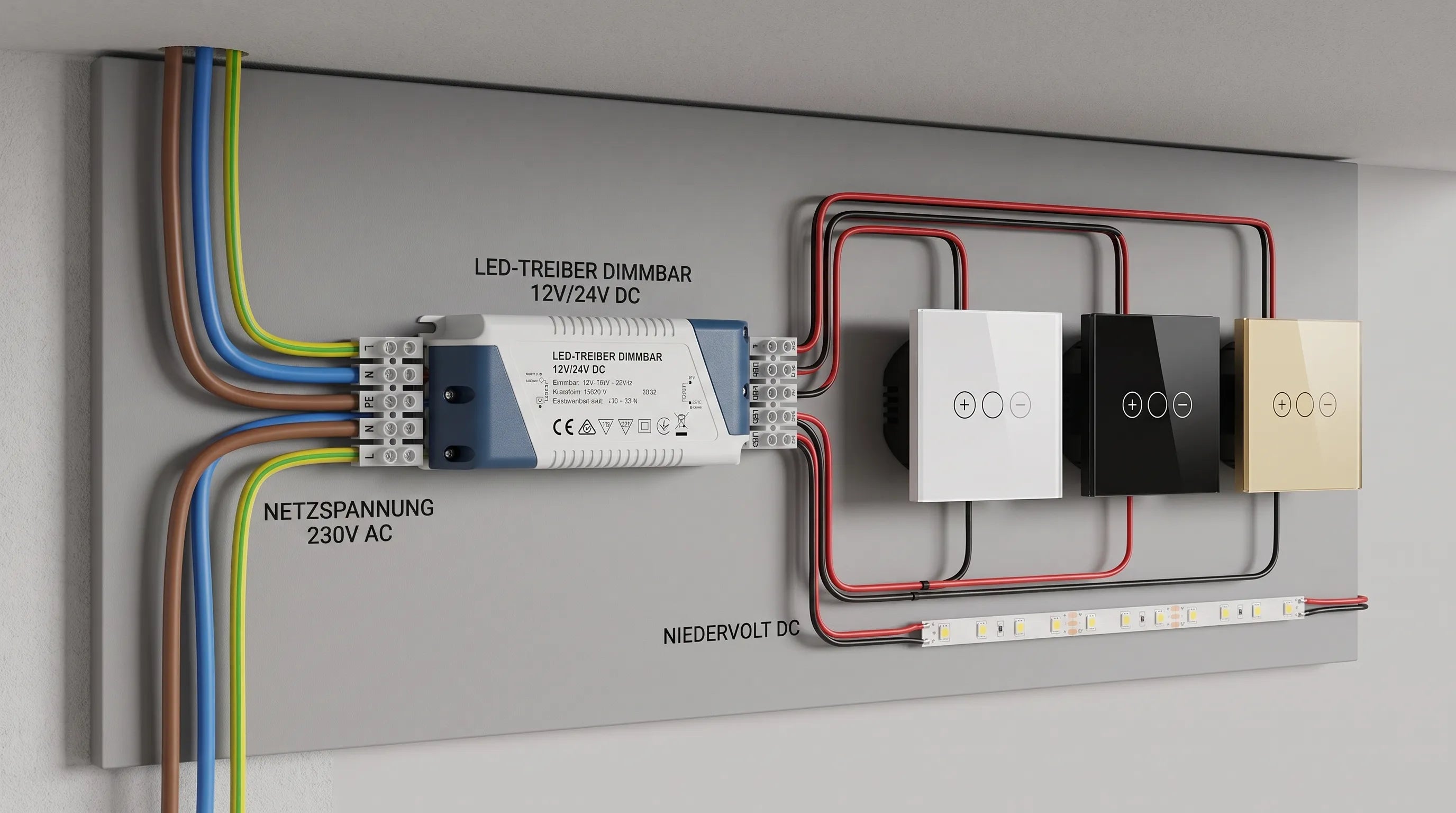
For 230-volt connections, installation should be carried out by a qualified electrician. This is particularly true if additional cables, new switches, suspended ceilings or damp rooms are affected. In the bathroom, protection areas and appropriate IP protection levels must be observed. A light that works smoothly in the hallway is not automatically suitable for every area in the bathroom.
The ceiling height also influences the planning. In low rooms, a flat panel is often ideal because it is hardly bulky. In high rooms, however, the lighting effect can appear diffuse and distant. A suspended solution or a combination with pendant and wall lights can be more pleasant.
Dimming quality: How you can recognize good LED panels
Dimmable does not automatically mean pleasantly dimmable. What matters is how finely the brightness can be regulated, whether the light flickers and whether the lowest level is really low enough. Especially in living areas, a panel light that only switches between very bright and medium-bright is often disappointing.
In the technical information, pay attention to terms such as low flicker, continuously dimmable, memory function, night light mode or separate control of brightness and light color. Glare is also an issue for computer workstations. UGR is known as an evaluation variable in the professional lighting sector. The lower the glare, the more pleasant the light is during prolonged use.
If an LED panel is controlled via its own remote control, the lamps, drivers and controls are usually thought of as a system. This reduces compatibility problems. It becomes more difficult if you also want to use an external wall dimmer. Then the luminaire, driver and dimmer must explicitly fit together. It is helpful to take a look at the basics Combine dimmable LED lamps without flickering let.
A practical test in everyday life is: Can you reduce the light so much that the room appears quiet in the evening without the panel visibly pulsating or the light color changing unpleasantly? If so, the dimming is probably better planned than with many brightness-only solutions.
Panel or designer ceiling light: The design decision
An LED panel is functional, flat and functional. This is exactly what can fit perfectly in modern rooms. In a living or dining room, a classic panel can also appear too technical, especially if the furniture, materials and colors are warm or high-quality.
That's why it's worth asking: Do you really need a panel or are you primarily looking for a dimmable ceiling light with quiet light? If the remote control is not a crucial must, but dimmable light intensity and a timeless look are the priority, a designer ceiling light can be the more harmonious solution.
An example is this Varo ceiling lamp. It is available in black and white and in three sizes and combines timeless elegance with modern design. For rooms in which a flat panel would appear too sober, such a lamp can create a better balance between function and furnishings.
This decision is particularly important in open living areas. A panel can take over the functional part, such as the kitchen or work area. A more decorative ceiling light can visually enhance the living or dining area. This does not create a uniform carpet of light, but rather a consciously designed light landscape.
Avoid typical planning mistakes
Many problems with LED panels arise not from bad products, but from false expectations. If you know in advance what is important, you can avoid the most common mistakes.
- The panel is selected based only on watts and not on lumens, room size and light distribution.
- The light color is too cool for living spaces and makes materials appear uncomfortable.
- A single central panel is intended to completely illuminate long or winding rooms.
- The remote control replaces a well-thought-out switch concept and later always ends up in the wrong place.
- The driver is no longer accessible after installation.
- Several panels are mixed even though the light color and dimming behavior do not match.
Glare is particularly underestimated. A very bright panel directly above the sofa, bed or desk can be unpleasant, even if the amount of light is mathematically correct. Therefore, you should not only plan the brightness, but also the line of sight, seating positions and reflective surfaces.
Planning check before purchase
Before you order a dimmable LED panel with remote control, a short checklist will help. It brings together technical data and a sense of space.
- Measure the size of the room and determine the desired lighting task.
- Calculate rough lumen requirements using lux times square meters.
- Choose the light color to suit the use, such as warm white for living and neutral white for work.
- Check whether brightness and light color should be controllable separately.
- Clarify mounting type, power outlet and location for drivers.
- Check operation via remote control, wall switch and possible memory function.
- Consider glare, sitting positions and computer workstations.
- Decide whether a panel fits the room visually or whether a designer ceiling light looks more harmonious.
A simple sketch is often enough. Draw in the shape of the room, furniture, electrical outlets, seating and work surfaces. It will then quickly become clear whether a central panel is sufficient or whether multiple light sources make more sense.
Frequently asked questions about the dimmable LED panel with remote control
How big should a dimmable LED panel with remote control be? The size depends on the room area, desired brightness and light distribution. A larger panel distributes light more softly, while a small panel dazzles more quickly at high power. It's not just the dimensions that are important, but also the lumen, radiation and mounting height.
Can I connect a remote control LED panel to a regular light switch? This is often possible if the light is designed for this purpose. The wall switch then takes over on and off, while the remote control controls brightness and light color. What is important is whether the light saves the last setting after it is switched on.
Do I also need a wall dimmer? Usually not if the panel can already be dimmed via remote control. An additional wall dimmer can even cause problems if the driver and dimmer are not compatible. Check the manufacturer's information or have the combination assessed by a professional.
Which light color is best for living spaces? For living rooms, warm white light between around 2,700 and 3,000 Kelvin is usually most pleasant. Neutral white can be useful in kitchens, hallways or work areas. Very cool light should be used sparingly in living areas.
Is an LED panel better than a regular ceiling light? Not fundamentally. A panel is very good for even, reserved basic light. A designer ceiling light can appear more homely and decorative. The better choice depends on the room style, lighting task and operating requirements.
Should installation be carried out by an electrician? If the ceiling lights are permanently connected, a qualified electrician is recommended. This is particularly true for new connections, wet rooms, suspended ceilings or if additional controls are integrated.
Plan light consciously instead of just buying technology
A dimmable LED panel with a remote control is a good choice if it fits the function of the room, the ceiling and everyday use. First, plan your lighting needs, position and mood. Only then should size, performance, control and design be decided.
If you are looking for modern lighting that not only works technically, but also fits into high-quality living spaces, look no further BUYnBLUE a curated selection of designer lights for different living areas. This turns a light source into a conscious design element for your home.