Retrofitting a dimmable light switch: What is possible?
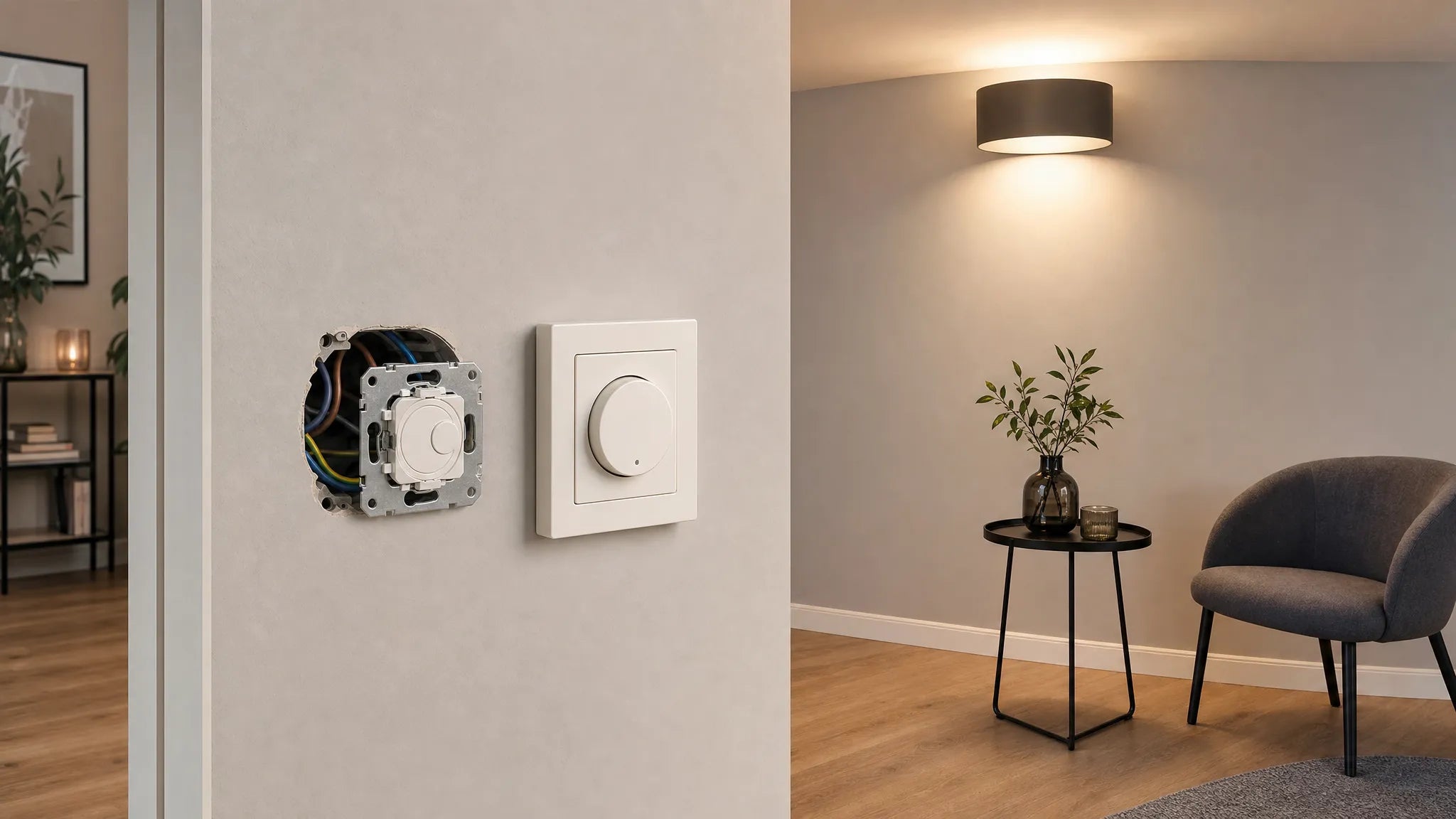
In many cases, an existing light switch can be replaced with a dimmer. However, retrofitting is no longer as easy as it used to be because modern LED lights, drivers, transformers and smart home components have to technically fit together. If you want to make a light switch dimmable, you should first clarify: which light is connected to the circuit, which dimmer is suitable and which cables are in the switch box?
The good news: There is a solution for almost every living situation. Sometimes an LED-compatible flush-mounted dimmer is enough. In other cases, a smart module, a different LED driver or a new dimmable light makes more sense. This guide shows what is possible, what the typical limits are and when you should definitely schedule a qualified electrician.
The short answer: What is possible when retrofitting?
If the existing light or bulb is dimmable, the classic on-off switch can often be replaced with a suitable dimmer. This works particularly well for lights with replaceable, expressly dimmable LED lamps or for LED lights whose drivers are approved for leading edge control, trailing edge control or another defined dimming technology.
Retrofitting with a normal wall dimmer is not possible if the light is not dimmable or if its integrated LED driver does not support mains voltage dimming. A dimmer can then cause flickering, humming, incomplete switching off or, in the worst case, damage to the lamp or electronics.
It is also important: work on 230-volt installations belongs in expert hands. In Germany it regulates, among other things § 13 of the Low Voltage Connection Ordinancethat electrical systems behind the grid connection may only be installed, expanded, modified and maintained by the grid operator or a registered installation company. You can prepare for planning, purchasing and product selection; the connection itself should be carried out professionally.
These retrofit variants are available
Depending on the building, the luminaire and the desired ease of use, different solutions come into question. The following overview helps with initial classification.
| Retrofit solution | Suitable for | Advantages | Boundaries |
|---|---|---|---|
| Classic LED flush-mounted dimmer | Individual lights or groups of lights with dimmable LEDs | Usual operation on the wall switch, inconspicuous solution | Must match the load and dimming technology |
| Universal LED dimmer | Lots of LED bulbs and mixed installations | Detects or supports multiple dimming types | Not automatically compatible with every light |
| Smart dimmer or flush-mounted actuator | Smart home projects, scenes, app or voice control | Flexible control, schedules, scenes possible | Often a neutral conductor, gateway or compatible system is required |
| Dimmable bulbs plus radio remote control | Rental apartments or simple retrofitting without opening the wall | Low installation effort | Wall switches are often just on-off switches |
| New dimmable LED driver | Designer lights with integrated LED module | Can make high quality lights compatible | Only possible if driver is accessible and replaceable |
| DALI, 1-10V, KNX or Casambi | New construction, renovation, architectural projects | Very precise light control | More planning, cabling or system integration required |
For many private living spaces, a high-quality LED flush-mounted dimmer is the most pragmatic solution. For sophisticated lighting concepts, for example in open living-dining areas, galleries, stairwells or projects with several lighting zones, systemic planning is worthwhile.
Before retrofitting: Decide on these 5 questions
Before purchasing a dimmer, you should check the existing installation and the light. This prevents bad purchases and later problems.
Is the light dimmable at all? A dimming release must be specified on the bulb, luminaire or driver. For replaceable LED bulbs, this is usually stated on the packaging or product data sheet. With integrated LED lights, the driver is crucial.
Which dimming technology is needed? Many LED lights work with trailing edge dimmers, some with trailing edge dimmers, others require DALI, 1-10V or a manufacturer-specific solution. The specification of the luminaire is more important than a blanket recommendation.
How high is the connected power? LED dimmers have a minimum load and a maximum load. If the minimum load is not reached, the light may flicker or not dim properly in the lower range. If the maximum load is exceeded, the dimmer can overheat.
Which cables are in the switch box? Simple dimmers often make do with the existing switch cables. However, smart flush-mounted modules often require a neutral conductor. In addition, the box must be sufficiently deep so that dimmers, terminals and cover frames can fit safely.
Is it a changeover or cross connection? In hallways, bedrooms or stairwells, a light is often switched from several places. Compatible touch dimmers, extension modules or other circuit logic are required here.
If you are choosing a new lamp anyway, it is worth taking a closer look at the dimming information. At dimmable LED ceiling lights It's not just the design that decides, but above all the interaction between the LED module, driver and dimmer.
Which type of dimmer suits LEDs?
Dimming old light bulbs was comparatively uncomplicated. Incandescent lamps are ohmic consumers that can be continuously regulated using many classic dimmers. LEDs work differently. You need electronics, either in the bulb itself or as a separate driver in the light. It is precisely this electronics that determines compatibility.
Phase control dimmer
Phase control dimmers are often described with the abbreviation RL. They have long been common in conventional transformers and certain loads. They are not the first choice for many modern LEDs, but may be expressly provided for in certain LED drivers.
Trailing edge dimmer
Trailing edge dimmers are often marked RC and are common in many LED lamps and electronic transformers. If an LED lamp is approved for trailing edge control, this is often a good starting point for low-flicker dimming.
Universal LED dimmer
Universal LED dimmers can support or automatically detect multiple load types. That sounds like the perfect solution, but it doesn't replace the compatibility check. Universal devices also have minimum loads, maximum loads and limits in the lower dimming range.
Button dimmer and smart dimmer
Button dimmers are not turned, but are operated by a short or long press. They are well suited for modern operating concepts and multiple control points. Smart dimmers go one step further: you can control lights via app, scenes, schedules or voice assistants, as long as the system is planned correctly.

Typical problems after installing a dimmer
If a retrofitted dimmer does not work properly, it is rarely the dimmer alone. Usually a component in the system does not fit. The most common symptoms can be easily identified.
| problem | Common cause | Possible solution |
|---|---|---|
| LED flickers when dimming | Dimmer and LED bulbs not compatible | Check the type of dimmer and choose a compatible lamp |
| Light doesn't go out completely | Residual current or electronics in the dimmer | Have the LED compensator or other dimmer checked by a professional |
| Light hums | Driver or transformer reacts to dimmer | Replace drivers or choose suitable dimming technology |
| Only a small dimming range can be used | Minimum load or driver limit reached | Set the dimming range on the dimmer, check the components |
| Dimmer gets warm | Too high a load or poor installation situation | Calculate load, check installation, choose suitable model |
Flickering in particular is not only annoying, but can significantly reduce the quality of living. If you work with replaceable bulbs, it helps to take a careful look at choosing one Dimmable light bulb without flickering, especially for decorative pendant lights, table lamps or wall lights with visible light sources.
Can you dim every light using the light switch?
No. A luminaire must be designed for the desired type of dimming. The built-in driver is particularly important for modern designer lights with a permanently integrated LED module. If this driver is not dimmable, a retrofitted wall dimmer will not work reliably.
Retrofitting pendant lights, chandeliers and ceiling lights with E27, E14 or GU10 sockets is often easier. Here, non-dimmable lamps can be exchanged for dimmable versions, provided the new dimmer fits. For low-voltage systems, such as 12-volt halogen or certain LED spots, the transformer must also be dimmable and compatible.
There are several scenarios with integrated LED lights:
- The lamp is approved for triac dimming and can be operated with a suitable wall dimmer.
- The luminaire requires DALI, 1-10V or another control protocol and requires appropriate cables or components.
- The lamp has a non-dimmable driver, which can only be replaced with a suitable dimmable driver if technically possible.
- The light can only be dimmed via remote control, app or your own system and should not also be controlled via a wall dimmer.
This is an important planning aspect for interior designers and builders. The question is not just: Is the lamp beautiful? It is also crucial: How should it be used in everyday life?
Classic dimmer or smart home solution?
A classic wall dimmer is ideal if you want to control a light quickly, intuitively and without an app. It fits well in bedrooms, dining rooms, living rooms or hallways when a single group of lights needs to be dimmed. The advantage is its simplicity: turn, press, done.
A smart home solution is worthwhile if light becomes part of a larger living concept. This can be a scene for dinner, reading, home office or indirect lighting. Smart control can also be convenient with high ceilings, multiple lighting circuits or switches that are difficult to reach.
| Decision criterion | Classic LED dimmer | Smart dimmer or smart light |
|---|---|---|
| Service | Right at the counter | Switch, app, scene or language |
| Installation | Often manageable | Depends on neutral and system |
| Suitability for everyday use | Very intuitive | Very flexible, but system dependent |
| Suitable for | Individual rooms and clear circles of light | Connected living areas and scenes |
| Risk when changing systems | Low | Higher if devices are manufacturer-specific |
Important: Smart lamps and classic wall dimmers should not be combined arbitrarily. Many smart lamps require constant power and are dimmed internally. An additional leading edge or trailing edge dimmer can interfere with the electronics. In such cases, a smart wall switch, a radio module or a suitable system concept is usually better.
Special cases: old building, rented apartment and high ceilings
Retrofitting is often possible in old buildings, but the existing cabling makes the difference. Old switch boxes can be flat, neutral conductors are more often missing, and testing by a qualified electrician is particularly important for older installations. If you are renovating at the same time, this is the ideal time to plan additional cables, deeper device boxes or multiple lighting circuits.
In rented apartments, you should obtain the landlord's consent before making any permanent changes. Replaceable light sources, smart lamps or wireless solutions are often easier to dismantle than intervening in the permanent electrical installation. The connection of lights must still be carried out safely.
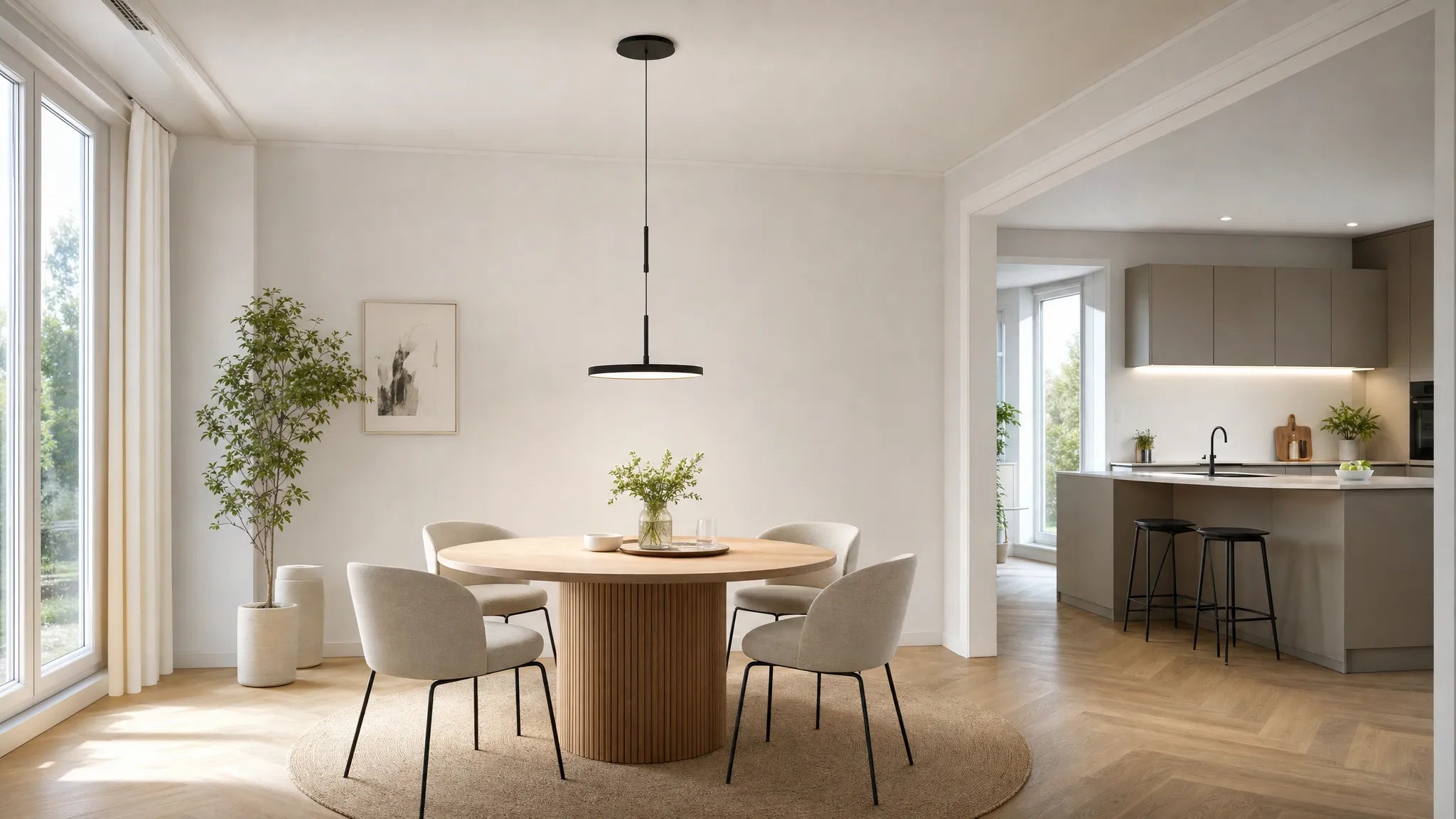
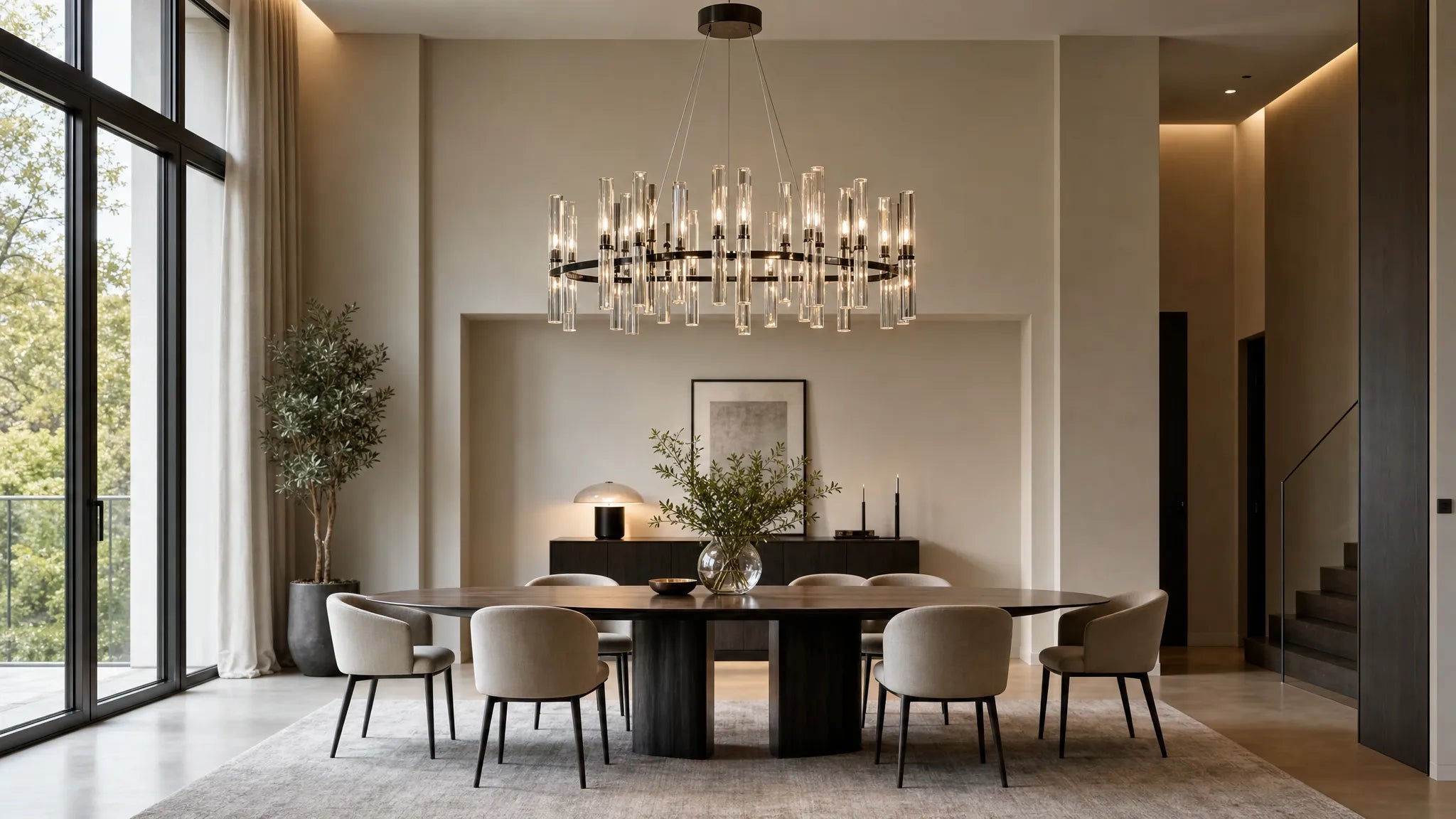
For high ceilings, galleries or open living areas, the dimmer is only part of the planning. The cable length, canopy position and lighting effect also have to be right. BUYnBLUE offers free adjustment for selected chandeliers and pendant lights, for example in terms of cable length, canopy or color. This means that a lamp can be better adapted to the room height, furniture and switching concept.
Practical planning: How to proceed sensibly
Don't start with the dimmer, but rather with the desired lighting effect. Should the dining table glow warmly and atmospherically? Should the ceiling light be bright in the morning and soft in the evening? Should a pendant light above a kitchen island provide both task light and mood light? Only then is the technical selection worthwhile.
This sequence has proven useful for planning:
- Define the lamp and the desired lighting mood.
- Check whether the lamp, bulb or driver can be dimmed.
- Determine the type of dimming from the product data sheet or manufacturer’s information.
- Have the existing circuit and cables checked by a specialist.
- Select the appropriate dimmer and adjust the dimming range properly.
The color of the light is also important in high-quality living concepts. Warm white light in the range of around 2700 Kelvin appears homely, while neutral white light appears more objective. Some lights offer dim-to-warm, i.e. a warmer light color when dimmed down. This creates an atmosphere that is similar to classic incandescent lamps.
If you are new modern lights and lamps It is therefore worth taking a look at the design, material quality, dimming capability and installation conditions at the same time. A beautiful lamp only develops its full effect when the operation, height and lighting character suit the room.
How much does retrofitting cost approximately?
Specific costs depend heavily on inventory, dimmer model, circuit and regional craft business. Simply replacing a switch with a compatible dimmer is usually significantly cheaper than a new smart home integration or converting several lighting circuits.
The main cost factors are:
- Type and quality of the dimmer.
- Number of light circuits and control points.
- Condition and depth of the existing switch box.
- Need for a neutral conductor or additional lines.
- Replacement of lamps, drivers or transformers.
You shouldn't skimp on compatibility. A cheap dimmer that flickers or makes the lower dimming range barely usable is rarely a good solution in everyday life. A well-coordinated system consisting of luminaires, bulbs, drivers and dimmers is better.
Frequently asked questions about retrofitting dimmable light switches
Can you replace any light switch with a dimmer? No. Replacing it only makes sense if the lamp, bulb or LED driver is dimmable and the dimmer matches the electrical load and dimming technology.
Do I need an electrician to install a dimmable light switch? Yes, as soon as work is carried out on the fixed 230-volt installation, a qualified electrician should be hired. This is important for safety, liability and standards reasons.
Why does my LED flicker despite having a dimmable dimmer? Dimmers and lamps often do not fit together, the minimum load is not reached or the driver of the lamp is not suitable for this type of dimming. An incorrectly set dimming range can also cause flickering.
Can I retrofit a dimmer in a two-way circuit? Yes, but not with every dimmer. Touch dimmers, extensions or special circuits are often required. A specialist can check which variant fits the existing wiring.
Is a smart dimmer better than a classic dimmer? Not fundamentally. A classic dimmer is simpler and very intuitive. A smart dimmer offers more convenience, scenes and remote control, but requires compatible technology and sometimes a neutral wire.
Can I make a non-dimmable LED light dimmable? Sometimes if the driver is accessible and can be replaced with a suitable dimmable driver. However, this is not the case with many lights. Then a new dimmable light is usually the better solution.
Conclusion: A lot is possible, but only with the right technology
Retrofitting a dimmable light switch is easily possible in many living spaces if the lamp, dimmer and installation fit together. The most important success factors are clear dimming approval, the correct type of dimmer, appropriate minimum and maximum loads and professional installation.
For renovations, new buildings and sophisticated interior projects, it is worth treating dimming not as an afterthought, but as part of the lighting concept. This creates light that not only works, but really changes the room: bright when working, soft in the evening and atmospheric when design and atmosphere are the focus.
If you are looking for a lamp that matches the room height, furnishings and lighting concept, discover at BUYnBLUE a curated selection of high-quality designer lighting, with free adjustment of cable length, canopy or color upon request. This turns a beautiful lamp into a solution that is also technically and spatially impressive.