Select LED recessed spotlights that can be dimmed without humming
Humming recessed spotlights are one of those small details that immediately make a room seem less high-quality. Especially in quiet living areas, bedrooms, hallways or open kitchens, a quiet buzzing noise is quickly noticeable, especially when the lights are dimmed. Who Select LED recessed spotlights that can be dimmed without humming You should therefore not only pay attention to the design, wattage or “dimmable” on the packaging. The interaction between LED, driver, dimmer, load range and installation situation is crucial.
The good news: In most cases, humming can be avoided if you plan the technology carefully before purchasing. This guide will show you how to recognize quietly dimmable recessed spotlights, which types of dimmers make sense and which mistakes particularly often lead to annoying noises during renovation or new construction.
Why dimmable LED recessed spotlights hum at all
LEDs themselves do not hum in the classic sense. The noise usually arises in the electronic components that supply power or dim the LED. These include the LED driver, an external transformer, the wall dimmer or sometimes components in the lamp itself.
When dimming, the electrical power is reduced or controlled in very fast pulses. Inferior or incorrectly combined components can easily vibrate mechanically. This vibration can be heard as a buzzing, whirring or humming sound. In a suspended ceiling, the noise can increase because cavities act like a resonance body.
Common causes are:
- Although an LED bulb is dimmable, it is not compatible with the existing dimmer.
- The dimmer is operating outside its minimum or maximum load range.
- An old halogen transformer is still used even though it is unsuitable for LEDs.
- The LED driver is of poor quality or not designed for quiet operation.
- Several different spot types are mixed on one dimmer.
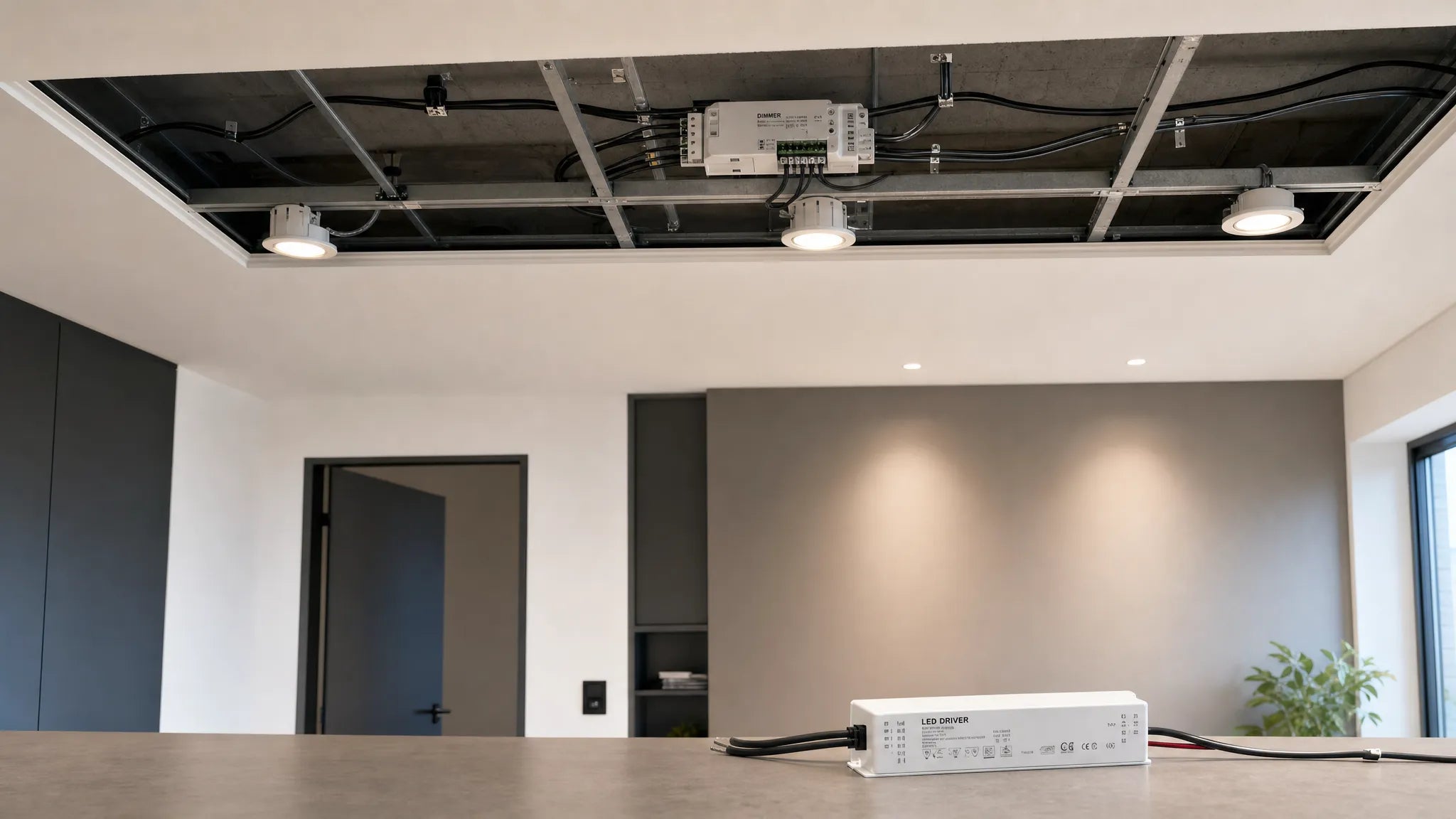
- The driver lies loosely in the ceiling and transmits vibrations to plasterboard or metal profiles.
It is important: “Dimmable” only means that a spot is generally dimmable. It does not automatically mean that it works quietly, with little flicker and cleanly across the entire range with every dimmer. If you would like to go deeper into the topic of flicker-free dimming, you can also find this BUYnBLUE-Guide Dimming LED lamps: What really works without flickering.

The most important decision: Which recessed spotlight system is right?
Before you choose a dimmer, you should clarify what type of LED recessed spotlight you want to use. The technology behind it has a major influence on whether noises arise later.
| system | Typical usage | advantage | What to look out for about humming noise |
|---|---|---|---|
| 230V GU10 LED spot | Renovation, replacement of old spots | Easily replaceable, no separate transformer required | Only use dimmable GU10, check dimmer compatibility |
| Integrated LED recessed spotlight with driver | New building, high-quality lighting planning | Slim design, often better light quality | Check driver quality, dimming type and manufacturer information carefully |
| 12V MR16 LED with transformer | Existing with old low-voltage spots | Use of existing built-in boxes possible | Old halogen transformers often cause humming or flickering |
| Smart LED recessed spotlight | App, radio or voice control | Internal dimming, often without a wall dimmer | Do not also dim using a classic dimmer |
230 V GU10 spots are practical for many living spaces because they are easy to replace. With very high-quality planning, flat ceilings or special lighting angles, integrated LED modules are often more elegant. It is worth being particularly careful with existing 12 V systems: old electronic halogen transformers often have a minimum load that cannot be achieved with economical LED spots. This can lead to humming, flickering or failures.
If you're planning something new, it's usually better to look at the LED drivers and dimmers as a system instead of throwing individual components together later.
Which type of dimmer is the quietest?
The dimmer is often the crucial point. Many older wall dimmers were designed for incandescent or halogen lamps. However, LEDs require different loads and are more sensitive to inappropriate control.
Leading edge or trailing edge
When it comes to classic wall dimmers, a distinction is made between leading edge and trailing edge. Phase control dimmers were previously often used for conventional transformers and incandescent lamps. Trailing edge dimmers are the better choice for many modern LED drivers because they often work quieter and more evenly. However, this is not an absolute rule. The manufacturer’s compatibility information remains crucial.
When purchasing, pay attention to wording such as “suitable for LED”, “phase cutter”, “R, C” or specific compatibility lists. If the spot or driver only says “dimmable” but no dimming technology is mentioned, you should ask or choose a different product.
Push-Dim, DALI and 0 to 10 V
In new buildings, renovations or professional lighting planning, controls such as Push-Dim, DALI or 0 to 10 V are often more reliable than simple wall dimmers. They require suitable drivers, but usually offer finer control and reduce typical problems with minimum loads.
DALI is particularly interesting when several lighting groups, scenes or architectural lighting concepts are planned. It's not always necessary for a single living room, but it can make sense for open floor plans, kitchen islands, galleries or home office zones.
Smart dimming
Smart spots usually dim internally via app, remote control or radio protocol. As a rule, they should be permanently supplied with voltage and not also run via a classic wall dimmer. Double dimming, i.e. smart bulbs plus phase dimmers, is a typical cause of humming, flickering and connection problems.
| Dimming technology | Suitability for LED spots | Risk of humming | Recommendation |
|---|---|---|---|
| Old halogen dimmer | Low to uncertain | High | Only use if explicitly LED compatible |
| LED phase control | Depending on the situation | Means | Check compatibility list |
| LED trailing edge | Often good | Low to medium | The first test for many 230 V LED spots |
| Push dim | Good with the right driver | Low | Useful for planned LED systems |
| DALI | Very good at planning | Low | Ideal for professional lighting concepts |
| Smart dimming | Good if installed correctly | Low | Operate without an additional wall dimmer |
Correctly calculate minimum load, maximum load and number of spots
A common mistake is the wrong load on the dimmer. This used to be easier because halogen lamps had more power. Today, six LED spots together can consume less power than a single halogen spotlight used to. However, many dimmers require a minimum load to work stably.
The basic calculation is simple: multiply the power of a spot by the number of spots. If one spot is 6W and you connect six spots, the total load is 36W. The dimmer must support this value within its LED load range. Not only the maximum wattage counts, but also the minimum load.
Example: A dimmer with an LED load range of 5 to 100 W can generally work at 36 W. An old dimmer with a minimum load of 40 W would be critical. In practice it can hum, flicker or only react at a certain dimming level.
The maximum load is not just a calculation exercise either. LEDs have inrush currents that can be higher for short periods. Therefore, dimmers should not be operated permanently at the limit. For larger spot groups, it makes sense to divide light circles, for example the kitchen work surface, dining area and hallway separately.
This is how you can identify quietly dimmable LED recessed spotlights before you buy them
Absolute silence can never be completely guaranteed because installation, dimmers and room acoustics also play a role. However, you can greatly reduce the risk if you pay attention to the correct technical information.
A good purchase review includes:
- The spot or driver is expressly marked as dimmable.
- The appropriate dimming technology is mentioned, for example trailing edge, DALI or Push-Dim.
- There is information about the compatible dimmer or a compatibility list.
- The dimming range is realistically specified, approximately from 100% to 10% or lower.
- The driver is designed for LED operation and not just an old halogen transformer.
- Spot types, drivers and bulbs are not mixed within a light circle.
- The installation depth, ventilation and heat dissipation match the ceiling construction.
In addition to the technology, you should also check the light quality. For living rooms, 2,700 to 3,000 K usually seems pleasantly warm. 3,000 to 4,000 K can make sense in the kitchen, bathroom or work areas. A high color rendering index, often CRI 90 or higher, makes materials, skin tones and surfaces appear more natural. Especially in high-quality interiors, this is more important than the highest possible lumen value.
Installation in ceiling and cavity: Why installation can increase noise
Even a good driver can become audible if it is installed poorly. In suspended ceilings, drivers sometimes lie loosely on plasterboard or touch metal profiles. Small vibrations are then amplified as resonance. Narrow installation openings, heat build-up or poorly fitting terminals can also cause noise.
Therefore, make sure that recessed spotlights and drivers are installed according to the manufacturer’s instructions. Drivers should not be crushed, should not lie directly on vibrating surfaces and should be adequately ventilated. Suitable installation housings are important in insulated ceilings so that heat is dissipated safely and insulating material does not come into direct contact with hot components.
If you have permanently installed lighting, you should have electrical work carried out by a qualified electrician. This is especially true with new wiring, multiple lighting circuits, bathrooms, outdoor areas and smart controls. You can also find general safety information at VDE. For bathrooms, protection areas and appropriate IP protection classes are also relevant, and this fits BUYnBLUE-Guide Bathroom lamp: Which IP protection class do you need where?.
Spatial effect: Plan recessed spots correctly instead of just placing lots of spots
Hum-free technology is just one part of good lighting. Recessed spotlights can make rooms look modern, calm and clear, but they can also become sterile or blinding if they are too close, too bright or misdirected.
The following applies to homely lighting planning: Spotlights are well suited for basic lighting, paths, work surfaces and accents. However, they do not always replace a decorative light. Especially in the living room, dining area or bedroom, a combination of recessed spotlights, pendant lights, wall lights and indirect light looks much more high-quality.
Therefore, do not automatically plan spots in an even grid across the entire ceiling. It is better to align them with functions: work surface in the kitchen, wardrobe in the hallway, art wall in the living room or shower in the bathroom. Spotlights should be positioned above seats so that they do not shine directly into the eyes.
| space | Sensible spot usage | light color | Note on dimming |
|---|---|---|---|
| Living room | Basic light, accent on wall or shelf | 2,700 to 3,000 K | Finely dimmable for an evening atmosphere |
| Kitchen | Work surfaces, island, walkways | 3,000 to 4,000 K | Switch separately from pendant light |
| bedroom | Cabinet zone, indirect basic brightness | 2,200 to 3,000 K | Very low dimming level is important |
| hallway | Orientation and wall illumination | 2,700 to 3,000 K | Motion detector or soft dimming possible |
| bathroom | Shower, general light, zone light | 3,000 to 4,000 K | Pay attention to IP protection and specialist installation |
If you are unsure how many light sources a room needs, simple lumen planning can help. You can also use the guide LED lighting: This is how you calculate lumens per m² correctly use. Even if the focus is broader there, the basics for LED planning are helpful.
What to do if existing LED recessed spotlights are already humming?
If your spots are already installed and are humming, you should proceed systematically. Don't replace all the lights straight away, as the problem often lies in just one component.
First check whether the hum is coming from the dimmer, a single spot, a transformer or the ceiling. Set the dimmer to different brightness levels. Some systems only hum in the lower range, others especially at medium dimming settings. If an individual spot is significantly louder, a defective lamp or an inferior driver may be the cause.
Then it's worth taking a look at the dimmer and load. Does the total wattage match the minimum load? Is the dimmer suitable for LED? Are different light sources mixed? For 12 V spots, you should check whether the transformer is really suitable for LEDs.
A typical order for troubleshooting is:
- Check all spots for the same brand, same power and same dimming type.
- Check dimmer model and LED load range.
- Have a compatible LED trailing edge dimmer used as a test.
- For 12 V systems, have the old transformer replaced with an LED driver.
- Have loose drivers or vibrating built-in parts professionally fastened.
- If the noise continues, switch to a higher quality spot or driver system.
If it also flickers, smells warm, fuses trip or switches get hot, you should stop operating the system and call in a qualified electrician.
Common purchasing mistakes for dimmable recessed spotlights
The most common mistake is buying based on appearance and price without knowing the existing installation. Especially during renovations, it is often assumed that old dimmers and transformers can still be used. This works sometimes, but not reliably.
Another mistake is mixing different spot series within a circle of light. Even if all spots are dimmable, they may have different drivers or dimming curves. The result is uneven brightness, flickering or humming.
Too much reduction in brightness is also problematic. Many LEDs do not dim properly to 0%. If you want very soft evening light, you should pay attention to a low, stable dimming range or also plan for another light source. A dimmable pendant lamp, wall lamp or table lamp can often create more beautiful mood lighting than heavily dimmed ceiling spotlights.
For a harmonious overall concept, it is also worth looking at visible lights. BUYnBLUE offers curated designer lighting for modern living spaces, including pendant lights, chandeliers, ceiling lamps and other lighting solutions. The free adjustment for pendant lights and chandeliers, for example in terms of cable length, canopy or color, is particularly practical. This means that technical recessed spotlights can be combined with a visible designer light that exactly matches the room height and furnishings.
Short checklist before purchasing
Before you order or have dimmable LED recessed spotlights installed, these points should be clarified:
- What voltage is used, 230 V, 12 V or an integrated LED system?
- Which dimming technology is intended, trailing edge, push-dim, DALI or Smart?
- According to the manufacturer, do the dimmers, drivers and lamps fit together?
- Is the total load of the spots within the permitted LED load range of the dimmer?
- Are all spots in a light circle designed identically?
- Is there enough installation depth and ventilation?
- Are the light color, beam angle, CRI and glare appropriate to the room?
- Are the bathroom, kitchen or insulated ceilings planned professionally and in accordance with standards?
If you answer these questions before purchasing, there is a significantly higher chance that the spots will not only be dimmable, but will also remain pleasantly quiet in everyday life.
Frequently asked questions about dimmable LED recessed spotlights without hum
Why do LED recessed spotlights only hum when dimming? When dimming, the dimmer changes the power supply or the driver regulates the LED power. If the dimmer, driver and LED do not fit together well, electronic components can vibrate and hum audibly.
Are trailing edge dimmers always better for LED spots? Not always, but often. Many modern LED drivers work more quietly with leading edge dimmers than with old leading edge dimmers. However, the compatibility information provided by the respective manufacturer is crucial.
Can an old halogen transformer make LED recessed spotlights hum? Yes. Many old transformers require a higher minimum load and are not designed for economical LEDs. For 12 V systems, you should therefore check whether a driver suitable for LEDs is necessary.
Does it help to simply use a different LED bulb? Sometimes yes, especially with GU10 spots. However, if the problem comes from the dimmer, transformer or the installation, simply replacing the bulb will not permanently solve the humming.
Can LED recessed spotlights be dimmed completely silently? In very quiet rooms it is difficult to guarantee absolute silence. However, with high-quality, compatible components, appropriate load and clean installation, hum can usually be reduced to a non-disturbing level.
When should an electrician be called in? Whenever fixed cables, dimmers, transformers, drivers or recessed spotlights in the electrical installation are changed. A specialist is also important for bathrooms, insulated ceilings, unclear old systems or components that get warm.
Calm light starts with good planning
Dimmable LED recessed spotlights without annoying humming are not created by chance. They are the result of suitable technology, accurate load calculation, high-quality drivers, suitable dimmers and an assembly that avoids resonances. Especially when renovating or building new buildings, it is worth clarifying these points early on, before ceilings are closed or switch programs are determined.
If you would like to combine recessed spotlights with visible designer lighting, you can find them at BUYnBLUE modern lights for stylish living spaces. Pendant lights and chandeliers can be adapted free of charge to your room situation, for example in terms of cable length, canopy or color. This creates a lighting concept that works smoothly from a technical point of view and visually fits your home perfectly.