Dimming LED lamps: What really works without flickering
LEDs are ideal for atmospheric living, but when dimmed they sometimes show their unpleasant side: the light flickers, hums, jumps between brightness levels or appears restless when dimmed low. If you want to dim LED lamps, you need more than just a rotary control on the wall. The interaction between the luminaire, LED driver, light source and dimmer is crucial.
The short answer: LED dimming usually works with really low flicker with a suitable LED trailing edge dimmer, a high-quality integrated driver, DALI, 0 to 10 V or well-executed app control. It becomes problematic when old dimmers, non-dimmable LEDs, incorrect minimum loads or several incompatible components are combined.

Why LED lamps flicker when dimming
A light bulb was electrically simple: less voltage meant less heat on the filament and therefore less light. Things work differently with LEDs. An LED requires a suitable operating current. There is therefore a driver or electronics between the 230 V network and the LED that converts alternating voltage into a suitable direct current.
When dimming, this current is not simply reduced arbitrarily. Depending on the system, the mains voltage is switched on, the current is reduced analogously, a digital control signal is sent or the LED is switched on and off very quickly. If the electronics work properly, the eye only notices a uniform change in brightness. If not, visible flickering, subtle unrest or stroboscopic effects will occur.
Typical causes are:
- A non-dimmable LED lamp is operated with a dimmer.
- An old halogen or incandescent lamp dimmer with LED falls below the required minimum load.
- Dimmers and LED drivers do not use the same dimming technology.
- Several different LED bulbs hang on a common dimmer.
- The lower dimming limit is set too low.
- A smart LED is also dimmed using a wall dimmer.
The last point in particular is often the case: smart lamps need to be permanently supplied with electricity. Dimming is done internally via app, remote control or voice control. An upstream wall dimmer interferes with these electronics and can cause flickering, humming or failures.
What flicker-free really means
Flicker-free sounds clear, but it is not always so. Some lights flicker visibly. Others appear calm to the eye, but produce stroboscopic effects when there is movement, camera shots or very low brightness. Particularly sensitive people also notice invisible light modulation as exertion, headache or restlessness.
In lighting technology, temporal light artifacts are described using, among other things, Pst LM and SVM. Pst LM evaluates short-term flicker, SVM describes stroboscopic visibility during movement. The EU Ecodesign Regulation for light sources takes these values into account for modern light sources and operating devices. Also the standard IEEE 1789 deals with recommendations for reducing flicker risks with LED lighting.
For everyday use, this means: A high-quality LED lamp should not only shine quietly at 100 percent brightness, but also remain stable in the dimmed area. Very low dimming values below around 20 percent are particularly critical because some drivers no longer regulate properly.
The most important dimming techniques in comparison
Not every type of dimming is automatically good or bad. What matters is whether it fits the luminaire and how high-quality the implementation is. The following table shows the common variants for living spaces, renovations and high-quality lighting planning.
| Dimming technology | Typical use | Low flicker in practice? | What you should pay attention to |
|---|---|---|---|
| Phase control | Older incandescent and halogen dimmers, some of which are LED compatible | Rather critical with many LEDs | Only use if LED and dimmer are explicitly compatible. Check minimum load. |
| phase section | Lots of dimmable E27, E14 and GU10 LEDs | Often the best solution for retrofit LEDs | Choose an LED dimmer with a low minimum load and note the compatibility list. |
| Universal LED dimmer | Replacing old wall dimmers | Good if set correctly | Automatic detection helps, but does not replace a compatibility check. |
| PWM dimming | LED strips, smart lights, integrated LED modules | Very good at high frequency, critical at low frequency | Pay attention to high-quality drivers. Low PWM frequency may be visible in cheap products. |
| CCR or analog constant current dimming | High quality LED modules and drivers | Very low flicker | Good choice for integrated designer lights when the driver and module are coordinated. |
| 0 to 10V or 1 to 10V | Renovation, architectural light, larger rooms | Very stable with suitable drivers | Requires compatible drivers and often additional control lines. |
| DALI | Professional lighting planning, scene control | Very stable and precise | Ideal for new buildings, renovations or complex lighting zones. Planning by a specialist company makes sense. |
| Smart LED via app | Apartments, flexible lighting moods | Depending on the light source and electronics | Do not also dim using a classic wall dimmer. Ensure continuous current. |
The following applies to most living situations: If you want to dim replaceable LED bulbs in existing sockets, a high-quality trailing edge dimmer is often the most obvious solution. With integrated LED lights, pendant lights or chandeliers, however, the built-in driver is crucial.
Which really works without flickering, depending on the situation
1. Replaceable LED bulbs in E27, E14 or GU10
For classic sockets, the most important rule is simple: the light source must be expressly marked as dimmable. An LED without dimming enable can sometimes respond to a dimmer, but the result is rarely reliable. Flickering, afterglow or a limited dimming range are typical consequences.
An LED-compatible trailing edge dimmer often works best for these lamps. Make sure the minimum load is low, for example if you only want to dim a single LED with 5 to 8 watts. Many older dimmers were designed for 40, 60 or 100 watts. A modern LED significantly undercuts this load.
The number of lamps also plays a role. Three identical dimmable LEDs on a dimmer often behave more stable than a single, very weak LED. It becomes problematic when different brands, wattages or dimming curves are mixed.
2. Integrated LED lights and designer pendant lights
With integrated LED lights, the bulb is not easily replaceable. The quality of light depends heavily on the driver. A good driver reduces the current cleanly, keeps ripple low and ensures that the light remains quiet even at low brightness.
If you are planning a high-quality pendant light or chandelier, you should clarify dimmability early on. Not every beautiful light is automatically compatible with every wall dimmer. Some models are dimmed via remote control, app or integrated control device. Others require a specific external dimmer.
At BUYnBLUE you will find curated designer lights for modern living spaces. It is important: Before purchasing, always check the product information on dimmability or ask which control is provided. The free adjustment service can also help with pendants and chandeliers, for example if the cable length, canopy or color needs to be adapted to the room height and furnishings.
3. LED strips and indirect lighting
LED strips are very often dimmed using PWM. That's not automatically bad. High-quality PWM dimmers work at a sufficiently high frequency so that the light remains calm to the eye. However, cheap controllers can cause visible flickering at low brightness, especially when moving quickly or when there are shiny surfaces in the room.
For indirect lighting in the living room, in niches or on ceiling profiles, a good power supply with sufficient power reserve is worthwhile. If you operate several meters of LED strips, the controller should match the overall performance. Undersized power supplies are a common cause of flickering or brightness fluctuations.
You can find more ideas for atmospheric lighting planning in BUYnBLUE-Guide to indirect lighting in the living room.
4. Smart LEDs and app control
Smart LEDs usually dim internally. This can be very convenient because you can save scenes, color temperatures and schedules. This solution is low-flicker if the internal electronics are of high quality and the LED is not additionally controlled via a conventional wall dimmer.
The basic rule is: Smart lamps receive continuous power. Dimming is only possible via an app, remote control, voice control or the appropriate smart home system. If you also use an old rotary dimmer, the smart LED cannot work correctly.
Separate lighting zones also make sense for smart lighting concepts. A ceiling light, a floor lamp and an accent light should not necessarily all be equally bright. It is better to control each zone individually and only access the required brightness.
5. DALI and 0 to 10 V for renovations or new buildings
If you are renovating, building new or planning a particularly high-quality lighting concept, it is worth taking a look at professional control systems. DALI and 0 to 10 V do not work like a classic wall dimmer that changes the mains voltage. Instead, the LED driver receives a control signal and regulates the LED itself.
This has advantages: the dimming range is often larger, the behavior is more stable and several lights can be precisely organized into scenes. DALI is particularly interesting for residential buildings when open floor plans, galleries, kitchens and dining areas or multiple layers of light are planned.
You can read more about structured lighting planning in the guide Plan LED lighting: 3-layer light for the entire home.
Why LEDs often only flicker in the lower area
Many users report: At full brightness everything is quiet, but from around 30 percent the light starts to flicker. This is often because dimmers or drivers become unstable at the lower control range. The electronics then receive too little energy to work constantly.
Modern LED dimmers often offer an adjustable minimum brightness. This allows you to determine how far the dimmer can be turned down. If the lower limit is raised slightly, the flickering often disappears immediately. Although you lose the extremely dark area, you gain a calm, everyday light.
The term dimming range is also important. An LED that dims cleanly from 100 to 20 percent can be completely sufficient for living spaces. For bedrooms, hotels or atmospheric dining areas, however, a deep, stable dimming range of up to 5 or 1 percent is interesting. But this must explicitly match the light and the driver.
Troubleshooting: If your LED flickers when dimming
Before you replace the entire lamp, it is worth carrying out a systematic check. Many problems can be solved with a suitable dimmer or a correct setting.
- Check whether the lamp is really dimmable: Dimmability must be clearly stated on the packaging or product data sheet. Terms like LED, energy-saving or warm white say nothing about dimming capability.
- Check the dimmer type: Old dimmers for incandescent lamps are often not suitable. For many retrofit LEDs, an LED trailing edge dimmer is the better choice.
- Compare minimum and maximum load: If your dimmer only works stably from 20 watts, but a single LED only uses 6 watts, flickering can occur.
- Set the minimum brightness higher: Many LED dimmers have an adjustment screw or digital setting for the lower dimming value.
- Do not mix different LEDs on one dimmer: Different electronics react differently. Use identical bulbs if possible.
- Do not also dim smart LEDs on the wall: For smart bulbs, use the app or remote control and leave the wall switch permanently on.
- Check drivers, transformer and cabling: In the case of integrated lights, low-voltage systems or unclear connections, an electrician should check whether the driver and installation fit.
If a lamp flickers even without a dimmer, the problem may not be due to dimming. Then loose contacts, defective lamps, network fluctuations or installation errors can play a role. The guide fits this Flickering lamps: what to do if the light flickers?.
Room by room: Which dimming makes sense
Low-flicker dimming is not just a technical question. It also influences how pleasant a room appears. You need different lighting moods in the dining room than in the home office or bathroom.
| space | Sensible dimming strategy | Recommendation |
|---|---|---|
| Living room | Wide dimming range, warm light, multiple light sources | Combine dimmable main lamp with additional table, wall or floor lamps. |
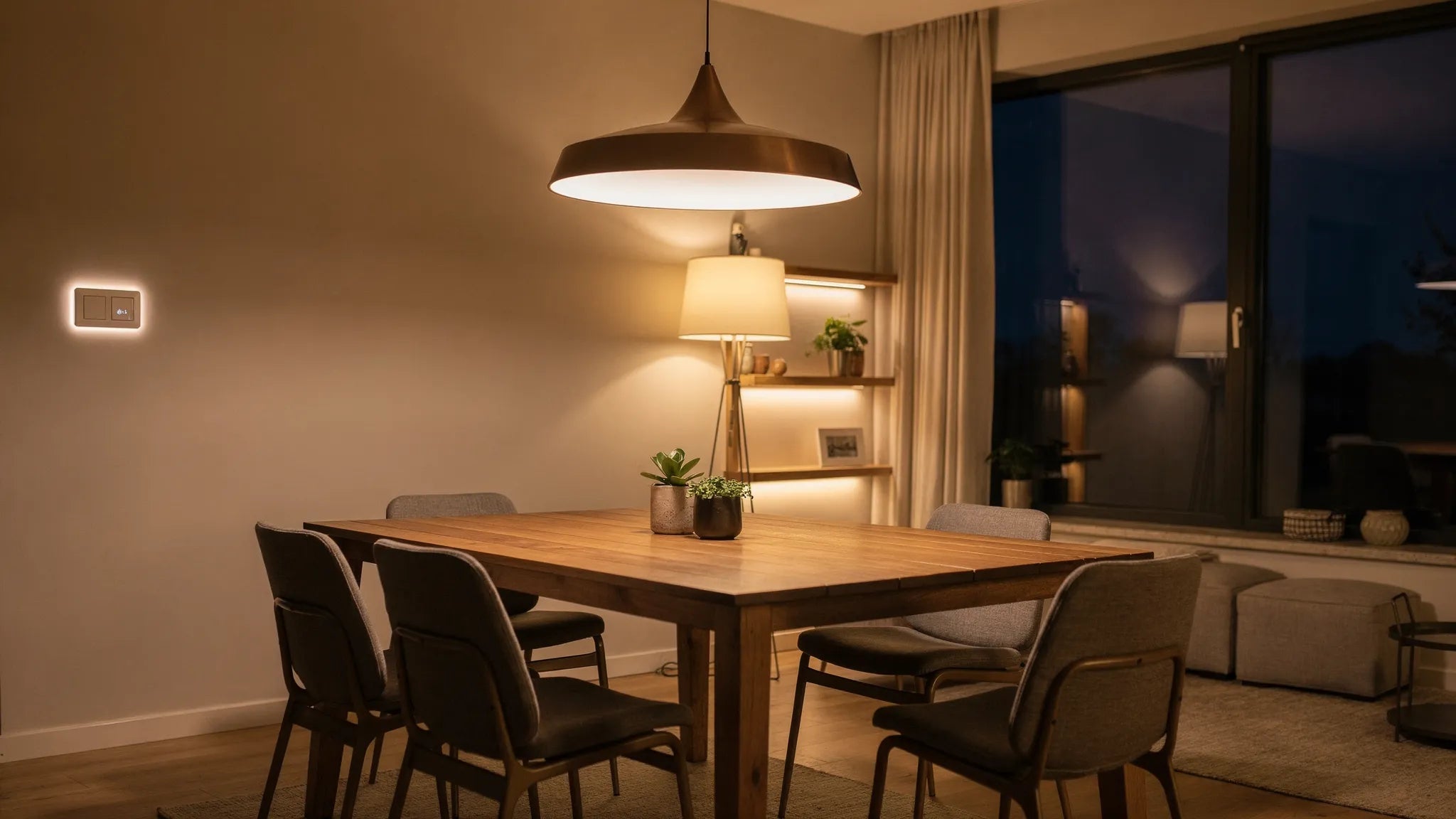
| Dining area | Mood lighting above the table, as calm a light as possible | Choose a pendant light or chandelier with a suitable driver, dim-to-warm can be very pleasant. |
| Kitchen | Bright when working, dimmed when eating | Switch or dim work light and ambience separately. Prefer low-flicker drivers for work surfaces. |
| bedroom | Very low brightness in the evening | Make sure the lower dimming range is stable. Use warm white or dim-to-warm. |
| Home office | Concentration light without visual disturbance | Choose low-flicker LED table and ceiling lights to avoid glare and reflections. |
| hallway | Gentle orientation light | Use motion detectors, indirect light or low dimming levels, but pay attention to stable drivers. |
| bathroom | Bright on the mirror, soft for evening routine | Observe protection areas and IP classes. Plan dimmability only with suitable luminaires that are suitable for damp rooms. |
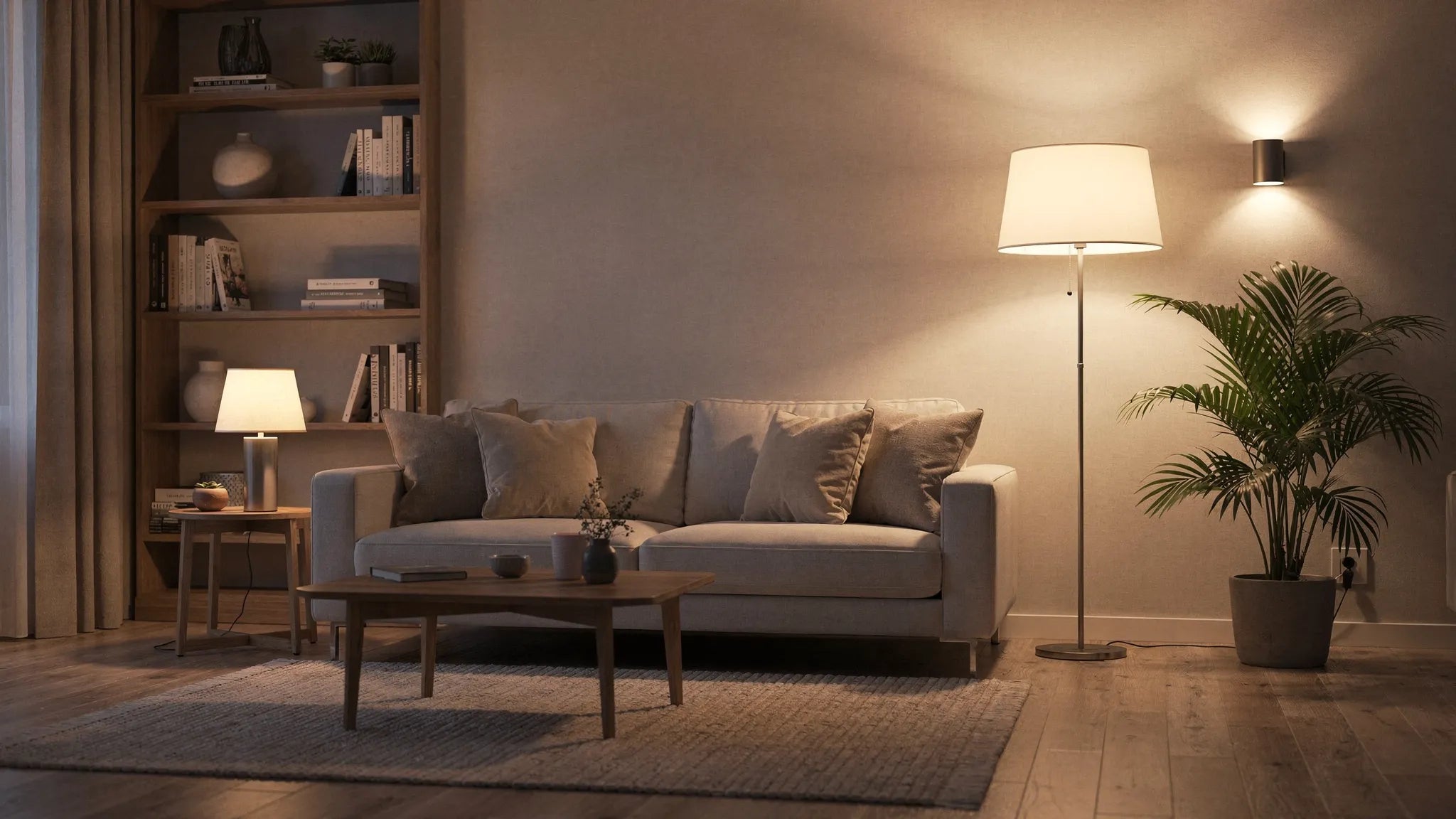
Especially in living and dining areas, a single, heavily dimmed ceiling light is often not the best solution. A layered concept looks more pleasant: basic light, zone light and accent light. This means that no individual LED has to be dimmed down extremely far, which means that flickering problems are less common.
Purchasing criteria for low-flicker LED dimming
When buying, you shouldn't just pay attention to design, lumens and Kelvin. The electrical information is just as important for dimmable LED lamps. If you are unsure, a look at the product data sheet is more valuable than a vague marketing statement.
| Question before purchasing | Why it is important |
|---|---|
| Is the LED expressly dimmable? | Non-dimmable LEDs may flicker or become damaged. |
| Which dimming technology is supported? | Trailing edge, leading edge, app, DALI or 0 to 10 V must fit the installation. |
| Is there a compatibility list? | Manufacturers often name tested dimmer models. This reduces bad purchases. |
| How big is the dimming range? | 100 to 10 percent is different than 100 to 1 percent. |
| Is the driver integrated or separate? | With integrated LED lights, the driver largely determines the quality of light. |
| Is dim-to-warm supported? | The light becomes warmer when dimmed and appears more homely. |
| Is there any information about Flicker, Pst LM or SVM? | Measured values are more meaningful than pure advertising claims. |
| Does the solution fit the room? | Workspaces need different priorities than lounge or bedroom lighting. |
If you are still at the beginning of the selection, this will also help you BUYnBLUE-Guide Buy an LED lamp: This is how you find the right model. It's about lumens, Kelvin, CRI, beam angle and other basics that should be considered together with dimmability.
Can you test flickering with your smartphone?
A simple smartphone test can provide information, but is no substitute for measurement. If you point the camera at a dimmed LED and see moving stripes, this may indicate flickering. It often becomes even clearer in slow motion mode. A quick hand or pen test in front of the light source can also reveal stroboscopic effects.
Nevertheless, caution is advised: cameras work with their own frame rate and exposure time. Some stripes are caused by the camera itself. Conversely, an LED can appear calm in the camera image and still show measurable modulation. The test is therefore practical for rough comparisons, but not technical proof.
For living spaces, a combination of visual inspection and feeling of comfort is usually sufficient: Does the light appear calm? Does it flicker when dimmed low? Is it tiring when staying for a longer period of time? Are there streaks when moving or on shiny surfaces? If so, it's worth getting a better dimmer, a different light source or a light with a higher quality driver.
Safety: When you need an electrician
Everything that is changed on 230 V cables, fixed wall dimmers, ceiling connections or drivers in the canopy should be carried out professionally. Switching off the power alone is not enough if you don't know for sure which line has which function or whether there is voltage.
An electrician is particularly useful when an old dimmer needs to be replaced, when several lights are connected to one circuit, when neutral wire issues arise with smart dimmers or when integrated LED drivers need to be replaced. Additional safety requirements also apply in damp rooms.
You can find the basics for safe assembly in the article Installing lamps correctly: A short guide. If you are unsure: Don't experiment, but have it checked by a professional.
Conclusion: Flicker-free is no coincidence
Dimming LED lamps works reliably if all components are coordinated with one another. For classic sockets, dimmable brand-name LEDs plus LED trailing edge dimmers are often the best choice. Integrated lights include high-quality drivers, clear information on dimming technology and a suitable control path. For new buildings or extensive renovations, DALI and 0 to 10 V offer particularly stable options.
The most important tip: Don't plan dimmability as an additional function at the end, but as part of the lighting concept. A beautiful lamp that is impressive at 100 percent but flickers when dimmed quickly becomes annoying in everyday life. A carefully selected LED solution, on the other hand, creates exactly what modern lighting should achieve: efficient, calm and atmospheric light.
Frequently asked questions
Can I dim any LED lamp? No. Only LEDs that are expressly marked as dimmable should be operated with a dimmer. For integrated LED lights, the driver must also match the type of dimming.
Which is better for LED, leading edge or trailing edge? For many dimmable retrofit LEDs, trailing edge is the better and quieter solution. Phase control can work, but is more often problematic, especially with old dimmers.
Why does my LED only flicker at low brightness? In the lower dimming range, some drivers work unstable or the dimmer falls below its minimum load. A higher minimum brightness on the dimmer or a compatible LED dimmer can help.
Are smart LEDs automatically flicker-free? Not automatically. Good smart LEDs can dim very pleasantly, but the quality depends on the internal electronics. It is important not to additionally regulate them using a classic wall dimmer.
What does dim to warm mean? Dim-to-warm means that the light color becomes warmer when dimmed down. This imitates the cozy effect of classic light bulbs and is particularly popular in the living room, dining room and bedroom.
Can a flicker-free dimmer solve every problem? No. The best dimmer is of little help if the lamp is not dimmable, the driver is not compatible or the installation was incorrectly designed. The entire system is always crucial.
Find dimmable designer lighting that suits your space
If you want to plan LED lighting that is not only technically clean but also stylish, it is worth taking a look at the selection BUYnBLUE. Here you will find modern designer lights for various living areas, from pendant lights and chandeliers to ceiling and accent lighting.
Before purchasing, check the information on dimmability and get support if you have any questions. Especially with pendants and chandeliers, the free adjustment of the cable length, canopy or color is helpful so that the lamp not only looks good, but also fits perfectly into the room height, furnishings and lighting concept.