Place the bathroom wall light correctly on the mirror
Good mirror lighting in the bathroom looks unspectacular until it is missing. Then shadows appear under the eyes, the face looks tired, the makeup colors are not right and you miss details when shaving. This is exactly why the position of a bathroom wall light on the mirror is more important than its design alone.
The optimal solution is always a combination of functional light, a pleasant atmosphere and safe installation. The lamp must illuminate your face evenly, must not be dazzling and must match the size of the mirror, vanity and room. In this guide you will find specific heights, distances and light values that will help you plan your bathroom wall light correctly.
Why placement on the mirror is so crucial
In the bathroom you don't look at a work surface, but directly into a reflective object. This changes the lighting effect. A light that looks pleasant in the hallway can dazzle in the mirror. A ceiling light that brightens the room often creates harsh shadows on the face because the light comes from above and emphasizes the eye sockets, nose and chin.
For the mirror area you therefore need light from the front and slightly to the side. It should be sprinkled softly so that no hard shadows are created. At the same time, it must be bright enough to see skin, hair and details naturally. The goal is not maximum brightness, but Even, glare-free illumination at face level.
Correct positioning is crucial, especially in modern bathrooms with dark tiles, large mirrors or minimalist washing areas. Dark surfaces absorb light, shiny surfaces reflect it more strongly. Both influence how well the wall light works on the mirror.
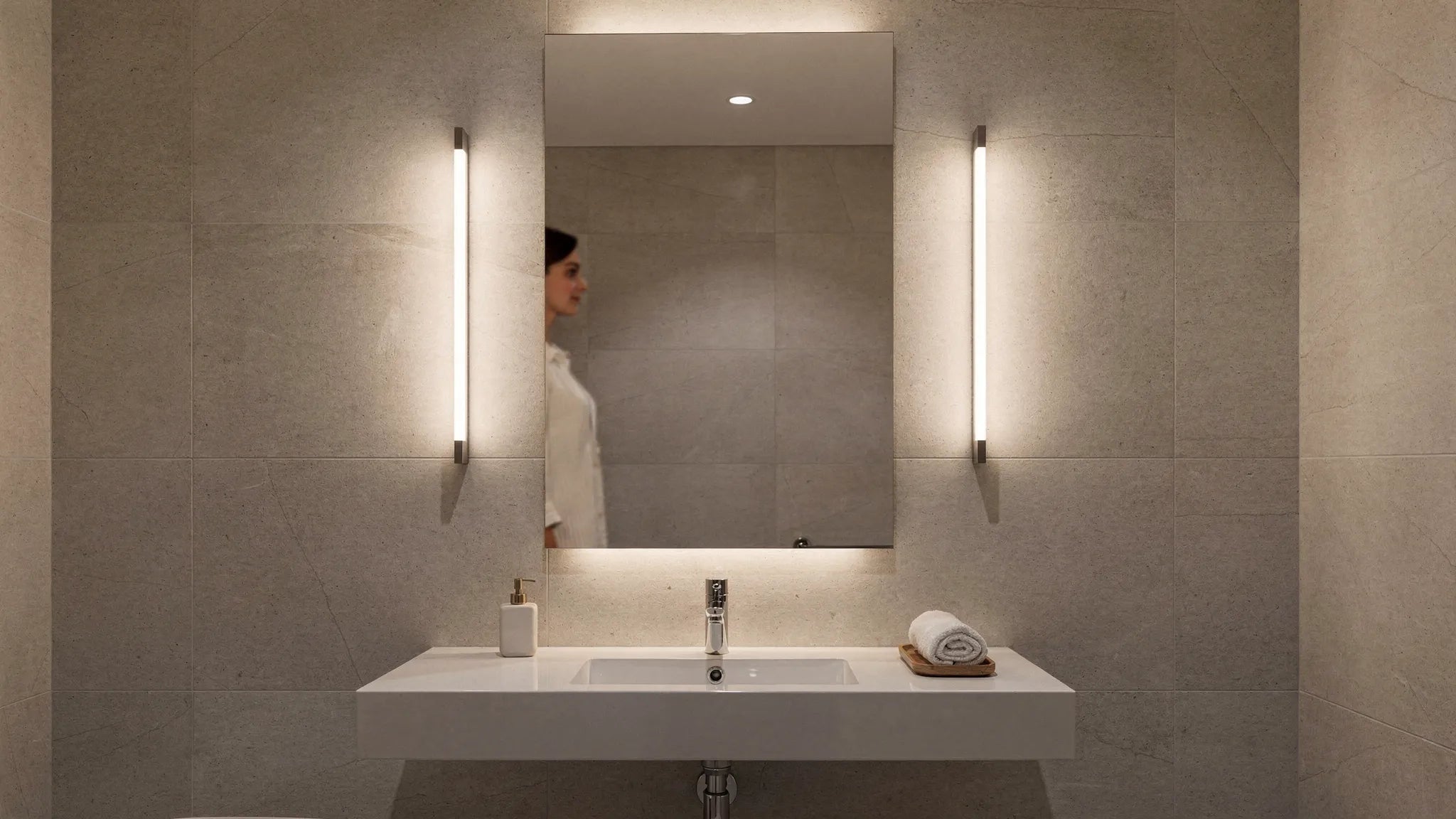
The best solution: wall lights Left and to the right of the mirror
If space allows, two side wall lights are the best choice for the mirror. They illuminate the face from both sides and reduce shadows much better than a single light from above. This is particularly important when applying make-up, shaving, eyebrow shaping or skin care.
A symmetrical arrangement is ideal Left and to the right of the mirror. The lights should not be located too far out, otherwise the middle of the face will remain darker. However, you should not stick directly to the mirror frame because it looks crowded and can lead to annoying reflections with wide lights.
As a rule of thumb, the center of the illuminated area should be approximately at eye level. For most households this is around 150 to 170 cm above the finished floor. If several people use the bathroom, focus on the average user and choose a diffused light that covers a larger vertical area.

Guide values for side bathroom wall lights
The following values are practical guidelines. They can be adjusted depending on the shape of the lamp, the width of the mirror and your height.
| Planning point | Recommendation | Why it matters |
|---|---|---|
| Height of the center of the lamp | approx. 150 to 170 cm from the ground | Approximately corresponds to the height of the face and reduces shadows |
| Distance to the mirror edge | approx. 5 to 15 cm | Works harmoniously and prevents excessively large dark spaces |
| Distance between two lights | often around 70 to 100 cm | Depends on the width of the vanity and mirror |
| Lamp shape | vertical or elongated diffuse | Illuminates forehead, cheeks and chin more evenly |
| light emission | forward or soft all around | Avoids harsh shadows and strong reflections in the mirror |
For very wide mirrors, a pair of lights on the outside is often not enough. Especially for double washbasins, it can make sense to plan three vertical lights: one Left, one in the middle between the washing areas and one on the right. This means that each person gets illumination from the side without the faces becoming darker towards the middle.
If there is no space on the side: wall light above the mirror
Not every bathroom has enough wall space for two side lights. Mirrors can reach up to the wall, mirror cabinets need door clearance or the electrical connection is already above the mirror. In such cases, a light above the mirror is a good alternative if sized and positioned correctly.
A horizontal mirror light should be as wide as possible. As a guideline, a width of works at least 60 to 80 percent of the mirror width. For an 80 cm wide mirror, a light of around 50 to 65 cm would make sense. A very short light in the middle, on the other hand, quickly creates a bright center and darker areas of the face on the sides.
The lamp sits ideally 5 to 20 cm above the top edge of the mirror. If it is mounted too high, it almost looks like a ceiling light and again casts shadows from above. If it is too low, it can dazzle or optically compress the mirror. For high mirrors and small bathrooms, a flat, wide light bar is often the most elegant solution.
The orientation is also important: the light should not fall steeply downwards, but should scatter softly forwards and downwards. Matte covers, opal glass or satin diffusers are much more pleasant than visible individual LEDs or clear, point-shaped lamps.
Which position fits which mirror?
The shape of the mirror and the width of the washbasin influence the optimal placement. A round mirror requires different proportions than a wide rectangular mirror or a deep mirror cabinet.
| situation | Best placement | Practical tip |
|---|---|---|
| Small single washbasin | Two narrow lights Left and right | Vertical lights visually stretch the wall |
| Wide rectangular mirror | Side lights plus possibly a central addition | Particularly useful for double washbasins |
| Round mirror | Glow outside the circle shape at eye level | Leave some air between the mirror and the light |
| Mirror cabinet | With a wide light bar on the outside or top | Check door openings and cabinet depth beforehand |
| Guest toilet | A wide light above the mirror | Good solution for limited wall space |
| Wall-filling mirror | Lights on the mirror or above | Check glare and reflections particularly carefully |
With round mirrors, slim side wall lights often appear particularly high-quality. They frame the mirror like a design element. With square mirrors, on the other hand, the light can appear a little more linear and architectural, for example as a narrow light rod or a subtle up-and-down wall light with a diffuse front.
Light quality: brightness, Kelvin and color rendering
The correct position alone is not enough. A bathroom wall light can be perfectly installed and still appear unflattering if the light color or color rendering is not correct. Three values are particularly relevant for the mirror area: Lux, Kelvin and CRI or Ra.
For everyday care there are things like in the mirror area 300 to 500 lux a good target area at face level. For precise make-up or very detailed care, it can be a little brighter, preferably dimmable. In small bathrooms there is often less luminous flux than in dark, tiled or windowless rooms.
The color of the light depends on the desired mood. Warm white light with around 2700 to 3000 Kelvin has a homely and flattering effect. Neutral white light at around 3500 to 4000 Kelvin shows colors more soberly and is well suited for make-up, shaving and skin care. Very cold light above 5000 Kelvin can quickly appear sterile in a private bathroom.
Color reproduction is even more important. If possible, you should have a lamp with you for mirror light CRI or Ra of at least 90 choose. Skin tones, lipstick, hair color and textiles appear more natural. A low CRI can distort colors even if the lamp is sufficiently bright.
| criterion | Recommendation for the mirror | Note |
|---|---|---|
| Illuminance | approx. 300 to 500 lux | Practical for grooming and shaving |
| color temperature | 3000 to 4000 K | Warm-neutral looks natural and homely |
| Color rendering | CRI/Ra 90 or higher | Important for skin tones and makeup |
| Glare | diffuse coverage | No visible, bright points of light at eye level |
| Dimmability | recommended | Functional in the morning, more relaxed in the evening |
If you want to go deeper into lumens, Kelvin, CRI and LED selection, this will help BUYnBLUE-Guide Buy an LED lamp: This is how you find the right model.
IP protection in the bathroom: Don't decide on security based on feeling
Electricity, humidity and water splashes collide in the bathroom. That's why the IP protection rating for bathroom lights is not a detail, but a safety criterion. Which protection class is necessary depends on which area of the bathroom the light is installed in.
Special protection areas apply around the shower and bathtub. Depending on the zone, splash-proof or more protected lights may be required. There is not always a defined protection area requirement on the washbasin itself as in the shower, but a splash-proof light is often the sensible choice, especially in small bathrooms, open showers or low ceilings.
For a bathroom wall light near the mirror is IP44 often a useful orientation if splashing water is possible. If the light is closer to the shower or bathtub, higher requirements may apply. Don't just rely on the look or product photos, but check the specific installation position.
You can find a detailed explanation of the bathroom zones in BUYnBLUE-Contribution Bathroom lamp: Which IP protection class do you need where?. If new cables are laid, connections are moved or lights are installed in damp rooms, a qualified electrician should be consulted. You can find further basics on safe assembly in the guide Install lamps correctly.
Step by step: This is how you plan the placement on the mirror
Proper planning prevents incorrect drilling, shadows and inharmonious proportions. It's best to work with a tape measure and painter's tape first before drilling or laying a connection.
- Determine the center of the washbasin: Don't just look at the mirror, but also at the faucet and sink. The axis of the washing area is often what matters to the eye.
- Check mirror size: Measure the width and height of the mirror and mark the side edges on the wall.
- Determine eye level: Mark the average eye level of the main users. This is approximately where the light center of side lights should be.
- Tape off the lamp position: Stick the planned lights onto the wall as an outline. This way you can immediately see whether the proportions and distances are correct.
- Test door and cabinet movement: Open the mirror cabinet, bathroom furniture and doors. The light must not be in the way.
- Check connection and IP protection: Before purchasing, clarify whether the power connection is suitable, whether a dimmer is planned and what type of protection is required in the position.
This simple test is particularly valuable for round mirrors and asymmetrical vanities. What seems logical on a plan may look too narrow, too high or visually unbalanced on the wall.
Common mistakes with bathroom wall lights on the mirror
Many problems arise not from the lamp itself, but from its position. You should avoid these mistakes:
- Use only one ceiling light: It brightens the room, but not automatically the face.
- Mount lights too high: Light from above creates shadows under the eyes, nose and chin.
- Select visible light points: Clear LEDs or unprotected lamps quickly dazzle on the mirror.
- Choose wrong light color: Light that is too cold appears harsh, light that is too warm can distort colors.
- Leave too little distance from the mirror: The lamp appears crowded and can reflect distractingly in the mirror.
- Ignore IP protection: In the bathroom, the mounting position must fit the light correctly.
Another classic is the exclusively backlit mirror lighting. It looks modern and creates atmosphere, but often does not illuminate the face sufficiently. Backlight is very nice as an accent light. For shaving, make-up and grooming, it should be supplemented with front lights or side wall lights.
Design: Functional does not have to look technical
A well-placed bathroom wall light can do much more than just provide light. It frames the mirror, emphasizes materials and gives the bathroom a more homely character. Modern bathrooms in particular benefit from lights that do not look like purely functional lighting.
Slim light rods, matt surfaces and clear lines work in minimalist bathrooms. Opal glasses, brushed metal tones or soft curves work well in warm, natural bathrooms. With dark tiles or natural stone, the lamp can be a little more present because it acts as a contrast and light accent.
It is important that design and lighting technology fit together. A sculptural wall light can look beautiful on the mirror if it shines diffusely and without glare. However, if it only shines decoratively up or down, it is more suitable as an accent light and not as the main light for the mirror.
For a particularly harmonious bathroom, a layered concept is worthwhile: ceiling light for orientation, wall lights on the mirror for care and subtle accent lighting for atmosphere. You can find out more about the basic principle in BUYnBLUE-Guide Which bathroom lighting is the right one?.
Short buying checklist for the bathroom wall light
Before you decide on a model, the lamp should not only be visually impressive. Also check the technical and practical points that make the difference in everyday life.
| Question before purchasing | Good answer |
|---|---|
| Does the light match the width of the mirror? | Yes, it appears proportional and shines sufficiently broadly |
| Is the light diffuse? | Yes, no visible bright points of light at eye level |
| Is the CRI high enough? | Ideally Ra 90 or higher |
| Does the light color match the bathroom? | 3000 to 4000 K, depending on the desired effect |
| Is the light safe for the position? | IP protection and installation location have been tested |
| Can it be dimmed? | Recommended for flexible use in the morning and evening |
| Is the assembly realistic? | Connection, drilling points and cabinet movement are clarified |
If you are planning or renovating your bathroom, it is worth determining the position of the lights as early as possible. Wall lights can often be installed later, but connections, tile joints and mirror shape then dictate much more.
FAQ: Place the bathroom wall light on the mirror
How high should a bathroom wall light hang next to the mirror? The center of the illuminated area should be approximately at eye level, usually around 150 to 170 cm above the ground. For very tall or short users, the height can be adjusted accordingly.
Is one light above the mirror or two lights on the side better? Two side lights are usually better for shadow-free mirror light. A wide light above the mirror is a good alternative if there is no space on the side.
How far should wall lights be from the mirror? A distance of 5 to 15 cm from the edge of the mirror often works well. The decisive factors are the mirror width, lamp shape and possible reflections in the glass.
Which light color is ideal for the bathroom mirror? For most bathrooms, 3000 to 4000 Kelvin makes sense. 3000 K looks more homely, 4000 K looks more neutral and precise for make-up or shaving.
Do I need IP44 for a bathroom wall light on the mirror? Not every mirror position is automatically within a special protection area, but IP44 is often a sensible choice when it comes to possible splash water. Stricter requirements apply near showers or bathtubs, which should be checked by a specialist company.
Is an illuminated mirror enough without an additional wall light? That depends on the light output and radiation. Lots of backlit mirrors create a nice ambience, but not enough front light. An additional side or top mirror light is often better for grooming, shaving and make-up.
Conclusion: Position first, then buy
The perfect bathroom wall light on the mirror doesn't come about by chance. The decisive factors are eye level, distance to the mirror edge, diffuse light distribution, suitable light color and safe IP protection class. If you plan these points early, you will get a bathroom that is functional in the morning and pleasant in the evening.
At BUYnBLUE You will find a curated selection of modern lights for stylish living areas, including high-quality wall, ceiling and designer lights for well-thought-out lighting concepts. Discover modern lighting at buynblue.com and choose lights that not only look good, but also fit the space, use and atmosphere.