Select living room lights according to light zones
The living room is rarely just a space for sitting. It is a retreat, a meeting place, a media room, a reading corner, sometimes a dining area and often a home office. This is exactly why the question “Which living room lamp is right?” You rarely get a good answer if you just think about a single lamp in the middle of the room.
It is better to have the living room in Light zones to plan. Each zone has a clear task: orientation, relaxation, reading, watching television, accentuation or work. This means that the room not only looks more beautiful, but also quieter, more flexible and more suitable for everyday use.
Why light zones are more important than a single bright lamp
A central ceiling lamp can evenly illuminate a living room, but it rarely makes it comfortable. The room quickly appears flat, corners remain dark, faces get hard shadows and reflections occur when watching TV. Good living room lighting therefore works with several light sources at different heights.
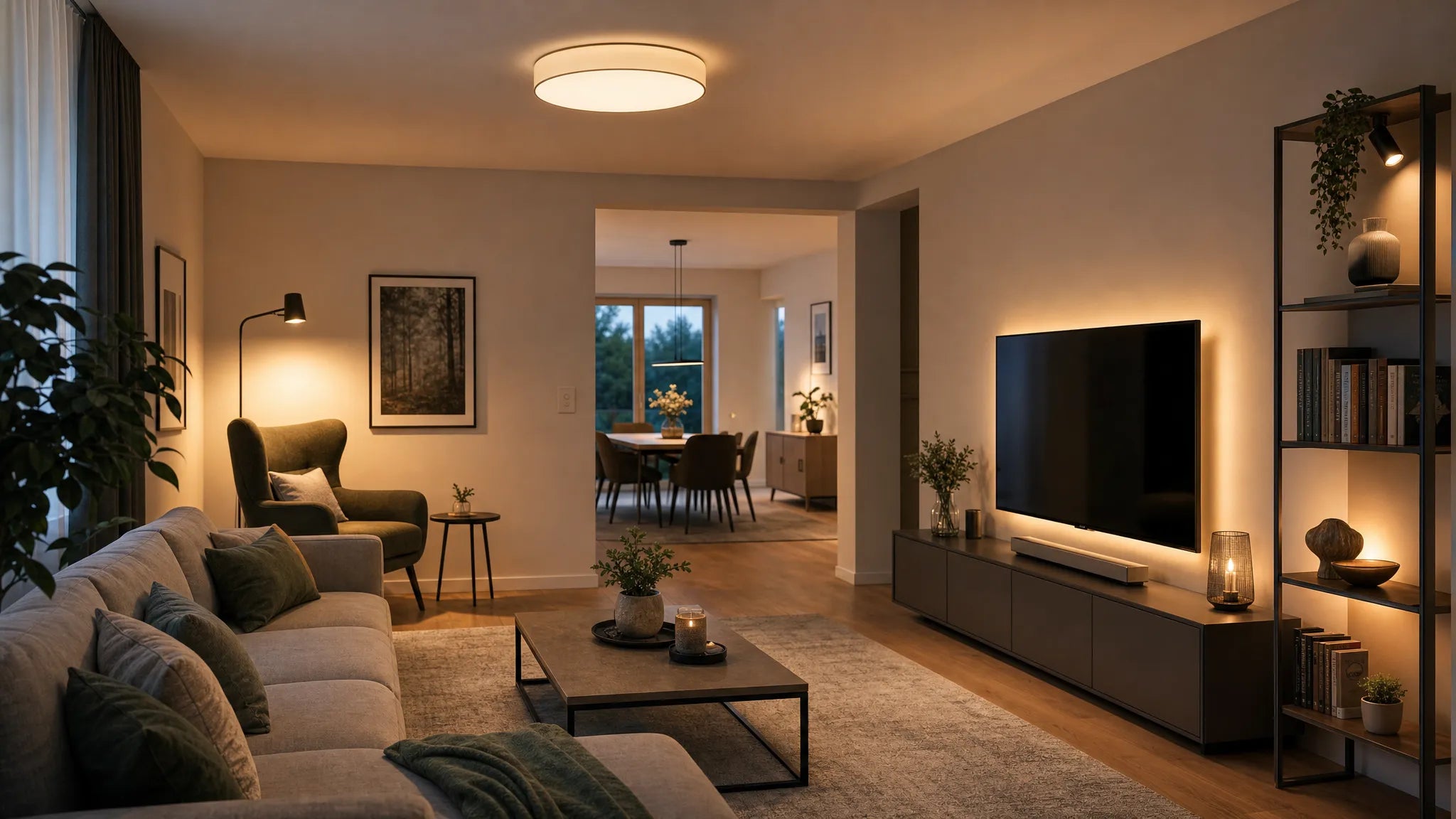
The principle is simple: Basic light provides orientation, zone light supports specific activities and accent light creates depth. Also licht.de recommends a combination of different types of light for living spaces because this brings function and atmosphere together better.
When choosing, this means: Don't start with the most beautiful lamp, but rather with the question: Where in the living room which light is needed. Only then do you decide whether a pendant lamp, ceiling lamp, floor lamp, wall lamp or table lamp is best.
The most important light zones in the living room
Not every living room needs all zones. A small apartment often needs three well-placed light sources; an open living area with a sofa, dining table and gallery requires significantly more planning. The following overview helps as a basis.
| Light zone | task | Suitable lights | Orientation for the lighting effect | Planning tip |
|---|---|---|---|---|
| Basic light | Move safely, capture space | Ceiling light, flat LED ceiling light, chandelier, indirect ceiling light | Even, soft, around 100-150 lux as a living space orientation | Don't choose too bright, it's better to plan dimmable ones |
| Seating group | Conversations, relaxation, guests | Pendant lamp, arc lamp, floor lamp, table lamps | Warm, low-glare, zoned | Align with the sofa, rug and coffee table, not just the center of the room |
| Reading zone | Reading, handicrafts, concentrated activities | Reading lamp, adjustable floor lamp, wall lamp | Direct, well-shielded light, often 300-500 lux locally | Place the light on the side behind the shoulder |
| TV zone | Television without harsh contrasts | Wall lights, indirect LED, small table lamps | Low, indirect, low reflection | Do not allow bright lights to be in your field of vision or reflected on the screen |
| Accent zone | Emphasize pictures, shelves, plants, architecture | Spotlights, wall lights, small table lamps | Directional or decorative light | Use accents sparingly, otherwise the room will appear restless |
| Edge and path zone | Passageways, dark corners, storage space | Wall lamp, floor lamp, indirect light | Gentle orientation | Check cable routes and walkways early |
| Additional function | Eating, playing, home office in the living area | Pendant lamp, table lamp, focused ceiling lamp | Depending on usage, usually brighter than relaxation light | Plan your own switching or dimming |
The values in the table are practical guidelines for living spaces, not rigid regulations. It is crucial that you judge the light not just by brightness, but by usage, glare and mood.
This is how you plan your living room light according to zones
Read the room first, do not buy immediately
Stand in the room and observe how it is used. Where do you sit in the evening? Where do you read? Where do you watch TV? Are there dark corners, art on the wall, an open shelf or a plant that needs to be highlighted? Only when these points are clear will it become clear which living room lamp is really needed.
A simple floor plan on paper is helpful. Mark the sofa, coffee table, TV, windows, doors, electrical outlets and existing ceiling outlets. Then draw islands of light. This way you can quickly see whether a central ceiling lamp is sufficient or whether you need additional floor, wall or table lamps.
Start with the basic light
The basic light is the basis. It doesn't have to be spectacular, but it should pleasantly capture the space. A modern ceiling light, a flat LED body or a compact chandelier often works in small and medium-sized living rooms. In higher rooms, a pendant or hanging light can create more presence.
The light distribution is important. A living room lamp with an open, downward-directed light can quickly dazzle if it hangs above the seating area. A model with a diffuser, opal glass, textile shielding or indirect light usually looks more homely.
If you are unsure whether your ceiling light fits in size and light distribution, it is also worth taking a look BUYnBLUE-Guide to choosing one Lamp on the ceiling according to diameter, height and light distribution.
Treat the seating area as the most important island of light
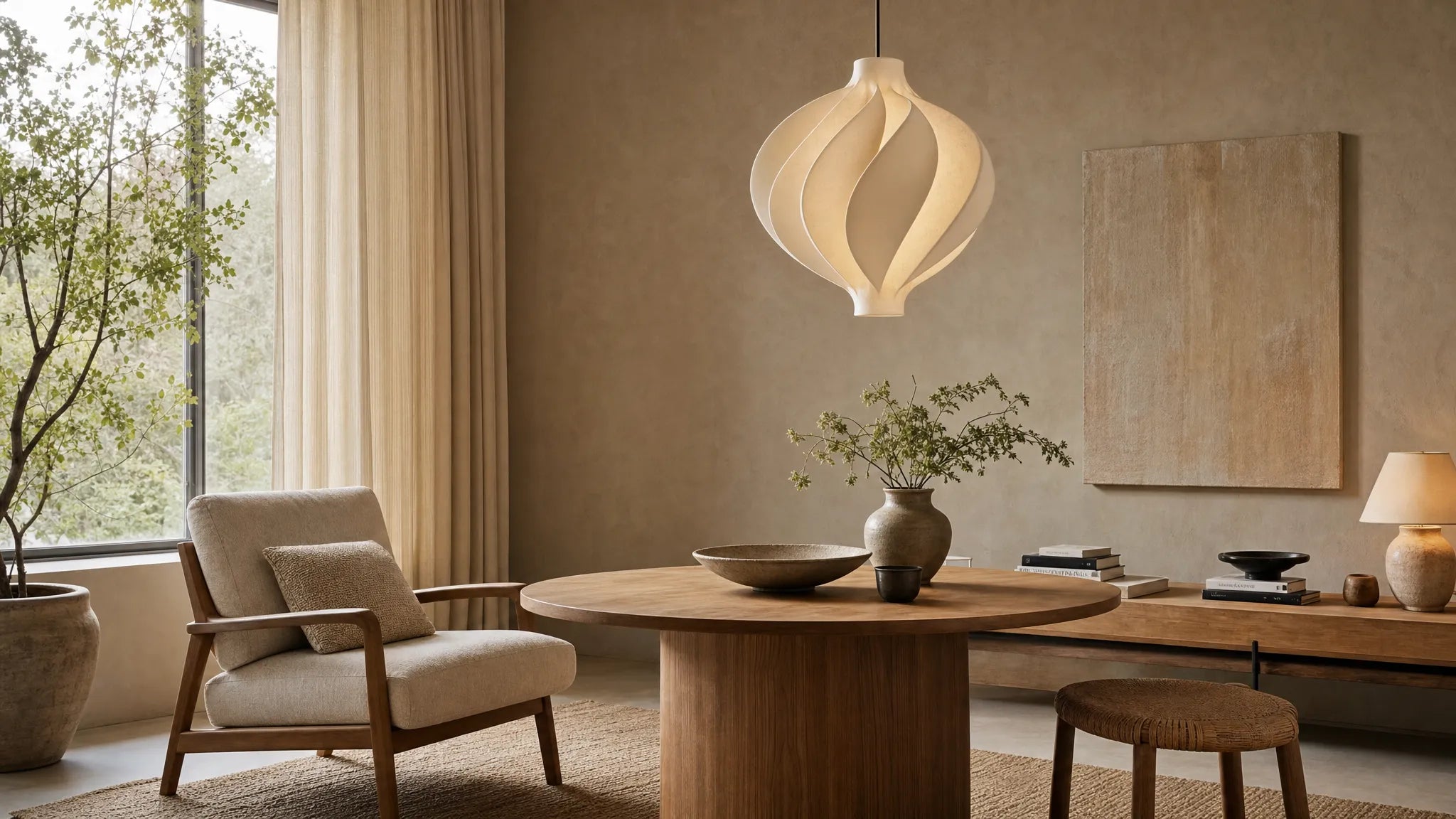
The seating area is usually the emotional center in the living room. Here, light should not only make things bright, but also create closeness. A pendant lamp above the coffee table, an arc lamp next to the sofa or several small table lamps can clearly define this zone.
Make sure the light is on Furniture group to align. If the ceiling outlet is in the middle of the room but the sofa is on the side, a light in the middle of the room often seems random. For pendant and hanging lights, an adjusted cable length or a suitable canopy can help to position the light correctly visually.
For more in-depth planning around the sofa, TV and coffee table, you will find practical measurement and placement tips in the article Which living room lamp goes with the sofa, TV and coffee table?.
Do not confuse reading zones with mood lighting
Cozy light does not automatically mean good reading light. To read, you need a directed light source that illuminates the book page, armchair or side table without glaring your face. An adjustable floor lamp, a wall lamp with a swivel arm or a table lamp with a good shade is ideal for this.
The best position is usually slightly to the side behind the shoulder. Right-handed people often benefit from light Left, Left-handed people light from the right so that the hand does not cast a shadow. A dimmable solution is particularly practical for armchairs and sofa corners because the same zone can be used brighter during the day and softer in the evening.

Consciously plan the TV zone darker
Many living rooms are either too dark or incorrectly lit when watching TV. Completely dark rooms create strong contrasts between the screen and the surroundings. A bright ceiling light, on the other hand, is reflected in the TV or is distracting.
A soft background lighting is better. Indirect light behind the sideboard, subtle wall lights next to the TV area or a small table lamp outside the direct field of vision reduce contrasts. The light should be warm and dimmed low. Avoid lights whose light source is directly visible on the screen.
Use accent lighting for depth and personality
Accent lighting turns a functional space into a designed space. It highlights art, materials and architecture. A picture appears more present with a narrow beam of light, a shelf gains depth, a structured wall gets shadows and character.
Use accents sparingly. Two to three deliberately illuminated points are often enough. Too many lighting accents compete with each other and make the living room appear busy. If colors, wood, textiles or art are important, ensure good color reproduction. A CRI of at least 80 is common; values around 90 are particularly pleasant for high-quality materials and art.
Which type of luminaire suits which zone?
The shape of the luminaire should always match the purpose of the zone. A decorative pendant light can be beautiful, but unsuitable as a reading light. A strong ceiling light can be practical, but too dominant for an evening watching TV.
| Type of luminaire | Particularly suitable for | Strength | What to pay attention to? |
|---|---|---|---|
| Ceiling light | Basic light, small living rooms, low ceilings | Uniform orientation | Check glare, light distribution and dimming |
| Pendant lamp | Seating group, coffee table, open living areas | Sets a clear island of light | Pay attention to the suspension height, cable length and visual axes |
| Chandelier | High rooms, representative living areas, galleries | Strong design statement | Carefully check the room height, diameter and weight |
| Floor lamp | Reading area, sofa, dark corner | Can be used flexibly and without a ceiling outlet | Check stability, shield height and cable route |
| Arc lamp | Seating group, coffee table, zone without ceiling connection | Light from above without mounting point | Pay attention to the projection, base size and headroom |
| Wall light | TV zone, accent wall, passageway | Space-saving, atmospheric | Plan the installation height and direction of glare |
| Table lamp | Side table, sideboard, windowsill | Soft atmosphere at eye level | Match the shade material and light color |
If you are hesitating between several types of lights, a simple rule can help: The closer the light is to people, the more important anti-glare, warm light color and dimming are. The more the light shapes the entire room, the more important proportion, material and light distribution are.
Light quality: Kelvin, lumens, dimming and glare
The most beautiful lamp can disappoint if the light quality is not right. Especially in the living room, it's not just the design that matters, but also the effect of the light source or LED module.
Light color: warm, but not yellowish
For most living rooms, warm white light is between 2,700 and 3,000 Kelvin ideal. It looks homely, makes skin tones appear pleasant and harmonizes with wood, fabrics and warm wall colors. For very quiet evening areas, 2,200 to 2,700 Kelvin can be useful, especially for table and accent lights.
Cooler light from around 4,000 Kelvin can be useful in work areas, but quickly appears objective in the classic living area. If the living room also serves as a home office, a separate, targeted work light is better than an overall cool room.
| Usage | Recommended light color | Effect |
|---|---|---|
| Relax in the evening | 2,200-2,700K | Very warm, quiet, cozy |
| Everyday life and guests | 2,700-3,000K | Cozy, natural, versatile |
| Reading and hobby | 3,000 K, also a little more neutral depending on your taste | Clearer, more focused |
| Home office in the living room | 3,000-4,000K locally | More activating, more functional |
Brightness: better distributed than concentrated
Many bad purchases occur because people only pay attention to watts or a single high lumen number. Modern LED lighting is assessed in lumens, i.e. according to luminous flux. For a living room, around 100-200 lux often makes sense as a general guideline. The required lumens are roughly calculated from the room area multiplied by the desired lux number, after which a small practical surcharge is planned for umbrellas, dark surfaces and light losses.
Example: A 20 m² living room with 150 lux basic orientation mathematically needs around 3,000 lumens for the basic brightness. In practice, however, it is more pleasant to distribute this amount across several light sources, such as ceiling lights, floor lamps and accent lights, rather than having everything come from a single, very bright lamp.
Dimmability: almost always useful in the living room
A living room changes throughout the day. You need orientation in the morning, maybe work light in the afternoon, atmosphere in the evening. Dimming is therefore a great convenience in many zones.
However, make sure that the light, LED driver, bulb and dimmer fit together. Not every LED can be automatically dimmed without flickering. If you want to use existing dimmers, check compatibility before purchasing. More technical details can be found in BUYnBLUE-Guide Dimming LED lamps: What really works without flickering.
Glare: the often underestimated comfort factor
Glare occurs when the light source is directly visible or when shiny surfaces are reflected. In the living room, this particularly applies to glass coffee tables, shiny sideboards, TV screens and open lamps at eye level.
Good solutions include diffusers, opal glasses, textile shades, indirect light components or careful alignment. Always test a lamp from typical sitting positions: from the sofa, from the reading chair, from the dining area and from the entrance.
Examples of typical living rooms
Small living room
In small spaces, less is often better. A dimmable ceiling light for basic lighting, a floor or table lamp on the sofa and a small accent on the shelf are often enough. Avoid pendant lights that are too large if they block walkways or visually depress the room.
Light materials such as glass, light fabrics, slim metal shapes or reduced wooden details often appear calmer than solid shades. Indirect light on the wall or ceiling makes small rooms appear larger.
Open living and dining area
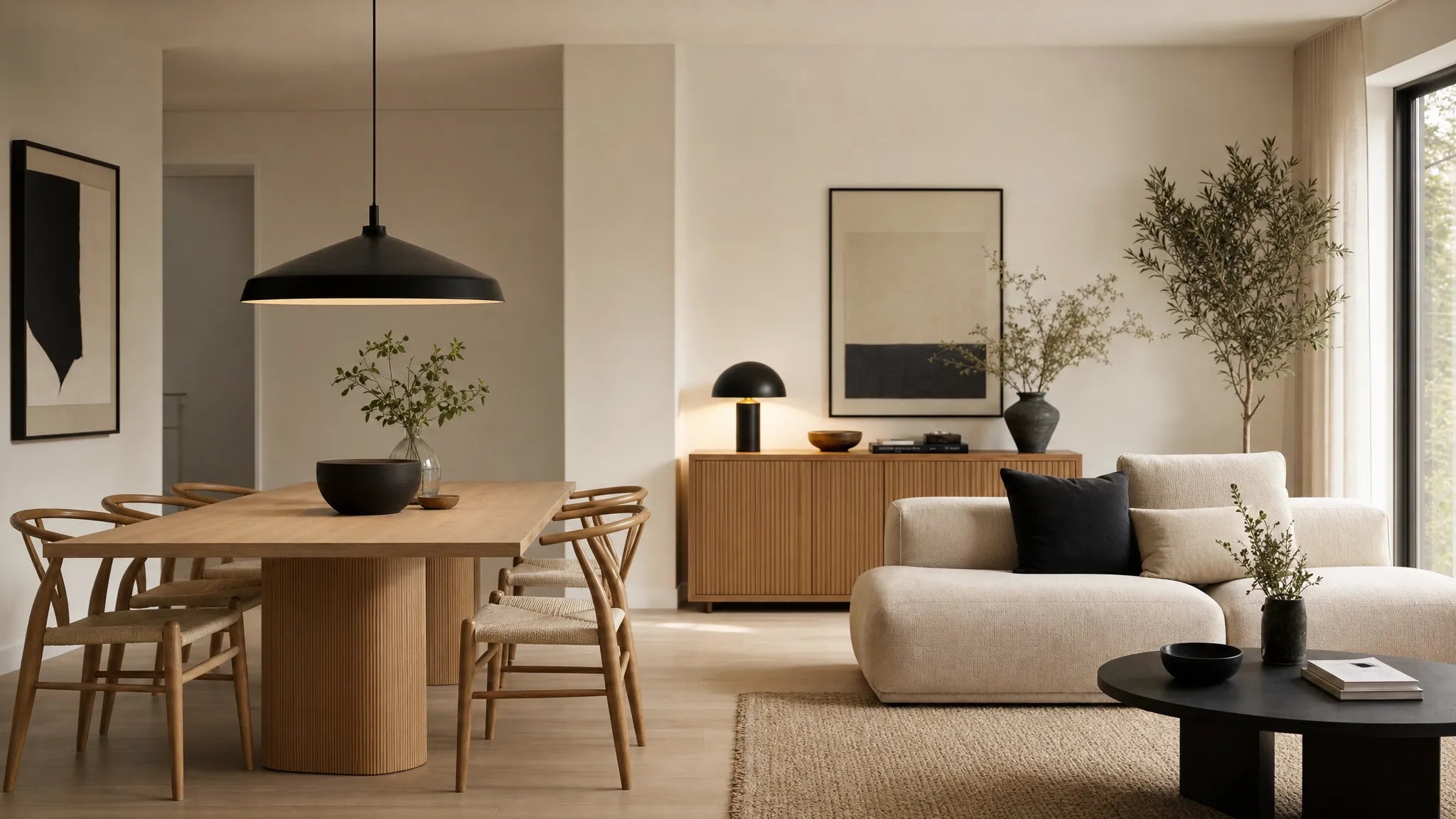
Open floor plans need clear islands of light. The sofa, the dining table and possibly a kitchen island should each have their own lighting logic. A pendant light above the dining table, a softer living room light above or next to the seating area and indirect light in the TV area create structure without building walls.
It is important that the lights appear related to each other. They don't have to be from the same series. It is often enough if the material, color, design language or light color repeat.
High ceilings and galleries
High rooms can tolerate larger lights, but they also need light at eye level. A chandelier or long pendant lamp can fill the room vertically, but does not automatically replace wall, table or floor lamps. Without additional light sources, the lower living area often remains uncomfortable despite impressive lighting.
Adjustments are particularly important for high ceilings. Cable length, canopy and suspension determine whether the lamp appears present in the room or hangs lost.
Common mistakes with lighting zones in the living room
A common mistake is the single, very bright ceiling lamp. It creates brightness, but little comfort. Equally problematic is a room with many decorative lights that are all similarly dim. Then there is no orientation and every zone appears random.
Incorrect light colors are also annoying. Cool light in the relaxation area, too yellow light when reading or different Kelvin values next to each other can appear restless. If you combine multiple lights, stick to a similar warm white light family in the main area if possible.
Another classic is the wrong height. Pendant lights hang too low in the field of vision, arc lights protrude into walkways, wall lights dazzle at eye level or table lamps are so low that only the shade lights up, but not the zone.
Short checklist before purchasing
Before you choose a living room lamp, check these points:
- Which zone should the light illuminate?
- Do I need basic light, reading light, accent light or mood light?
- Is the lamp glare-free from typical sitting positions?
- Does the light color match the other lights in the room?
- Is the brightness sufficient but dimmable?
- Is the size, height and distance to the sofa, table, wall and walkways correct?
- Are there suitable power connections, sockets or secure cable routing?
- Should the light be adjusted, for example in terms of cable length, canopy or color?
The last point in particular is often underestimated. A high-quality lamp only appears truly planned if it matches the room in height, position and finish.
Frequently asked questions
How many light zones does a living room need? For most living rooms, three to five lighting zones are enough: basic light, seating area, reading zone, TV light and one or two accents. Large or open rooms may require additional zones for a dining table, home office or gallery.
Which living room lamp is suitable as basic light? Ceiling lights, flat LED ceiling lights, pendant lights or chandeliers with good light distribution are suitable as basic lighting. What is important is freedom from glare, the right size and ideally dimming.
Which color of light is the most comfortable in the living room? Warm white light between 2,700 and 3,000 Kelvin is usually most pleasant. For a very quiet evening atmosphere, table and accent lights can also have 2,200 to 2,700 Kelvin.
Can a floor lamp replace a ceiling lamp? In small living rooms or rental apartments, a strong, indirect floor lamp can partially replace the basic light. For consistent orientation, a combination of floor, table and wall light is usually better.
How do I avoid glare when watching TV? Do not place a bright light directly opposite or above the screen. Indirect light behind or next to the TV, dimmed wall lights and warm, low brightness are better.
Should all living room lamps be the same style? No. A room often appears more exciting when the lights are not identical. But pay attention to connecting elements such as material, color, shape, light color or surface finish.
Living room lighting with BUYnBLUE implement precisely
If you know your light zones, the selection becomes much easier: you are no longer looking for just any nice lamp, but rather a lamp with a clear task. This is exactly where it is worth having a well-curated selection of designer lights that fit the room in terms of both design and functionality.
At BUYnBLUE You will find modern lights for various living areas, including pendant lights, chandeliers, ceiling lights and other design solutions. Particularly practical: pendant and hanging lights can be adjusted free of charge, for example in terms of cable length, canopy or color. This means that the lamp can be adjusted to the height of the ceiling, the position of the furniture and the lighting zone.
With free worldwide shipping, a 14-day return policy, secure payment options, real-time tracking and 24/7 customer support, lighting planning becomes a relaxed purchase. If you design your living room according to light zones, you will not only end up with a brighter room, but also a living area that fits into your everyday life.