How much light does a room need: much too bright or too dark?
In this informative article we want to look at the effects of too strong and too weak lighting on eyes and well-being. The question of how much light a room really needs is anything but trivial. Too little light makes it difficult to see and makes you tired; too much or poorly directed light can dazzle and, in extreme cases, even damage the eyes.
When researching this topic, I primarily looked at the lighting levels for typical living spaces - and how realistic the concern about “eye damage caused by poor light” is today.
Basics: What does “too much or too little light” actually mean?
When people talk about “light” or “dark” in everyday life, it is usually a subjective impression - but from a technical point of view there are clearly defined sizes.
Illuminance is measured in lux and describes how much luminous flux (lumen) reaches an area of one square meter. One lux corresponds to one lumen per square meter; the higher the lux value, the brighter a surface appears.
Standards such as DIN EN 12464 1 specify clear minimum values for workplaces, around 500 lux for typical office workplaces. There are no legal requirements for private living spaces, but there are established guidelines from standards and specialist literature.
Guidelines: How much light does which room need?
Typical Lux areas have been established for living spaces that differentiate between cozy basic lighting and functional work lighting.
- Living room: Around 150 lux for comfortable basic lighting where you can orientate yourself and relax.
- Reading area in the living room: Around 500 lux on a book or tablet, usually via an additional one Floor lamps.
- Kitchen: Around 500 lux as uniform, functional lighting of the work surfaces.
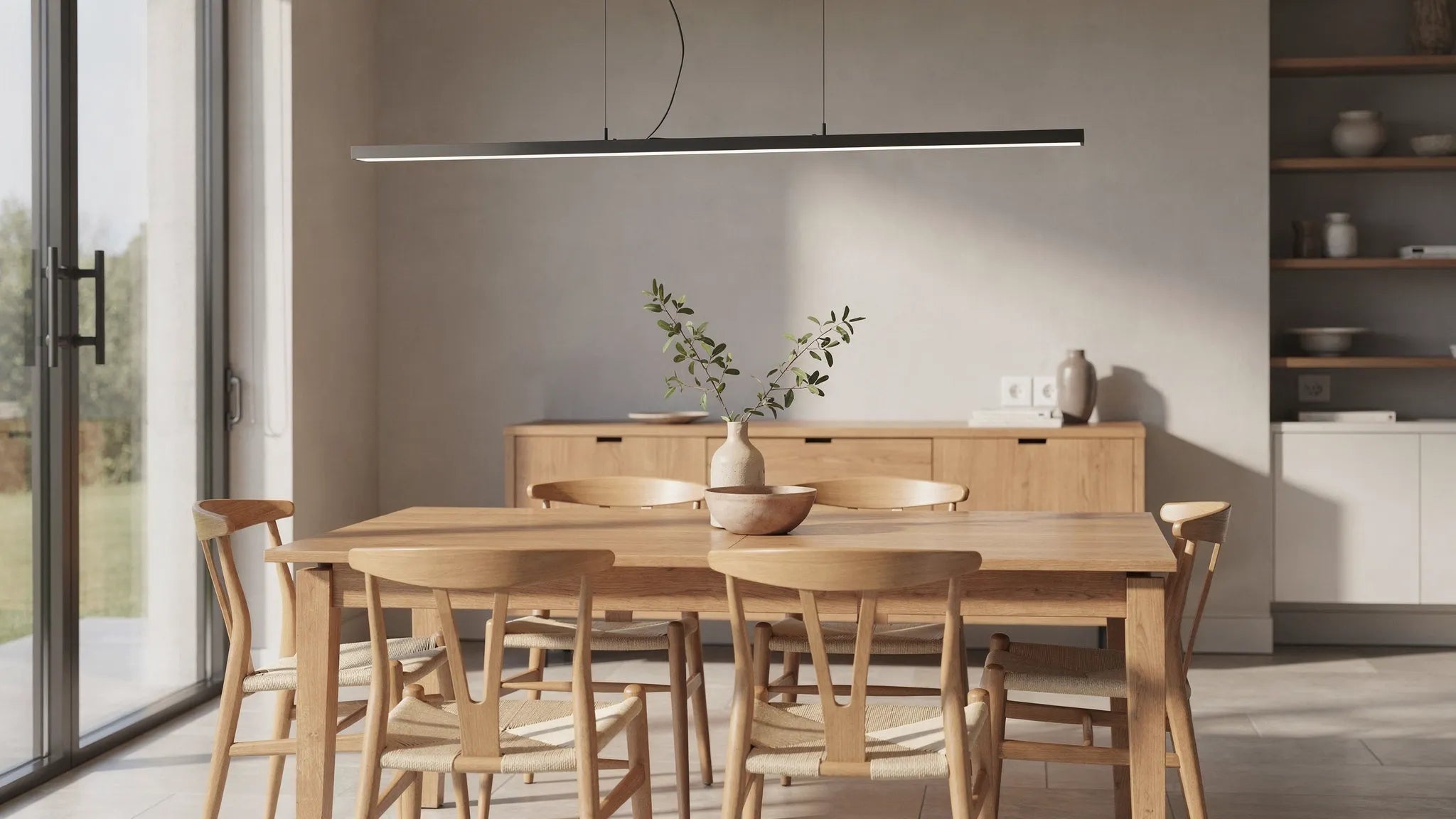
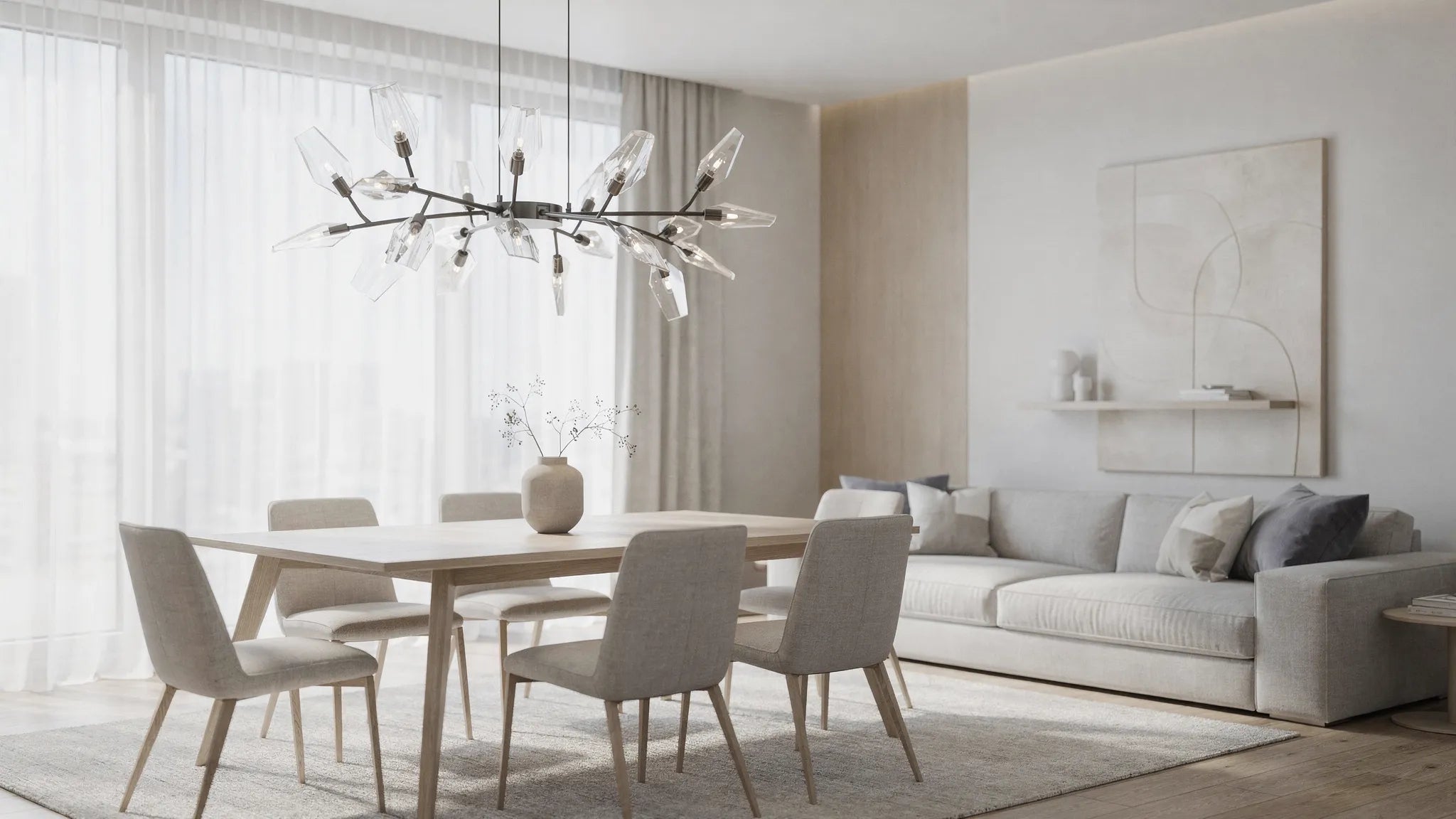
- Dining room: Around 150 lux, ideally dimmable – depending on your mood and use.
- Bedroom: Around 100 lux for basic lighting, supplemented by reading lamps on the bed.
- Children's room: Around 200 lux, so that playing, learning and crafting are possible.
- Bathroom: Around 200 lux for safe orientation.
- Mirror and makeup area: Around 500 lux and even illumination, preferably from the side.
- Hallway and hallway: Around 100 lux as orientation lighting.
These values are deliberately chosen to be moderate - older people often perceive the same level of illumination as darker and benefit from a little more lux.
Subjective feeling vs. standard values
Whether a room is perceived as “bright enough” depends not only on the lux value, but also on contrasts, reflections and the distribution of the light. Uniform basic lighting ensures that the eyes do not have to constantly switch between very bright and very dark areas. Additional accent and zone lighting then provides more light where it is needed - for example on the reading chair or on the kitchen worktop - without outshining the entire room.
The color temperature also influences the impression: warm white light (approx. 2700-3000 Kelvin) appears cozy, while neutral to daylight white (4000-6500 Kelvin) is more activating. However, these differences are less important for eye health than sufficiently bright and functional lighting.
What happens if the lighting is too dim?
Light that is too dim makes it difficult to see, especially when doing activities such as reading, writing or doing handicrafts. Biologically speaking, when there is little light, the pupils dilate to allow more light to reach the retina. This reduces the depth of field and the image becomes blurrier. In order to keep small letters or details sharp, the eye muscles and the ciliary muscle have to work harder - the eye strains more and tires more quickly.
Typical consequences are:
- irritated, dry or burning eyes
- Headache and feeling of pressure in the head
- blurred vision after prolonged exposure
- the subjective feeling “I strained my eyes”
However, doctors emphasize that, based on current knowledge, reading or working in poor light generally does not cause permanent structural damage to the eye. The visual system is put under greater strain, but the eyes recover fully with sufficient breaks and during sleep.
The famous parental saying “Don’t read in the dark, otherwise you’ll ruin your eyes” is now considered a myth. It is still unpleasant - and it can make existing vision problems more noticeable.
Damage to health caused by weak and artificial lighting
Even though we have dispelled our parents' myth, there are relevant connections between light, viewing habits and the development of nearsightedness (myopia). Studies show: Children who spend a lot of time indoors with artificial light and little time outside have an increased risk of becoming nearsighted.
Two factors are particularly in focus:
- Lack of daylight: Bright outside light influences messenger substances in the retina and has a regulating effect on eye growth.
- Long close vision: Reading for hours, using a tablet or smartphone at short distances can further increase the risk of myopia.
What is important here is not the “bad lamp” per se, but rather the mix of little natural light, a lot of close-up work and constant stay indoors. For everyday life, this means: If you work a lot indoors, you should plan breaks outside - this will help your eyes significantly more than just an “even brighter” desk lamp.
What happens if artificial lighting is too strong?
Too strong light or poorly directed, very bright light sources can be more problematic than moderately too little light.
Typical effects are:
- Glare: Even moderate light sources can dazzle in dark environments or in strong contrasts and make vision acutely difficult.
- Afterimages & temporary vision loss: A sudden look at headlights, flashlights or very bright spots can lead to afterimages and a short-term deterioration in visual acuity.
- Photochemical and thermal damage: Very intense light sources with a strong UV content (sun, arc welding) can actually damage the cornea and retina.
However, in normal living spaces, lights are designed in such a way that they do not cause permanent eye damage when used correctly. According to current knowledge, LED lamps are safe in the home, but they should not be stared at for minutes at a time from a short distance - especially not as strong, cold white spots.
Typical light damage
“Eyes spoiled” – what does that actually mean? In everyday life, people mean very different things by this: their eyesight has deteriorated (nearsightedness, presbyopia), their eyes are constantly dry, irritated or sensitive to light, and more.
After certain events (intense light, screen stress), vision is blurred for longer or unusually stressful. From a medical perspective, it is worth making a rough distinction between functional overload and structural changes:
- Functional overload: eye fatigue, headaches, dry eyes - here the “hardware” (cornea, lens, retina) is still intact, the muscles and the tear film are simply overwhelmed.
- Structural changes: myopia (elongated eye), corneal scars, cataracts (clouding of the lens), macular degeneration - here tissue or structures have changed permanently.
Depending on what exactly is “spoiled,” the healing or treatment options look very different.
Healing options for overexertion and “tired eyes”
If you feel like your eyes are “spoiled” from light or work, this is often a reversible condition – the eyes can recover.
Important measures:
- Regular breaks: The well-known 20-20 rule (look about 6 meters away for 20 seconds every 20 minutes) helps to relieve the accommodative system
- Optimize lighting: Sufficient brightness at the workplace (approx. 500 lux for reading, PC work)
- No point-like, dazzling light sources in the field of vision: combination of indirect light and targeted desk lamp
- Support the tear film: Dry room air, screen work and infrequent blinking quickly lead to dry eyes. Artificial tears (without preservatives) can moisten the surface, but if the symptoms persist, an ophthalmologist should clarify the cause.
- Check screen and working distance
In many cases, these measures can noticeably improve the feeling of “I have strained my eyes” and are an important part of the “healing” if the symptoms are purely functional.
Conclusion
The question “How much light does a room need?” cannot be answered with a single number, but the guidelines and principles mentioned in this blog post provide reliable guidance.
For the practical design of rooms, this means: Balanced, glare-free lighting with multiple, sensibly placed light sources that can be adapted to the activity and time of day supports both visual comfort and long-term eye well-being.
If you need support in developing a suitable lighting concept for your living space, contact BUYnBLUE.