Recognizing lamp design: quality instead of dazzling
Good lamp design is not recognized by its loudest appearance, but rather by how naturally a lamp works in the room. A beautiful shape is important. But if the light is dazzling, the surface appears stained after a short time or the proportions are not right, there is little left of the supposed design piece.
The distinction is difficult, especially online. Product photos are staged, trends change quickly and many lights look higher quality at first glance than they actually are. However, if you know what's important, you can reliably recognize blender and invest in lights that will continue to impress even after years.
What does high-quality lamp design really mean?
High-quality lamp design combines four levels: shape, material, lighting effect and usability. A lamp is not just a decorative object. It shapes the atmosphere of a room, influences visual comfort and must function reliably from a technical point of view.
A good piece of design looks harmonious when switched off and provides pleasant light when switched on. It fits the architecture, harmonizes with furniture and remains practical in everyday life. For pendant lights, for example, this means: The light hangs at the right height, does not dazzle at the dining table and distributes the light where it is needed.
A blender, on the other hand, often only relies on the first impression. It has a striking silhouette, a trendy finish or a dramatic product shot. But a closer look reveals weaknesses: thin material, unclean transitions, poor cable routing, flickering light or a canopy that doesn't fit the lamp.
The first quality check: consistency instead of show effect
Before you check technical details, it's worth getting a simple overall impression. Don't just look at whether you like the lamp. Ask yourself whether every detail contributes to the design or whether individual elements are just intended to attract attention.
A good sign is creative calm. This does not mean that the lamp has to be minimalist. Even an opulent chandelier can be of high quality if its proportions, materials and light points are logically structured. What matters is whether the form has an internal order.
Pay particular attention to these points:
- Silhouette: Does the shape appear balanced from different angles or just from a photo perspective?
- Material change: Do metal, glass, textiles, wood or stone fit together or do they look randomly combined?
- Details: Are screws, transitions, cables and suspensions part of the design or do they seem like later stopgap solutions?
- Scale: Does the lamp match the size of the room, the ceiling height and the furniture below?
If a lamp only attracts attention because of its extreme size, unusual color or strong reflections, but does not fulfill a clear function, caution is advisable. Quality often appears more quietly.
Material quality: How to expose thin blenders
Material is one of the most important indicators of real lamp design. High-quality materials don't always have to seem heavy or expensive, but they should be honestly made. A thin sheet of metal can be used deliberately with good design. It becomes problematic when the material is supposed to look solid, but is actually wobbly, sharp-edged or sensitive.
When it comes to metal lights, uniform surfaces, clean edges and stable connection points are crucial. Paintwork should not appear blotchy. Brushed or anodized surfaces should have a calm structure. When it comes to brass, aluminum or stainless steel, it's worth taking a look at the material information, because terms like "gold look" or "metal look" say little about the actual substance.
Glass is a particularly good example. High-quality glass has depth, controlled transparency and clean edges. Small irregularities can even be a quality feature in handcrafted glass, as long as they appear deliberate and aesthetic. If you are interested in the effect of glass, see the article about hand-blown lamp glass from Germany additional insights into material character and manufacturing quality.
| area | Quality feature | Warning signal |
|---|---|---|
| metal | Even surface, stable edges, clean holes | Waves, paint noses, sharp edges, visible dents |
| Glass | Clear or deliberately structured surface, secure frame | Bubbles or streaks without any design intention, crooked edges |
| Textile | Tightly stretched shade, clean seams, even light distribution | Adhesive edges, waves, uneven transparency |
| Cable | High quality coating, matching color, straight guide | Kinks, cheap plastic look, too short or unsuitable length |
| canopy | Shape and color match the lamp, stable seat | Too small, crooked, not visually coordinated |
A good dealer makes these details visible. Close-up photos, clear material information and dimensional drawings are not a luxury, but rather part of serious purchasing advice.
Processing: The small spots reveal the great quality
Many blenders look convincing from a distance. The truth is revealed in transitions, connections and hidden areas. A high-quality light not only looks neat at the front, but also at the canopy, at the bottom and at the fastenings.
Check whether shades are symmetrical, whether arms of a chandelier are aligned evenly and whether screw connections have been neatly integrated. Suspension is particularly important for pendant lights. Cables, ropes or rods should not only hold, but also visually belong to the design.
Weight can also be an indication, but not the sole quality feature. A massive light is not automatically better. The decisive factor is whether the weight fits the construction and the assembly remains realistic. A light lamp can be of very high quality if the material, stability and light guidance are right.
If you would like to go deeper into the evaluation of material, details and proportions, the guide adds Buy a designer lamp: check the material, details and proportions these points with a practical purchasing perspective.
Light quality: Beautiful object, bad light?
A lamp can be interesting in terms of design and still disappoint in everyday life. That's why light quality is the crucial test. A blender often relies on dramatic brightness or eye-catching LED effects. High-quality lamp design, on the other hand, ensures pleasant, controlled light.
Important key figures are lumens, Kelvin and color rendering. Lumen describes the brightness, Kelvin the light color. Warm white light in the range of around 2700 to 3000 Kelvin usually looks comfortable in living rooms. More neutral light colors can be useful in work areas. The color rendering index CRI shows how natural colors appear under the light. A CRI of at least 80 is common for living spaces; higher-quality lighting solutions often rely on higher values.
Freedom from glare is equally important. Directly visible LEDs, poorly shielded lamps or reflective interior surfaces can be unpleasant. A good light uses diffusers, reflectors or the geometry of the shade to direct light. This is crucial for comfort, especially above the dining table or at eye level.

With LED lights, it is also worth looking at dimming behavior, driver quality and freedom from flicker. Very cheap LED lights often save money exactly at this point. This isn't noticeable in the product photo, but it's very noticeable in everyday life. The article offers in-depth orientation Design lamp LED: CRI, drivers & processing checked quickly.
Proportions: Why the most beautiful lamp can appear wrong
Quality doesn't just mean that a lamp is well made. It must also be used in the right amount. A pendant light that is too small above a large dining table looks lost. A chandelier that is too large in a low room can be overwhelming. When it comes to lamp design, proportion is often the difference between elegant and intentional.
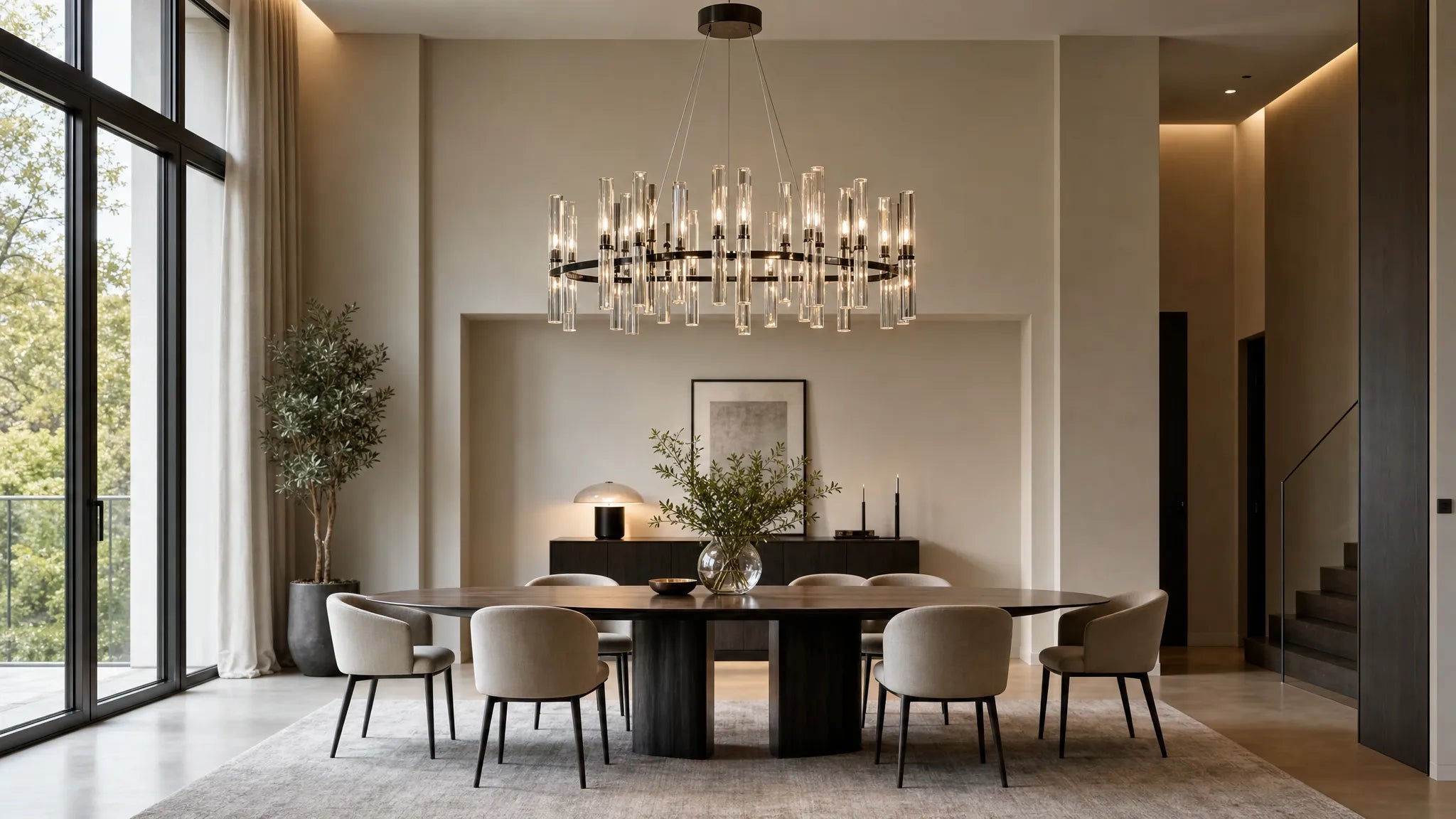
As a rule, a pendant light should hang above a dining table in such a way that it clearly marks the table but does not disturb the view. The lower edge is often around 60 to 80 centimeters above the table top. This is not a rigid rule, because the size of the lamp, light distribution and seating position all play a role. In open living areas, a lamp can also serve as zoning, for example to visually separate the dining area and sofa area.
When it comes to chandeliers, the height of the room is crucial. The luminaire can be more present in high rooms. In lower rooms, flatter, horizontal designs often appear more harmonious. The canopy should also match the ceiling. A delicate ceiling finish can appear too weak for an opulent lamp, and a canopy that is too dominant can disrupt a fine design.
This is exactly where adaptation is a real quality criterion. If the cable length, canopy or color can be coordinated with the room, the lamp does not look like a standard object, but rather like a part of the interior. At BUYnBLUE This free customization option for chandeliers and pendant lights is part of the offer, for example in terms of cable length, canopy or color.
Technical information: Not dry, but decisive for the purchase
Many buyers skip technical data because it seems complicated. It is precisely this information that protects against bad purchases. If you decide based solely on appearance, you will quickly overlook whether the lamp actually fits the room and its use.
Dimensions, lamp type, maximum power, voltage, protection class and dimmability are particularly important. In bathrooms or outdoor areas, the IP protection class plays a major role. In the living and dining areas, light color, brightness and controllability are more important.
The EU energy label for light sources also helps to classify efficiency. What is important, however, is that a good energy class alone does not make a good light. It says nothing about material quality, lack of glare, workmanship or proportions. Conversely, a high-quality design can lose its impact due to a poorly chosen light source.
CE marking is also often misunderstood. CE is a mandatory marking in the EU for many product groups and means that the manufacturer declares conformity with relevant requirements. However, it is not an independent seal of quality for design, workmanship or lighting comfort. For consumers this means: CE is important, but it does not replace testing the other criteria.
Buy online: How to read product pages correctly
When buying online, the quality of the information is crucial. A reputable product page gives you enough data to mentally place the lamp in your room. If all there is is a pretty picture, a fancy name and a rough size indication, you should be skeptical.
Good product pages show the lamp from multiple perspectives. Ideally you will see close-up photos of the surface, suspension, shade, glass or joints. Dimensional drawings help to realistically estimate the size. Information about material, light source and assembly should be specific.
| Check question before purchasing | Why it is important |
|---|---|
| Are there exact dimensions including cable length and canopy? | This is the only way to plan the lamp to suit the height of the room. |
| Are materials specifically named? | Terms such as “optics” or “look” can obscure real material information. |
| Is the lighting effect explained? | Brightness, light color and radiation determine its suitability for everyday use. |
| Is there information about customizations? | Dimensional adjustments prevent a beautiful lamp from sitting incorrectly in the room. |
| Are returns, shipping and support transparent? | Clear conditions reduce the risk when buying online. |
At BUYnBLUE Customers can discover modern designer lighting by room category and request sensible adjustments to many pendant lights and chandeliers. Plus free worldwide shipping, 14-day returns, secure payment options, tracking, and 24/7 customer support.
Typical Blender signals you should take seriously
Not every cheap light is bad and not every expensive light is automatically good. Nevertheless, there are patterns that often indicate poor quality.
If the light is heavily retouched in photos or only shown in dark, atmospheric scenes, important information is often missing. If material information remains unclear, for example only “premium material” without any specifics, you should ask in more detail. If the design is very eye-catching but no specifications are given about the light source, this may be an indication of surface marketing.
Unrealistic promises are particularly critical. A lamp can be elegant, efficient and high quality. But if at the same time it has to be extremely affordable, individually perfect, particularly durable and technically complex, without any explanation of the material and workmanship, the calculation often doesn't fit.
Interchangeable trend shapes are also a signal. Some lights pick up on current social media aesthetics without developing a long-term design language. This can be attractive in the short term, but it often quickly seems arbitrary. If you want to furnish for a long time, you should pay attention to proportion, honesty of materials and lighting comfort, not just to the trend moment.
Quality is also service: adjustment, advice and traceability
An often underestimated part of good lamp design is the service surrounding the lamp. This starts with clear information and ends with the question of whether the lamp actually fits into your room. Standard dimensions are not always ideal, especially for renovations, new buildings or demanding interior projects.
A pendant light above a kitchen island needs different suspension than a light above a round dining table. An old building with a high ceiling has different requirements than a modern new building with a flat ceiling. This is precisely why cable length, canopy color, canopy shape and surface coordination are not just extras, but are often crucial for a professional result.
If you want to use a lamp for the long term, you should also pay attention to understandable communication. Can the dealer answer questions? Are adjustments clearly described? Are there return conditions? Is shipping handled transparently? Such points seem less glamorous than a nice product photo, but they make the difference between a spontaneous purchase and a safe decision.
A short practical check before making the decision
Once you've found a light you like, take five minutes for a final reality check. Don't imagine the lamp in the perfect showroom, but in your everyday life: morning, evening, while eating, reading, cleaning, in daylight and when switched on.
Ask yourself: Is the shape still convincing when the trend is over? Does the surface match door handles, furniture legs, faucets or other metal tones in the room? Does the lamp throw light where you need it? Can it be installed correctly without the cable or canopy appearing improvised?
If several of these questions can be answered clearly, chances are good that you have real lamp design in front of you. If you have to make a lot of guesses when it comes to material, lighting effects and installation, it makes sense to exercise restraint.
Frequently asked questions about lamp design
How can you quickly recognize high-quality lamp design? The combination of harmonious proportions, specific material specifications, clean workmanship and pleasant lighting effects. If a lamp only impresses in photos but offers hardly any technical details, caution is advised.
Is a heavy light automatically higher quality? No. Weight can indicate solid materials, but is not evidence of quality. Construction, stability, surface quality and safe installation are crucial.
Which light color is suitable for living spaces? For many living and dining areas, warm white light of around 2700 to 3000 Kelvin is perceived as pleasant. More neutral light can be useful in work areas.
Are integrated LEDs worse than replaceable bulbs? Not fundamentally. Integrated LEDs can be of very high quality if the light quality, drivers, heat conduction and service information are correct. If this information is missing, you should check more closely.
Why is adjustable cable length so important? Because the right height is crucial for lighting effect, visual comfort and proportion. Especially with pendant lights and chandeliers, a suitable cable length prevents the light from appearing too high, too low or improvised.
Conclusion: Good lights are also convincing at second glance
Real lamp design is not just an eye-catcher. It is reflected in the honesty of the materials, precise workmanship, good light and a proportion that fits the room. Blenders often seem spectacular at first glance, but quickly lose value in everyday life.
If you are looking for modern lights that not only look beautiful, but also impress spatially and technically, a curated selection is worth it. At BUYnBLUE You will find designer lighting for different living areas, with high-quality materials, free worldwide shipping and the possibility of having many chandeliers and pendant lights adapted to your room conditions free of charge.