Select a dimmable LED transformer and connect it correctly
An LED transformer is often the invisible component that determines the quality of your lighting. Especially with modern pendant lights, LED strips, recessed spotlights or designer lights, it is not enough to just pay attention to wattage and appearance. If the lighting is to be continuously dimmable, the LED module, transformer and dimmer must technically fit together.
Who one LED transformer dimmable Therefore, you quickly find yourself in front of terms such as constant voltage, constant current, phase cut-off phase, PWM or minimum load. This guide explains what really matters, how you can avoid typical mistakes and which points are important when connecting.
Important in advance: Work on the 230 V installation may only be carried out by qualified electricians. As a homeowner, planner or interior designer, you can select the right components and prepare the lighting planning, but the permanent mains connection belongs in professional hands.
What does “dimmable LED transformer” actually mean?
In everyday life, almost everything that supplies an LED light with power is called an “LED transformer”. Technically this is not always entirely correct. Classic transformers convert alternating voltage. Modern LED systems usually work with electronic power supplies or LED drivers that provide precise voltage or current for the LED.
In practice, the most important thing is whether the transformer matches the type of LED. A 24 V LED strip requires something different than an integrated LED module in a pendant light. If the wrong driver is used here, the light can flicker, remain too dark, overheat or be permanently damaged.
| term | Typical application | What to pay attention to? |
|---|---|---|
| Constant voltage transformer | LED strips, furniture lighting, some low-voltage spots | Output voltage, e.g. B. 12 V or 24 V, must fit exactly |
| Constant current driver | LED modules, recessed spotlights, many designer lights | Output current, e.g. B. 350 mA or 700 mA, must match the LED |
| Dimmable LED driver | Integrated LED lights, high-quality ceiling and pendant lights | Dimming type must match the wall dimmer or control system |
| Smart or PWM controller | LED strips, indirect lighting, light zones | Controller must be suitable for voltage, power and LED type |
The most important rule is: The luminaire is not simply “dimmed somehow”, but the entire system must be dimmable. This includes LED, drivers, dimmers, wiring and sometimes the smart home system.
The most important types of dimming at a glance
You can't tell whether an LED transformer is dimmable just by looking at the word "dimmable" on the packaging. What matters is which technology is used for dimming. Different types of dimming are not automatically compatible with each other.
Leading edge and trailing edge
Many wall dimmers work on the 230 V side. The alternating voltage is changed so that the connected dimmable LED driver passes on less power to the LED. The two most important methods are leading edge and trailing edge.
Trailing edge is often used in modern LED drivers, while leading edge is more familiar from the world of classic light bulbs or certain transformers. There are also universal dimmers that can handle both processes. Nevertheless, the data sheet of the LED transformer should always state which type of dimming is permitted.
PWM dimming
PWM stands for pulse width modulation. The LED switches on and off very quickly. This creates a lower brightness for the eye. PWM is often used in LED strips and low-voltage systems.
Good PWM systems work at high frequencies so that the light appears calm and flickers as little as possible when taking camera shots or moving quickly. Very cheap controllers can cause visible flickering, especially at low brightness.
0-10 V, DALI and smart home dimming
In professional projects, large living areas, hotels or architecturally sophisticated interiors, 0-10 V, DALI or smart controls are often used. These systems separate supply and control signals. This allows precise light zones, scenes and group controls.
For private renovations, this is sometimes more technology than necessary. However, for new buildings, open living areas or sophisticated lighting concepts, it can make sense to plan this control early on.
| Dimming type | Typical use | advantage | Important risk |
|---|---|---|---|
| phase section | Lots of modern LED lights | Operation via classic wall dimmer | Dimmers and drivers must be compatible |
| Phase control | Certain transformers and older dimmers | Often present in existing installations | Not suitable for every LED driver |
| PWM | LED strips, indirect lighting | Very flexible for low-voltage systems | Inferior controllers may flicker |
| 0-10V or DALI | Planning, architecture, larger light zones | Precise controls and scenes | Requires suitable cables and components |
| Smart home | Convenience, schedules, app controls | Flexible operation in everyday life | Not every smart product is automatically a dimmer |
If you are still at the beginning of choosing a luminaire, the in-depth guide will also help dimmable LED ceiling lights, because the interaction between the luminaire, LED module, driver and dimmer is explained in more detail there.
Selecting a dimmable LED transformer: the most important criteria
A suitable LED transformer is not bought based on feeling. The following criteria determine whether your lighting will later work reliably.
1. Output voltage or output current must match exactly
First, check whether your LED requires constant voltage or current. LED strips are usually designed with 12 V or 24 V constant voltage. Many integrated LED modules, for example in high-quality pendant lights or recessed spotlights, require a constant current driver.
A 24 V transformer cannot simply be connected to a constant current LED module. Conversely, a constant current driver can damage an LED strip. You can find the information on the old transformer, in the data sheet of the light or on the packaging of the LED module.
2. Calculate power correctly
For constant voltage systems, add the power of all connected LEDs. For LED strips, the simple formula is: length in meters times watts per meter. A 5 m long strip with 9.6 W per meter requires 48 W. The LED transformer should have some reserve, but not be completely oversized.
A reserve of around 10 to 25 percent makes sense in many residential applications. It reduces long-term stress and heat development. However, the transformer should not be too large, as some dimmable transformers and dimmers require a minimum load to work properly.
3. Coordinate the dimming type with the dimmer
A common mistake is to buy a dimmable transformer and combine it with any existing wall dimmer. This doesn't work reliably. It should be clear on the transformer or in the data sheet whether it can be dimmed with trailing edge, phase control, PWM, 0-10 V or DALI.
If you would like to replace an existing switch, it is also worth taking a look at the options Retrofitting a dimmable light switch, especially if old wiring, low loads or multiple lighting circuits are involved.
4. Observe minimum load and maximum load
Many classic dimmers were developed for incandescent lamps and require a relatively high minimum load. LEDs consume significantly less power. This can mean that the light can only be dimmed in a small area, flickers or does not switch on correctly at all.
Therefore, pay attention not only to the maximum wattage, but also to the minimum load. This information can usually be found on the dimmer or in the data sheet. This point is particularly crucial for individual small LED lights.
5. Plan installation location, heat and protection class
LED transformers don't like heat. If a driver is installed in a narrow ceiling, directly on insulation material or in a closed canopy without air circulation, the service life can be reduced. Therefore, plan enough space, a suitable mounting surface and access for later maintenance.
A different type of protection is often sufficient for dry interior rooms than for bathrooms, kitchens or outdoor areas. In damp rooms, protection areas and appropriate IP protection types must be observed. An electrician should check this on a project-specific basis.

Connecting the LED transformer correctly: the basic principle
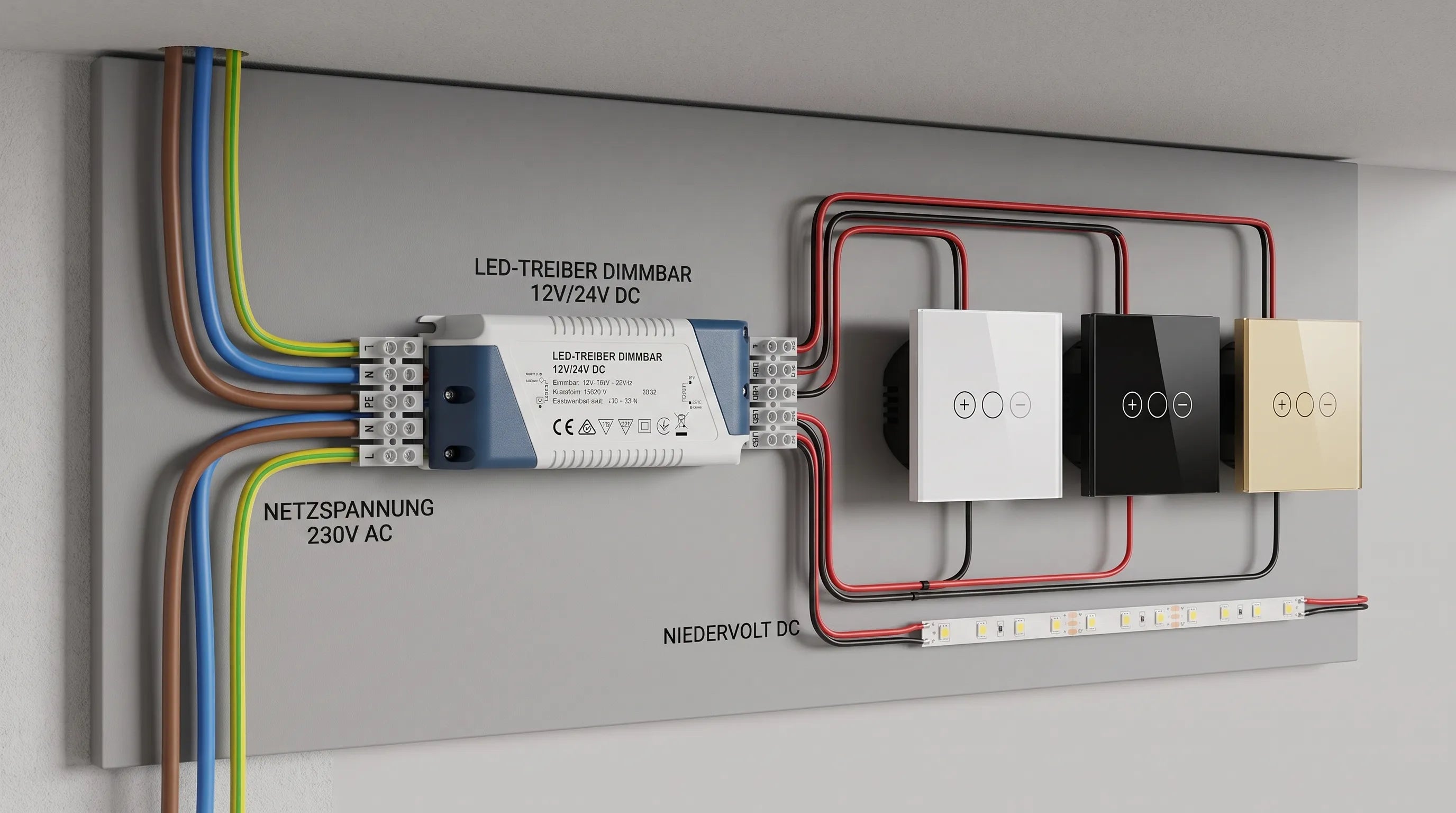
The connection depends on the dimming technology. In many residential applications with phase dimmers, the principle is simplified as follows: Mains voltage leads to the dimmer, the switched or dimmed phase goes from the dimmer to the dimmable LED transformer, and the transformer then supplies the LED on the low-voltage or constant current side.
That sounds simple, but it is safety-related. On the 230 V side there is a danger to life if installed incorrectly. In addition, incorrectly connected dimmers, a lack of strain relief, unsuitable terminals or installation spaces that are too narrow can cause damage.
You can use this structure as a guide for planning:
| Connection area | What needs to be checked | Typical mistake |
|---|---|---|
| Mains side 230 V | L, N, protective conductor and dimmer connection according to circuit diagram | Neutral wire missing or dimmer wired incorrectly |
| Dimmer | Dimming type, minimum load, maximum load, LED suitability | Old incandescent lamp dimmer continues to be used |
| LED transformer input | Permissible input voltage and dimming type | Non-dimmable transformer is operated on a dimmer |
| LED transformer output | Voltage or current, polarity, power | Confusing constant voltage and constant current |
| LED light | Data sheet, performance, connection type | Multiple LEDs are incorrectly connected in parallel or in series |
For constant voltage LEDs, the polarity at the output is important: plus to plus, minus to minus. With LED strips, feed points and voltage drop must also be taken into account. Long routes can end up visibly darker if the cable cross-section or feed is not suitable.
The connection is particularly critical for constant current LEDs. Many modules are operated in series so that the same current flows everywhere. An incorrect parallel connection can overload individual LED modules. The specifications of the luminaire or driver manufacturer should be strictly adhered to.
Typical errors that cause flickering and humming
Flickering is not only annoying, but also an indication that components are not in harmony or are operating at their limits. Often it is not the LED itself, but the combination of dimmer, transformer and load.
| Symptom | Probable cause | Possible solution |
|---|---|---|
| LED flickers at low brightness | Minimum load not reached or dimming curve unsuitable | Choose an LED-compatible dimmer or suitable transformer |
| Light hums | Dimmer and transformer do not work together or components vibrate | Check other types of dimming, use high-quality drivers |
| LED doesn't turn off completely | Residual current, indicator light in the switch or smart module | Have a suitable interference suppression solution checked by a specialist |
| Dimming range is very small | Wrong dimmer or too low load | Pay attention to the driver compatibility list |
| Transformer gets very warm | Overload, poor ventilation or incorrect installation location | Check performance, improve air circulation, change assembly |
Mixed installations are particularly critical. If there are several different LED drivers on a dimmer, the dimming can become uneven. For high-quality living areas, it is usually better to cleanly separate lighting circuits and use compatible components for each zone.
The length of the cable between the transformer and LED can also play a role. In low-voltage systems, a cable that is too long or too thin leads to a voltage drop. With LED strips, this often shows up as a difference in brightness between the beginning and end.
Combine dimmer, smart home and ease of use in a sensible way
In addition to the technical function, the operation also plays a major role. In living spaces, light should not only be switched on and off, but should also be adjusted depending on the time of day, mood or use. Warm, dimmed light is pleasant when eating. More brightness is needed when working. A schedule can come in handy in the hallway.
For manual brightness control on LED lights, a compatible wall dimmer can be an elegant solution. The Smart touch dimmer is specially developed for LED lights and is available in gold, white and black. But it remains important here too: Before installation, check whether the LED transformer used, the load and the type of dimming match the dimmer.
If the primary focus is not on dimming, but rather on smart control, an intelligent light switch can make sense. This Light switch panel smart home enables the connection of a light source to a device such as a smartphone and also supports schedules. For dimmable installations, it should still be clarified in advance whether the control only switches or should also be combined with the desired dimming technology.
Interior designers and architects should integrate this decision into the lighting planning early on. A beautiful canopy or minimalist ceiling loses its effect if additional controllers have to be visibly retrofitted later. Especially for pendant lights and chandeliers, it is worth planning the cable length, canopy, transformer placement and operating concept together.
Planning for pendant lights, chandeliers and designer lights
In high-quality lights, the LED transformer is not just a technical detail. It affects how clean the installation looks. In open living areas, above dining tables or in stairwells, the suspension, cable routing and canopy are particularly visible.
If a lamp is customized, the transformer should be taken into account right from the start. Does it fit in the canopy? Does it have to be placed in the ceiling? Is it accessible later? Is there enough space for clamps and strain relief? These questions should be clarified before ordering and not just on the construction site.
At BUYnBLUE You will find curated designer lights for modern living areas. What is particularly practical for demanding projects is that chandeliers and pendant lights can be individually adjusted, for example in terms of cable length, canopy or color. This allows the technical planning to be better combined with the desired spatial effect.
Short checklist before purchasing
Before you order a dimmable LED transformer, the most important data should be determined. This checklist will help you avoid making bad purchases:
- LED type is known: constant voltage or constant current
- Initial value fits exactly: e.g. B. 24 V or 700 mA
- Total performance was calculated and reserves were planned
- The transformer's dimming type matches the desired dimmer
- Minimum load and maximum load are compatible
- Installation location offers enough space and ventilation
- Protection class suits the room, especially in the bathroom, kitchen or outdoor area
- Connection plan is available and will be implemented by a specialist
If any of these points are unclear, it is better to ask before purchasing. This saves time, reduces returns and prevents lights from being of limited use later.
Frequently asked questions about dimmable LED transformers
Can I dim any LED transformer? No. An LED transformer must be expressly marked as dimmable and match the dimming technology used. A non-dimmable transformer may flicker, hum, or become damaged if used on a dimmer.
How do I know if I need constant voltage or constant current? Look at the data sheet, the old transformer or the light. Information such as 12 V or 24 V indicates constant voltage. Information such as 350 mA, 500 mA or 700 mA indicates constant current.
Why does my LED flicker despite a dimmable transformer? Often the dimmer and transformer do not fit together, the minimum load is not reached or the LED works unstable in the lower dimming range. Long cables, inferior drivers or mixed installations can also cause flickering.
Can I connect an LED transformer myself? Experienced people can often understand the low-voltage connection technically, but permanent work on the 230 V installation must be carried out by a qualified electrician. This particularly applies to ceiling connections, flush-mounted dimmers and fixed lighting circuits.
Can I combine a smart home switch with a dimmable LED transformer? Yes, but only if the functions match. Some smart switches only switch on and off, others support dimming or work with separate controllers. Before installation, the transformer, switch, dimming type and load must be checked.
How much power reserve should an LED transformer have? In many residential applications, around 10 to 25 percent reserve makes sense. The transformer should not run permanently at the limit, but should also not be so oversized that the minimum load or dimming behavior becomes problematic.
Conclusion: First plan compatible, then dim nicely
A dimmable LED transformer is the right choice if it matches the LED, the desired dimming technology, the power and the installation location. If you clarify these points early on, you will get calm light, a pleasant dimming range and an installation that is visually and technically convincing.
Are you planning a modern pendant lamp, chandelier or atmospheric lighting for your home? Discover modern lights from BUYnBLUE And when making your selection, consider not only the design, but also the transformer, dimming, cable length and mounting environment. This creates light that works just as well in everyday life as it looks.