Select a modern LED ceiling light for quiet rooms
A calm room effect doesn't start with the color of the walls or the sofa, but often with the ceiling. Anyone looking for “modern LED ceiling light” usually doesn’t want a flashy technical solution, but rather a light that makes the room appear clear, warm and calm. This is exactly where it is decided whether a living room appears relaxing, a bedroom relaxing or a hallway pleasantly inviting.
Modern LED ceiling lights can be very subtle and still change the entire character of a room. The challenge is to not just buy based on design. The decisive factors are light color, lack of glare, dimming behavior, proportion, material and the question of how the luminaire fits into the existing space. A good light is not necessarily immediately noticeable. Rather, it ensures that furniture, surfaces and architecture work harmoniously together.
What makes an LED ceiling light for quiet rooms?
Quiet rooms appear orderly, soft and visually balanced. When it comes to lighting, this means: no harsh light spots, no visible LED points, no cold atmosphere and no light that is visually too loud. A modern LED ceiling light for quiet rooms should distribute light evenly while creating enough depth so that the room does not appear flat or sterile.
The difference between “bright” and “pleasant” is particularly important. A room can be sufficiently bright and still feel busy if the light is blinding or creates strong contrasts. Conversely, warm, well-directed light with lower brightness can appear more high-quality because it gently shapes surfaces and does not stress the eye.
For a supplementary overview of style, proportions and spatial effect, it's worth it BUYnBLUE-Guide to modern ceiling lamps for quiet and stylish living spaces. In this article, we'll specifically look at how to choose a modern LED ceiling light that creates visual calm.
Light color: the most important lever for atmosphere
The light color is specified in Kelvin and determines whether a room appears warm, neutral or cool. Warm white light colors are usually the best choice for quiet living spaces. They make wood, fabrics, natural stone, matt surfaces and warm wall colors appear more harmonious.
| light color | Effect in space | Suitable for |
|---|---|---|
| 2200 to 2700 K | Very warm, cozy, evening | Bedroom, lounge, comfortable living areas |
| 2700 to 3000 K | Warm, clear and versatile | Living room, dining area, hallway, general living spaces |
| 3500 to 4000 K | More objective, fresher, more functional | Kitchen, bathroom, home office, work areas |
| Over 4000K | Cool, activating, technical | Rarely recommended for quiet living spaces |
2700 K is often particularly pleasant for living rooms and bedrooms. If you like it a little clearer, for example in an open living-dining area, you can choose 3000 K. It is important that the light color matches the rest of the furnishings. A minimalist room with concrete, glass and white surfaces can appear calm and precise with 3000K. A room with wood, linens, carpets and warm wall tones will often benefit from 2700K.
If a lamp offers an adjustable light color, you should make conscious use of this function. The light can be a little clearer in the morning and when working, but in the evening a warmer setting appears calmer. However, for a permanently relaxed room atmosphere, a constant, warm basic mood is often the more elegant solution.
Brightness: enough light but without overloading
Quiet rooms are not dark. They are well lit. A ceiling light that is too weak makes corners appear heavy and uncomfortable. On the other hand, a light that is too strong can overemphasize any surface and make the room uneasy.
Lumens per square meter can help as a guide. These values are not rigid rules, as wall color, ceiling height, furniture and daylight play a major role. Dark walls absorb light, light ceilings reflect it more.
| space | Rough orientation for basic light | Recommendation for calm effect |
|---|---|---|
| bedroom | approx. 100 to 150 lm/m² | Warm, dimmable, very low-glare |
| Living room | approx. 100 to 200 lm/m² | Diffuse or indirect, combine with additional accent lighting |
| hallway | approx. 100 to 150 lm/m² | Even, without harsh shadows |
| Kitchen | approx. 200 to 300 lm/m² | Ceiling light plus targeted work light |
| bathroom | approx. 200 to 300 lm/m² | Clear, but not bright, illuminate mirrors separately |
| Home office | approx. 300 to 500 lm/m² in the working area | Supplement basic lighting with a desk lamp |
Dimming capability almost always makes sense for quiet rooms. It prevents the ceiling light from only allowing you to choose between “too bright” and “off”. A dimmable model can serve as a clear basic light during the day and be reduced to a soft lighting mood in the evening.
Freedom from glare: often more important than pure brightness
Glare is one of the most common reasons why a modern lamp does not look pleasant in everyday life. Especially with LED lights, the light can be very selective and intense. If the light source is directly visible, hard reflections quickly appear on tables, floors, glass surfaces or shiny kitchen fronts.
For quiet rooms you should pay attention to the following features:
- Opal or satin diffusers that cover individual LED points
- Indirect light components that gently illuminate the ceiling or wall
- Lower or shielded light sources for spots
- Matte instead of very shiny surfaces if the room already has a lot of reflections
- A luminaire position that does not dazzle directly in the main line of sight
In the professional sector, glare is often described using the UGR value. This value is not always specified in private living spaces, but the principle remains relevant: the less direct glare and harsh reflections, the quieter the room appears. It's worth taking a closer look at the diffuser, beam angle and mounting height, especially in the home office, in the dining area and above sofa areas.
Color rendering: so that materials appear high-quality
Natural colors also create a calm spatial effect. If skin tones, wood grains, fabrics or artwork appear distorted, the room loses depth. Therefore, pay attention to the color rendering of the LED, usually stated as CRI or Ra.
A CRI of at least 80 is common for living spaces. If you value high-quality materials, art, textiles or a particularly natural atmosphere, you should choose CRI 90 or higher if possible. This is particularly true for dining rooms, living rooms, dressing rooms and rooms with warm natural materials.
A high CRI does not automatically make the light quieter, but it does make the interior appear more harmonious. Poor color reproduction is particularly noticeable in minimalist interiors with few colors because every detail becomes more visible.
Shape and proportion: the lamp must not dominate the room
A ceiling light for quiet rooms should match the architecture. With low ceilings, flat LED lights close to the ceiling often have the quietest effect. They create light without visually shortening the space. In rooms with high ceilings, the lamp can be larger or more sculptural, but should retain a clear design language.
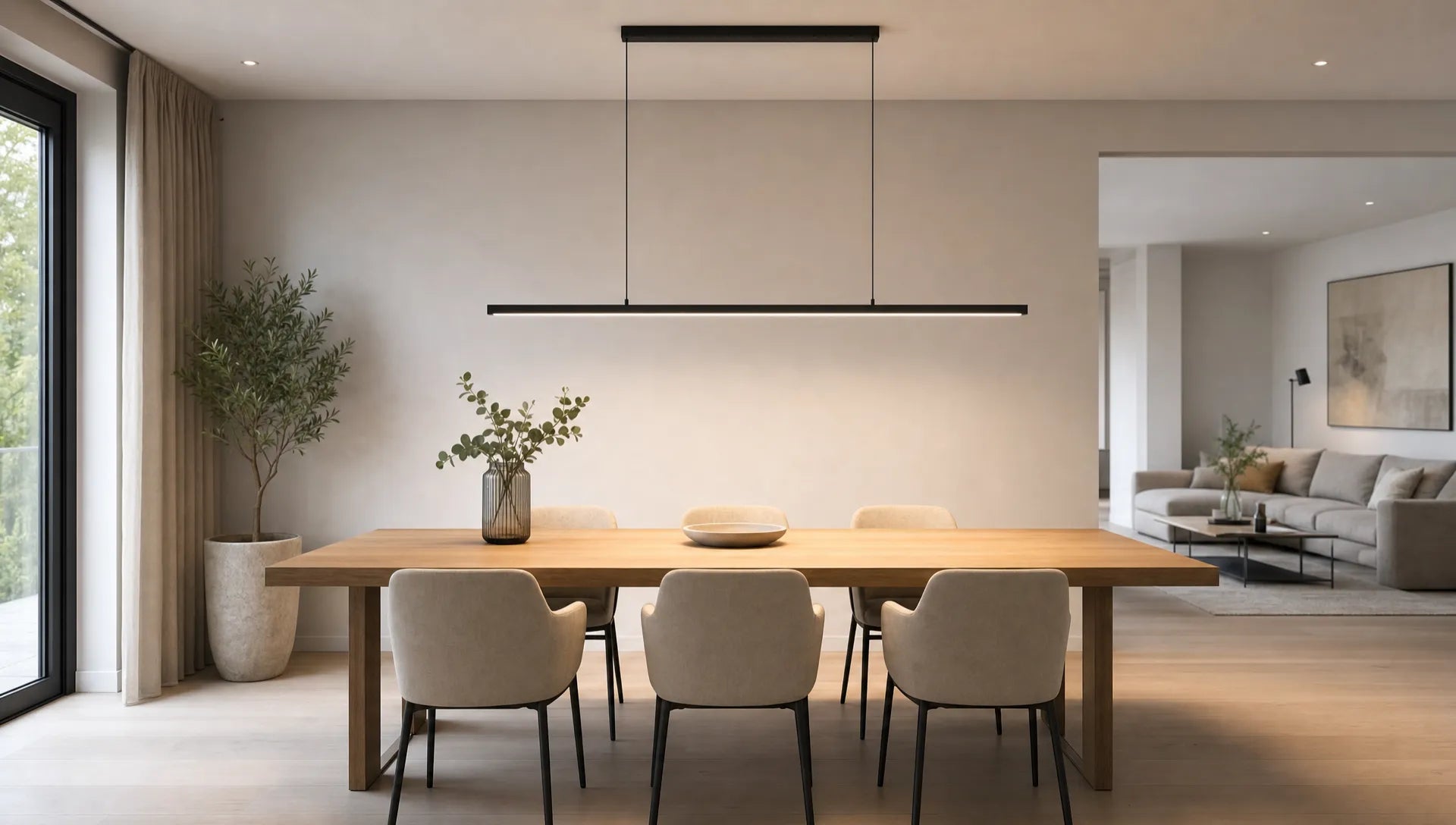
Round shapes usually have a soft and balancing effect. Linear lights go well with long tables, hallways or kitchen islands. Square or rectangular lights can appear very calm if they reflect the lines of the architecture. What is important is less the form alone, but rather its relationship to furniture and spatial axes.
The size should also be chosen carefully. A lamp that is too small appears lost and can produce uneven light. A light that is too large can weigh down the room. The lamp can be more prominent above a coffee table or dining table. In bedrooms, hallways and small rooms, restraint is often the better choice.

Materials and colors: visual calm through restraint
Materials not only influence the style, but also the lighting effect. Matte surfaces diffuse reflections more softly. Glass can look elegant, but depending on the design, it creates stronger reflections. Metal in black, brass, nickel or chrome sets accents, but should match the rest of the room concept.
The following work particularly well for quiet rooms:
- Matte white lights if you want them to visually blend with the ceiling
- Warm metal like brushed brass when the room needs more depth
- Black details when clear lines and contrast are desired
- Opal glass or diffuse shades for soft light distribution
- Natural tones when wood, linen or stone dominate the room
A common mistake is to find each light individually attractive, but forget about the overall effect. When ceiling lamps, floor lamps, pendant lamps and wall lamps have different styles, colors and levels of gloss, visual unrest arises. A recurring line is better, such as the same metal color, similar curves or a uniform light color.
Room by room: which modern LED ceiling light is right?
Not every room needs the same type of ceiling light. A calm selection is based on usage, lines of sight and the desired mood.
| space | Matching lamp type | What to pay attention to? |
|---|---|---|
| Living room | Flat LED ceiling light, indirect ceiling light or subtle design light | Dimmable, warm white, combine with floor or table lamps |
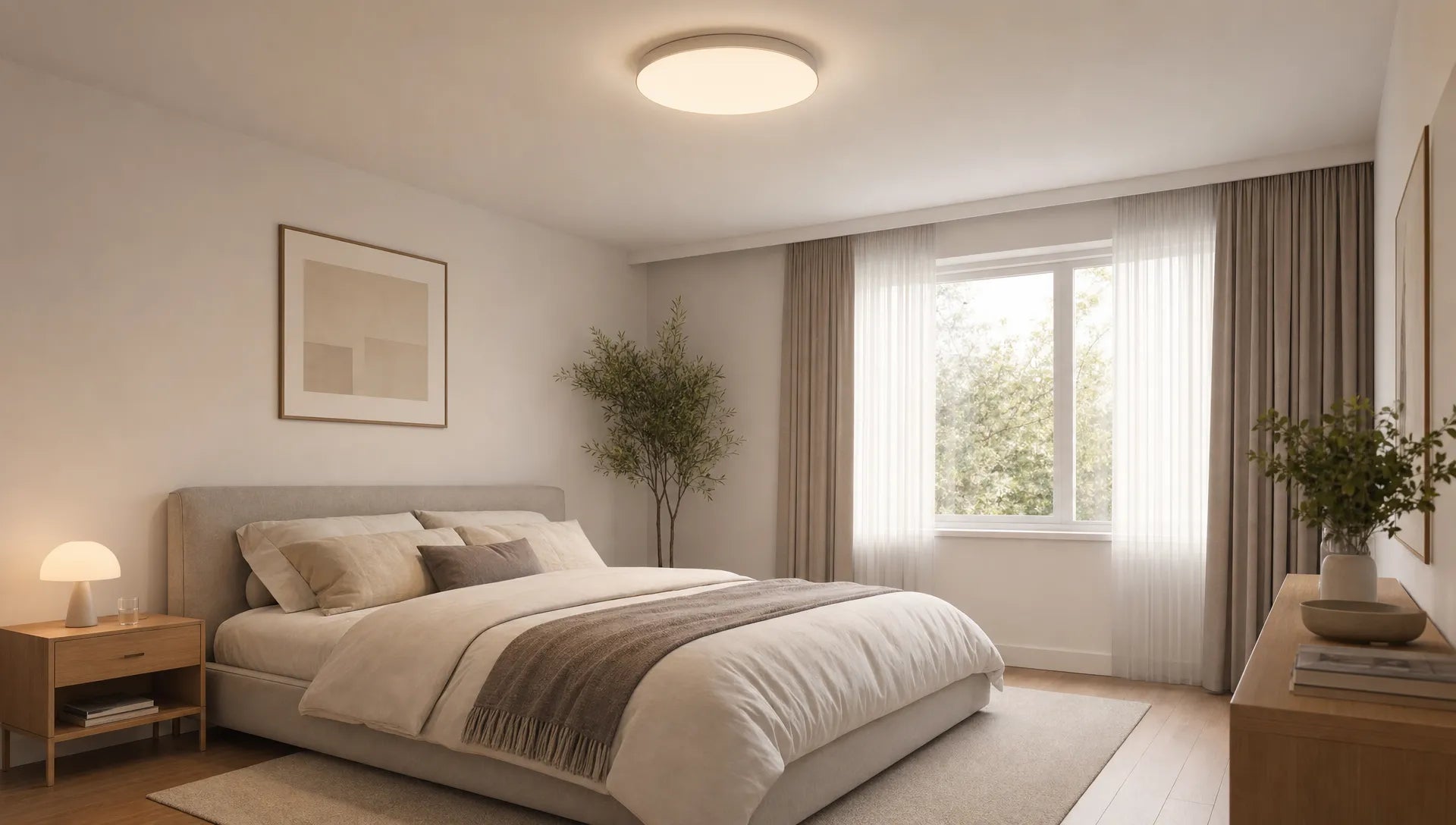
| bedroom | Very low-glare, warm basic light | No visible LED dots from bed, low brightness in the evening |
| Dining room | Ceiling light or pendant light above the table | Good color rendering, warm light color, appropriate height above the table surface |
| hallway | Uniform LED ceiling light or several small lights | No dark transitions, clear orientation, calm design |
| Kitchen | Bright basic light with separate work light | Neutral-warm, sufficient lumens, no shadows on work surfaces |
| bathroom | LED ceiling light suitable for wet rooms | Appropriate protection type depending on the zone, add low-glare light to the mirror |
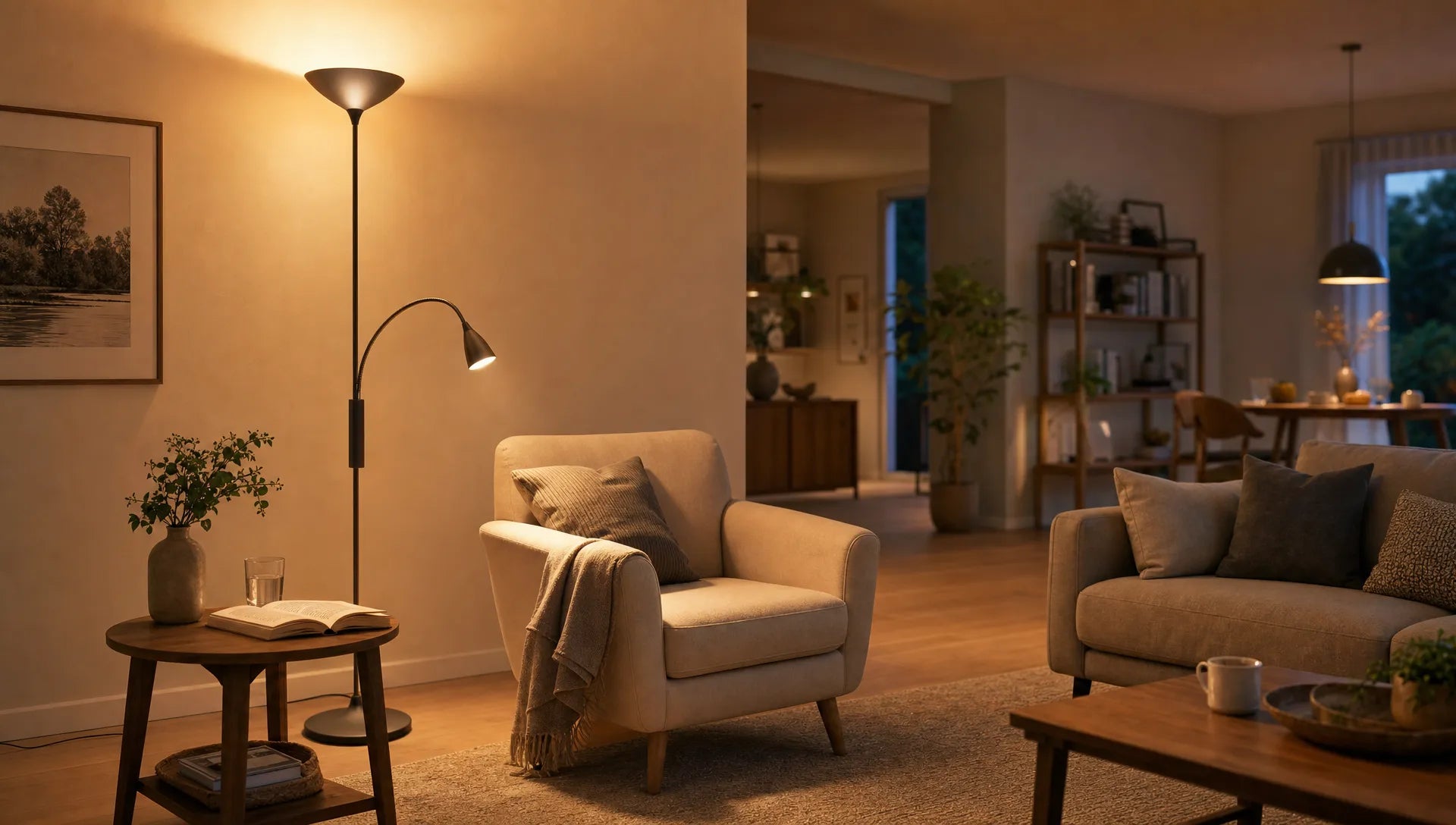
In the living room, the ceiling light should rarely be the only source of light. A quiet room thrives on layers of light: basic light from above, soft light at eye level and individual accents. In the bedroom, the most important thing is that the light does not glare from the bed. In the hallway, uniformity is more important than decorative effect.
Dimming and Control: Peace comes from adaptability
A modern LED ceiling light should be able to adapt to the course of the day. In the morning you may need clear light to get dressed or tidy up. In the evening, the same room is intended to relax. Without dimming there is only a compromise.
When purchasing, pay attention to whether the light is dimmable and what type of dimmer is required. Not every LED works with every existing wall dimmer. If the dimmer and light are not compatible, flickering, humming or uneven dimming behavior may occur. For high-quality living spaces, it is worth clarifying this technical question before installation.
Smart home control can be practical, but it is not a must. For quiet rooms, it is more important that operation remains simple. Three well-chosen settings are often enough: bright everyday light, dimmed evening light and very soft orientation light. Too many scenes and color changes can even disrupt the desired peace and quiet.
Modern LED ceiling light: practical purchase checklist
Before you decide on a model, a quick check will help. In this way you avoid a situation where a lamp looks beautiful but does not achieve the desired effect in the room.
- Does the light color match the use of the room and the materials?
- Is the brightness sufficient but dimmable?
- Are LED points or light sources directly visible?
- Does the shape look harmonious in relation to the size of the room, furniture and ceiling height?
- Does the luminaire have good color rendering, ideally CRI 90 or higher for demanding living areas?
- Is the mounting height appropriate, especially for pendant or chandelier shapes?
- Do the color and material harmonize with other lights in the room?
- Are dimmers, smart home systems or switches compatible with the light?
- Is the protection class suitable for bathrooms or other wet rooms?
These questions are especially helpful when buying online. Product images show the shape, but not always the actual spatial effect. Therefore, check the technical specifications, dimensions and lighting information just as carefully as the design.
Typical mistakes that make rooms appear restless
Many lighting errors are not caused by bad products, but by an inappropriate selection. The table below shows common problems and better alternatives.
| Error | Effect | Better solution |
|---|---|---|
| The light color in the living room is too cold | The room appears matter-of-fact or uncomfortable | Select 2700 to 3000 K |
| Visible LED dots | Glare and technical optics | Use diffuser, indirect light or shielded LEDs |
| Just a central light source | Flat space without depth | Combine ceiling light with accent and mood lighting |
| Lamp too small | Unbalanced proportion and uneven light | Adjust dimensions to suit room size and furniture axes |
| No dimmer | Light is often too bright or too dark | Choose a dimmable model with a suitable control |
| Shiny lamp in reflective room | Lots of light reflections, visual unrest | Prefer matt or satin surfaces |
Consistency is particularly important in open floor plans. If the kitchen, dining area and living room merge into one another, the light color and design language should match. This does not mean that all lights have to be identical. But they should appear related to each other.
Correctly classify energy efficiency and quality
LED lights are generally more efficient than many older light sources, but not every LED light is automatically of the same quality. In addition to watts and lumens, also pay attention to lifespan information, dimming behavior, color rendering and workmanship. Since the change in EU energy labels, light sources are again rated on an A to G scale. The European Commission explains energy labeling for light sources and helps to better classify efficiency information.
However, maximum efficiency is not the only thing that counts for quiet rooms. An extremely bright, cool and dazzling light can be technically economical and still not contribute to the quality of living. The best choice combines efficient LED technology with pleasant lighting, good color rendering and long-lasting design.
Why adjustment makes so much difference when it comes to ceiling lights
Quiet rooms thrive on precision. Just a few centimeters can decide whether a lamp looks elegant or distracts. This is particularly true with high ceilings, sloping ceilings, open living areas or dining tables that are not exactly in the middle of the power outlet.
This is where individual customization is a real advantage. At BUYnBLUE Chandeliers and pendant lights can be adjusted free of charge, for example in terms of cable length, canopy or color. This means that a luminaire can be better coordinated with the ceiling height, room layout and furnishings. If you are looking for a suitable solution, you can find it at BUYnBLUE modern lights for different living areas, with curated selection, free worldwide shipping and 14-day return policy.
Especially with a modern LED ceiling light for quiet rooms, the goal should not be to choose the most eye-catching eye-catcher. It is better to have a lamp that feels natural, structures the room and remains pleasant in everyday life.
Frequently asked questions
Which light color is best for a quiet LED ceiling light? For living rooms and bedrooms, 2700 to 3000 K is usually ideal. 2700 K looks particularly warm and cozy, 3000 K looks a little clearer and more modern. A more neutral light color can be useful for work areas.
How bright should a modern LED ceiling light be? This depends on the size of the room, wall colors and usage. Living rooms are often around 100 to 200 lm/m², bedrooms are more like 100 to 150 lm/m². More importantly, the light is dimmable and low-glare.
Does an LED ceiling light make sense in the bedroom? Yes, if it is warm white, dimmable and very low-glare. Be careful not to look directly at bright LED points from your bed. A diffuse umbrella or indirect light is particularly pleasant here.
Which is better for quiet rooms: flat ceiling light or pendant light? With low ceilings, flat ceiling lights usually appear quieter. In high rooms or above dining tables, a pendant light can be very harmonious if the height, size and light distribution are right.
How do I recognize a glare-free LED ceiling light? Pay attention to opal diffusers, indirect light components, shielded LEDs and matt surfaces. Product images with visible LED dots or very small, intense light sources may indicate increased glare.
Should I only use a central ceiling light for quiet rooms? Mostly not. A central light provides basic light, but real peace often comes from multiple layers of light. Complement the ceiling light with table lamps, floor lamps or wall lights in a similar light color.
Conclusion: The best lamp appears calm before it attracts attention
A modern LED ceiling light for quiet rooms is more than just a beautiful object. It is part of the architecture, the furnishings and the daily mood. When light color, brightness, lack of glare, color rendering, proportion and material match, a room is created that appears clear, warm and relaxed.
Therefore, take your time when making your selection. Check not only the design, but also technical details and customization options. A well-chosen ceiling light will remain pleasant for years because it doesn't have to be loud to radiate quality.