Choose a pendant light for the living room to match the seating area
A pendant light in the living room is more than just a light source. If chosen correctly, it frames the seating area, creates a cozy island of light and combines the sofa, coffee table, carpet and armchair into a harmonious centerpiece. If chosen incorrectly, it hangs in the field of vision, dazzles when you relax or appears too small in relation to the furnishings.
The most important change in perspective is: Don't choose the lamp based on the center of the room, but rather based on the seating area. Because in the living room you rarely sit exactly under the geometric center of the room. What matters is where people read, talk, watch TV, relax and where the coffee table or carpet defines the living area.
Why the seating area is the best starting point
Many living rooms have multiple zones: TV wall, sofa, reading chair, open dining area, perhaps a fireplace or a large window. A pendant light should therefore not just sit “somewhere on the ceiling”, but rather fulfill a specific function. Above the seating area, it marks the social center of the room.
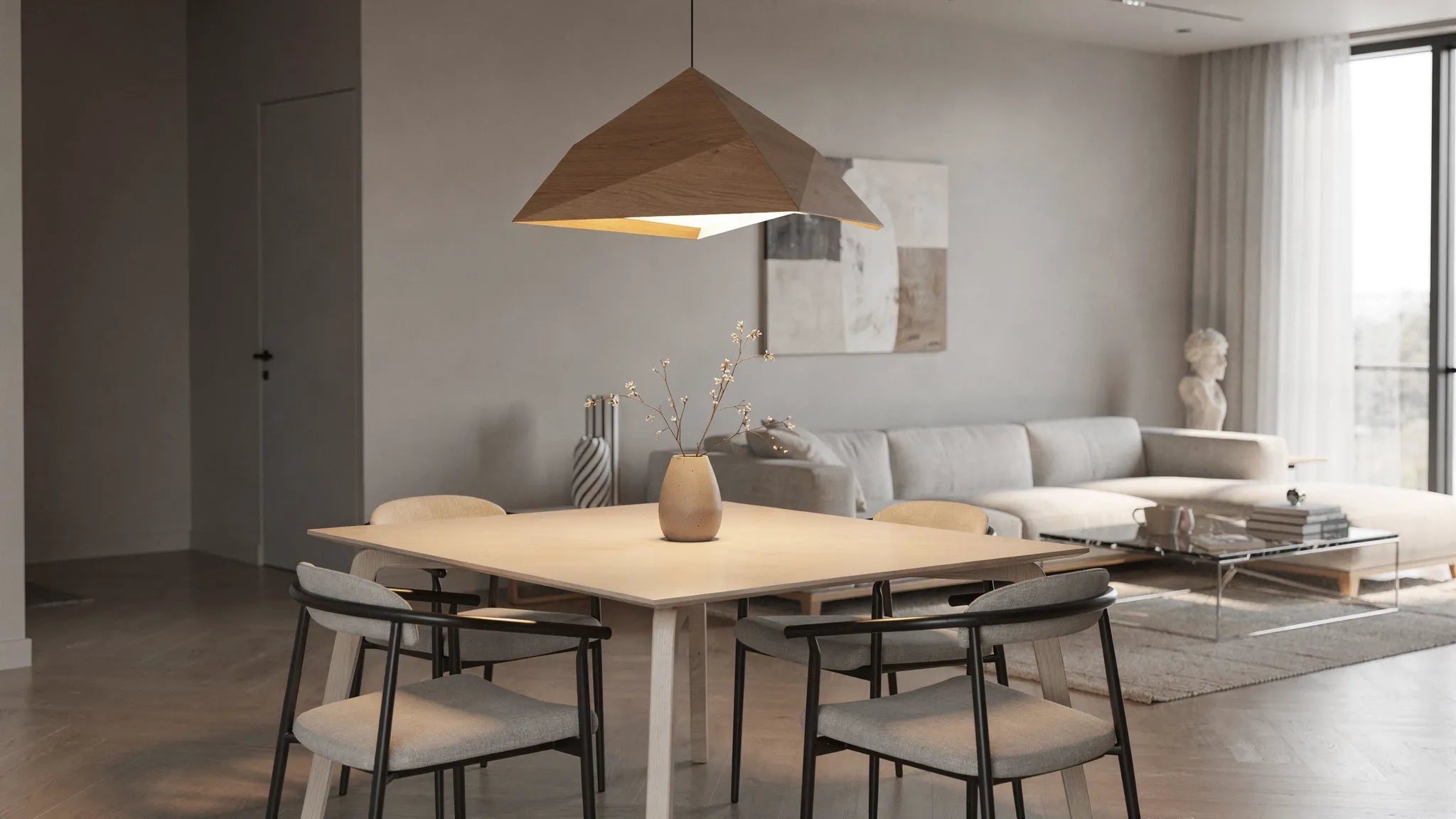
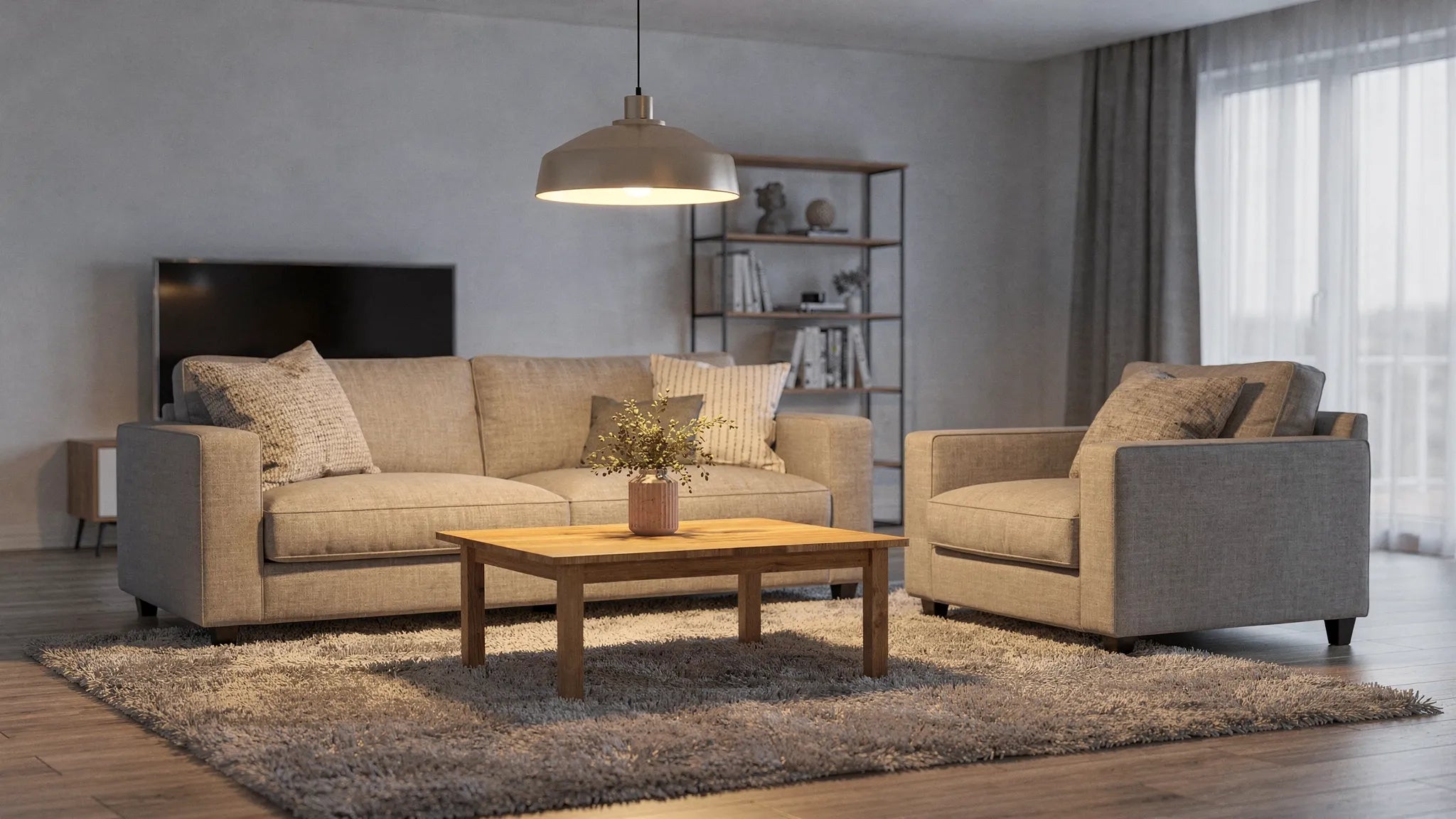
This works particularly well when the sofa, coffee table and lamp visually form a unit. The pendant light does not always have to hang exactly above the coffee table, but it should clearly relate to the seating area. With a symmetrical sofa landscape, a central placement is often ideal. In the case of a corner sofa or an open living area, the lamp can deliberately be hung slightly offset if this makes the entire area appear more balanced.
A good pendant light usually fulfills three tasks in the living room at the same time: It provides warm basic or zone light, makes a decorative statement and helps to structure the seating area in the room. This can make a big difference, especially in open floor plans, because light visibly brings groups of furniture together.

Measure the seating area: You need these dimensions before purchasing
Before you choose a pendant light for the living room, it's worth taking a quick look at the proportions. You don't have to create a professional lighting plan, but a few dimensions prevent typical bad purchases.
First measure the width of your seating area. This includes not only the sofa, but also armchairs, poufs and side tables, provided they belong to the living area. Then measure the coffee table or the central area of the rug. This area often shows best where the light should work.
The ceiling height is also important. In old buildings with high ceilings, the light can be voluminous and hang lower. In new buildings with ceiling heights of around 2.40 to 2.60 m, slimmer pendant lights, flatter shades or transparent materials are needed so that the room does not appear cramped.
You should note these measurements:
- Width and depth of the entire seating area
- Length, width and height of the coffee table
- Ceiling height and position of existing electrical outlet
- Distance between sofa, coffee table, TV and walkways
- Line of sight from a sitting position, especially to the television, window or fireplace
The last point is often underestimated. A lamp can be perfectly beautiful and still be annoying if it hangs exactly in the line of sight between the sofa and the TV. Therefore, test the planned position with a tape measure or a piece of string from the ceiling.
The right position: Above the coffee table, in the middle of the sofa or in the middle of the seating area?
When it comes to positioning, there is no one rule for every living room. What matters is which center in the room really counts. This can be the center of the coffee table, the center of the rug or the visual center of the entire seating area.
If there is a coffee table, it is usually the best reference point. The pendant light can then hang above the table because no one is constantly standing or walking there. This allows for a deeper, more comfortable placement and turns the lamp into a decorative centerpiece.
With large corner sofas, the pure center of the coffee table is sometimes too far out. Then placing it above the middle of the carpet or slightly towards the corner of the sofa looks more harmonious. If there are two sofas facing each other, the lamp should hang in the axis between both seats, not above a single sofa.
| Living room situation | Recommended position | What you should pay attention to |
|---|---|---|
| Sofa with coffee table | Above the coffee table or slightly offset to the center of the sofa | Check the view of the TV, avoid glare |
| Corner sofa | Above the middle of the carpet or seating area | Don't pull too hard into the corner |
| Two sofas opposite | In the middle between the sofas | Use the light as a connecting center |
| Living landscape with several elements | Above the main zone, often above the largest coffee table | Choose a larger or multi-bulb light |
| Small living room | Above the coffee table, as compact as possible | Prefer transparent, bright or open umbrellas |
| Open living-dining area | Clearly above the seating area, separated from the dining area light | Coordinate both lights stylistically |
If the ceiling outlet is not in the ideal location, that is no reason to abandon all planning. Depending on the room, longer cable routing, a decentralized suspension or an adapted ceiling rose can help. At BUYnBLUE Pendant lights and chandeliers can be adjusted free of charge, for example in terms of cable length, canopy or color. This is particularly practical if the seating area is not located under the existing connection.
Choose the size and shape to suit the seating area
The most common uncertainty is: How big can a pendant light be in the living room? The answer depends less on the size of the room alone and more on the size of the seating area. A small lamp above a large living area seems lost. An oversized lamp above a compact sofa can visually overwhelm the room.
As a guide, the light should be visible enough to define the seating area, but not so dominant that it competes with the sofa, art, carpet or TV wall. Round or organic pendant lights work particularly well with round coffee tables. For elongated coffee tables or straight sofas, linear pendant lights, oval shapes or several small pendants can be more harmonious.
| Seating group | Matching lamp shape | Rough size orientation |
|---|---|---|
| 2-seater with small coffee table | Single pendulum, small glass ball, slim shade | approx. 30 to 45 cm in diameter |
| 3-seater with rectangular table | Round pendant, oval shade, short linear lamp | approx. 50 to 70 cm or 70 to 110 cm in length |
| Corner sofa | Cluster lamp, asymmetrical pendant group, large round shade | approx. 60 to 90 cm total effect |
| Large living area | Multi-flame pendant light, chandelier, sculptural statement | approx. 80 to 120 cm, depending on the ceiling height |
| Small seating area | Mini pendant, subtle opal glass lamp, slim shape | approx. 20 to 35 cm |
These values are not rigid regulations. A delicate chandelier can be larger than a solid metal shade without appearing heavy. Transparent glass lights can often be a little more voluminous because they leave lines of sight open. Dark, closed lights, on the other hand, have a stronger effect and should be proportioned more consciously.
The right hanging height in the living room
There are clear habits when it comes to pendant lights above dining tables, but in the living room the situation is more sensitive. Here people sit lower, look to the side or forward more often and move around the sofa area. The light must not dazzle, hang in the way or block the view.
A good rule of thumb: headroom is needed where people walk under the light. Where the lamp hangs above a coffee table and there is no walkway underneath, it can hang lower. At the same time, it should not interfere with eye level from a sitting position.
| placement | Sensible hanging height | Practical tip |
|---|---|---|
| Above a coffee table without a walkway | Lower edge often approx. 140 to 170 cm above the ground | When looking at the TV, hang higher or choose a transparent screen |
| Above seating area with passage | Lower edge at least approx. 200 cm above the ground | For tall people it is better to plan for 210 cm or more |
| Low ceiling under 2.40 m | Very short suspension or flat pendulum shape | Avoid bulky lights |
| High ceiling from approx. 2.80 m | Longer suspension, cluster or vertical luminaire | Luminaires can make the room downstairs more comfortable |
| Next to sofa over side table | Deeper possible, but not directly in the eye | Choose a shade with a diffuser or side-shielded light |
A simple test helps: Sit on all of the main seats in the seating area and check the planned lower edge with a piece of string. If you automatically tilt your head or would like to avoid it, the pendant light is hanging too low or too present.
Light quality: Warm, glare-free and dimmable
A pendant light above the seating area should create coziness. That's why light quality is more important than maximum brightness. Warm white light colors between around 2700 and 3000 Kelvin are usually pleasant in the living room. 2700 K looks particularly homely and soft, 3000 K looks a little clearer and more modern.
Dimming almost always makes sense for relaxed evenings. The light can be brighter during the day or when tidying up, but a dimmed, warm light is sufficient for a movie night or conversation. If you want to learn more about LED values such as lumens, Kelvin and dimmability, see the BUYnBLUE-Guide Buy an LED lamp: This is how you find the right model a technical but practical explanation.
When it comes to brightness, it depends on whether the pendant light forms the main lighting or just supplements an island of light. For a cozy living room, a combination of several light sources is often better than a very bright ceiling light. A pendant light above the seating area can be supplemented with floor lamps, table lamps, wall lights or indirect light, for example. You can find more ideas about this in the article above indirect lighting in the living room.
Also ensure there is no glare. Open lamps can look decorative, but they can quickly become unpleasant above a seating area if they shine directly into the eye. Opal glass, fabric shades, diffusers or lights that are shielded upwards and downwards distribute the light more softly. Models that slightly emphasize the coffee table and at the same time release some scattered light into the room are particularly pleasant.
Which pendant light goes with which sofa?
The seating area not only dictates the size, but also the style. A deep, soft sofa often requires a different light fixture than a straight-lined leather sofa or a minimalist modular sofa. The goal is not to choose everything in the same material. A conscious dialogue between form, color and surface is usually more exciting.
A light fabric sofa harmonizes well with warm metals, opal glass, wooden details or soft textile shades. A dark leather sofa can tolerate stronger contrasts, such as black, smoked glass or brushed metal. Round lights go well with very angular sofas because they balance out the severity. Geometric pendant lights can provide structure for organically curved seating furniture.
| Sofa or interior style | Matching pendant lights | Effect |
|---|---|---|
| Scandinavian bright | Opal glass, wood, matt white and beige tones | Quiet, friendly, easy |
| Modern minimalist | Linear LED pendants, clear metal shapes, black or chrome | Precise, tidy, architectural |
| Japandi | Paper-like diffusers, natural tones, reduced shapes | Warm, calm, natural |
| Industrial | Metal, smoked glass, visible structure | Striking, urban, full of character |
| Classically elegant | Multi-flame pendant light, discreet chandelier, brass or glass | Valuable, homely, representative |
| Glamorous | Gold, polished metal, crystal or glass details | Luxurious, decorative, eye-catching |
If there are already a lot of materials in the room, the pendant light should be more calming. If the sofa, carpet and walls are very simple, the lamp can be the statement. Particularly in 2026, sculptural lights, opal glass bodies, warm metal tones and customized pendant lights remain strong because they combine function and personality.
Pendant light alone or as part of a lighting concept?
Even the most beautiful pendant light should rarely work alone in the living room. A single point of light from above quickly creates harsh shadows and makes corners appear dark. A lighting concept with several levels is much more homely.
The pendant light takes on the role of the visual center. In addition, floor or arc lamps provide reading areas, table lamps create soft islands of light, and wall lights or LED strips provide depth. This creates a room that is bright enough when needed, but remains cozy in the evenings.
If the pendant light is very decorative, it can also be deliberately made less bright. Then other lights provide the functional brightness. If, on the other hand, it is the main light source, you should pay attention to sufficient lumens, good light distribution and dimmability. For a more precise calculation it is worth it BUYnBLUE-Guide LED lighting: This is how you calculate lumens per m² correctly.
Common mistakes with pendant lights above the seating area
Many problems arise not from the design of the lamp, but from incorrect proportions or placement. It is particularly common for a pendant light to be chosen too small because it appears larger in the shop or in product pictures than in the real living room.
Another mistake is to orientate yourself towards the ceiling outlet instead of the seating area. If the connection is not ideal, the light quickly appears randomly placed. Modern adjustments to cable length and canopy can help to align the luminaire visually correctly.
Also avoid light that is too cold. A technically bright but cool pendant light can make the living room uncomfortable. Warm, dimmable lighting solutions are almost always the better choice for living areas.
Typical errors at a glance:
- The lamp hangs in the middle of the room, but not in the middle of the seating area.
- The bottom edge is exactly in the line of sight to the television.
- The shade blinds from a sitting position.
- The lamp is too small for the sofa, carpet and coffee table.
- The light color is too cool or cannot be dimmed.
- The pendant light should alone illuminate the entire room.
If you are unsure, take a photo of your seating area from multiple angles before purchasing. Then mark digitally or with tape on the floor where the light should hang. This simple step often shows immediately whether the position and size are correct.
Mini pre-purchase checklist
Shortly before making a decision, you should summarize the most important points again. A pendant light for the living room is ideal if it visually matches the seating area, technically offers the desired lighting effect and can be practically integrated into your room.
Before purchasing, check:
- Does the lamp fit the width of the sofa, coffee table and carpet?
- Is the hanging height comfortable for seated people and walking paths?
- Is there a clear view of the television, window or fireplace?
- Is the light warm white and, if possible, dimmable?
- Do the shade, diffuser or orientation prevent direct glare?
- Do the material and color harmonize with the sofa, table, carpet and existing lights?
- Can the cable length or ceiling rose be adjusted if necessary?
The last point in particular is crucial for high-quality pendant lights. A lamp can have a perfect design, but only really look professional if it is suspended appropriately.
Frequently asked questions about pendant lights in the living room
How big should a pendant light be in the living room? The size should be based on the seating area, not just the size of the room. For small sofas, a diameter of 30 to 45 cm is often sufficient; larger living areas can tolerate 80 cm or more, especially in delicate or multi-flame designs.
How high do you hang a pendant light above the coffee table? If no one is walking under it, the bottom edge can often be around 140 to 170 cm above the ground. If you are facing the TV or have low ceilings, the light should hang higher or appear particularly transparent.
Can a pendant light hang directly above the sofa? It is possible, but usually a position above the coffee table or the middle of the seating area is more comfortable. The lamp should hang high enough directly above your head and be glare-free.
What color light is best in the living room? For living and seating areas, 2700 to 3000 Kelvin is usually ideal. 2700 K seems very comfortable, 3000 K seems a little clearer and more modern. Colder light colors are more suitable for work areas than for the sofa zone.
What to do if the power outlet is not above the seating area? Then a decentralized suspension, suitable cable routing or an individually adapted ceiling rose can help. At BUYnBLUE Many pendant lights and chandeliers can be adjusted free of charge, for example in terms of cable length, canopy or color.
Is a pendant light sufficient as living room lighting? Sometimes for small rooms, but usually not for a homely lighting concept. A combination of pendant light is better, Floor lamps, Table lamp, wall lamps or indirect light.
Find a pendant light that matches the seating area
The perfect pendant light for the living room is created from the interplay of proportion, position, light quality and style. If it is based on the sofa, coffee table and carpet, the seating area automatically appears more organized, of higher quality and more inviting.
At BUYnBLUE You will find a curated selection of modern designer lights made from high-quality materials. Particularly helpful for living rooms with special room dimensions: pendant lights and chandeliers can be adjusted free of charge, for example in terms of cable length, ceiling rose or color. Plus free worldwide shipping, 14-day return policy, secure payment options, real-time order tracking and 24/7 customer service.
This turns a beautiful lamp into a solution that really fits your seating area, your room and your everyday life.