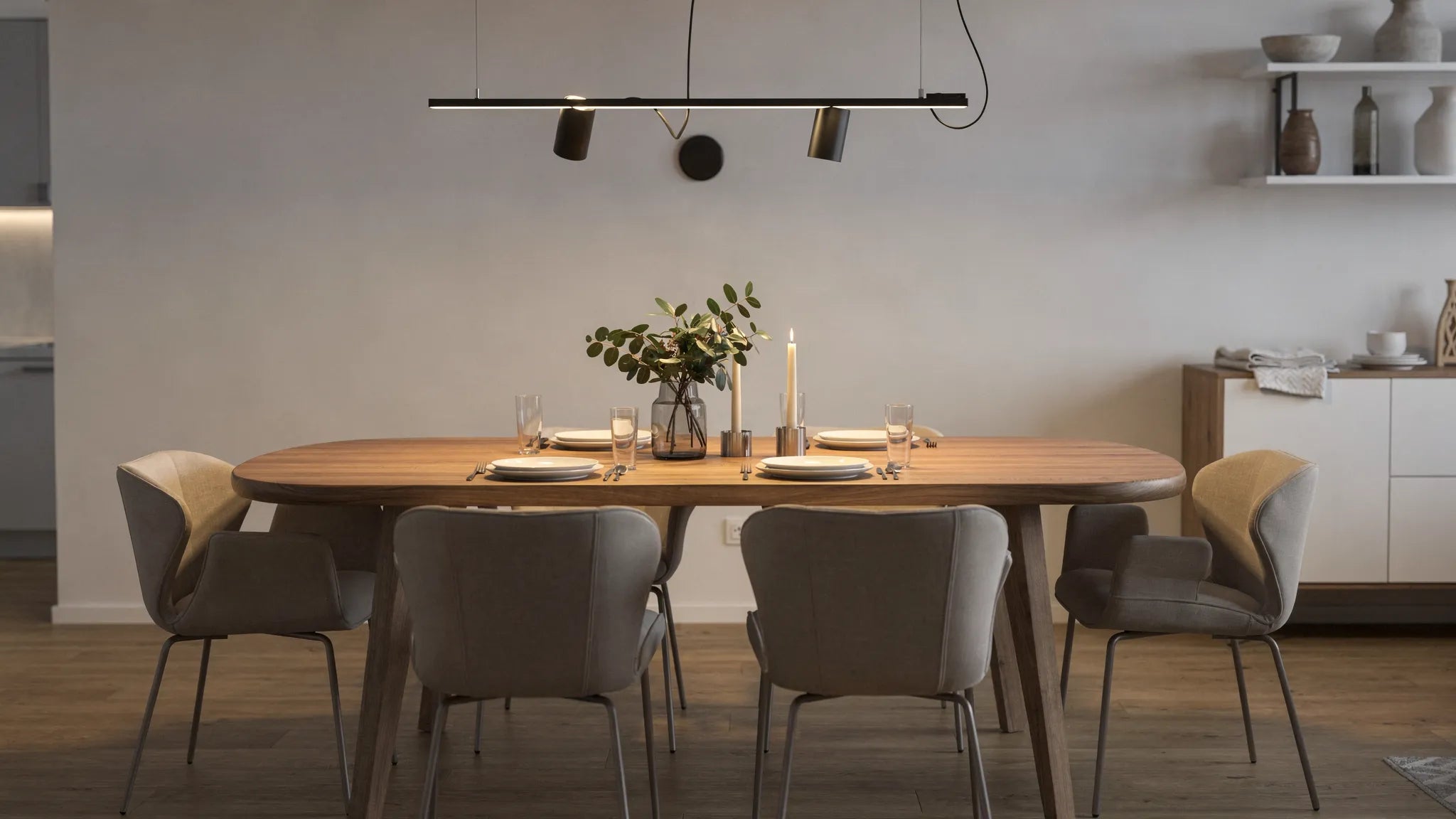
Choose and hang the hanging light correctly at the dining table
The dining table is rarely just a place to eat. Here we discuss, work, play, celebrate and sometimes sit until late into the evening. That's exactly why the hanging light above the dining table has to do more than just look good: it should illuminate the table pleasantly, make faces appear natural, not dazzle and at the same time fit the style of the room.
Whoever chooses a hanging light for the dining table decides on atmosphere, comfort and proportions. The good news: With a few clear rules of thumb, most bad purchases can be avoided.
Dining table hanging light: first clarify usage, then choose model
Before you fall in love with a design, it's worth taking a look at everyday life. A dining table in an open-plan kitchen-living room often needs brighter, more flexible light than a separate dining area that is used primarily in the evening. Families with children benefit from dimmable lights because the table can also be used for homework or craft projects during the day. Anyone who frequently receives guests should pay more attention to glare-free light distribution and a warm lighting atmosphere.
The most important question is: Should the lamp have a primarily decorative effect, provide functional illumination or combine both? In modern interiors, the combination is usually ideal. A high-quality pendant light becomes a visual focal point without dominating the room.
| Table shape | Matching hanging light | Rule of thumb for size | Effect |
|---|---|---|---|
| Rectangular table | Linear pendant light, bar light or multiple pendants | Light about 1/2 to 2/3 of the table length | Quiet, balanced, architectural |
| Round table | Single pendant, round chandelier or small cluster | Diameter about 1/2 to 2/3 of the table diameter | Harmonious, sociable, centered |
| Oval table | Elongated, organic or multi-bulb lamp | Orient the length on the main axis of the table | Soft, elegant, flowing |
| Extendable table | Adjustable or multi-part solution | Plan for the most commonly used table size | Flexible, suitable for everyday use |
A lamp that is too small will look lost over a large dining table. A lamp that is too large can visually overwhelm the table and block the view across the room. Particularly in open floor plans, the hanging light should clearly define the dining area, but not stand out like a foreign body in the overall picture.
The right size: Proportions determine elegance
A simple look at the edge of the table helps when choosing the size. The lamp should generally remain well within the surface of the table. This means it appears deliberately placed and no one bumps into the lamp body when getting up or serving.
Linear lights work particularly well for rectangular tables because they reflect the shape of the table. For a 180 cm long table, a lamp that is around 90 to 120 cm long usually looks harmonious. For a 220 cm long table, the lamp can be correspondingly larger or consist of several pendants.
For round tables, a centered single pendulum is often the strongest solution. A cluster of several small pendulums can also work well when the group is read as a unit. It is important that the entire composition does not become too wide and that the shape of the table remains recognizable.
A common planning mistake is to only look at the room and forget about the table. Above the dining table, it is not the center of the room that counts, but the center of the table. If the table is slightly offset, the lamp should also sit above the table.
Hanging height: low enough for atmosphere, high enough for eye contact
The ideal height of a hanging lamp above the dining table is usually around 60 to 75 cm between the table top and the lower edge of the lamp. This area ensures that the table is clearly illuminated without the light blocking the view of those sitting opposite.
The exact height depends on the shape of the lamp, body size, ceiling height and light distribution. A transparent glass lamp can hang a little lower because it blocks the view less. A massive, dark or very wide light often looks better if it is positioned a little higher.
| situation | Recommended orientation | Why it works |
|---|---|---|
| Standard dining area | 60 to 75 cm above the table top | Good balance of light, proximity and visibility |
| Open or transparent light | more like 60 to 70 cm | Looks cozy without being visually heavy |
| Solid or opaque light | more like 70 to 80 cm | Avoids an overly dominant effect |
| High ceiling | Longer suspension instead of mounting close to the ceiling | The dining area appears more homely and clearly zoned |
| Very low ceiling | flat lamp body and careful height test | Prevents optical narrowness |
Before final assembly, do a simple seat test. Hold the lamp or a cardboard template above the table at the planned height and sit in different places. If the light disrupts eye contact, creates too much glare, or appears too heavy in the room, correct the height before installation.

Positioning: the lamp belongs to the table zone, not to the center of the ceiling
Many dining areas appear restless because the ceiling outlet is in the middle of the room, but the table has been moved for practical reasons. The result: The lamp hangs next to the table, the beam of light doesn't hit the right spot and the whole interior appears random.
Therefore, always plan from the furniture. First determine the final table position, then the center of the table top and only then the light point. In new buildings or renovations, the ceiling outlet should be set accordingly. In existing rooms, an offset canopy, a rail solution or a professionally planned cable redirection can help.
At BUYnBLUE What is particularly practical is that many chandeliers and pendant lights can be adjusted free of charge. Cable length, ceiling canopy or color can be tailored to the room. This is a big advantage, especially with high ceilings, unusual floor plans or off-center ceiling outlets.
Light quality: warm, dimmable and colorfast
The dining table is not just about brightness. The light should make food appear appetizing, present skin tones in a pleasant way and emphasize the table decoration. Light that is too cold can quickly make the dining area look objective or uncomfortable. Light that is too dim is inconvenient when eating, reading or working.
For most dining areas, warm white light between 2,700 and 3,000 Kelvin is ideal. If the dining table is also used as a workplace, a lamp with an adjustable color temperature can be useful. Warm light seems more pleasant in the evening, but during the day it can be a little more neutral.
| criterion | Recommendation for the dining table | What you should pay attention to |
|---|---|---|
| color temperature | 2,700 to 3,000 K | Warm white for cozy meals and long evenings |
| brightness | often around 1,500 to 3,000 lumens depending on the table size | It's better to plan for dimmability than to be permanently too bright or too dark |
| Color rendering | if possible CRI 90 or higher | Food, wood, textiles and skin tones appear more natural |
| Dimmability | highly recommended | One lamp can cover everyday life, dinner and celebrations |
| Light distribution | directly downwards, preferably with a soft spread | The table is emphasized, the room remains pleasant |
Lumen values are always just a guide because the beam angle, shade material and room colors have a big influence. A dark dining table, matt walls and a closed lampshade require more light output than bright surfaces and a diffuse glass pendant.
Dimmable LED lights are particularly convenient. They save energy, offer modern design freedom and can be adapted to different situations. For a quiet dinner, reduced brightness is often sufficient. The light can be much stronger for game nights, birthday parties or working at the table.
Avoid glare: the underestimated comfort factor
A beautiful pendant lamp quickly loses its appeal if it dazzles you when you sit there. Glare is often caused by visible lamps, shiny reflectors, LEDs that are too bright or a suspension that is too low. Particularly clear glass balls with a visible light source can look beautiful, but require a well-matched light source.
Look for opal diffusers, low-lying light sources, or shades that direct light downward. Matt surfaces also help to reduce harsh reflections. If there are shiny table tops, glass surfaces or polished stone, the lamp should be tested particularly carefully because reflected glare is more noticeable.
A good test: Sit at the table and look at the person opposite in a normal conversation position. If the light source falls directly into the eye, the lamp should be hung higher, dimmed or combined with another light source.
Design: the hanging light as a space anchor
A hanging light above the dining table is often the strongest design element in the dining area. It combines furniture, materials and colors to create an overall picture. That's why it shouldn't be selected in isolation, but rather in dialogue with the table, chairs, floor, wall color and decoration.
In minimalist rooms, clear lines, glass, black, chrome or brushed metals look particularly elegant. Wood, smoked glass, linen look or softly tinted surfaces work well in warm, natural interiors. For luxurious furnishings, the lamp may be more sculptural, for example with multiple levels, a striking shape or an elegant finish.
Small details on the table also play a role: cutlery, vases, candle holders and even jewelry reflect light. Anyone who has a penchant for reduced, light-inspired design will also find similar aesthetic ideas minimalist jewelry inspired by light and French design, which shows how powerfully shiny accents can shape an overall mood.
The following applies to the choice of lighting: Either repeat an existing material or consciously set a contrast. A black metal frame can refer to chair legs. A gold light fixture can accommodate warm wood and brass tones. An opal glass lamp brings lightness to rooms with massive furniture.
Several pendants or one large lamp?
Whether a single large pendant light or several small pendants are better depends primarily on the shape of the table and the desired effect. A large lamp appears calmer and often more high-quality because it is read as a clear statement. Several pendulums create rhythm and can illuminate longer tables more flexibly.
With multiple pendulums, uniformity is important. The distance between the lights should be chosen so that the beams of light overlap without creating spots or dark zones. Three pendants over a rectangular table are a classic, but two larger lights can also look very elegant.
An odd number often appears more dynamic, an even number more calm and architectural. What is important is not the rule itself, but rather the harmony with table length, room height and furniture.
Step by step: Hang the pendant lamp safely
The installation of a hanging light should be well prepared. This is particularly true for heavy designer lights, high ceilings or if the power connection needs to be relocated. Work on 230 V should only be carried out by people who are qualified to do so. If you are unsure, a qualified electrician is the safest choice.
- Set table position: Set up the dining table the way it will actually be used in everyday life, including chairs and movement areas.
- Mark the center of the lamp: Measure the center of the table and transfer this position to the ceiling.
- Test size visually: Use cardboard, paper or painter's tape to simulate the length and width of the light above the table.
- Determine hanging height: Start with 60 to 75 cm above the tabletop and adjust the height to suit the lamp shape and line of sight.
- Check load capacity: Heavy lights need suitable dowels, hooks or ceiling fasteners that match the type of ceiling.
- Switch off electricity safely: Before any electrical work, the circuit must be switched off and the absence of voltage must be checked.
- Final test: After installation, check brightness, glare, dimming and seating comfort in daylight and in the evening.
If a lamp needs to be individually shortened, extended or combined with another canopy, it is worth clarifying before purchasing. This way you avoid visible compromises on the ceiling.
Special cases: high ceilings, sloping ceilings and displaced connections
Not every dining area has perfect conditions. Old buildings, attic apartments and open kitchen-living rooms in particular often present special challenges. The appropriate solution depends on whether the problem is visual, electrical or structural.
| Challenge | Sensible solution | Note |
|---|---|---|
| High ceiling | longer suspension or multi-level luminaire | Don't install it too close to the ceiling, otherwise it won't be comfortable |
| Low ceiling | flat, light or transparent hanging light | Test line of sight and headroom particularly carefully |
| Sloping roof | suitable sloping ceiling adapter or flexible suspension | Check fastening and alignment in advance |
| Ceiling outlet is incorrectly positioned | offset canopy, rail or professional new placement | Plan cable routes carefully |
| Extendable table | several pendants or elongated lamps | Orientate yourself to the most common table size |
Individualization is particularly valuable in special cases. An adjusted cable length can determine whether a light looks as planned or seems improvised. A suitable canopy can also help to integrate ceiling outlets in a visually clean manner.
Common mistakes when buying a pendant light for the dining table
Many problems arise not from bad lights, but from a lack of planning. These errors are particularly common:
- The lamp is chosen according to the size of the room instead of the size of the table.
- The bottom edge hangs too high, making the dining area appear uncomfortable.
- The light hangs too low and interferes with eye contact or serving.
- The light color is too cold for a homely dining atmosphere.
- A dimmer is missing, although the table is used for various activities.
- The ceiling outlet is accepted although it does not match the table position.
- The lamp is blinding because the shade, diffuser and brightness do not match.
If you check these points before purchasing, you will save on later modifications and get a significantly higher quality result.
Purchase checklist for the right hanging light
Use a short checklist before ordering. It is particularly helpful when several models are possible and the decision is difficult.
| Test question | Good orientation |
|---|---|
| Does the lamp match the shape of the table? | Rectangular to linear, round to central or cluster-shaped |
| Does the lamp stay within the edge of the table? | Yes, at a visually pleasant distance from the edge |
| Is the cable length appropriate? | Adjust to desired height and ceiling height |
| Is the light dimmable? | Almost always recommended for dining areas |
| Does the light color seem cozy? | Warm white between 2,700 and 3,000 K |
| Is glare avoided? | Check diffuser, shade depth and lamps |
| Does the canopy match the ceiling? | Consider shape, color and position |
At BUYnBLUE You will find a curated selection of modern designer lights for different living areas. The free adjustment of the length, canopy and color is particularly helpful for dining areas, so that the hanging light not only looks beautiful, but also fits the room exactly.
Care and long-term effects
A hanging light above the dining table is visible every day. Dust, fingerprints and cooking fumes from open kitchens are therefore more noticeable than with many other lights. Glass and metal should be cleaned regularly with a soft, dry or slightly damp cloth. Aggressive cleaning agents can damage surfaces, especially coated or brushed materials.
Also check occasionally whether the lamp is still hanging straight and whether any fasteners have become loose. With height-adjustable systems, it's worth a quick check after a few weeks because cables or suspensions can settle minimally.
A high-quality pendant light remains a design element for years. If it is well chosen in terms of proportions, light quality and material, it can withstand furniture changes much better than a purely trendy purchase.
Frequently asked questions
How high should a pendant light hang above the dining table? A distance of 60 to 75 cm between the table top and the lower edge of the lamp is usually ideal. For massive lights or very tall people, a little more distance may be more comfortable.
How big can a hanging light be above a dining table? For rectangular tables, a lamp that is around 1/2 to 2/3 of the table length often looks harmonious. It is important that it does not protrude beyond the edges of the table.
Which light color is best for the dining table? Warm white light between 2,700 and 3,000 Kelvin is usually ideal for dining areas. It looks cozy and makes food and skin tones appear pleasant.
Do I need a dimmable pendant light at the dining table? Yes, dimmability is highly recommended. The dining table is often used for eating, working, celebrating and playing, which means different brightness levels make sense.
What to do if the ceiling outlet is not located above the table? An offset canopy, a rail solution or professional repositioning of the connection are possible. A qualified electrician should help with electrical changes.
Are several pendant lights better than one large light? Not fundamentally. Multiple pendulums work well for long tables and rhythmic designs. A large light appears calmer and can function as a strong design statement.
Find the right hanging light for your dining table
A good hanging light makes the dining table the center of the home. It's not just design and material that are important, but also size, hanging height, light color, dimmability and neat positioning above the table.
If you are looking for a lamp that fits your room exactly, discover the modern designer lighting from BUYnBLUE. Thanks to free adjustment of cable length, canopy and color, your hanging light can be individually tailored to the ceiling height, table position and furnishing style. Plus free worldwide shipping, secure payment options, real-time order tracking, 14-day return policy and 24/7 customer support.