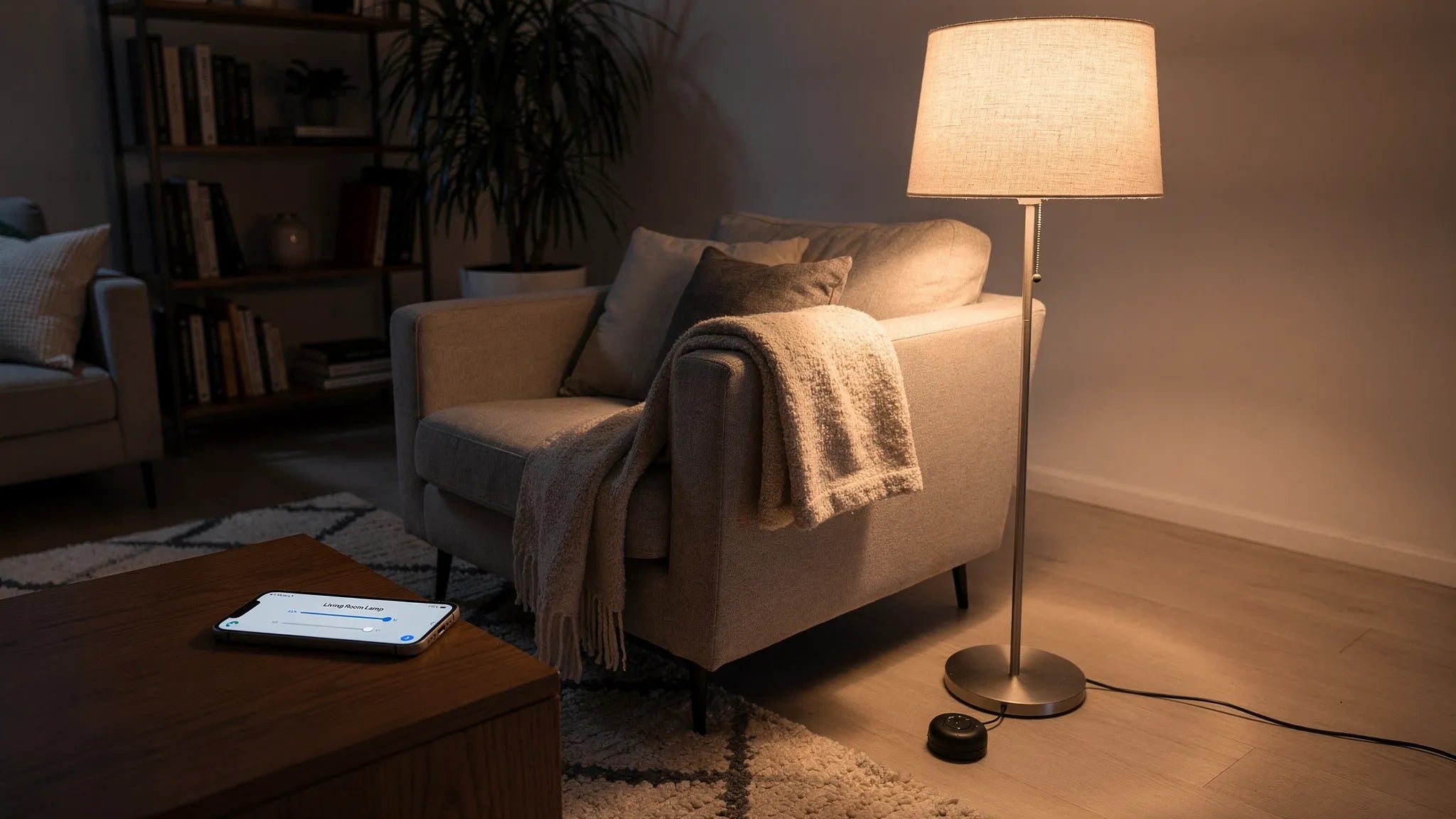
LED lighting: This is how you calculate lumens per m² correctly
Who one Lighting LED plans, sooner or later stumbles upon the same question: How many lumens per m² do I really need so that the room neither appears too dark nor uncomfortably bright? The good news: With a simple calculation you can get very close to the right brightness, and with a few correction factors it becomes really reliable in practice.
In this guide you will learn how Lumens per m² calculate correctly, how to find suitable target values (without guessing), and why many lighting concepts fail even though “enough lumens” have been purchased.
Lumens per m², lux and why both are important
- Lumens (lm) describes how much light a lamp emits in total.
- Lux (lx) describes how much light actually reaches a surface Lumens per m².
The central formula is:
Lumen requirement = lux target value × area (m²)
So if you know what level of illumination (lux) you want in the room, you can do it directly the necessary lumens derive.
Important: Lux is always application-related. When cooking, you need more lux on the worktop than when watching TV on the sofa.

Step 1: Calculate the area correctly (so that the calculation is correct)
Measure the room area in m² the same way you heat and furnish.
- Rectangular: Length × width
- L-shape: Divide space into two rectangles and add them together
- Open living area: consider zones separately (living zone, dining zone, kitchen zone), instead of “everything together”
Why this counts: Open floor plans are often planned too brightly because the total m² number is multiplied by a high kitchen lux value.
Step 2: Set the appropriate lux target value (per room and usage)
There are thumbnail values for living spaces that have proven themselves in practice. Standard values are common for workplaces (e.g. DIN EN 12464-1 for interior spaces in a work context). Home is the best strategy: Plan basic brightness moderately and specifically reinforce work zones.
Here are practical guideline ranges (as a starting point, not a hard and fast rule):
| area in the home | Typical usage | Guide value (Lux) |
|---|---|---|
| Living room (basic light) | Walk, orient yourself, sit comfortably | approx. 100–200 lx |
| Living room (reading) | Reading on the sofa/armchair | approx. 300–500 lx |
| Bedroom (basic light) | Dress, orient yourself | approx. 100–150 lx |
| Hallway/stairs | Orientation, security | approx. 50–150 lx |
| Kitchen (basic light) | General brightness | approx. 200–300 lx |
| Kitchen (work surface) | Cutting, cooking | approx. 500 lx |
| Bathroom (basic light) | General | approx. 200 lx |
| Bathroom (mirror/face) | Shaving, makeup | approx. 300–500 lx |
| Home office/desk | Screen work, writing | approx. 500 lx |
If you want a well-thought-out concept, it's worth looking into the values Layers of light to distribute (basic light, work light, accent light). This prevents the classic problem of “a ceiling lamp should be able to do everything”. This guide fits well as an in-depth look: Plan LED lighting: 3-layer light for the entire home.
Step 3: Calculate lumen requirements (and correct realistically)
3.1 Basic formula
- Area (m²) determine
- Target Lux choose
- multiply
Example: 18 m² living room, basic light 150 lx
- 150 lx × 18 m² = 2700 lm
This is the luminous flux that should “arrive” in the room as the basic brightness.
3.2 The practical check: incorporate planning factor
In real rooms, light is lost (shades, indirect light, dark walls, scattering). That's why in practice you expect one Planning factor.
| situation | What happens | Recommendation |
|---|---|---|
| Lots of bright areas (white/light) | Light is reflected well | Factor approx. 1.1–1.2 |
| Neutral, mixed interior | normal living standards | Factor approx. 1.2–1.4 |
| Dark walls, lots of wood/anthracite | Light is “swallowed” | Factor approx. 1.4–1.6 |
| Lots of indirect light (uplight, light coves) | more losses due to detours | Choose a higher factor |
This results in the example (2700 lm) with neutral setup:
- 2700 lm × 1.3 = 3510 lm (planned total luminous flux)
This does not mean that a single lamp has to have 3500 lm. On the contrary: multiple light sources are usually more pleasant.
Step 4: Convert to luminaires (without getting confused by watts)
When it comes to LEDs, it's not watts that count Lumens. Pay attention to what exactly is stated:
- At bulbs (E27, GU10 etc.) the luminous flux per bulb is often in lumens.
- At integrated LED lights is the luminous flux of the entire lamp in lumens.
A practical approach:
- You know your planned total value, e.g. b. 3500 lm for the living room basic lighting.
- You distribute it across light sources, e.g. b.
- Ceiling light: 2000-2500 lm
- Floor lamp: 800-1200 lm
- Table lamp or wall light: 400-800 lm
This means you have reserves, can dim and get depth in the room.
Spot and beam angle: Why “enough lumens” can still appear spotty
He plays in spots Beam angle a big role.
- Narrow angle (spot): bright center, quick decrease on the outside
- Wide angle: even, “flat” impression
If you plan basic lighting with spots, you usually need more individual points of light or deliberately use wide-beam solutions, otherwise dark zones will arise despite the high lumen total.
Calculation examples (typical living situations)
Example A: Kitchen 10 m², basic light plus work surface
- Basic light: 250 lx × 10 m² = 2500 lm
- Planning factor (neutral): 2500 × 1.3 = 3250 lm
Additionally (plan separately): work surface, e.g. B. 3 m² effectively illuminated area
- 500 lx × 3 m² = 1500 lm
- Factor 1.2: 1500 × 1.2 = 1800 lm
Result: The kitchen appears balanced because you create brightness where you need it.
Example B: Bedroom 14 m², cozy and functional
- Target: 120 lx × 14 m² = 1680 lm
- Factor 1.2: 1680 × 1.2 = 2016 lm
This works well as a basic level, supplemented by bedside lamps (for reading, more like 300 lx locally, not in the whole room).
Example C: Home office 12 m², work without fatigue
- Basic light: 300 lx × 12 m² = 3600 lm
- Factor 1.2–1.3: approx. 4300-4700 lm
Plus: A good workplace lamp brings the light specifically to the table, instead of just getting brighter “above”.
What many people forget when calculating the lumen per m²
1) Ceiling height and lamp position
The higher the ceiling and the more indirect the lighting, the more lumens you need in practice to achieve the same lux effect on the usable area (sofa, table, worktop). The simple m² calculation is a great start; for very high rooms, a slightly higher planning factor is worthwhile.
2) Glare makes it “too bright” even if lux is right
A light can be mathematically perfect and still feel uncomfortable.
Typical causes:
- unshielded light source in the field of vision
- directed light without scattering
- Incorrect placement (e.g. ceiling light directly above seating position)
Diffusers, shades, indirect components and dimmability help here.
3) Light quality matters: CRI and light color
Lumens say nothing about them Quality of the light.
- CRI (Ra): Common for living spaces CRI 90+ Recommended if you want colors to appear high-quality (art, wood, textiles, make-up on the mirror).
- Kelvin (K): Warm white looks homely (often around 2700-3000 K), it becomes more neutral in the kitchen/bathroom, work-oriented in the office.
If you want to go deeper, additionally: What is Kelvin and what does this number mean for lamps and lights?
Quick test: Is your room currently underlit or overlit?
- Subjective: Do you have to strain your eyes or do you feel blinded?
- Practical: A real lux meter is the most reliable. Mobile phone apps can help roughly, but they are heavily dependent on the sensor and are not standard-accurate.
- Check zones: Measure mentally (or with a lux meter) where you actually do something: worktop, dining table, desk, reading area.
If you notice that individual areas are missing, that is almost always a sign that Layering makes more sense than “a lamp with even more lumens”.
Common LED lighting mistakes (and how to avoid them)
- Plan with watts instead of lumens: Watt is consumption, not brightness.
- Calculate total space with working lux: Leads to overbrightness, better calculate zones.
- Only one light source per room: Flat, uncomfortable, often blinding.
- Dark interior with no planning factor: Mathematically ok, practically too dark.
- No dimming option: Then the only option is “on or off” instead of controlling flexibly.
Frequently Asked Questions (FAQ)
How many lumens per m² are normal? A practical range for living spaces is often roughly between 100 and 200 lm per m² as basic light (corresponds to 100–200 lx). Much more makes sense for work zones (desk, kitchen worktop).
Which is better: Lux or Lumen? Both are important for planning. Lumen is written on the lamp, Lux describes the effect in the room. That's why the combination of lux target value and m² calculation is so helpful.
Do I always have to use a planning factor? For realistic results yes, at least roughly. Rooms “swallow” light through colors, materials and luminaire design. With a factor of around 1.2-1.4 you are much closer to practice in many apartments.
Why does my LED seem too dark despite the high lumen rating? Common reasons are a narrow beam angle (spot effect), very dark wall colors, a lot of indirect light with losses or an unfavorable positioning of the luminaire.
Can a room be too bright even though the lux values are correct? Yes. Glare, harsh shadows and too cool light colors can make the room appear “too bright”, even if the illuminance is technically within limits.
Find suitable lights and have them adjusted if necessary
If you now know how many lumens you need, choosing the lights becomes much easier: you can decide based on luminous flux, dimming option and light distribution instead of based on gut feeling.
At BUYnBLUE you will find a curated selection of modern designer lights. Particularly practical if you plan with specific lumen goals: Chandeliers and pendant lights can be customized free of charge, for example cable length, canopy or color, so that the light fits exactly to the ceiling height and floor plan. You can find more inspiration directly on buynblue.com.