The perfect party cellar: Which disco and party lights can be used to optimally illuminate the room
Imagine opening the cellar door and being greeted by this familiar smell from the dark room: concrete, old boxes, maybe a hint of detergent from the next room. The room is barren, with only a bare light bulb dangling from the ceiling, somehow making everything grayer than it needs to be. Right here, in this imperfect place, the story of your party cellar begins.
At the beginning there is a vision. You no longer see the bare basement, but a dance floor, a shimmering bar, a lounge area where friends sink away while everyone upstairs in the house is long asleep. Light isn't just "you see something", it's the stage for everything else: it can make walls disappear, ceilings appear higher, and bar shelves look like a skyline. Lamps and LED strips are your tools, your brushes, with which you draw walls, edges and transitions - just in light, not in color. In this article we present solutions on how you can design an optimal party room.
The conversion from a musty basement to a miniDisco
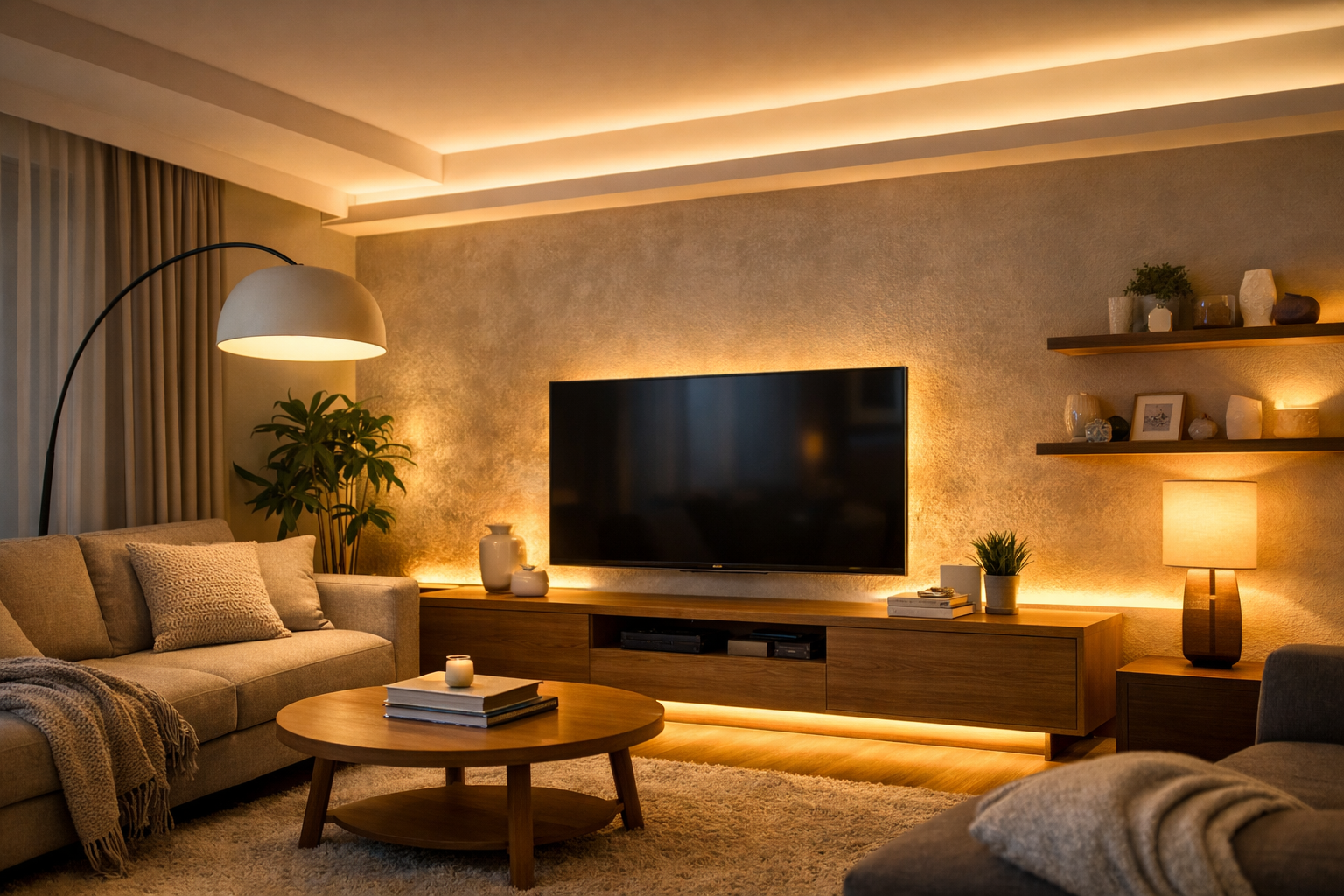
The central idea: Instead of hanging a single "disco lamp" in the middle, the room is lined in a ring with LED strips - along the ceiling, behind shelves, under the edge of the counter and perhaps even as a line of light on the floor. This creates an immersive cone of light that can be transformed from “chilled lounge light” to “pulsating club atmosphere” in a matter of seconds using software.
While a simple lamp only offers "on" or "off", RGB LEDs reveal the entire color palette. You can bathe the room in deep blue when an electronic track is playing, then change to warm amber light the next moment as everyone at the bar has a drink. And then there are the addressable strips – the ones where each individual LED can do its own thing.
Imagine the ceiling line pumping like an equalizer to the bass of the music, the stripes on the walls making waves, and little sparks of light running along the bar when the chorus starts. This is exactly what addressable chips make possible.
Planning the party cellar
Let's start planning. Grab a pad and make a rough layout of your basement. Where should we dance later? Where is the counter? Where are the sofas or bar stools? A good layout could look like this: The dance area on one side - as free as possible, with little furniture, perhaps a corner for the DJ or at least the laptop and the system. Opposite the bar, a counter, shelves with bottles, maybe a fridge. In another corner is the lounge area with seating for those who prefer watching rather than jumping.
Why LED light is particularly suitable in the party cellar
Now technology comes into play, but don't worry: you don't have to be an electrical engineer to pull this off. There is a special environment in the party cellar: the room is cooler, the air can be humid, and when things really get going, a beer sometimes gets knocked over. That's exactly why the combination of LED and low voltage is so brilliant. The strips run on 5, 12 or 24 volts, so far below what comes from the Power plug comes. This means: Even if a drink spills over the front of the counter and splashes against the bar where the light is, it is primarily annoying for the person who has to clean up afterwards.
What's important is that IP protection rating pay attention to the lighting. For dry living spaces, IP20 is sufficient; in the party room with glasses, bottles and condensation, it is better to aim for IP65 or higher. This means: The electronics are protected against dust and splash water, usually by a silicone cover or casting compound.
It is particularly important that you take all points where you cut or connect the LED strips seriously. Because there are contacts exposed here that could corrode. A popular trick is to place the LED strips in aluminum profiles with opal (i.e. milky) covers. This not only looks more stylish and professional, but also protects the technology: beer and cleaning agents hit the profile first, not the circuit board.
The magical transformation
At some point the moment will come when you pick up the cordless screwdriver. The basement is cleaned up, cobwebs are removed, the walls are painted with new paint. You measure the lines along which the light should later run: once all the way around the ceiling, just below the edge, so that the strip shines indirectly upwards; then a line under the edge of the bar so that the bar appears to be floating.
If the lamps and LED strips lie loosely in the profiles and are attached, they are usually connected to special power supplies and the controllers that will later control the light. Especially with addressable strips, small arrows show in which direction the signal is running. The first effects flicker through the shell: simple color changes, perhaps a rainbow effect. At this moment you feel how a self-made project is being created into a space that will later be the setting for stories - of loud nights, confessions at the bar, dance sessions at three in the morning.
Insert and connect LED strips
While you're wiring, you're probably not just thinking about the show, but also about the morning after. Cables on the floor become a tripping hazard, so route them along the ceiling and walls as much as possible. Several LED lines are fed in a star shape from one corner, instead of hanging them over many meters one behind the other - this way all areas remain equally bright.
The power supply itself disappears into a dry niche, perhaps in a technology cabinet or high up in a corner where no one touches it. A residual current circuit breaker in the house distribution gives you additional peace of mind: If something goes wrong, the system switches off quickly before anyone even notices what has happened.
Lighting control via ready-made solution and self-made
Once the hardware is in place, comes the heart: the lighting control. On the Homemade There is a small microcontroller on the side, such as an ESP32, onto which you can play special firmware such as WLED. It sounds more complicated than it is: you flash the software once, connect the controller to your WLAN and tell it how many LEDs are on which output. From then on, you control everything via a web interface or app – colors, animations, speed. With the Audio‑Reactive extension, this little chip even listens to the music: either via a built-in or connected microphone or directly via an audio signal. The effects then react to the bass, the treble, the tempo - like a visual equalizer.
On the side of the Ready-made solutions There are smart systems such as LED strips from Philips Hue or Govee brands, often including an app, music mode and cloud connection. You stick it there, connect it to the home network, and an app does the rest. For many party rooms, that's enough: you choose "party", "lounge" or "concert", and the room adapts. The disadvantage: You are somewhat trapped in the manufacturer's logic, whereas with an open system like WLED or a DMX controller you can define practically everything - from the waveform of the effect to the way the lights should snap out into a specific drop.
DMX is the “top league” if you want to go beyond LED strips at some point and add real stage lights: moving heads, strobes, scanners. This isn't a must in a private basement, but if you have the image of a small club in your head, you can give the LED strips a kind of starring role as "architectural light" and add the spots and beams as show lights. The same controller that tells your stripes how to light can then also control the headlights - all tactfully, all from a single source.
Mood effects and music synchronous effects
But even without this extravagance, the combination of well-placed LED strips and clever control is enough to tell different chapters of an evening. In the "welcome phase" perhaps a warm, golden light along the ceiling, slightly emphasizing the bar, nothing dazzling, more of a glow like on a summer terrace. When the first songs play, you'll bathe the dance floor in deep blues and purples, with gentle waves rolling through the room. Later, when people are actually dancing: quick color changes, hammering patterns, short strobe interludes.
At the end, when the last guests leave, the music fades out and the cellar door closes behind you again, you are left with this sight for a moment: the empty room, in which a faint remaining light still glows, as if it had celebrated a little itself. You click on your cell phone, switch to a subtle night preset that only lets a few meters of strips glow in warm light. And as you collect the glasses and sort the bottles, you notice how this room has changed.
Conclusion
Stylish lamps and LED strips in the party room are not just technology, not just cables and chips. They are a tool to build mood and bring people together to give a place a new identity. Concrete becomes a stage, pipes become lines, a cellar door becomes a portal into a world that only belongs to you and your guests. And all you need is a little planning, respect for electricity and humidity - and the courage to stick on that first meter of LED tape and turn it on.
We would be happy to support you BUYnBlue Help you plan your lighting for all your rooms. Contact us at any time for more information and offers.