Einstein is in every LED lamp: How he revolutionized our lighting concepts
If you use an LED lamp in your home today, you are taking advantage of a physical discovery that Albert Einstein made over 100 years ago. In 1916, the pioneer who dealt with the curvature of space and relativity provided the physical explanation for the most modern lighting technology of our time.
Unfortunately, his own discovery was never presented to him. However, at the beginning of the 20th century, he already had the knowledge that has revolutionized our lighting industry since the 2000s: the LED, the light-emitting diode that is installed in almost every lamp today. This article examines Albert Einstein's groundbreaking discoveries and their relevance today.
Historical review
What is the connection between Albert Einstein and the LED? The answer is fascinating and leads directly to the core of LED technology: Albert Einstein uncovered the theoretical basis for how LEDs work.
In 1916, Einstein published a groundbreaking paper entitled “On the Quantum Theory of Radiation.” In his work he described three fundamental interactions between light and matter: absorption, spontaneous emission and stimulated emission. The third option - stimulated emission - was unknown at the time, both theoretically and practically. Up to this point, no experimental observations had been made on this subject.
Imagine this: an atom is in an excited state associated with an increased unit of energy. Under normal circumstances, this energy would be emitted in the form of light after a certain period of time and then returned to its original state. If a photon with exactly the same energy hits an atom at a certain moment, this has a remarkable consequence:
The atom is "stimulated" by the incident photon to immediately release its energy - and it emits a second photon. It is amazing that the newly created photon has the same energy, color, phase and direction of motion as the original photon. The number of photons has doubled.
In 1928, 12 years after the publication of Einstein's theory, Rudolf Ladenburg achieved the first experimental demonstration of this phenomenon.
From theory to LED practice
The process in question is carried out in today's LED lamp at exactly this frequency, millions of times per second. In the semiconductor material of an LED (typically gallium nitride or similar materials), electrons are excited (by electrical voltage). The excited electrons are in a higher energy state. When the particles then return to recombine, light is created - through the emission described by Einstein.
The first light-emitting diodes based on this principle were brought onto the market in the 1970s. However, they were not used for household use, but as signal lights in electronic devices. The red color was very weak and its possible uses were limited. However, it should be noted that technology has evolved rapidly.
In 2007, the first white LED lamp with a standard Edison thread (E27) was brought onto the market. These retrofits initially had low brightness and emitted an undesirable bluish-cold light, which had a negative impact on consumer acceptance. Rapid technological improvement occurred. LEDs were already available in different color temperatures in 2010. The luminosity increased, the prices fell and from around 2015 the LED lamp became a real alternative for every household.
The LED revolution has fundamentally changed our homes. Anyone who still lights rooms with classic light bulbs is not only losing money, but is also missing out on the opportunity to use smart lighting technology. In recent years, LEDs have evolved from an exotic technology into a real trend.
The different LED lamps
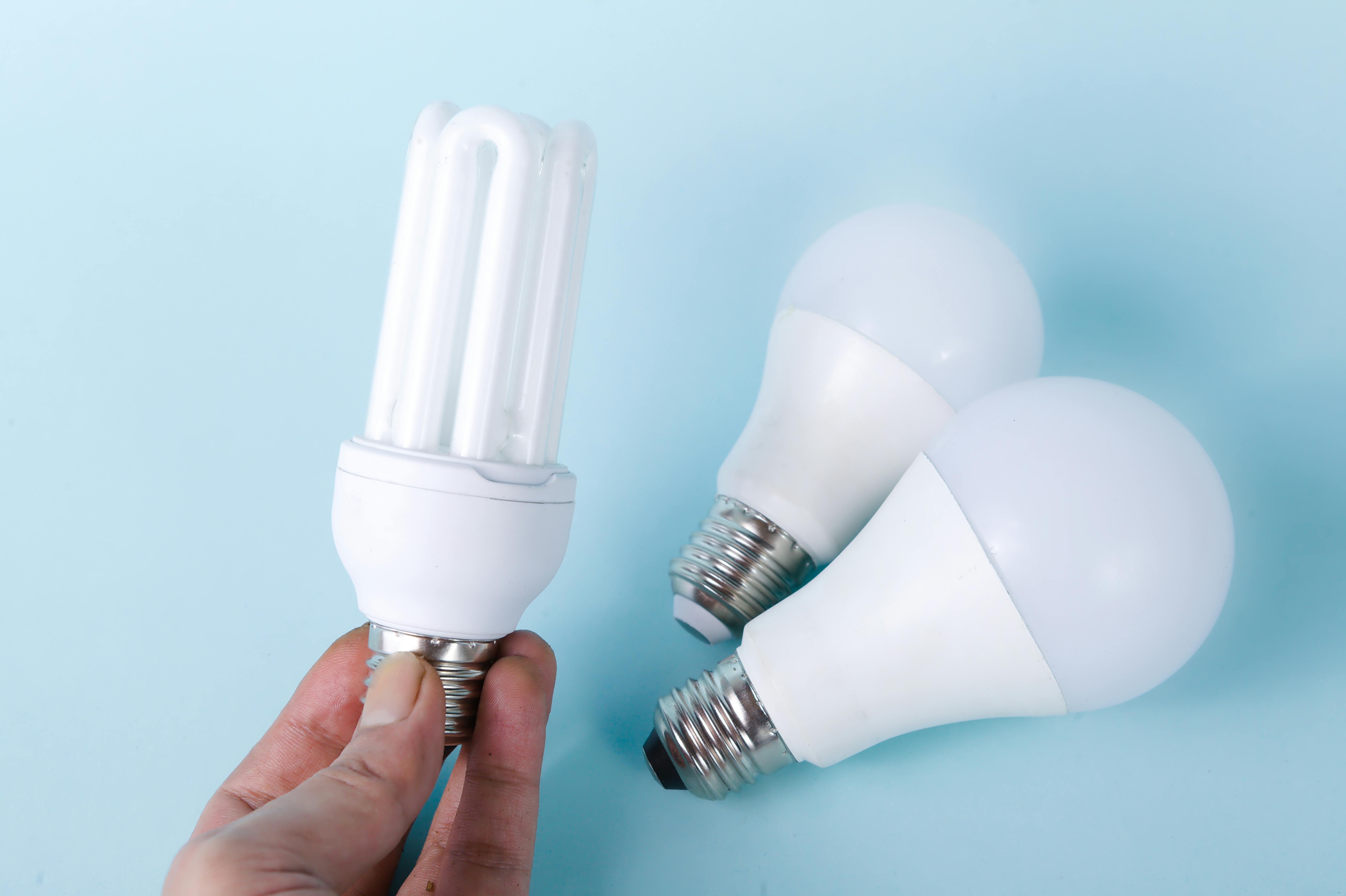
LEDs are available in many versions and can easily replace old bulbs:
- E27 bulbs are the classic screw sockets - for all common lamp holders.
- E14 bulbs are the smaller versions, often used in chandeliers.
- GU10 spots are ideal for replacing halogen spots - they can be pushed straight in.
- Rod or tube lamps replace fluorescent tubes. They do not flicker, contain no mercury and are instantly bright.
- LED strips are flexible light sources for creative lighting ideas. They can be installed under shelves, in steps or as indirect wall lighting.
- Smart LEDs with WiFi connection enable remote control via smartphone, dimmability and even color change. Perfect for modern smart homes.
LED bulbs and their advantages
Since the 2010s, the manufacture and sale of incandescent and halogen lamps have been banned by law. This is due to the limited lifespan of the bulb, which is typically around 1,000 hours of use. A halogen lamp offers a lifespan of up to 4,000 hours. An LED on the other hand? 25,000 to 50,000 hours. High-quality LEDs have a service life of up to 100,000 hours.
Durability is significantly influenced by two factors: heat and switching cycles. The lifespan of an LED depends on its temperature. For this reason, high-quality LED lamps are usually equipped with aluminum heat sinks. Please note that frequent switching off and on can shorten the lifespan. However, this effect is less pronounced with modern LEDs than with energy-saving lamps.
Please note: Unlike incandescent bulbs, which can suddenly burn out, LEDs are reliable and long-lasting. Instead, they darken over time, a process known in technical terms as “degradation.” The standard rated service life is usually given as L80. It refers to the point at which the LED still achieves 80 percent of its original brightness. This means that the LED lamp hardly gets noticeably darker over the years and you can continue to use it for a long time.
Color temperature: The right light for every room
One of the advantages of LED technology is its remarkable flexibility in terms of light color. The light color is measured in Kelvin (K). A low Kelvin number represents warmer (redder) light, while a high Kelvin number represents cooler (bluer) light.
Warm white light with a color temperature of up to 3,300 Kelvin creates a cozy, yellowish atmosphere that is reminiscent of classic incandescent lamps. It is ideal for bedrooms, living rooms and anywhere you want to relax. Warm white light has a calming and inviting effect.
Neutral white (3,300 to 5,300 Kelvin) has a pleasant and neutral effect without tiring or irritating. It is ideal for use in kitchens, bathrooms, study rooms and hallways. Daylight white or cool white (over 5,300 Kelvin) is similar to natural daylight. It has an activating effect, promotes concentration and alertness. It is ideal for use in work areas, garages or studios.
Brightness: lumens instead of watts
One of the aspects that can cause confusion when purchasing LED lights is the meaning of the traditional wattage rating. An 8-watt LED can have comparable luminance to a 60-watt incandescent bulb. Why? Due to the higher energy efficiency of LEDs. Compared to heat sources, they have lower energy consumption.
To correctly specify the brightness, the luminous flux, measured in lumens (lm), must be used. The lumen value indicates how brightly a lamp shines. Below you will find some practical guidelines:
The light intensity of 400 lumens corresponds to one 40 watt bulb.
The light intensity of 600 lumens roughly corresponds to one 60 watt bulb.
800 lumens roughly correspond to the luminosity of one 75 watt bulb.
A light intensity of over 1,000 lumens is with a conventional one 100 watt bulb comparable.
For everyday use, a lighting level of 400 to 600 lumens in the bedroom is recommended. A light intensity of 600 to 800 lumens is recommended for the living room. In the kitchen and at the desk, the light intensity is 800 to 1,200 lumens. The exact requirements will depend on the size of the room and your personal preferences, with these guidelines serving as a good starting point.
The cost comparison: How much money do you really save?
Let's look at a concrete example. Replace a traditional 60-watt incandescent bulb with an 8-watt LED bulb that produces comparable brightness. With an electricity price of 34 cents per kilowatt hour, you can save around 18 euros per lamp per year, which can easily be 300 to 400 euros per year per household. The same applies to halogen lamps.
Although LED lamps were initially more expensive, prices have now fallen significantly due to lower production costs. The price for a high-quality LED lamp today is between 2 and 10 euros (depending on the type and manufacturer). Due to the electricity savings achieved and the extraordinarily long service life, the costs are usually paid back within one to three years.
LEDs for the dimmer
Dimmable LED lamps offer perfect control over the room design. With this solution you can design the atmosphere as you wish: choose an intense light for work that promotes concentration and a warm, feel-good light for relaxation. In this way, a bedroom that is used at full brightness can no longer be perceived as uncomfortable. With continuously dimmable LEDs you can create targeted comfort. Cozy lighting not only has a positive impact on your well-being, but also on your health. Dimmed light promotes melatonin production and contributes to better sleep.
Dimmable LEDs allow you to save electricity, extend your lifespan through intelligent use and create the perfect mood for every moment.
Do LEDs contain toxic substances?
LED lamps, unlike energy-saving lamps, contain energy saving lamps none Mercury. This is a real safety and health benefit for the home.
LED lamps can contain small amounts of substances such as heavy metals (lead, arsenic, cadmium). In addition, rare earths, phosphorus compounds and non-biodegradable materials such as plastics and epoxy resin are also found.
The amounts are usually extremely small. In a normal usage situation, LEDs do not emit any of these substances. For regular households, there is no immediate health risk from using LED lamps in operation. You can use them in living rooms, bedrooms or bathrooms without hesitation.
The correct disposal
Please note that LEDs must not be disposed of with household waste. According to the current regulations in Germany, old LEDs are subject to the obligation to dispose of electronic waste (ElektroG).
Please take the used batteries to recycling centers, collection points or retailers. Valuable materials such as aluminum and copper are recovered in the production process.
Conclusion
LED bulbs offer a number of benefits including the ability to save costs, long lifespan, flexible color temperatures and a more environmentally friendly alternative to other lighting technologies. Investing in LED lighting is one of the best energy saving measures you can make in your home.
From an economic, ecological and practical point of view, a switch is definitely recommended. Regardless of whether you use incandescent or halogen lamps, switching to LED lights usually pays for itself very quickly. Take advantage of the opportunity to optimally illuminate every room in your home while reducing your electricity bill.