Understanding LED light: Kelvin, CRI and flicker briefly explained
At first glance, LED light seems simple: on, off, bright, warm or cold. In practice, however, three values determine whether a room appears pleasant, color-fast and fatigue-free: Kelvin (light color), CRI (color rendering) and Flicker (Flicker). Anyone who understands these terms will not just buy “just any LED”, but rather light that suits the use, furnishings and people.
1) Kelvin: What color of light does LED light have?
Kelvin (K) describes this color temperature a light source. Important: Kelvin doesn't say anything about "better" or "worse", but rather about the Appearance of the light.
- Warm white (low Kelvin number) appears cozy, relaxing, homely.
- Neutral white appears objective, clear, suitable for activities.
- Cool white / daylight white looks very fresh and rich in contrast, but can quickly appear “cool” in the living room.
Typical Kelvin ranges and what they suit
The following classification has proven useful as a guide (for interior spaces):
| Kelvin range | Light effect | Typical locations | Tip for practice |
|---|---|---|---|
| 2,200-2,700K | very warm, “candle-like” | Bedroom, lounge, evening in the living room | Ideal with a dimmer so that it doesn't look too dark |
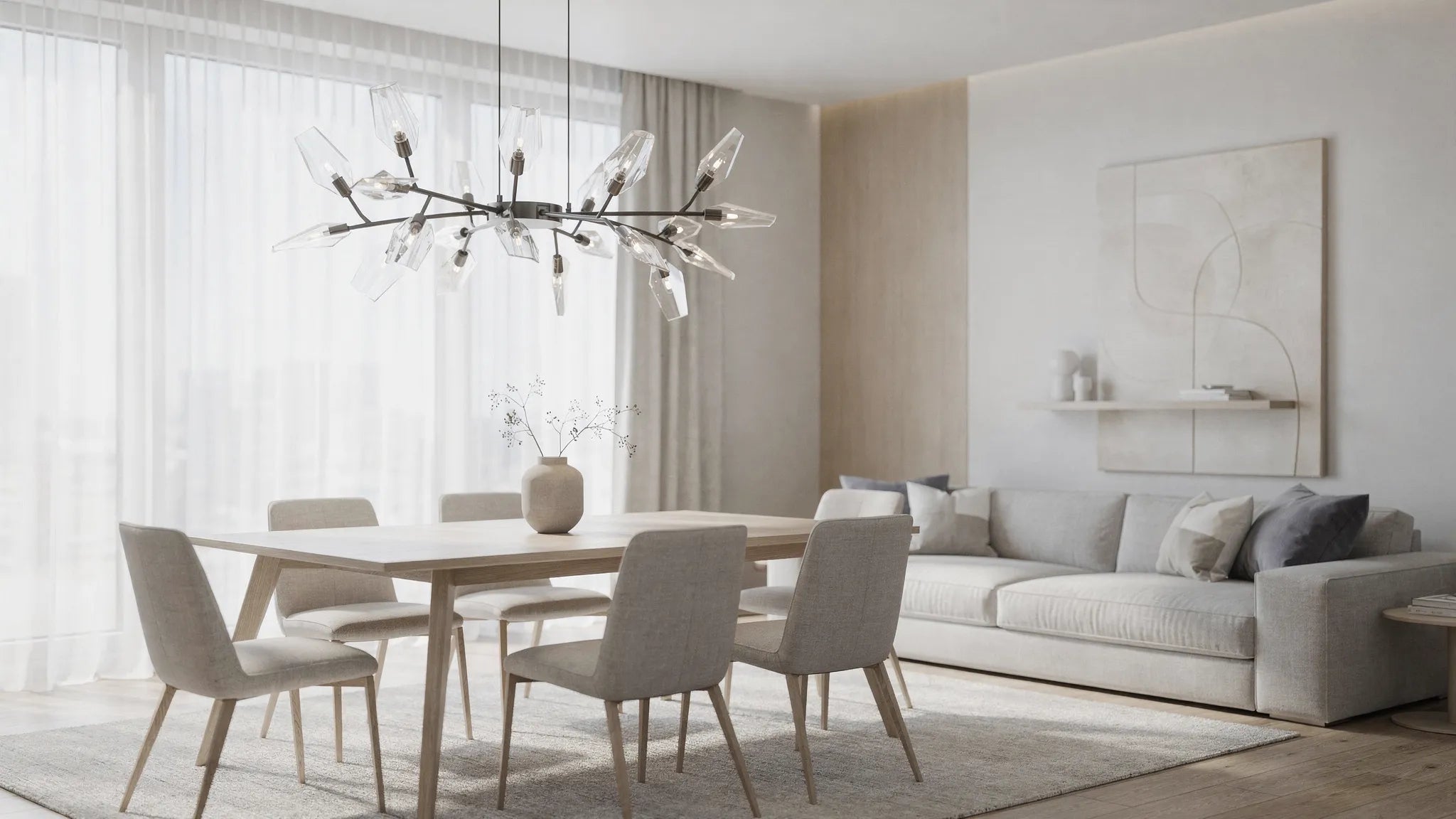
| 2,700-3,000K | warm white, homely | Living room, dining room, hallway, restaurants | Usually the sweet spot for pendant lights above the table |
| 3,000-4,000K | neutral white | Kitchen, bathroom, housekeeping, home office zones | Often more pleasant for mirrors and work surfaces than very warm light |
| 4,000-6,500K | cold white to daylight white | Workshop, cellar, concentrated work | Use more specifically in the living area (e.g. in a work niche) |
Common misconception: “More Kelvin = brighter”
Kelvin influences that color of light, not primarily brightness. For brightness is (with LEDs) above all Lumens relevant. Two LEDs with identical lumens can appear completely different if one is 2,700K (warm) and the other is 4,000K (neutral).
Pro Tip: When a room has multiple tasks
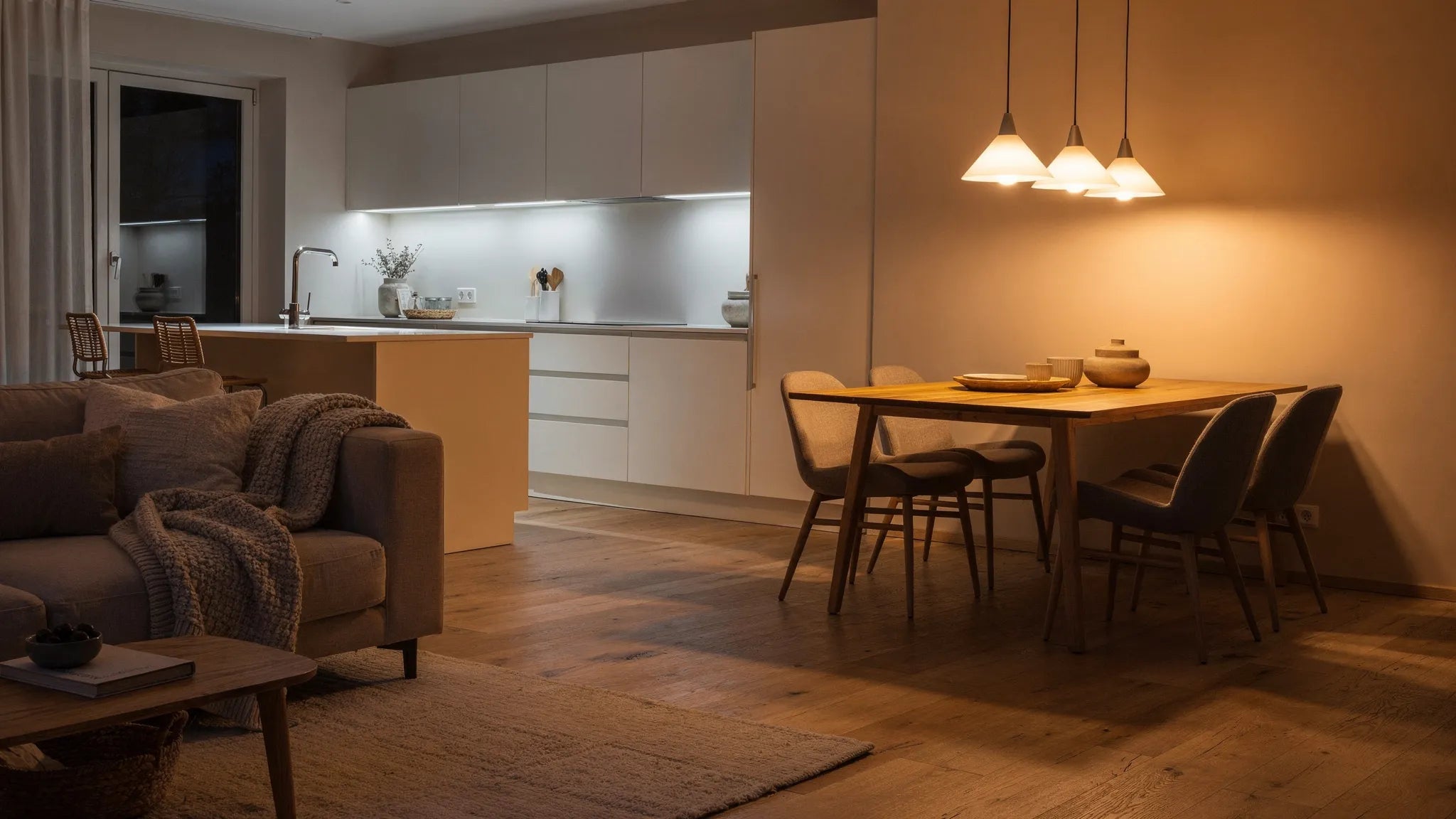
Open kitchen-living rooms or living-dining areas benefit from this two lighting moods:
- warm white, dimmable light for dining and relaxation
- Neutral white light for cooking, cleaning, concentrated tasks
This can be implemented with separate lighting circuits, multiple lights or smart bulbs.

2) CRI: Why colors sometimes look “wrong” under LED light
CRI (Color Rendering Index) is called in German Color rendering index and is often used Ra specified. In simple terms, the value describes how true colors appear under artificial light compared to a reference.
- CRI 80: common in the standard range, often sufficient for hallways or pure basic lighting
- CRI 90+: visibly better color rendering, recommended for living rooms, kitchens, bathrooms and anywhere where materials and skin tones need to look good
The CRI is an established standard from the International Commission on Illumination (CIE), known as CIE Ra (e.g. CIE 13.3).
Why high CRI is so important in interiors
High CRI is particularly noticeable in:
- Wood, leather, textiles (look richer instead of grayish)
- Wall colors and art (nuances remain)
- skin tones (mirror light in the bathroom, applying make-up, shaving)
- Food (Kitchen and dining area, food appears more appetizing)
Especially in modern interiors with carefully selected materials, a low CRI can make the room appear “cheaper”, even though furniture and lights are of high quality.
CRI is good, TM-30 is more accurate (relevant for planners)
For demanding projects (architecture, hospitality, retail) CRI is appearing more and more often IES TM-30 on. TM-30 evaluates color rendering in a more differentiated way because CRI only reproduces some LED spectra to a limited extent. When manufacturers provide TM-30 values, it is often an indication of a technically serious specification. For most private purchases, CRI is sufficient as a practical minimum filter.
Recommendation by room
| Room/Zone | CRI recommendation | Justification |
|---|---|---|
| Living room/dining room | CRI 90+ | Materials, art, skin tones and atmosphere visibly benefit |
| Kitchen (work surface) | CRI 90+ | Food and the impression of cleanliness appear more natural |
| bathroom (mirror) | CRI 90+ | Skin tones and details become more realistic |
| Hallway/storage room | CRI 80+ | usually sufficient if it is primarily about orientation |
| Home office | CRI 80-90+ | depending on use, more like 90+ for creative work |
3) Flicker: The underestimated comfort factor
You can sometimes see “flickering” immediately, but Flicker can also be invisible and still be annoying. Symptoms can be:
- faster fatigue
- Headache
- Feeling of restlessness
- unpleasant light when looking at moving objects (strobe effect)
Important: Flickering is not “typical for LEDs”, but depends heavily on Drivers, power supply, dimmer compatibility and electronics off.
Why LED light flickers
LEDs react extremely quickly. If the current is not smoothed properly or a dimmer is working “incorrectly”, the light can pulsate.
Common Causes:
- cheap or poorly tuned LED drivers
- incompatible dimmers (leading edge/leading edge) or incorrect dimming curves
- Inferior power supplies for LED strips
- Voltage problems or loose contacts (technical defect)
Measurements that professionals pay attention to
Manufacturers do not always disclose flicker transparently. In lighting technology, among other things: The following terms are common:
- Flicker Percentage
- Flicker index
- PstLM/SVM (Measurements from the world of standards, relevant for professional planning)
The procedure is often used as a guide IEEE Std 1789-2015 which describes recommendations for limiting flicker depending on frequencies.
How to Check Flicker Quickly (Without a Meter)
These checks do not replace laboratory values, but they do help in everyday life:
- Smartphone camera test: Aim the camera at the lamp. If dark bars move heavily through the image, this is a warning signal. (Note: Depending on your phone and camera settings, the result may vary.)
- Dimmer test: If an LED flickers visibly at certain dimming levels, the dimmer and driver are often not optimally combined.
- “Pen test”: Move a pen quickly in front of the light source. If clear “multiple images” arise, flicker may be present.
Planning for low flicker: What works in practice
- At dimmable LEDs Pay attention to the compatibility of the light, driver and dimmer.
- At LED strips It is better to rely on clean power supplies and suitable controllers instead of “no-name”.
- Prioritize low-flicker quality in areas where people spend a lot of time (living room, home office, bedroom).
Interaction: Combining Kelvin, CRI and Flicker correctly
Many bad purchases occur because you only pay attention to one value. In practice:
- Kelvin sets the mood.
- CRI determines the color quality.
- Flicker determines comfort.
An example from everyday life:
- A pendant light above the dining table with 3,000 K generally appears “really warm”. However, if the CRI is only 80, the food and wooden plate often appear flatter.
- A very bright 4,000K LED in the kitchen can work great if the CRI is 90+ and it doesn't flicker when dimmed.
Short purchase check for LED light (without a technical degree)
If you are comparing bulbs or lights, these questions will help:
- Does it fit? Kelvin number for use (relaxing vs. working)?
- Is that right? CRI ideally at 90+ in living rooms, kitchens and bathrooms?
- Is the light dimmable, and if so, is the dimmer compatible?
- Are there any clues? low flicker Technology (e.g. high-quality drivers, clear specifications)?
It is also worthwhile for architects and interior teams to systematically document technical data. In larger projects, digital workflows are often used, from specification lists to quality assurance, sometimes supported by external technology partners for process and data. Anyone interested in such solutions can find an overview at digital and AI solutions from Syneo.
Frequently asked questions about renovation and interior design
"Warm white is cozy, but sometimes seems too yellow. What should I do?"
Instead of 2,200-2,700K, choose sooner 2,700-3,000K and pay attention CRI 90+. Poor color reproduction often reinforces the “yellowish” impression because white tones and materials tilt unnaturally.
“Is CRI 80 really that bad?”
Not automatically. For passage areas, CRI 80 can be sufficient. In zones where you live, eat, cook or look in the mirror CRI 90+ usually a noticeable upgrade.
“Why does an LED only flicker when dimming?”
This is a classic Dimmer driver incompatibility. Not every dimmable LED is stable with every dimmer. A suitable dimmer (or a driver that matches the type of dimming) often helps, but sometimes a replacement is the cleanest solution.
Frequently Asked Questions (FAQ)
What does Kelvin mean for LED light? Kelvin describes the color temperature, i.e. whether LED light appears warm white, neutral white or cool white. It's a mood and functional decision, not a brightness specification.
Which CRI value makes sense for living spaces? CRI 90+ is recommended for living rooms, dining rooms, kitchens and bathrooms because colors, materials and skin tones appear more natural. CRI 80 is often enough for a hallway or storage room.
How do I recognize flickering LED light? Visible flickering is a clear sign, but flicker can also be unnoticeable. A smartphone camera test, a dimmer test and the pen test are helpful.
Does cold white light always make you awake? Cold white often has an activating effect, but can also be perceived as uncomfortable. It can be suitable for concentrated work; in the living area, warm white or neutral white is often more pleasant.
Why do colors sometimes look different under LED than during the day? The main reason is the color rendering (CRI) and the spectrum of the LED. With CRI 90+ and the appropriate Kelvin number, colors come much closer to the effect of daylight.
Conclusion and next step
Who LED light after Kelvin, CRI and Flicker chooses, not only gets “bright”, but also lighting that really enhances rooms: harmonious, colorfast and comfortable.
If you are looking for a pendant lamp or a chandelier that not only fits visually, but also needs to be technically neatly integrated into the concept, it is worth going to a shop that pays attention to planning and details. At BUYnBLUE you will find a curated selection of modern designer lights, plus free customization (e.g. cable length, canopy, color), Free worldwide shipping and 14 day return policy. Browse by room category buynblue.com and have the light adjusted to your ceiling height and layout.