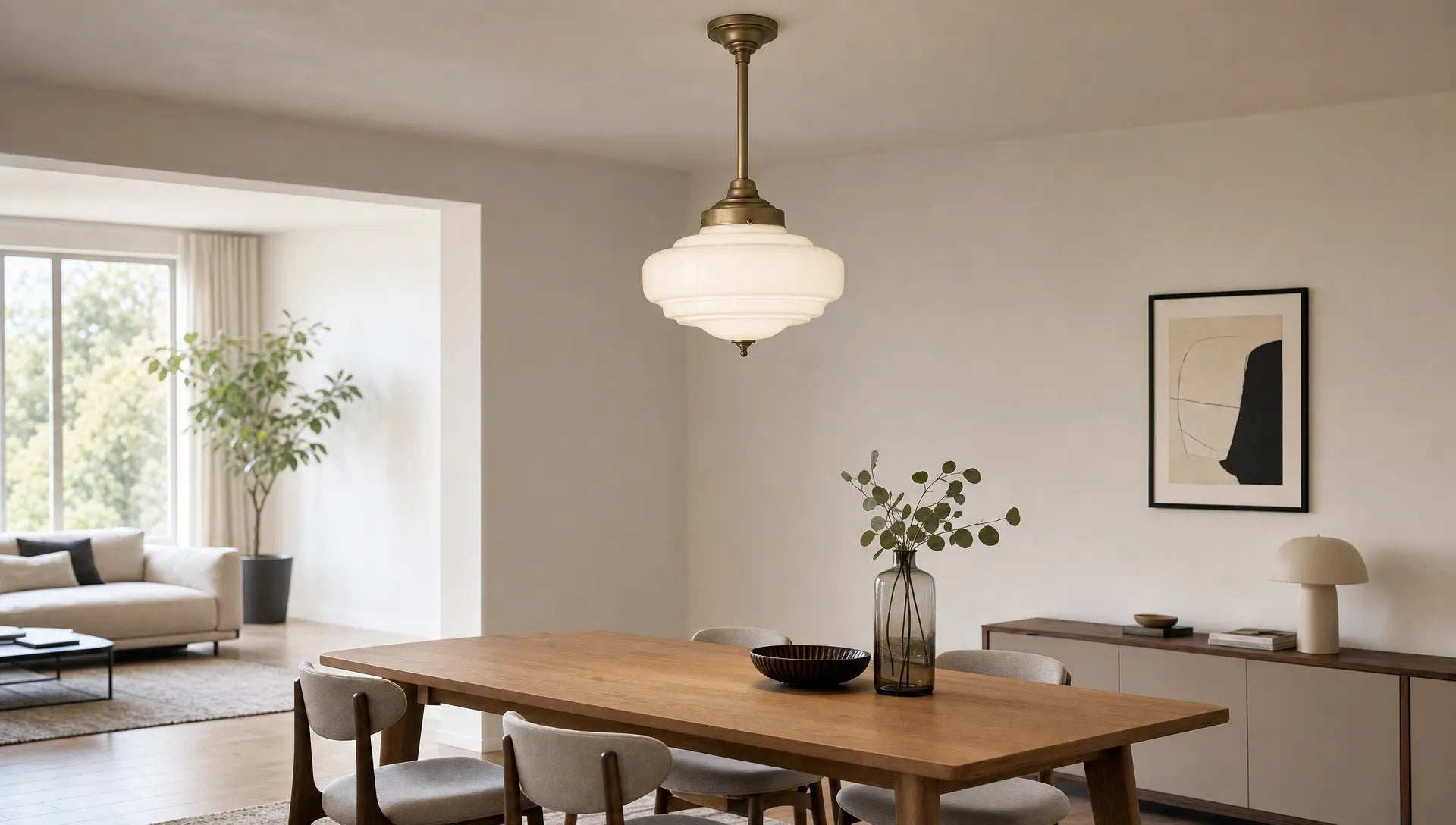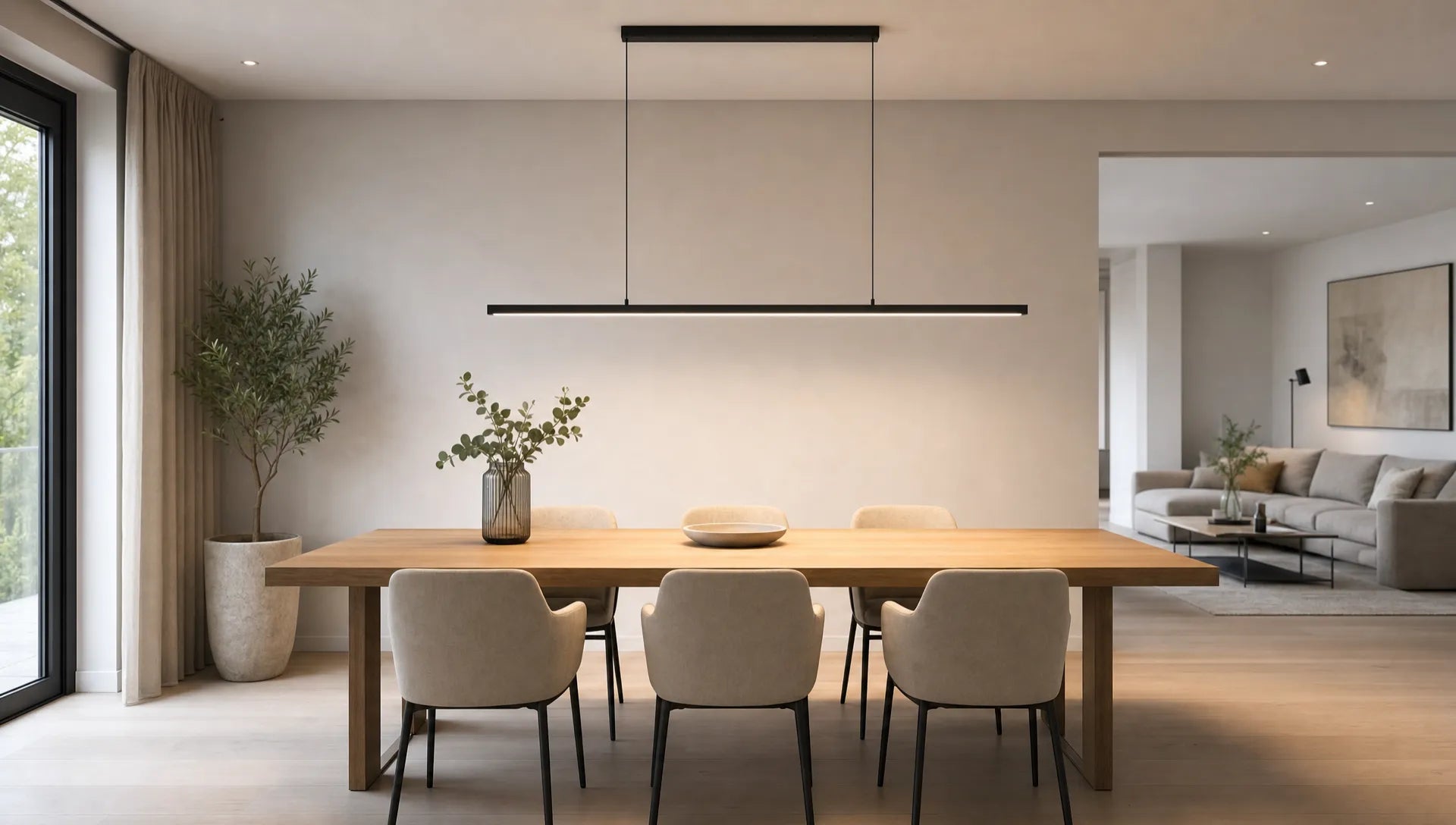
Find a dining room pendant light that matches your table and room
A dining room pendant light is more than just a light source. It frames the table, shapes the atmosphere and often decides whether a room appears elegant, cozy or restless. Precisely because the dining table can do so many things these days, from family breakfasts to home offices to dinners with guests, the lamp should not only look beautiful, but also fit the size of the table, the room architecture and your habits.
The most important principle is: The lamp should emphasize the table, but not dominate it. It should bring enough light onto the table surface, illuminate faces pleasantly and at the same time not block the view across the room. With a few clear guidelines, the selection can be made much easier.
Think from the dining table, not from the lamp
Many bad purchases occur because a design is first selected and only then is it checked whether it fits the table. The reverse order is better: table shape, table length, use of space and ceiling height determine the framework in which the hanging lamp must function.
A round table looks harmonious with a round or sculpturally centered lamp. A long rectangular table, on the other hand, usually needs a linear light, several pendants or an elongated chandelier so that the entire table surface is illuminated evenly. When it comes to extendable tables, it is worth considering not only the everyday length, but also the maximum length.
As a rule of thumb, the lamp should remain visibly smaller than the table. It can make a strong statement, but should not extend to the edges of the table. Otherwise it looks too heavy and can be annoying when getting up or serving.
| Table shape | Matching lamp shape | Good orientation |
|---|---|---|
| Round | Round pendant lamp, ball lamp, small chandelier | Lamp diameter approximately half to two thirds of the table diameter |
| Rectangular | Linear pendant light, bar light, multiple pendants | Light about 60 to 80 percent of the table length, away from the ends of the table |
| Oval | Elongated or organically shaped hanging lamp | Accommodate soft shapes, plan length similar to rectangular tables |
| Square | Central pendant lamp, symmetrical cluster | Place the light in the middle and don't choose it too wide |
If you would like to go into more detail about the proportions for individual table shapes, see the article on how to make one Choose a pendant light in the dining room to match the table, additional practical orientation.
Correctly consider room size and ceiling height
The same pendant light can look completely different in two dining rooms. In an open living-dining area it can be more staged because it defines a zone. In a small dining room, the same model can quickly appear bulky. Therefore, the luminaire should always be viewed in relation to the volume of the room.
If the ceiling is low, flatter, airier shapes make sense. Delicate metal frames, transparent glass bodies or lights with slim arms appear lighter than solid shades. In high rooms, more volume, more levels or longer suspensions can be used so that the luminaire does not appear lost.
The position of the ceiling outlet also plays a major role. Ideally, the lamp sits centrally above the table, not necessarily in the middle of the room. If the table and power outlet don't match, an offset canopy, rail system or custom solution can help.
| Room situation | Recommendation | Why it works |
|---|---|---|
| Small dining room | Slim hanging lamp, glass, light materials | The room remains open and does not appear overloaded |
| Open living-dining area | Striking lamp or pendant group | The dining area gets a clear visual center |
| Low ceiling | Shorter suspension, compact shape | The view remains clear and the light does not disturb everyday life |
| High ceiling | Multi-part light, longer cables, vertical design | The height of the room is used consciously and appears more homely |
The right height: see comfortably without being blinding
For many dining areas, a lower edge of the light about 60 to 75 cm above the tabletop works well. This is not a hard and fast law, but it is a reliable starting point. For very tall people, particularly large lights or open umbrellas, a little more distance may make sense. For small, focused pendulums, the light can hang a little lower as long as it doesn't dazzle.
The sitting test is important. Sit at the table and check whether you can see the person you are talking to clearly. A dining room pendant light should allow eye contact. If it hangs exactly at eye level or if bright lights are directly visible, it quickly becomes unpleasant.
Freedom from glare doesn't just depend on height. The shape of the shade, diffuser, light source and surface also work together. Downward-directed light works well for the table surface, but should be soft enough. Opal glass, textured glass, fabric shades or integrated diffusers can help to avoid harsh light spots. For detailed planning, it's worth taking a look at the tips on how to do one Pendant Lamp Plan the dining room so that it is glare-free and harmonious.
Light color, brightness and dimmability
The dining room is about atmosphere, but also about function. The light should make food appear appetizing, reflect faces naturally and, if necessary, be bright enough for everyday activities. For living and dining areas, warm white light in the range of around 2,700 to 3,000 Kelvin is often perceived as pleasant. 2,700 Kelvin looks particularly comfortable, 3,000 Kelvin seems a little clearer and more modern.
When it comes to brightness, the table size is crucial. A single small pendant light above a long table often leaves the ends dark. Several light points or an elongated lamp distribute the light better. As a guide, around 200 to 300 lux on the table surface is pleasant for many dining situations, although personal sensitivity, wall colors and material surfaces influence the result.
Dimmability is particularly valuable in the dining room. The light can be softer when eating with guests, but it can be brighter when doing crafts, working or tidying up. Make sure that the lamp, bulb and dimmer technically fit together. Not every LED lamp can be controlled flicker-free with every dimmer.
Material and style: harmony instead of complete matching
The lamp does not have to fit exactly to every piece of furniture. A room often appears more exciting when materials correspond to each other instead of being identical. A wooden dining table can look warmer with brass, more modern with black metal or lighter with glass. What is crucial is that at least one element can be found in the room, such as metal color, design language or surface structure.
In minimalist spaces, a sculptural pendant light can be the central accent. In classically furnished dining rooms, a modern chandelier adds elegance without appearing old-fashioned. Matt surfaces, warm metals, paper look or softly tinted glass work particularly well in Japandi or natural concepts.

The best effect is created when the hanging light has a clear role. Either it fits in quietly and supports the overall concept, or it deliberately becomes an eye-catcher. It usually only becomes problematic when several strong elements compete with each other, for example a very eye-catching table, patterned wallpaper, striking art and an oversized lamp.
Positioning in the room: The table is the anchor
A hanging light above the dining table should almost always be aligned with the table. This also applies if the table is not exactly in the middle of the room. Especially in open floor plans, the lamp is an important means of visually separating the dining area from the living area.
For rectangular tables, the light should run along the axis of the table. If there are several pendulums, an even distance is important. The outer pendants should not hang too close to the ends of the table so that the light does not dominate over the edge and the composition does not fall apart.
If the table is frequently moved or extended, flexibility is more important than a perfect static solution. Height-adjustable pendants, longer linear lights or multiple light points can help cover different situations. For very flexible floor plans, a combination of hanging lights, wall lights and indirect lighting can also make sense.
Common selection mistakes and how to avoid them
The most common mistake is a light that is too small. It looks appropriate in the shop or in a product photo, but later gets lost over the table. A single small pendulum is rarely enough, especially for long tables. Therefore, always check dimensions with tape, paper or a simple sketch directly in the room.
A second mistake is incorrect hanging height. If mounted too high, the lamp appears distant and illuminates the room more generally than the table. When mounted too low, it disturbs the view and can be blinding. A few centimeters difference can make a big difference here.
The lighting effect is also often underestimated. A beautiful design is of little use if the lamp is visibly dazzling or illuminates the table surface in spots. Therefore, check not only the shape and color, but also the direction of radiation, diffuser and dimmability.
Before you buy, these questions will help:
- Which table shape and maximum table length should be illuminated?
- How high is the ceiling and how low can the light hang?
- Should the lamp be a statement piece or a quiet addition?
- Do you just eat at the table or do you also work, play and read?
- Does the light color match the rest of the lighting in the room?
Customization can make all the difference
Not every room corresponds to standard dimensions. Old apartments often have very high ceilings, new buildings sometimes have low ceiling heights, and in many dining rooms the ceiling outlet is not located where the table is. In such cases, adaptability determines whether a lamp really appears to be of high quality.
At BUYnBLUE The focus is therefore not only on the design, but also on the fit. The curated selection of modern designer lighting includes models for different living areas, and the free customization service can be particularly helpful for chandeliers and pendant lights. Depending on your needs, the cable length, canopy or color can be tailored to the specific room situation.
This is particularly valuable when a dining table needs to be positioned precisely in an open room or when a lamp needs to hang harmoniously despite the difficult ceiling height. In addition, customers benefit from free worldwide shipping, a 14-day return option, several secure payment options and shipment tracking. This makes choosing high-quality dining room lighting easier to plan.
Quick check: Does the dining room pendant light really fit?
Before you make your final decision, it's worth a quick reality check. Don't imagine the lamp in isolation, but in interaction with the table, chairs, wall colors, floor and daylight. A model that looks spectacular online may not automatically be the best solution in your space.
A suitable dining room pendant light ideally meets four criteria: It is proportional to the table, hangs at a comfortable height, produces low-glare, warm light and supports the style of the room. If additional adjustments to the length, canopy or color are possible, the chance increases that the lamp will not only look beautiful, but also look like it was made for the room.
Frequently asked questions about the dining room pendant light
How big should a pendant light be above the dining table? As a guide, the lamp should remain significantly smaller than the table. For rectangular tables, about 60 to 80 percent of the table length often works well, for round tables about half to two-thirds of the table diameter works well.
How high do you hang a dining room pendant light? A distance of around 60 to 75 cm between the table top and the lower edge of the lamp often works well. It is crucial that the lamp does not dazzle and that eye contact across the table remains pleasant.
Which light color is ideal in the dining room? Warm white light between around 2,700 and 3,000 Kelvin usually looks pleasant in the dining room. 2,700 Kelvin creates a particularly cozy atmosphere, 3,000 Kelvin appears a little clearer and more modern.
Do I need a dimmable pendant light in the dining room? Dimming is highly recommended because the dining table is often used in different ways. Bright light helps when working or tidying up, dimmed light creates a mood for dinner.
What to do if the power outlet is not centered above the table? Then an adapted canopy, offset installation, a longer cable or an individually planned solution can help. It is important that the lamp is visually aligned with the table and not necessarily with the center of the room.
Find the right light for your dining area
If you are looking for a dining room pendant light that not only impresses visually, but also really fits the table and room, it is worth taking a look at modern lights from BUYnBLUE. The combination of curated designer selections, high-quality materials and free customization makes it easier to find a solution that fits harmoniously into your home.