
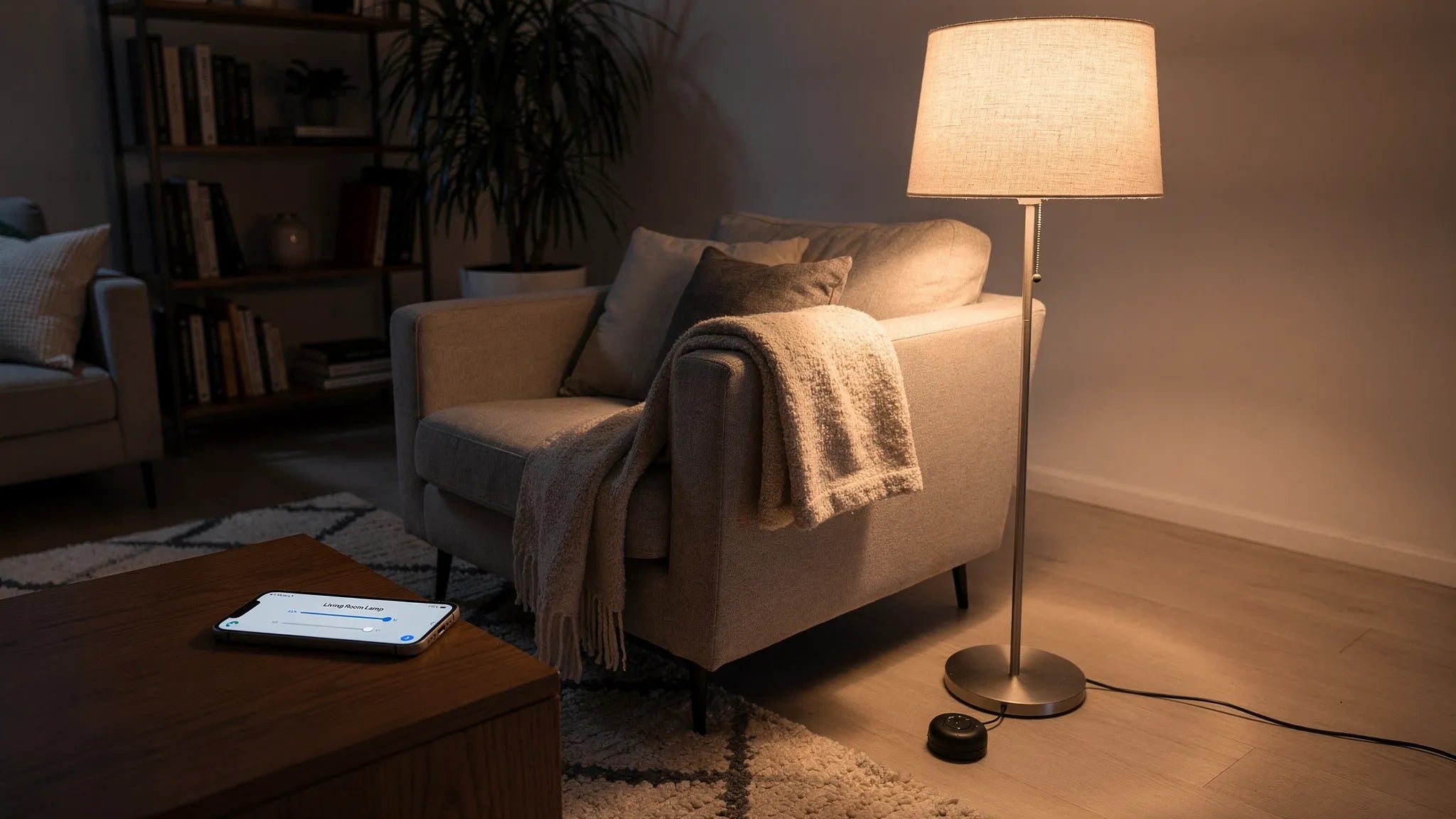
Dimmable Floor lamps: Which types of dimmers are really flicker-free
Who one dimmable Floor lamps If you want to buy something, you are usually looking for more than “just” cozy light: it shouldn’t be annoying when reading, it shouldn’t flicker during video calls and it should appear pleasantly warm in the evening. This is exactly where many setups fail because “dimmable” does not mean automatic flicker-free. What is crucial is like is dimmed and whether dimmers, lamps and LED drivers fit together.
Below you will find the types of dimmers that work in practice with little to no flicker, including typical pitfalls with floor lamps (socket dimmers, foot dimmers, smart bulbs).
What does flickering actually mean when dimming?
flicker rapid fluctuations in brightness. With LEDs it is often not caused by the LED itself, but by the combination of:
- Mains frequency (in Germany 50 Hz, after rectification often 100 Hz components)
- LED driver (Electronics that regulate current and voltage for the LED)
- Dimmer principle (e.g. leading edge, trailing edge, PWM)
Important: Some people are consciously aware of flickering, others are not. Nevertheless, it can be noticeable, for example as Eye strain, headache, restlessness while reading or as “banding” on smartphone videos.
For the technical background, the IEEE recommendation is IEEE 1789-2015 a frequently cited guidance on flicker risks (without automatically “clearing” a product).
Types of dimmers for floor lamps: what is it and how flicker-free is it?
When it comes to floor lamps, you encounter two worlds in practice:
- Floor lamps with replaceable light source (E27/E14/GU10 etc.)
- Floor lamps with integrated LED module (Driver permanently installed, often with touch, button or remote control)
The dimmer technology differs greatly depending on the situation.
Overview: Dimmer types and flicker risk
| Dimmer type | Where typical for floor lamps? | Technical principle (simplified) | Flicker practice | Typical risks |
|---|---|---|---|---|
| Leading Edge (TRIAC) | Socket/cord dimmer, older installations | “cuts” the sine wave at the beginning | Often problematic with LEDs | Humming, poor control range, visible flickering, LED goes out at low level |
| Trailing Edge (MOSFET) | Higher quality LED dimmers (also as cord dimmers) | “cuts” the sine wave at the end | Often the best choice for dimmable LED retrofit lamps | Still dependent on LED driver/bulb compatibility |
| PWM dimming (pulse width modulation) | Integrated LED floor lamps, smart bulbs, LED drivers | LED on/off very quickly | Can be very good if frequency is high enough | Strong flickering and camera artifacts at low PWM frequency |
| CCR / analogue dimming (constant current reduction) | High quality LED drivers in lights | Electricity is really reduced | Usually very low flicker | Not every LED light supports this, often only in better drivers |
| 0-10V / 1-10V | Rare in classic floor lamps, more architectural/object | Control line regulates driver | Very good if implemented cleanly | Needs a suitable system, rarely “plug and play” |
| DALI | Professional projects (architecture, object) | Digital control protocol | Very good, system dependent | Usually overkill for individual floor lamps at home |

Which types of dimmers are “truly flicker-free”?
Quite honestly: There is no blanket list without context, because the result always depends on the driver and light source. But there are combinations that work much more often in practice with less flicker.
1) Integrated LED driver with CCR dimming (top pick)
If one Floor lamps has an integrated LED module and the manufacturer has one good constant current driver installed, the analog (CCR) dimming, this is often the solution with the lowest flicker. Here the LED and driver are designed as a system.
How do you recognize that?
- Data sheets often say “CCR, analogue dimming, constant current reduction“.
- Often there is one Button/touch dimmer or one Remote control, and it is not dimmed via an external socket dimmer.
2) High frequency PWM dimming (very good if done correctly)
PWM is not automatically bad. That's what's crucial Frequency and how cleanly the driver controls.
- Low PWM frequencies (in simple terms: in the range of a few hundred Hz) can become visible.
- Higher frequencies (often in the kHz range) are significantly less critical in practice.
Unfortunately, many manufacturers do not specify the PWM frequency. Then the only solution is to test (see below).
3) Trailing edge dimmer (trailing edge) + “dimmable” LED lamp (solid solution)
For floor lamps with E27/E14 This is often the best way if you want to use an external dimmer.
Important:
- Use when possible phase section instead of phase control.
- Make sure that the LED lamp expressly says “dimmable“ is.
- However, it can still happen that a certain LED bulb flickers with a certain dimmer. This is a compatibility issue, not necessarily a quality judgment about just one component.
4) Dimming the Smart Bulb (convenient, but not always flicker-free)
Smart bulbs dim internally (often via PWM). This can work great or be annoying, depending on the product.
If you use smart bulbs:
- Dim in the app, not additionally with a socket dimmer.
- If you want to use a wall switch, then go with one smart compatible switch or a system provided by the manufacturer.
Practical decision: Which dimmer solution is right for you Floor lamps?
| Yours Floor lamps is… | Best low-flicker dimming option | What you should avoid |
|---|---|---|
| E27/E14 with dimmable LED bulb | Trailing edge dimmer (cord/foot dimmer or wall dimmer, suitable for the load) | Cheap universal plug-in dimmer, phase control without LED release |
| Integrated LED with touch/dimmer button | Dimming provided by the manufacturer (Driver+LED matched) | External socket dimmer between Power plug and lamp |
| SmartFloor lamps / Smart Bulb | App dimming, scenes, manufacturer-compliant switch if necessary | Additional dimming via external TRIAC dimmer |
| Architecture/project solution | 0–10 V, DALI (with suitable driver) | Tinkering solutions without proper system planning |
Typical flicker traps in dimmable floor lamps
“LED dimmable” does not mean “dimmable with any dimmer”
LED retrofit bulbs have internal electronics. Some people get along well with phase control, many run better with phase control, some are very picky.
Minimum load and control range
The lower area is particularly critical with external dimmers:
- The lamp first flickers under 30 percent.
- Or she leaves suddenly off.
- Or she hums.
This is often an interaction between dimmer characteristics and driver behavior.
Multiple dimming (please don’t)
A classic: Smart Bulb + socket dimmer + app dimming. This is almost guaranteed to lead to problems.
Here's how to test at home whether yours Floor lamps dims without flickering
These checks do not replace a measuring device, but are suitable for everyday use:
- Smartphone slow motion: Film the light source in slow motion. If noticeable dark “bars” move, this is an indication of flicker or PWM artifacts.
- Swivel test: Move your hand quickly in front of the light source. If you see “strobe effects” (multiple hand edges), it is probably flickering.
- Check critical area: Don’t just dim to “50 percent”, but do special testing very low (5 to 20 percent), this is where most problems arise.
If you are generally struggling with flickering, this troubleshooting guide will also help: Flickering lamps: what to do if the light flickers?
Buying Checklist: Dimmable Floor lamps find without flickering
Pay attention to these points when purchasing (or before retrofitting):
- Clarify lamp type: replaceable light source or integrated LED module?
- Clarify dimming path: via external dimmer (cord/foot/wall) or integrated (touch/button/remote control)?
- Check compatibility: If dimming is carried out externally, it must Dimmer + LED fit together (ideally manufacturer instructions/compatibility lists).
- Don't forget the quality of light: A high CRI is usually worthwhile for living spaces (colors appear more natural). As an overview this fits: Lamp with LED: advantages, light color and dimming explained
- Dimming behavior in everyday life: Smooth? No jumps? No hum? Stable at low brightness?
When is one worth it? Floor lamps with an integrated dimmer especially?
Integrated dimming is often the most stress-free solution when you:
- Dim down very low in the evening would like (bedroom, cozy living room)
- sensitive to flicker
- Don't feel like experimenting with dimmer compatibility
- Looking for a very quiet light for reading or concentrated work
A dimmable one can be used especially for atmospheric concepts Floor lamps They also work perfectly with indirect light, for example as an uplight on the wall or ceiling. You can find inspiration for this in: Indirect lighting in the living room
Frequently asked questions (FAQ)
Which type of dimmer is best for LED floor lamps? One is usually the most reliable Floor lamps with integrated dimming (driver and LED are coordinated with each other). For E27/E14 LEDs, a trailing edge dimmer often works best.
Are foot dimmers automatically flicker-free? No. A foot dimmer is just the design. The decisive factor is whether it is technically suitable for trailing edge technology and whether it fits the LED or driver.
Why does my dimmable flicker? Floor lamps only at low level? The lower dimming range is the most demanding for LED drivers. Often the dimmer and light source are not optimally compatible or the dimmer requires a different minimum load.
Can I have an integrated LEDFloor lamps Dimming with a socket dimmer? Generally not recommended. Many integrated LED drivers are not designed for external leading edge/leading edge dimmers. This often leads to flickering, humming or failures.
How do I know when buying online whether one Floor lamps is flicker-free? Look for clear information about the dimming technology (e.g. driver, dimming interface) and for information such as “flicker-free” or driver quality. If no information is available, often only a practical test and a good return policy will help.
Low-flicker light that really fits into your room
If you have a dimmable one Floor lamps Looking for something that not only looks good, but also looks good Height, color and suspension fits your home, it's worth going to a shop with real customization options. At BUYnBLUE You will find a curated selection of modern designer lights, and many models (especially pendants and chandeliers) can be adapted free of charge to your room situation, for example cable length, canopy or color.
Browse directly through the range buynblue.com or get advice from support if you are planning a low-flicker, dimmable setup for your living room, reading corner or home office.


