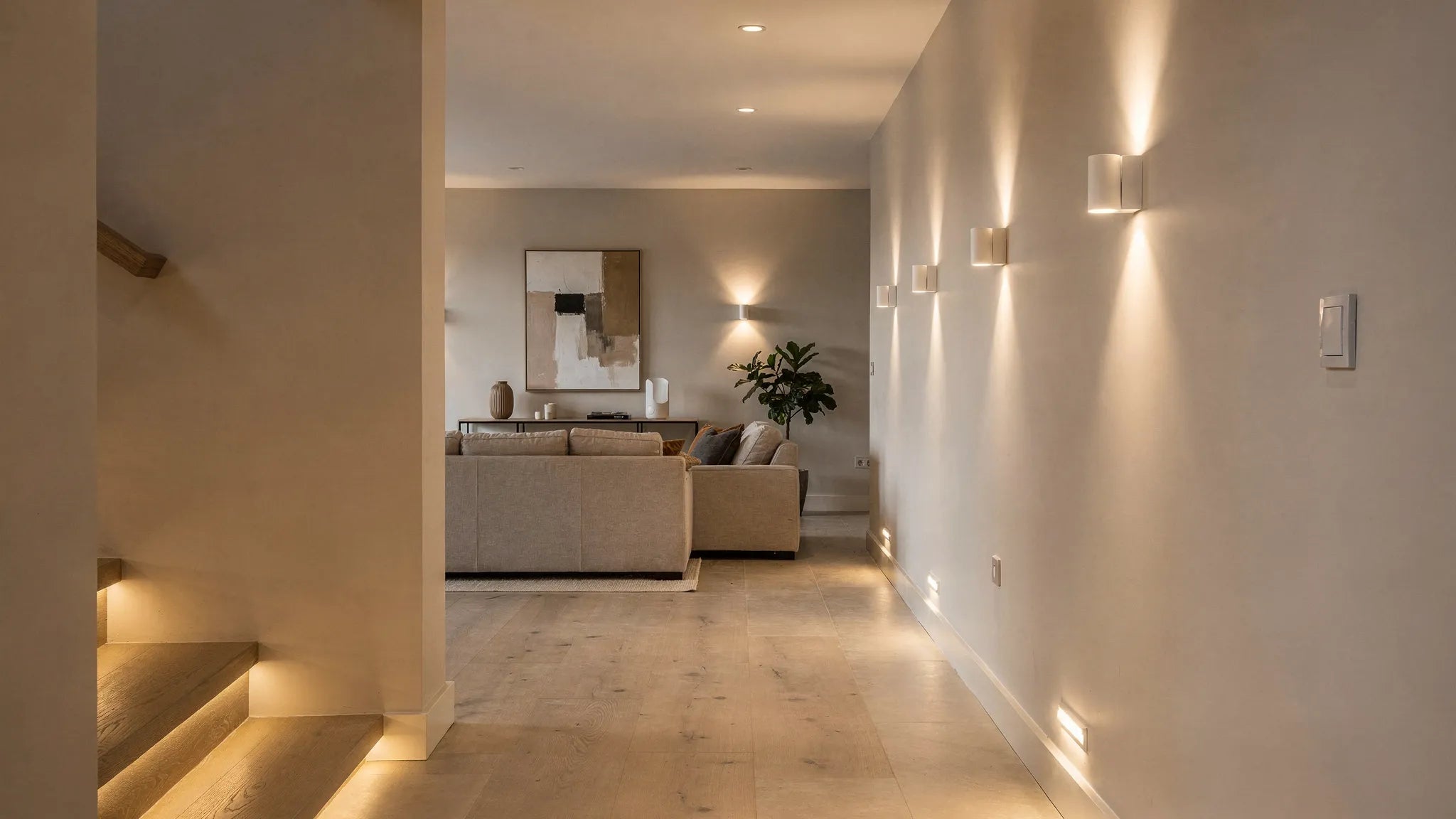
LED wall light: Indirect light for hallways, stairs and living rooms
A well-planned LED wall light can do more than just brighten a dark wall. Used correctly, it makes hallways more inviting, stairs safer and living rooms much more comfortable. The crucial point: Instead of shining directly into the room, it directs light onto the wall or ceiling. This creates a soft, glare-free brightness that emphasizes architecture and makes rooms appear more high-quality.
Indirect light is an effective design tool, especially in modern living concepts. It takes up little space, works even in narrow areas and can be easily combined with ceiling lights, pendant lights, floor lamps or LED strips. So if you are looking for an LED wall light for the hallway, stairs or living room, it is worth paying attention not only to the design, but also to the light color, radiation, mounting height and dimming function.

What does indirect light mean in an LED wall light?
Indirect light occurs when the light source does not shine directly on eyes, floor or furniture, but first illuminates a surface. This surface, usually a wall or ceiling, reflects the light into the room. The result is softer, more uniform and more pleasant than a visible point of light.
With an LED wall light, this often happens through a shielded light source. The light emerges upwards, downwards or on both sides. Up and downlights, linear wall lamps, lamps with diffusers and models that create a decorative light pattern are particularly popular. In contrast to classic wall spots, this is less about maximum brightness and more about atmosphere, orientation and spatial effect.
A big advantage of LED technology is its compact design. LEDs can be integrated into very flat, sculptural or minimalist lights. This means that modern wall lights not only look functional, but also like a part of the interior design.
Why LED wall lights are ideal for hallways, stairs and living rooms
Hallways, stairs and living rooms have very different requirements for light. This is exactly why the LED wall light is so versatile. In the hallway, light must provide orientation without overloading the often narrow space. Safety is paramount on stairs. In the living room, light should relax, provide structure and stylishly highlight furniture or wall surfaces.
An LED wall light fulfills these tasks particularly well because it activates vertical surfaces. The eye perceives illuminated walls more clearly than just illuminated floors. This makes a room appear brighter, larger and more homely, even if the actual light output is relatively moderate.
LEDs are also efficient, long-lasting and easy to control. Many modern lights are dimmable or can be combined with smart systems. This is particularly practical if you want the same room to appear functional during the day and cozy in the evening. You can also find more basics on holistic planning in BUYnBLUE-Guide to LED lighting with 3-layer light.
The main types of indirect LED wall lights
Not every wall light creates the same effect. What is crucial is how the light is designed and which area is illuminated.
| Type of LED wall light | Light effect | Particularly suitable for |
|---|---|---|
| Up and downlight | Light up and down, often with a graphic beam of light | Hallway, stairs, living room wall |
| Uplight | Light only upwards, the ceiling is brightened | Living room, high hallways |
| Downlight wall lamp | Light downwards, rather functional and quiet | Stairs, entrances, passages |
| Diffused wall light | Soft light through glass, acrylic or fabric | Living room, bedroom, cozy hallways |
| Linear LED wall light | Narrow, modern light line | Minimalist rooms, long walls, flights of stairs |
| Adjustable wall light | Light alignment can be flexibly adjusted | Reading corners, gallery walls, multifunctional rooms |
For indirect lighting, shielded models are usually more pleasant than open lights. Visible LED dots can be dazzling or appear unsteady, especially at eye level. Therefore, pay attention to diffusers, matt covers or a lighting system where the LED itself is not directly visible.
LED wall light in the hallway: bright, inviting and space-saving
The hallway is often the first room that guests enter, but is often underestimated when planning lighting. A single ceiling lamp in the middle quickly creates harsh shadows and makes narrow hallways appear even narrower. Indirect wall lights create a much more high-quality impression here.
In long hallways, several LED wall lights in a consistent rhythm are suitable. They guide the eye through the room and avoid dark areas. It looks particularly harmonious when the lights are mounted on one side of the wall and the opposite wall reflects the light softly. In very narrow hallways, flat lights are important so that they do not protrude into the walkway.
A warm white to neutral warm light color is ideal for the hallway. Around 2,700 to 3,000 Kelvin looks homely, 3,000 to 3,500 Kelvin looks a little clearer and more modern. If the hallway does not have additional ceiling lighting, the wall lamp should not only be decorative, but also provide sufficient luminous flux. If you have several lights, moderate lumen values per light are often sufficient because the light adds up.
Motion detectors or smart circuits are practical, especially in entrance areas. The light turns on automatically when you come home with shopping bags, jacket or luggage. Even at night, a gently dimmed hallway light is more pleasant than a bright ceiling lamp.
LED wall light on the stairs: safety without bright light
On stairs, good light is not just a design issue, but a safety factor. Steps must be clearly visible without the luminaire dazzling. Indirect LED wall lights are very suitable for this because they make contours visible and at the same time create a calm lighting atmosphere.
There are two proven approaches for stairs. The first is to install wall lights along the mid-height flight of stairs. Up and downlights or flat linear models that emphasize the course of the stairs are suitable here. The second approach is low orientation lights near the steps. These provide less room light, but mark the tread surfaces very precisely.
A consistent rhythm is important. Distances that are too large create bright and dark sections, which can be irritating on steps. For wall lamps along a staircase, mounting them on the inside is often particularly elegant if the structural situation allows it. However, it is always crucial that no light shines directly into the eye, neither when going up nor when going down.
Also plan switching points at the beginning and end of the stairs. Motion detectors can be useful, but they should react reliably and not switch on too late. The following applies to hard-wired lights: Work on 230 V lines should be carried out by a qualified electrician.
LED wall light in the living room: atmosphere instead of uniform light
Indirect wall lighting shows its greatest design strength in the living room. It can make a sofa area more comfortable, relieve a TV wall, subtly accompany works of art or activate a dark room area. In contrast to the ceiling light, the light comes from the side and therefore appears more homely.
An LED wall light behind or next to the sofa is particularly nice. The light shines across the wall and creates depth. Also Left and to the right of a sideboard, fireplace or shelf, wall lights can create a calm setting. If you like reading, the wall light should not only shine indirectly. Then an adjustable model or an additional reading light makes sense.
Warm white light is usually the best choice for the living room. 2,700 Kelvin looks classically cozy, 3,000 Kelvin looks a little fresher and more modern. Very cold light can quickly appear restless or matter-of-fact in the living area. If art, wooden surfaces, textiles or wall colors are to be shown to their best advantage, a high color rendering index is also worthwhile. CRI 80 is solid, CRI 90 or higher often appears visibly more natural in high-quality interiors.
Dimming function is particularly valuable in the living room. In the evening, low brightness is often sufficient, while more light is needed when tidying up, playing or welcoming guests. A combination of wall lights, ceiling or pendant lights and mobile light sources is ideal. This creates a flexible lighting concept instead of a single bright light source.
Guide values for height, distance, light color and brightness
The perfect placement depends on the room height, lamp design, wall color and usage. Nevertheless, some guidelines will help with initial planning.
| area | Recommended mounting height | light color | Typical use |
|---|---|---|---|
| hallway | approx. 160 to 180 cm, depending on the lamp and eye level | 2,700 to 3,500 K | Orientation, inviting atmosphere |
| Staircase, wall mounting | approx. 140 to 170 cm along the course of the stairs | 2,700 to 3,000 K | safe guidance, low-glare light |
| Stairs, low orientation lights | approx. 20 to 40 cm above the step level | 2,700 to 3,000 K | Marking steps, night orientation |
| Living room | approx. 150 to 180 cm, depending on furniture and design | 2,700 to 3,000 K | Atmosphere, accent lighting, wall design |
| Next to sofa or sideboard | Align with furniture height and line of sight | 2,700K | cozy light zone, decoration |
When it comes to distances between multiple wall lights, 1.5 to 2.5 meters is a common starting point. In long hallways, even spacing can look very elegant. In the living room, the placement can be more free, as furniture, pictures and lines of sight are more important than strict symmetry.
The wall color also plays a big role. Bright, matt walls reflect light softly and efficiently. Dark walls absorb more light, but have a particularly dramatic effect with targeted uplights and downlights. Shiny surfaces can cause reflections, which is why lights should be chosen to be particularly glare-free.
What you should pay attention to when buying an LED wall light
A beautiful shape alone is not enough. A good LED wall light must match the room situation, the existing electrical installation and the desired feeling of light.
Pay particular attention to these criteria:
-
Light emission: For indirect light, the LED should be shielded or reflect over the wall and ceiling.
-
Light color: 2,700 to 3,000 Kelvin is usually ideal for comfort, but it can be a little clearer for hallways.
-
Brightness: Check the lumen information and plan several lights if the wall light is also intended to provide basic light.
-
Dimmability: Only dimmable lights and compatible dimmers work reliably together.
-
Color rendering: CRI 80 is suitable for everyday use, CRI 90 or higher is particularly beautiful for living spaces, art and high-quality materials.
-
Height and depth: In hallways and stairwells, lights should be flat enough so that they do not become a nuisance.
-
Material and surface: Metal, glass, acrylic or wood change both the style and the lighting effect.
-
Type of installation: Clarify whether a wall connection is available or whether a solution with a plug, cable duct or battery is an option.
If you are unsure, it helps to look at the room in the evening. Where do dark corners arise? Which wall surfaces could reflect light? Which lines of sight should be emphasized? An LED wall light works best when it is not selected in isolation, but rather as part of an overall concept.
Common planning errors with indirect wall lights
The most common mistake is too bright light at eye level. Uplights and downlights in particular often look spectacular in product photos, but can cause unpleasant glare if the LED is poorly shielded. Therefore, always check whether the light output matches the planned installation height.
A second mistake is a light color that is too cold. Neutral white light can be practical in hallways, but it quickly becomes uncomfortable in the living room. When multiple light sources are combined, the color temperatures should also match each other. A warm white wall light next to a cold white ceiling lamp rarely creates a harmonious overall picture.
Incorrect distances are also problematic. Too many lights make the room uneasy, too few create dark gaps. On stairs this can even make orientation worse. It is better to plan with a clear rhythm and, if possible, test the effect with a temporary light source before the final assembly.
Another point is the wall quality. Indirect light shows unevenness, plaster structures and color transitions more clearly than diffuse room light. This may be desired, for example with natural stone or textured plaster. On very unsettled or damaged walls, grazing light can also emphasize flaws.
How to combine LED wall lights with other light sources
An LED wall light is rarely the only source of light in the room. It has the strongest effect when combined with other lights. In the hallway it can replace or complement a ceiling light. On the stairs it takes over orientation and atmosphere. In the living room it creates an accent or mood zone.
For a harmonious home, a mixture of three types of light is recommended: basic light for general brightness, zone light for specific activities and accent light for mood. Wall lights often lie somewhere between zone and accent lighting. They make rooms more usable, but above all more pleasant.
In the living room, a pendant light above the coffee table or dining table can form the centerpiece, while LED wall lights gently brighten the walls. In open living areas, wall lights visually connect individual zones with each other. If you are also planning pendant lights or chandeliers, the cable length, ceiling rose or color can be adjusted free of charge BUYnBLUE particularly helpful so that the lights match the room height and furnishings exactly.
Further information on calculating brightness can be found in the guide LED lighting: This is how you calculate lumens per m² correctly. The article is also worthwhile for a deeper introduction to wall lamps in general Wall lights - The inviting light from the side.
Care, lifespan and suitability for everyday use
LED wall lights are generally easy to care for. However, dust on diffusers, glass or metal surfaces reduces the lighting effect. Regular cleaning with a soft, dry or slightly damp cloth is usually sufficient. You should avoid aggressive cleaning agents, especially on painted or anodized surfaces.
When it comes to integrated LED modules, it is worth taking a look at the quality and workmanship. High-quality LEDs and good heat dissipation ensure that the light works reliably for a long time. Make sure that the light does not overheat in narrow niches and that ventilation or cooling surfaces are not covered.
In areas with higher humidity, such as near entrances, unheated hallways or adjacent to bathrooms, the protection type should also be taken into account. IP20 is often sufficient for normal living spaces. Higher requirements apply in damp rooms or outdoor areas. If a wall light is to be used in the bathroom or outside, the appropriate IP protection class should definitely be checked before purchasing.
FAQ: LED wall light and indirect light
Which LED wall light is best suited for indirect light? Shielded up and downlights, uplights, linear LED wall lights and models with a matt diffuser are particularly suitable. It is important that the LED does not directly glare, but illuminates the wall or ceiling.
How high should an LED wall light be mounted in the hallway? The installation height is often around 160 to 180 cm. However, the specific luminaire is crucial: the light emission should not dazzle directly at eye level and at the same time illuminate enough wall space.
Which light color is ideal for LED wall lights in the living room? For the living room, 2,700 to 3,000 Kelvin is usually ideal. This warm white light color looks cozy, high-quality and goes well with wood, textiles and homely wall colors.
Are LED wall lights bright enough as the only light source? This depends on the number, lumen value, wall color and room size. In hallways, several wall lights can often be sufficient. In the living room they are usually better suited as a complement to ceiling, pendant, floor or table lamps.
Can I install an LED wall light myself? You can often install lightweight plug solutions or battery-powered lights yourself. For safety reasons, the installation of hard-wired 230 V wall lights should be carried out by a qualified electrician.
Stylish indirect light with BUYnBLUE plan
An LED wall light can noticeably enhance the hallway, stairs and living room if the lighting effect, placement and design match. At BUYnBLUE You will find a curated selection of modern designer lights for different living areas, combined with high-quality materials, free worldwide shipping, secure payment, real-time order tracking, 14-day return policy and 24/7 customer support.
If you would like to take your lighting concept further, discover suitable modern lights directly here BUYnBLUE. For pendant lights and chandeliers BUYnBLUE We also offer a free adjustment service, for example for cable length, ceiling rose or color, so that your lighting not only looks beautiful, but also fits perfectly with the room height, floor plan and living style.