LEDFloor lamps Buy: check photo, height and dimming
An LEDFloor lamps can make a living room more comfortable, functionally enhance a reading corner or provide useful lighting for a room without a ceiling connection. Nevertheless, when purchasing it, it is often selected based on the design photo. This is exactly where most bad purchases occur: The light is blinding, the light is too low, the dimmer flickers or the light pattern doesn't suit the usage.
If you have one LEDFloor lamps buy, you should therefore not only pay attention to style and color. Three questions are crucial: How does the lamp distribute its light? Does the height match the seat or room height? And can the brightness be dimmed properly? This guide shows you how to check these points before purchasing and a Floor lamps find one that really works in everyday life.
Why an LEDFloor lamps is more than additional light
Floor lamps are particularly flexible because they do not require a ceiling connection and can be repositioned when the furnishings change. This makes them ideal for rental apartments, reading areas, sofa areas, bedrooms and open living areas. In rooms without a central ceiling outlet, they can even become part of the basic lighting, especially in combination with table lamps, wall lights or indirect light. You can find out more about this in BUYnBLUE-Guide on the topic Optimally illuminate a room without a ceiling connection.
LED technology brings additional advantages: it is efficient, compact, durable and enables slim designs that would be more difficult to implement with classic lamps. But LED alone is not a promise of quality. A strong LED can cause unpleasant glare, a light that is too weak can get lost in the room and a bad driver can flicker when dimming.
That's why it's worth taking a closer look at the light image, height, brightness and operation.
1. Check the light image: direct, indirect or diffuse?
The light image describes how a lamp actually illuminates the room. With an LEDFloor lamps it is often more important than the pure lumen number. 1,000 lumens that shine softly onto the ceiling have a completely different effect than 1,000 lumens that shine directly at eye level.
Basically, floor lamps can be classified according to their lighting effect:
| Photograph | Typical lamp shape | Ideal for | What to pay attention to |
|---|---|---|---|
| Indirectly upwards | Uplighter, uplight | Basic mood, living room, dark corners | Light ceilings enhance the effect, dark ceilings absorb light |
| Straight down | Reading lamp, arc lamp, spot | Reading, needlework, coffee table | Avoid glare, the light beam should hit the target zone |
| Diffuse all around | Shade lamp, opal glass, fabric shade | Atmosphere, bedroom, lounge | Shade material influences light color and shadow formation |
| Accentuated | Adjustable spot, narrow light source | Art, plants, shelves, architectural details | Do not point it too directly into the eye or onto shiny surfaces |
| Combined | Floor lamp with reading arm and uplight | Multifunctional living areas | Separate switching or dimming is particularly practical |
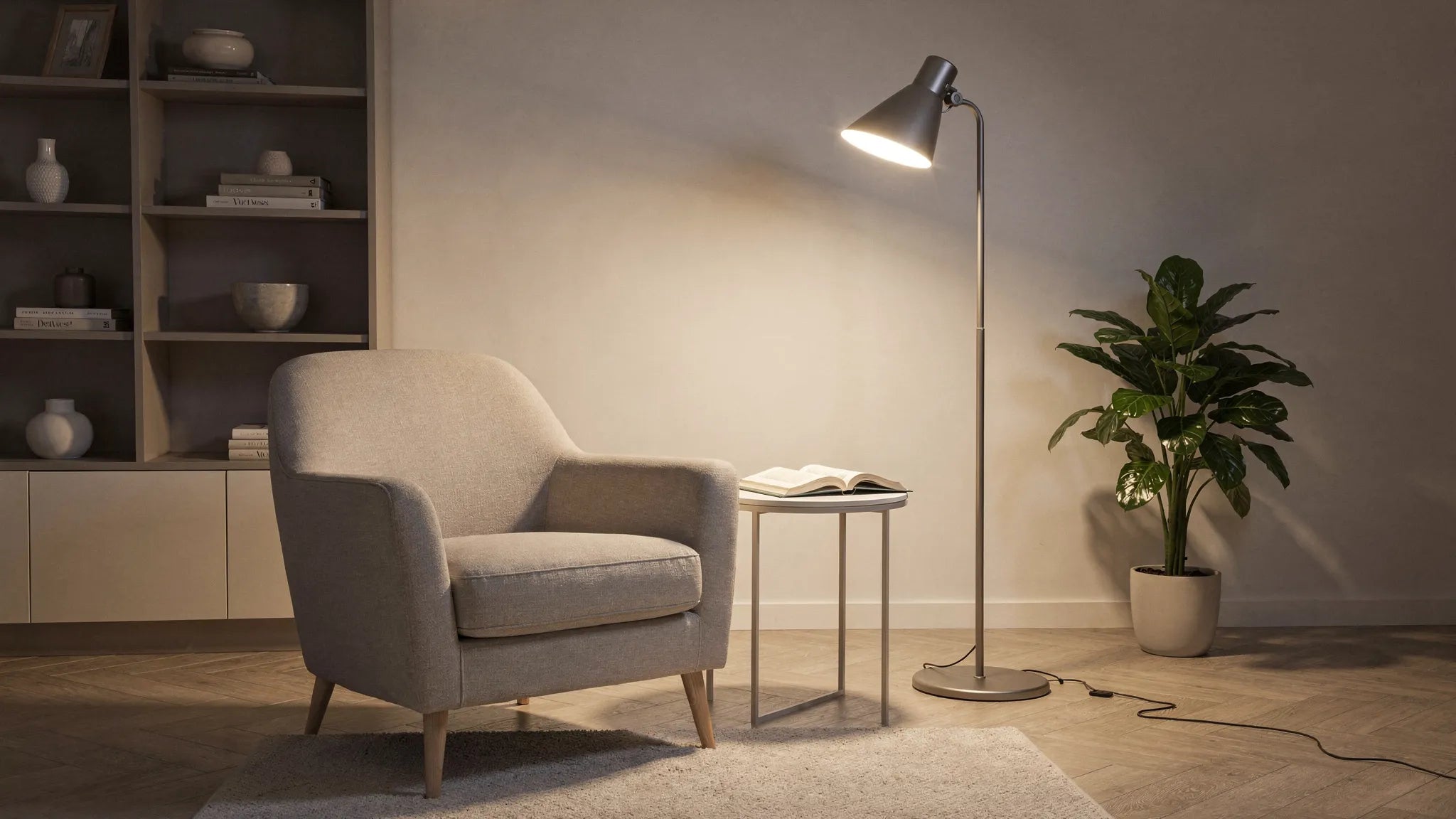
For the living room, an indirect or diffuse LEDFloor lamps often more pleasant than a purely direct light source. It reduces harsh shadows and creates depth. For the reading chair, on the other hand, you need directed light that illuminates the book or newspaper brightly enough. A good solution is often a combination: an uplighter for atmosphere and an additional adjustable reading arm for function.

Detect glare before it becomes annoying
Glare is one of the most common reasons why a Floor lamps Despite its beautiful appearance, it seems unpleasant in everyday life. Therefore, check whether the LED source is directly visible. Visible LED dots can be particularly annoying at eye level, for example next to the sofa or bed.
Pay attention to three typical situations: If you are sitting next to the lamp, the light source should not fall directly into your field of vision. If there is a television in the room, it should Floor lamps do not create any reflections on the screen. For arc lights, the shade should be low enough to hit the table or reading area, but not so low that you can see under it or bump into it.
A frosted diffuser, a low-slung shade or an upward light emission can significantly reduce glare. For cozy living areas, low-glare light is usually more important than maximum brightness.
2. The right height: proportion, line of sight and function
The height of an LEDFloor lamps decides whether it appears elegant or stands restless in the room. It also influences whether the light is pleasant or blinding. One Floor lamps should always match the seat height, furniture height and room height.
With a reading lamp, the position of the light exit is crucial. The light should fall on the reading surface from a slight angle above or to the side without shining directly into the eye. For orientation: For many adults, the eye height when sitting is between 100 and 120 cm. A reading lamp should therefore be planned in such a way that the shade or light source does not cause visible glare from the front above this line.
With an uplighter, however, the room height counts. The higher the light exit is and the brighter the ceiling, the softer the light is distributed. However, in very low rooms, high floodlights can appear bulky. In small rooms, slim, vertical models are often more harmonious.
| Location | Good altitude logic | Common mistake |
|---|---|---|
| Next to the sofa | Light emission slightly above or next to the sitting position | The shade sits exactly at eye level and is blinding |
| Reading chair | Adjustable head or arm meets book surface | Light falls behind the reader instead of on the page |
| bedroom | Diffused light within easy reach, not too bright | Light next to the bed that is too high or too bright |
| Open living area | Higher lights visibly zone the area | A light that is too small gets lost between furniture |
| Arch over coffee table | Measure the projection and clearance height in advance | Arch protrudes into walkways or appears unstable |
The standing area is also part of the height test. A tall or expansive one Floor lamps needs a stable foot. This is particularly important with arc lights because the center of gravity can be outside the base. Before purchasing, check whether the base fits under the sofa, sideboard or table edge and whether the cable can be routed safely.
3. Choose brightness, light color and color rendering sensibly
Even if the photograph is in the foreground, technical values remain important. For LEDs, lumen is a better orientation than watt. Watt describes the power consumption, lumen the amount of light emitted. You can find a detailed explanation in the article Watt and lumen, what's the difference?.
For a single LEDFloor lamps These values serve as a practical guide, depending on the size of the room, wall color, shade material and the desired effect:
| Usage | Sensible brightness | light color | Recommendation |
|---|---|---|---|
| Mood lighting | approx. 300 to 800 lumens | 2,200 to 3,000 K | Warm, soft, dimmable |
| Complementary living room lighting | approx. 800 to 1,500 lumens | 2,700 to 3,000 K | Indirectly or diffusely pleasant |
| Read | approx. 500 to 1,000 lumens as directed light | 2,700 to 3,500 K | Aim glare-free at a book or newspaper |
| Home office zone | approx. 800 to 1,500 lumens in addition to the work light | 3,000 to 4,000 K | More neutral, more concentrated, without screen reflections |
| Accent light | approx. 200 to 700 lumens | depending on the material | Pay attention to CRI, especially for art and textiles |
For living spaces, warm white light between 2,700 and 3,000 Kelvin is usually perceived as pleasant. For concentrated work it can be more neutral. Also pay attention to the color rendering index CRI or Ra. For general living areas, CRI 80 is often sufficient; for high-quality materials, art, wood, fabrics or areas close to make-up, CRI 90 or higher appears more natural.
4. Check dimming: comfort, atmosphere and freedom from flicker
A dimmable LEDFloor lamps is almost always the better choice because it takes on several functions. It can be lighter in the morning and softer in the evening. When reading, it provides targeted light, while during a movie night it only provides a gentle background atmosphere.
What is important, however, is that not every LED can be dimmed automatically. It depends on whether the light has an integrated LED module or works with replaceable light sources.
With integrated LED floor lamps, the LED, driver and dimmer are usually coordinated with each other. This can be particularly convenient if a touch dimmer, remote control or stepless control is integrated. But check whether the light is really dimmable, how low it dims and whether it flickers visibly during the dimming process.
For floor lamps with an E27 or E14 socket, the ability to dim depends on the LED bulb used and the dimmer. A dimmable light source only works reliably if the dimmer matches it. Old foot dimmers in particular can cause flickering, buzzing or uneven dimming.
| Dimming solution | advantage | Check before purchasing |
|---|---|---|
| Integrated touch dimmer | Fast, direct, without accessories | Is the lowest level really pleasantly dark? |
| Foot dimmer on the cable | Practical next to a sofa or armchair | Position accessible, LED compatible, no flickering |
| Remote control | Comfortable for living room and bedroom | Range, memory function, batteries |
| App or smart control | Scenes, schedules, color control possible | Compatibility with your own system |
| Dimmable LED bulb | Bulbs can be replaced later | Bulbs and dimmers must fit together |
A good practical test is simple: the lamp should glow stably at a low dimming level without visibly pulsating. The light should react evenly even when slowly dimming up and down. If you are sensitive to flickering or use the lamp for a long time while reading, it is worth looking for low-flicker models or high-quality LED drivers.
You can find more basics about LED technology and dimmability in BUYnBLUE-Guide Lamp with LED: advantages, light color and dimming explained.
5. Do not underestimate material, stability and operation
An LEDFloor lamps is a furniture object and a commodity at the same time. Therefore, in addition to the light, you should also check the workmanship and suitability for everyday use. A heavy, cleanly crafted base provides security, especially with tall or expansive models. Felt or rubber protectors under the base protect sensitive floors.
The cable should be long enough without running across walkways. A switch on the cable is only practical if it remains accessible. For lights behind the sofa or next to a sideboard, a higher switch, foot switch or remote control is often more convenient.
When it comes to integrated LED modules, it is worth taking a look at efficiency and repairability. The current one EU energy label for light sources helps to better classify energy consumption. When it comes to high-quality designer lights, it's not just efficiency values that are relevant, but also material quality, lighting comfort, service life and availability of spare parts.
Which LEDFloor lamps fits which room?
An LED light works in the living roomFloor lamps particularly good as part of a multi-layered lighting concept. Combine them with ceiling, wall or table lamps instead of lighting the entire room from just one source. Indirect floodlights or diffuse umbrella lights are suitable for cozy evenings. Models with an additional reading arm are ideal for sofa corners with a reading function.
It should be in the bedroom Floor lamps be soft and not too light. Warm white light, good dimming and operation from bed are more important than maximum lumens. Avoid cold white light right before bed.
In the home office one can Floor lamps Improve room brightness, but does not always replace an ergonomic desk lamp. Make sure it is placed to the side of the screen without glare. Light reflected in the monitor causes fatigue more quickly.
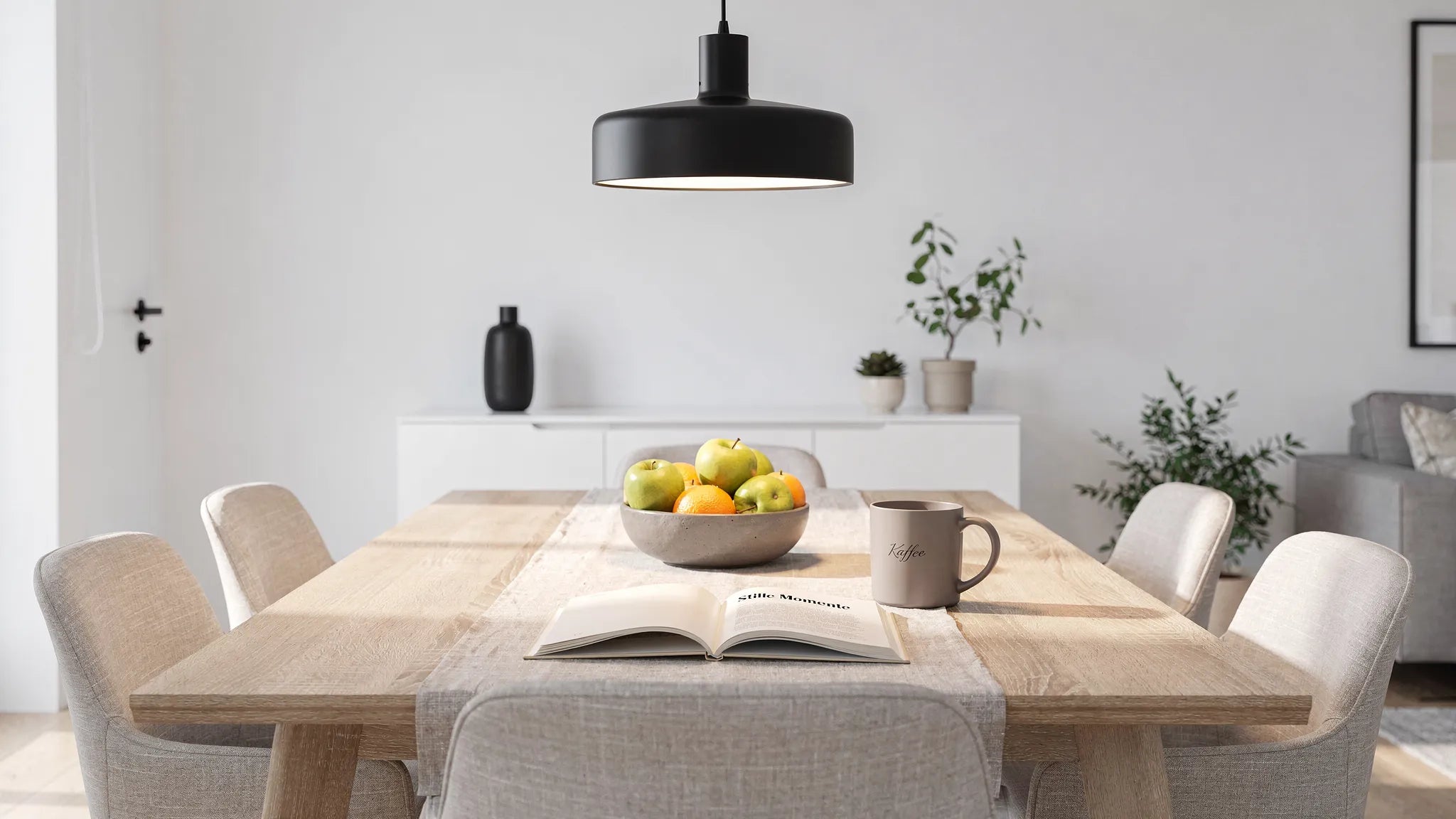
In the dining or living area with an open plan structure, an arc light can help define a zone if a pendant light is not to be installed. Carefully measure the projection, footprint and passageways. If you want a lamp to sit above the table permanently, a pendant lamp may be more harmonious in the long term.
For small rooms, slim LED floor lamps with a vertical light pattern are often the best choice. They draw the eye upwards, take up little space and can brighten dark corners. You can find more ideas for a cozy lighting atmosphere in the article Indirect lighting in the living room.
Mini pre-purchase checklist
- Check whether the Floor lamps mainly intended to provide atmosphere, reading light, accent light or basic brightness.
- Decide whether the light should be direct, indirect or diffuse.
- Measure floor space, cable routing, furniture height and possible walking paths.
- Make sure that the light source does not directly blind you while sitting.
- Choose lumens to suit the task, not watts.
- Use warm white light for coziness and more neutral light for work zones.
- Check dimmability, lowest dimming level and possible tendency to flicker.
- Compare integrated LED modules with replaceable bulbs.
- Make sure it has a stable base, high-quality materials and accessible switches.
- Match the design, height and proportion to the sofa, armchair, table and room size.
Frequently asked questions about LEDFloor lamps
How bright should an LEDFloor lamps be in the living room? For pure atmosphere, 300 to 800 lumens are often sufficient. If the lamp is intended to noticeably brighten a dark area, around 800 to 1,500 lumens make sense. But the light image is crucial: indirect light appears softer, directed light appears brighter on a certain surface.
What color of light is suitable for an LEDFloor lamps most pleasant? For living rooms and bedrooms, 2,700 to 3,000 Kelvin is usually ideal. This looks warm white and homely. For reading or work areas, 3,000 to 4,000 Kelvin may be more comfortable when clearer, more focused light is desired.
Is an integrated LEDFloor lamps better than one with replaceable bulbs? Not fundamentally. Integrated LEDs often enable very slim designs and well-coordinated dimming. Interchangeable bulbs offer more flexibility when changing later. The important things are light quality, dimmability, workmanship and the question of how long you want to use the lamp.
Why is my dimmable LED flickeringFloor lamps? Dimmers, drivers and LED lamps often do not fit together. A minimum load that is too low or an old foot dimmer can also cause flickering. Only use dimmable LEDs and pay attention to compatible dimmer technology.
Can an LEDFloor lamps replace the ceiling lamp? In small rooms or with an indirect lighting concept, it can take over a large part of the lighting. In larger living areas, a combination of several light sources is usually better so that the room is illuminated evenly, comfortably and functionally.
Choose modern LED floor lamps carefully
A good LEDFloor lamps You can recognize it not only by its design, but also by the balance of light image, height, dimmability and workmanship. If these points are correct, it turns from a decorative object into a real lighting solution for everyday life, atmosphere and interior design.
At BUYnBLUE You will find a curated selection of modern designer lights for stylish living areas. Benefit from high-quality materials, free worldwide shipping, secure payment options, tracking and 14-day return policy. If you would like to supplement your lighting concept with pendant lights or chandeliers, we offer BUYnBLUE Free adjustments are made, for example to cable length, ceiling rose or color.