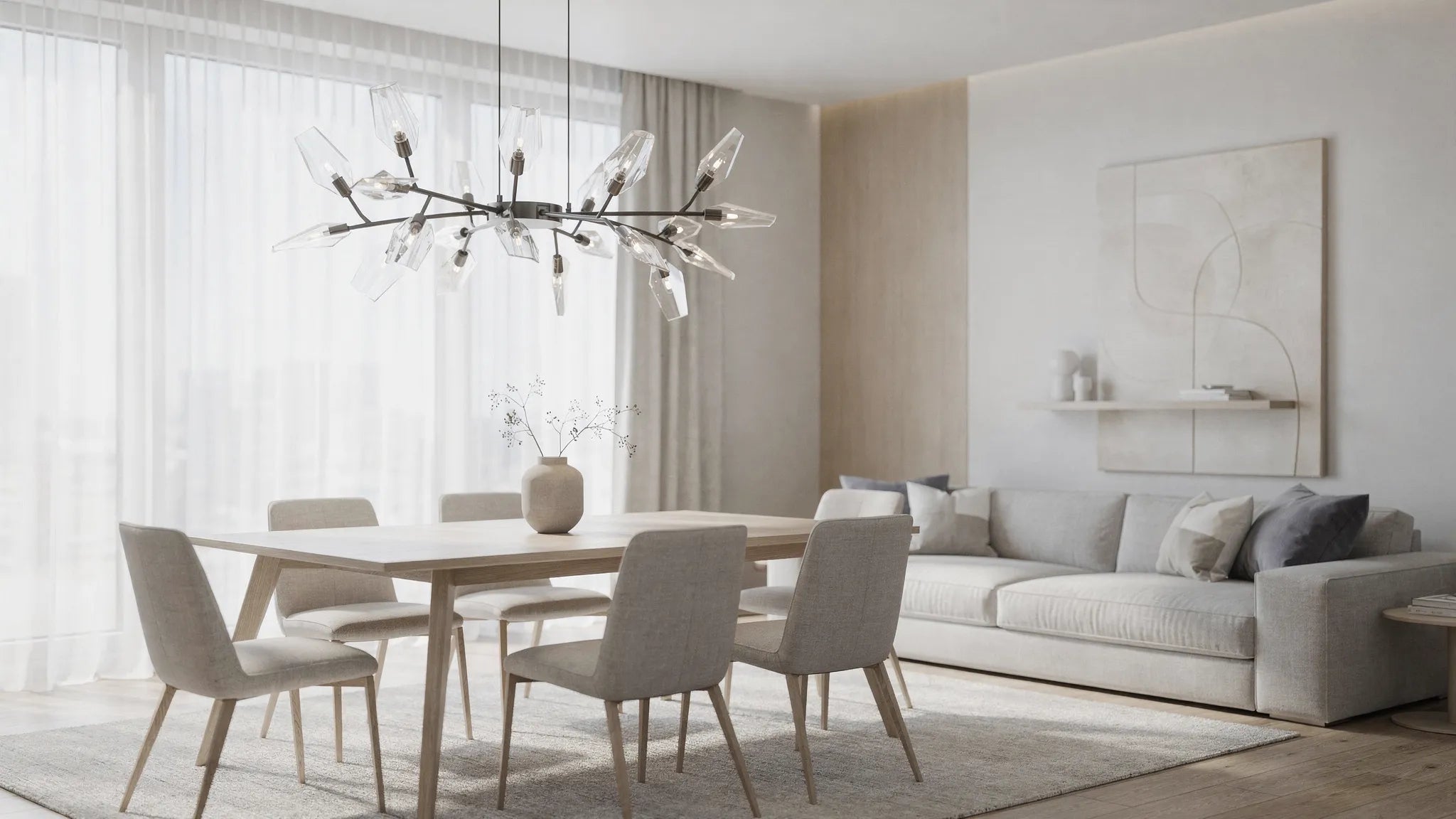
Modern chandelier: Which size looks elegant instead of bulky?
A modern chandelier can attract attention, but it should seem like a design statement, not like a foreign body. Whether a lamp looks “noble” or “massive” is rarely determined solely by style; it is usually proportions: diameter, height, suspension and the optical mass (material, shape, number of elements).
In this guide you will get practical rules of thumb, tables and a quick reality check so that your... chandelier modern fits the room perfectly.
Why “too big” immediately seems bulky (and “too small” cheap)
A chandelier is almost always dominant in the field of vision because it hangs in the axis of the room and (unlike furniture) has a lot of negative space around it. “Powerful” is typically created by one of these combinations:
- Diameter too large for the floor space or the zone (e.g. dining area in an open space)
- Too much height with a low ceiling (the chandelier “presses”)
- Too little air to walls, cupboards, passageways or window lines
- High optical mass (dark colors, dense shades, many arms, several levels) despite actually having a suitable diameter
Conversely, a chandelier that is too small can quickly appear “lost,” especially in rooms with high ceilings or spacious floor plans. The result is then not minimalist, but rather unfinished.
Step 1: Choosing the right chandelier size for the room (rule of thumb)
For the diameter A very useful rule of thumb has been established for a round, modern chandelier:
Diameter in cm ≈ (room length in m + room width in m) × 8 to 9
This is deliberately a corridor. For more airy, delicate designs you can go towards 9, for compact, dense shapes (lots of balls, umbrellas, crystal look) you can go towards 8.
If you would like even more concrete calculation help, take a look BUYnBLUE in a related size guide also uses this approach (see: Living room ceiling lamp: How to find the perfect size).
Guide values: Diameter depending on room size
| Room size (approx.) | Example floor plan | Recommended chandelier diameter | Note on effect |
|---|---|---|---|
| Small | 3 × 3 m | 45 to 55cm | Choose open shapes, otherwise it will quickly appear squat |
| Means | 4 × 4 m | 60 to 75cm | “Sweet spot” for many modern designs |
| Big | 5 × 4 m | 70 to 85cm | Dark/dense designs tend to be on the lower end |
| Very big | 6 × 5 m | 90 to 105 cm | Plan better with zones in open floor plans |
Important: In open living areas (kitchen-living room, loft), it is not the entire area that is important, but the zonethat the chandelier “plays” (e.g. sofa island or dining table area).

Step 2: The right height so that the chandelier appears light
Even a perfectly calculated diameter appears bulky if the luminaire hangs too low or brings too much “height” into a low room.
Two practice rules for suspension
In passage areas (without a table underneath): Plan so that the bottom edge of the lamp usually at least approx. 210 cm lies above the ground. In very high rooms it may be more so that the chandelier does not “stick to the top”.
Above the dining table: The bottom edge is often comfortable approx. 60 to 75 cm above the table top. (If you would like to plan this in detail, the height guide will also help: Dining table pendant light: Plan the height, width and distance correctly.)
Guide values: Suspension according to ceiling height
| Ceiling height | Without table underneath (bottom edge) | Above dining table (lower edge) | Tip against “force” |
|---|---|---|---|
| 240cm | approx. 205 to 215 cm | 60 to 70 cm above the table | Flat, open designs, low height |
| 260cm | approx. 210 to 225 cm | 65 to 75 cm above the table | Shorten the cable neatly, do not “compress” it |
| 280 to 300 cm | approx. 220 to 240 cm | 70 to 85 cm above the table | Larger diameter possible, quickly appears luxurious |
| > 300cm | depending on visual axes | 75 to 95 cm above the table | Multi-tiered or vertical designs work well |
Note: These are design values, not building regulations. What matters is your sense of space, lines of sight, lack of glare and usage (children, passageways, table height).
Step 3: Size above the dining table, this is where the most common bad purchases occur
At the dining table, an incorrect relationship is immediately noticeable because the table and lamp are “composed” directly together.
Rule of thumb for round lights over rectangular tables
The following often works as a starting point:
Chandelier diameter ≈ 1/2 to 2/3 of the table width
Examples (typical table widths):
| table width | Recommended diameter | Effect |
|---|---|---|
| 80cm | 40 to 55 cm | Rather elegant, good for compact dining areas |
| 90cm | 45 to 60 cm | Very common, balanced |
| 100cm | 50 to 65cm | Presenter, quick “statement” |
| 110cm | 55 to 70cm | Only if there is enough space around the table |
For long tables linear Chandeliers (e.g. modern rod or multiple pendant shapes) are often more harmonious than a single round body. The following often applies as a rough guide: Lamp length about 2/3 of the table length, so that the ends do not “fall off”.

Step 4: Visual mass, this is how a chandelier appears light despite its size
Two chandeliers can have the same diameter and still appear completely different. That's because of the visual density.
These design factors make larger or smaller
Rather light and elegant (even in smaller rooms):
- Open constructions (rings, delicate arms, transparent glass shapes)
- Bright or reflective surfaces (e.g. brass, chrome, opal glass)
- Few, clearly separated elements instead of “cluster”
Rather massive and bulky (especially with low ceilings):
- Dark, matt volumes (black, anthracite) in dense bodies
- Lots of umbrellas on multiple levels
- Large, opaque screen surfaces that form a “ceiling panel”.
Practical tip for modern interiors: If you want a large chandelier, choose a shape that more air than material shows. This usually appears to be of higher quality than “more parts” that sit close together.
Step 5: The 3-minute pre-purchase reality check
These checks prevent 80 percent of errors without the need for a CAD program.
1) Tape test on the ceiling: Tape the planned diameter as a circle (or rectangle) to the ceiling with painter's tape. Take photos from typical viewpoints (door, sofa, kitchenette).
2) Line of sight test: Sit in the main positions (sofa, dining table, entrance) and check whether the lamp hangs “in your face”, disrupts window lines or visually divides the room.
3) Height test with cord: Mark the bottom edge (e.g. 210 cm in the passage or 65 cm above the table) with a string or a temporary hanging point. If that feels too deep, everyday life won't get any better.
Special cases in which chandeliers quickly become bulky
Low ceilings (except old buildings)
With 230 to 245 cm ceiling heights, voluptuous, tall bodies are rarely flattering. Work better:
- Flat ring chandeliers or very open designs
- Multi-flame, but “airy” constructions (spaces instead of clusters)
- Lighter materials that suggest less weight
Sloping ceilings and offset ceiling points
Here it's not just the size, but above all that suspension critical because visual axes intersect quickly. In such situations, it is worth its weight in gold if the cable and canopy really fit the room situation.
Renovation: Change the room, install the lamp later
When ceilings are removed, floor plans are opened or floors are rebuilt, the ideal size can shift. Therefore, plan the zone (furniture) first and then the light. And very pragmatically: If you need to temporarily store furniture during renovation, you sometimes use external storage solutions, for example in the USA Buy storage containers (shipping containers) online and have it temporarily set up on site.
What makes modern chandeliers particularly “noble” (beyond size)
Size is the ticket, but “classy” comes from the finish and the lighting effect.
- Dimming ability: A chandelier often looks more luxurious in the evening if it is not constantly running at full power.
- Color temperature: Warm white (often around 2700 to 3000 K) is usually the classic for living and dining areas, while more neutral tones are more suitable for work areas. (If you are unsure: What is Kelvin? helps with classification.)
- Good color rendering: High-quality light appears more natural, especially over the dining table and art.
- Clean assembly: A “looped” cable that is too long immediately makes even the most beautiful lamp uneasy.
Fits here BUYnBLUE particularly well in the picture because they are used in many chandeliers and pendant lights free adjustments can make inquiries (e.g. cable length, canopy, color). This is one of the most reliable ways to avoid “bulky” without compromising on design.
Short checklist: Which size looks elegant instead of bulky?
If you only have 30 seconds, check these three points:
- Proportion: Does the diameter match the room zone (rule of thumb plus tape test)?
- Air: Do the typical distances remain consistent (bottom edge, passages, table distance)?
- Mass: Is the design open enough to the ceiling height and style (material, color, density)?
Frequently Asked Questions (FAQ)
What size chandelier fits in a 20 m² living room? As a rough starting point: add up the room dimensions and calculate 8 to 9. At e.g. B. 5 × 4 m you usually end up with a diameter of around 70 to 85 cm, depending on the design density.
When does a modern chandelier seem too bulky? Often when it hangs too low or is built too “densely” (many elements, dark, opaque surfaces), even if the diameter is mathematically correct.
How high should a chandelier hang in the hallway? So that you can walk underneath it comfortably. In many apartments, a lower edge of around 210 cm above the floor works well, depending on your height and spatial proportions.
What size is ideal for a 90 cm wide dining table? A diameter of around 45 to 60 cm usually works well. For very open, delicate designs it can also be slightly larger.
Can cable length and canopy be adjusted if ceiling height is difficult? Yes, that is often the key to making a chandelier look modern and elegant. At BUYnBLUE You can request free customization (e.g. cable length, canopy, color) for many models.
Modern chandeliers that really fit: this is how it works BUYnBLUE it easier
If you have your chandelier modern as an elegant highlight, it is worth first measuring carefully and then choosing the design to match the height of the room. At BUYnBLUE You will find a curated selection of designer lights made from high-quality materials, plus free customizations (cable length, canopy, color) so that the chandelier in the end like tailor-made works. There is also free worldwide shipping, a 14-day return policy, secure payment methods, shipment tracking and around-the-clock support.