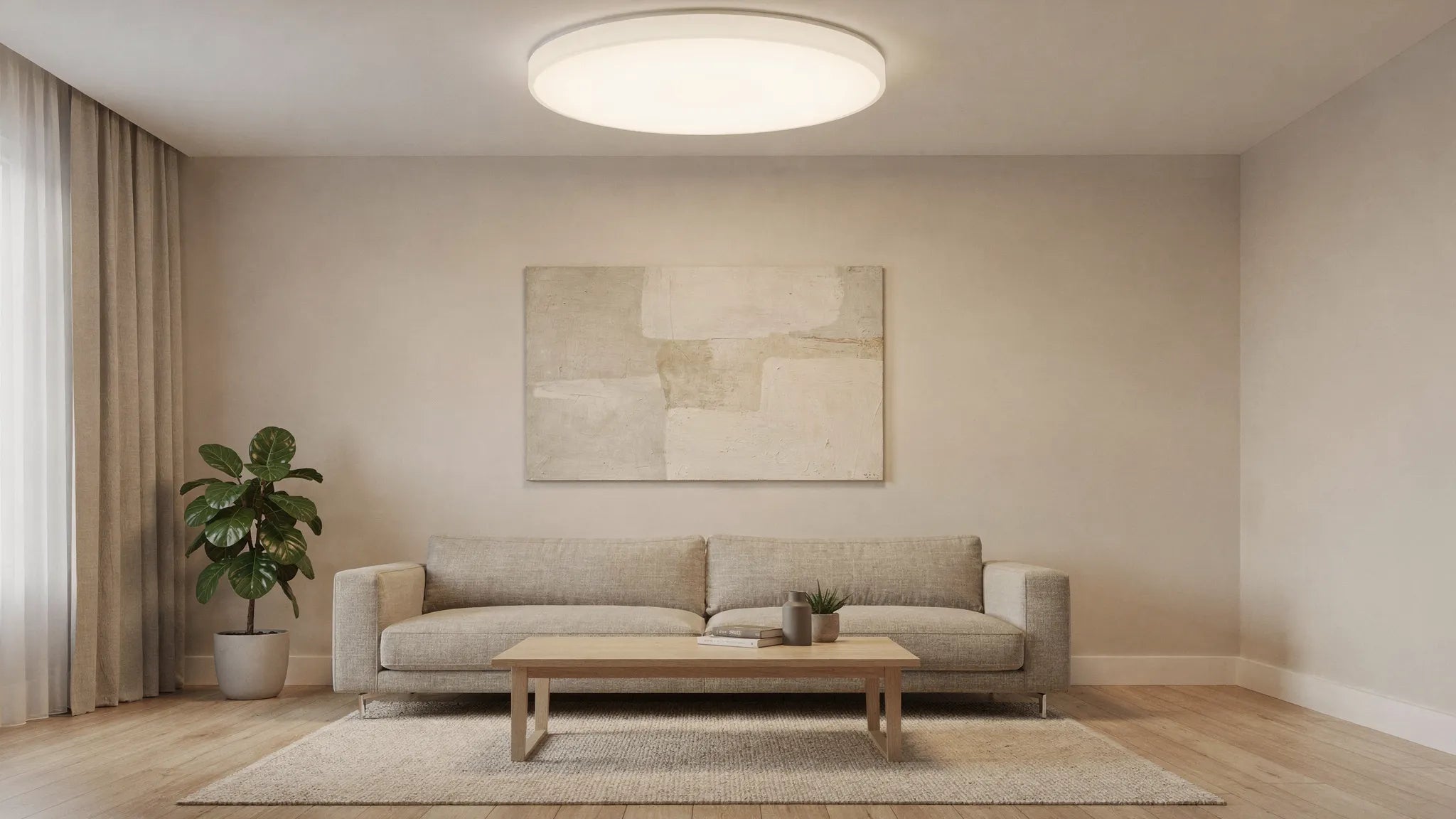
The 5 biggest lighting mistakes – and how to avoid them
Lighting is much more than just “hanging a lamp somewhere”: it influences mood, functionality, safety, concentration and even sleep patterns. Many problems – from “inharmonious” to “impractical” to “somehow uncomfortable” – are simply the result of poor lighting planning. The good news: Most errors are easy to identify and correct with simple measures.
Below you will find the top 5 mistakes that are made again and again when it comes to lighting - including practical tips, checklists and ideas for different rooms.
Mistake 1: Only a single light source in the room
Many people rely on a single ceiling light in the middle of the room - often a bright light that makes everything look flat and uncomfortable. The result is dark corners, harsh shadows and a mood that is more reminiscent of a hallway or an interrogation room than a cozy home.
Why is this a problem?
- A single light source creates harsh shadows and makes corners disappear in the dark.
- The room appears two-dimensional and not very atmospheric because there is a lack of depth and graduation in the light.
- Depending on the lamp, glare can easily occur - for example if you look directly into a strong ceiling lamp.
- Different needs (reading, working, relaxing, watching TV) can hardly be meaningfully covered with a single point of light.
The principle of light layers
Good lighting is created by the interaction of several types of light:
-
Basic or ambient light:
Uniform, rather diffuse lighting that enables orientation (e.g. ceiling light, large pendant light, flat LED panels). -
Work or zone light:
Brighter, directed light for specific activities - such as a reading lamp on the sofa, light above the kitchen worktop, desk lamp, mirror lighting in the bathroom. -
Accent and decorative light:
Light that highlights structures, pictures, plants or furniture and creates atmosphere (e.g. wall lights, LED strips, small spots).
A room only really looks harmonious when all three levels are consciously planned and combined.
Here's how to do it better
Plan at least three light sources per room, ideally from different directions (ceiling, wall, floor, table).
Complete the central ceiling lamp with:
- Floor or arc lamp next to the sofa.
- Wall lights or indirect lighting behind the TV lowboard.
- Table lamps on sideboard or bedside table.
- Under-cabinet lights in the kitchen and mirror lights in the bathroom.
- Think in zones, not just “one room”:
- Reading corner, dining area, work area and TV zone each have their own lighting solution.
Practical examples by room
- Living room:
- Basic lighting via a large, rather diffuse ceiling light or track system.
- Reading lamp next to the sofa, floor lamp in the corner, possibly LED strip behind the TV.
- Bedroom:
- Ceiling light (preferably dimmable) plus two bedside table or wall lights.
- Optional: indirect light in the wardrobe or as a base light.
- Kitchen:
- Bright basic light plus targeted lighting of work surfaces (under-cabinet lights) and island.
- Separate, more atmospheric light for the dining area.
Mistake 2: Incorrect color temperature – dental practice instead of living room
Another classic: There are lamps in the living room with cool, almost blue light that is more reminiscent of an office or hospital than of a cozy evening on the sofa. The color temperature of a lamp - measured in Kelvin - determines whether the light appears warm and yellowish or cool and bluish.
Basic knowledge of color temperature
Many specialist sources make a rough distinction:
- Extra warm white: up to around 2700 K – very warm, cozy, similar to a classic incandescent lamp.
- Warm white: approx. 2700-3300 K - pleasantly warm, ideal for living rooms and bedrooms.
- Neutral white / cool white: approx. 3300-5300 K - rather objective, good for work and functional areas.
- Daylight white: from around 5300-6500 K – very cool, more suitable for special applications (workshop, shop, office).
The higher the Kelvin value, the cooler the light appears, the lower the value, the warmer. Light color has been proven to influence mood, comfort and concentration - warm light relaxes, cooler light makes you more alert and focused.
Recommendations for different rooms
We suggest predominantly warm white light colors in living areas and neutral to cool white light in work areas.
- Living room, bedroom, dining room: 2700-3000 K for a cozy, homely atmosphere. Optionally, a slightly more neutral light source (e.g. floor or desk lamp) if you read or work there.
- Kitchen, bathroom, home office: 3000-4000 K so that colors of food, make-up or documents can be clearly seen. In work areas possibly up to 4000-5000 K, especially during the day.
- Hallway and entrance area: Warm white (2700-3300K) to make guests feel welcome.
How to avoid the color temperature error
When buying a lamp, pay careful attention to the Kelvin value that is stated on the packaging. Set a target light color for each room (e.g. living room: 2700-3000 K) and stick to it as much as possible.
In functional areas (kitchenette in the living room, desk corner), use additional targeted neutral white light sources without “cooling down” the basic mood of the room. Consider whether tunable white lights (continuously adjustable between warm and cold) make sense to flexibly reflect times of day and activities.
Mistake 3: No dimmability and lack of flexibility
Light is not static - you need something different when you get up in the morning than you do in the evening with a glass of wine on the sofa. A common mistake is to choose lights without dimming options and therefore always have the same brightness - day and night.
Why dimming is so important:
- Dimming makes it possible to adapt the lighting to the time of day, activity and mood.
- Bright, non-dimmable lights quickly appear too bright in the evening and prevent a relaxed atmosphere.
- In hallways, bedrooms and living areas, experts often recommend dimmable lights to switch from functional to cozy.
We would like to point out that dimmable ceiling lights significantly increase the usability of a room - from bright cleaning lights to a subdued evening atmosphere.
Typical symptoms of a lack of flexibility
- In the evening you only turn on a small table lamp because the ceiling light is too bright.
- However, it is too dark for cleaning or cooking because the existing lights do not provide enough light.
- In the bedroom, you have to use bright lights to navigate in the middle of the night because there is no dim option.
Solutions: dimming, switching, zones
- Use dimmable LED bulbs:
Make sure that lamps, transformers and dimmers are compatible and are expressly marked as dimmable. - Multiple circuits:
Divide light sources by function (e.g. basic light on one switch, zone and accent light on another) to combine flexibly. - Smart lighting solutions:
Smart lamps can often not only be dimmed, but also have their color temperature adjusted and controlled via scenes (e.g. “cooking,” “reading,” “movie night”).
Error 4: Incorrect brightness – too dark or too bright
“Somehow it’s always too dark here” or “It’s so bright that it’s uncomfortable” – both are signs that the brightness in the room doesn’t match the use and size. The brightness of a lamp is given in lumens and should be dimensioned depending on the size of the room and its function.
How many lumens per square meter make sense?
- Living room and bedroom: around 100-150 lumens per square meter.
- Kitchen and work areas: around 300 lumens per square meter.
- Hallway and entrance area: Values in the range of 100-150 lumens per square meter are common.
These guidelines are not absolute, but they give a good feeling that a 20 m² living room is significantly under-supplied with a single 600 lumen ceiling light.
How to find the right brightness
Roughly calculate:
- Room area (in m²) × target value (e.g. 120 lm/m²) = total lumen required.
- Divide this value across several lights (ceiling light, floor lamp, table lamp, etc.).
- When it comes to LED lights, always look at lumens, not just watts - different LED qualities produce very different brightness levels with the same wattage.
- Combine basic lighting with additional zone lights instead of trying to solve “all problems” with an extremely bright ceiling light.
Mistake 5: Poor placement and lack of indirect light
Even good lights with the right light color and brightness can fail to be effective if they are poorly placed or misaligned. Common problems include glare, uneven lighting or unsightly shadows.
Typical placement errors
- Incorrect position of the ceiling light:
A single ceiling light in the middle of the room can mean that walls and corners remain dark and the room appears visually smaller. - Spots that shine on your face:
Downlights mounted directly above seats or in front of the sofa can cause unpleasant glare.
- Shine too high or too low:
Too high – light is “lost”, creating shadows; too deep – the light has a suffocating effect or disturbs the view.
We warn against installing ceiling lights without taking into account the proportions of the room and the furniture, otherwise uneven light and unwanted shadows will result.
Why indirect light is so important
Many interior designers recommend working with a mix of direct and indirect light. Indirect light does not shine directly into the eye, but is reflected on walls, ceilings or furniture. It appears softer, more pleasant and provides more even illumination, without harsh shadows.
The lack of indirect light quickly leads to what is known as “hole lighting” – bright spots under the lights with dark areas in between. A typical implementation would be with LED strips on ceiling strips, behind TV boards, under shelves or behind the headboard of the bed.
How to place lights sensibly
Always plan lights in relation to furniture:
- Pendant lights in the middle above the dining table or kitchen island.
- Align spots so that they sweep over surfaces (countertops, pictures, textures) rather than directly into your face.
- Use wall lights to illuminate walls and ceilings - this often makes the room appear taller and larger.
- Make sure the ceiling lighting has the right proportions.
Conclusion
The most common lighting errors arise less from “bad taste” than from a lack of awareness of the effect of light. If you avoid the five big pitfalls - a single light source, incorrect color temperature, lack of dimmability, incorrect brightness and poor placement without indirect light - you are already much closer to a professionally lit home.
It's best to take 10 minutes for each room, go through the checklist and gradually add suitable light sources - instead of trying to do everything perfectly at once. Just one or two additional, well-placed lamps with the right light color can completely change the character of a room.