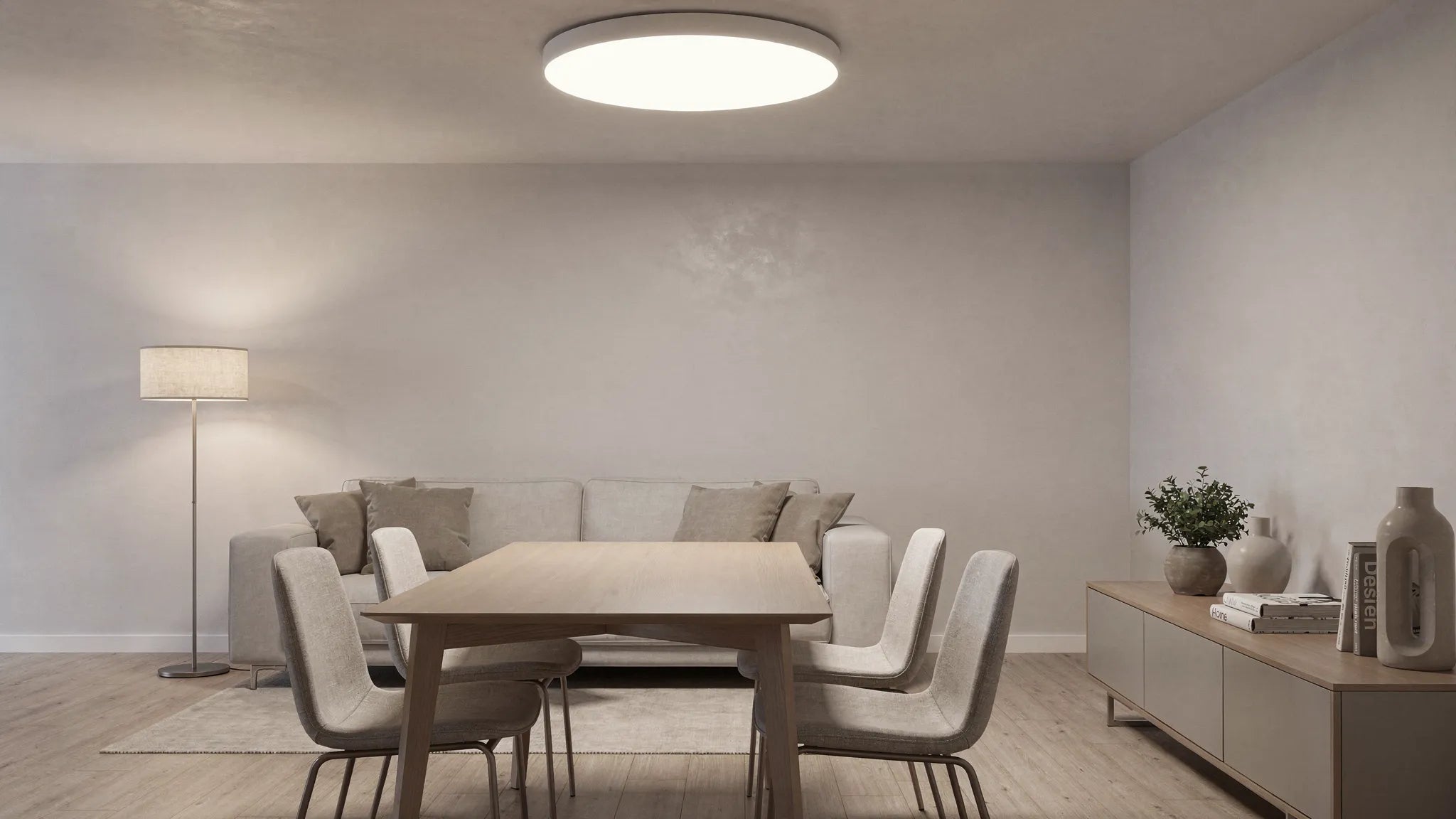
Dimmable ceiling floodlights: When is it really worth it?
A dimmable ceiling floodlight initially sounds like a simple one Floor lamps with brightness control. In practice, however, it can completely change the feeling of a room, especially where a hard ceiling lamp seems too uncomfortable or there is no ceiling connection at all. The big advantage lies in the combination of indirect light and flexible control: it can be bright during the day, warm and reserved in the evening, targeted when reading and glare-free when watching TV.
Nevertheless, a dimmable ceiling floodlight is not automatically worthwhile in every room. The decisive factors are ceiling height, ceiling color, light output, dimmer quality and the question of whether it is intended as a main light, mood light or supplement. This guide shows when the purchase really makes sense, what you should pay attention to when buying and when a pendant light, ceiling light or wall light can be the better choice.
What makes an uplighter special?
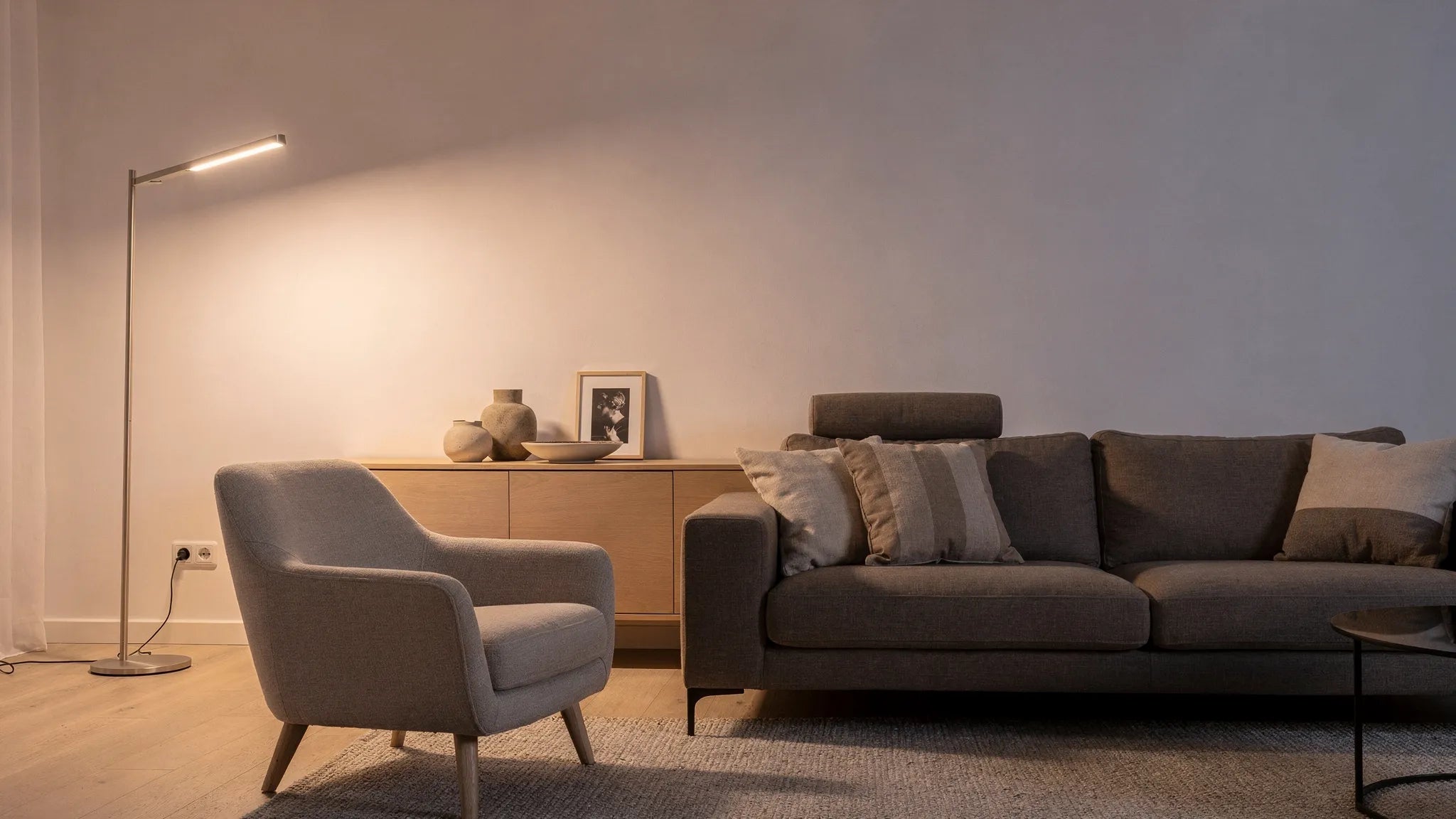
A ceiling floodlight is a floor or floor lamp whose light is predominantly directed upwards. The light hits the ceiling, is reflected there and spreads softly throughout the room. This creates indirect lighting that is less dazzling than a directly visible light source and often appears more homely than a single central ceiling lamp.
This effect is particularly popular in the living room because the room is not illuminated flat but has depth. The light doesn't just come from one point, but spreads across the ceiling and sometimes walls. An uplighter can create a relaxed basic brightness without making you feel like you are in a waiting room.
The dimming function is not just a nice extra. It decides whether the uplighter can be used sensibly in the morning, in the evening, when cleaning, while reading or at a movie night. Without a dimmer, a strong uplighter is often too bright, while a weaker model is too limited. With a dimmer, the same light point can be adapted to multiple situations.
You can also find more ideas about the effect of indirect light in BUYnBLUE-Guide to indirect lighting in the living room.

When is a dimmable ceiling floodlight really worth it?
An uplighter is particularly worthwhile if you want flexible, soft room lighting without interfering directly with the electrical installation. It is particularly strong in rooms that are used differently throughout the day.
In the living room, a dimmable ceiling floodlight can close the gap between functional brightness and a cozy atmosphere. The lights are dimmed brighter when tidying up or playing with children, and turned down significantly when eating dinner on the sofa or watching TV. This is more pleasant than a ceiling light that is either on or off.
Even in rented apartments, an uplighter is often a pragmatic solution. If the ceiling outlet is in an awkward position, is missing or cannot be moved, a mobile light can provide basic lighting. This is particularly interesting for old buildings, open living areas and rooms that were not originally planned as a living room or home office. In such cases, the additional contribution is worthwhile Illuminate the room optimally even without a ceiling connection.
Dimming shows its strengths in multifunctional rooms. A living room and study needs more brightness during the day and less intensity in the evening. A bedroom with a reading corner needs soft light to relax, but occasionally enough brightness to tidy up. An uplighter with an additional reading arm can be particularly practical here because it combines indirect room light and directed zone light.
| situation | Is a dimmable ceiling floodlight worth it? | Why |
|---|---|---|
| Living room with sofa and TV zone | Yes, very much | Indirect light reduces glare and creates atmosphere |
| Rental apartment without a suitable ceiling connection | Yes | Flexible solution without fixed installation |
| Bedroom with reading corner | Yes, if warm dimmable | Soft light in the evening, more brightness when needed |
| Home office as sole work lighting | Just supplementary | For concentrated work, additional directed light is required |
| Kitchen or workroom | Rather rare | Work surfaces need direct, shadowy light |
| Room with dark wooden ceiling | Only limited | Dark surfaces absorb a lot of light |
When is an uplighter less useful?
An uplighter thrives on reflection. If the ceiling is very dark, heavily structured or covered in wood, significantly less light reaches the room. Then even a powerful model quickly appears weaker than expected. In such cases, wall lights, pendant lights or multiple direct light sources are often more efficient.
Even with very high ceilings, an uplighter can have its limits. The light has to cover a greater distance before it is reflected. This means that the lamp requires more light output and the effect can be controlled less precisely. An uplighter can still work in high rooms, but should be viewed more as a complement to pendant lights, chandeliers or wall lights.
It is also less suitable if you need precise work light. At the desk, in the kitchen or when doing crafts, indirect light alone is rarely enough. Although it reduces harsh contrasts, it does not automatically produce the level of illumination that is comfortable for details and precise activities.
Another point is the style. An uplighter is visible in the room and takes up space. If the living area is planned in a very minimalist way or walking paths are limited, a permanently installed light can appear calmer. In small rooms, the model should therefore be slim, stable and visually light.
Buying a dimmable ceiling floodlight: The most important technical criteria
If a product description says that the ceiling floodlight is dimmable, this does not automatically mean that the light dims comfortably in everyday life. What matters is how finely the brightness can be regulated, whether the light flickers and whether the lowest level is really comfortable enough.
When it comes to LED ceiling floodlights, you should pay particular attention to a high-quality driver. Cheap or poorly tuned LED drivers can flicker, whir, or dim abruptly at low brightness. This is annoying in everyday life, even if the maximum brightness is impressive. A good dimmer regulates evenly from light to dark, without visible flickering and without unpleasant noises.
For models with replaceable bulbs, the bulb and dimmer must match. Not every LED lamp is dimmable, and not every dimmable LED works with every dimmer. With integrated LED ceiling floodlights, this coordination is usually done at the factory, but the light source cannot always be easily replaced later.
He explains further basics about LEDs, light color and dimming BUYnBLUE-Guide Lamp with LED: advantages, light color and dimming explained.
How bright should a dimmable ceiling floodlight be?
The right brightness depends on whether the uplighter is only intended to create an atmosphere or to noticeably brighten a room. For pure atmosphere, lower light outputs are sufficient. If it is supposed to partially replace a ceiling lamp, it needs significantly more lumens because indirect light always has losses due to reflection.
For a typical living room, uplighters in the range of around 2,000 to 4,000 lumens often make sense, depending on the size of the room, ceiling height, wall color and additional lighting. In small rooms, less may be enough, but with dark furniture or high ceilings, more may be necessary. What is important is that a more powerful ceiling floodlight is only pleasant if it can be easily dimmed.
But lumen alone doesn't say everything. A 3,000 lumen uplight with warm, diffuse light has a completely different effect than a direct spotlight with the same amount of light. For rough planning, you can work with target values in lux and transfer these to the room area. You can find practical instructions in the article LED lighting: This is how you calculate lumens per m² correctly.
| criterion | Recommendation for living spaces | Why it matters |
|---|---|---|
| Light output | approx. 2,000-4,000 lumens as a flexible orientation | Enough reserve for basic brightness, can be reduced using a dimmer |
| light color | 2,700-3,000 Kelvin for comfort | Warm white looks cozy and relaxing |
| Dimming span | If possible, stepless or with many steps | Prevents the light from remaining too bright in the evening |
| Color rendering | CRI from 80, better from 90 | Colors of furniture, textiles and art appear more natural |
| Stability | Heavy, stable base | Important for children, pets and narrow walkways |
| Service | Switch, touch, remote control or app to suit everyday life | The best light is only used if it can be easily controlled |
Pay additional attention to energy efficiency, but do not evaluate it in isolation. The EU energy labeling for light sources helps compare power consumption. However, lighting quality, dimming behavior and appropriate placement remain just as important for living comfort.
Light color: Warm white is usually the safe choice
An uplighter is often used in the evening. That's why warm white light is the most pleasant choice in most living spaces. 2,700 Kelvin looks classically homely, 3,000 Kelvin seems a little clearer and more modern. For bedrooms, lounge areas and TV zones, particularly warm settings are often more pleasant than neutral white light.
Models with a dimming-to-warm function are interesting. When dimmed down, the light not only becomes darker, but also warmer. This is similar to the behavior of old light bulbs and looks very natural in the evening. For rooms that are actively used during the day, an adjustable color temperature can be useful, for example warmer in the evening and more neutral during the day.
Neutral white light from around 4,000 Kelvin can be useful in work areas, but quickly appears matter-of-fact in the living room. If an uplighter is primarily intended to create comfort, warm white is usually the better decision.
The correct placement determines the effect
A dimmable ceiling floodlight works best when it can radiate freely upwards. Do not place it directly under shelves, rafters or low ledges. The more undisturbed the light reaches the ceiling, the more evenly it is reflected.
Popular positions include corners of rooms, areas next to the sofa, next to an armchair or behind a sideboard. In corners, the light is often reflected from two wall surfaces, which can make the room appear softer and larger. The effect is strongest on very light, matt ceilings.
Also be careful of glare. The light head should be designed or aligned so that you do not look directly into the light source from a sitting position. This is particularly important next to the sofa or armchair, because your eyes often stay in a similar direction there for a long time.
Being close to one is also practical Power plug. A long cable across the room appears unsteady and can become a tripping hazard. If the ideal light point is far from the Power plug away, clean cable management, skirting board channels or another lighting solution can help.
Uplighter or alternative: which is better?
A dimmable ceiling floodlight is particularly powerful as a flexible, indirect light source. However, it does not replace every other type of light. If you want to stage a dining area, illuminate a kitchen island or clearly structure a room architecturally, it is often better to use pendant lights, ceiling lights or wall lights.
| Type of luminaire | Strengths | Better suited if... |
|---|---|---|
| Dimmable ceiling floodlight | Flexible, indirect, no fixed installation | You want soft ambient light without a ceiling connection |
| Pendant lamp | Precise over a table or island, a strong design statement | A dining area or zone should be clearly emphasized |
| Ceiling light | Uniform basic lighting, space-saving | Walkways must remain clear or the room is small |
| Wall light | Structure, accent lighting, pleasant side lighting | Walls should be emphasized or corridors should be zoned |
| Arc lamp | Direct light over the sofa or coffee table without a ceiling connection | You want a hanging lighting effect but want to remain mobile |
If a pendant or chandelier solution fits your space better, it's worth customizing. At BUYnBLUE Chandeliers and pendant lights can be adjusted free of charge, for example in terms of cable length, ceiling rose or color. This is particularly helpful with high ceilings, open floor plans, or unusual room layouts.
Avoid common mistakes when buying
The most common mistake is to decide based solely on design. No matter how elegant an uplighter may look, if it doesn't provide enough light, doesn't dim enough, or doesn't glare enough, it'll quickly be rarely used in everyday life.
It is equally problematic to plan an uplighter as the sole solution for the entire room. Living rooms usually look better with several light sources: indirect basic light, a reading light, accent light on the wall or shelf and possibly a pendant light above the table. The ceiling floodlight is then an important component, but not the entire lighting concept.
Before purchasing, you should ask yourself these questions:
- Should the uplighter be the main light, mood light or supplement?
- Is the ceiling bright enough to reflect light well?
- Is there one Power plug in the desired position?
- Is an additional reading arm required?
- Is the dimming fine enough for an evening atmosphere?
- Does the height of the lamp match the ceiling height and the scale of the furniture?
- Is the foot stable enough for everyday use?
If you clarify these points, you will avoid bad purchases and find a model that not only looks good in the showroom, but also works in your own home.
Frequently asked questions about dimmable ceiling floodlights
Can a dimmable uplighter replace a ceiling lamp? In some living rooms and bedrooms, yes, especially if the ceiling is light and the room is not too big or too high. For kitchens, work areas or very large rooms, it is usually more of an addition than a complete replacement.
Which light color is best for an uplighter? For living spaces, 2,700 to 3,000 Kelvin is usually ideal. The light appears warm, cozy and goes well with indirect lighting. An adjustable color temperature can be useful for actively used areas.
How many lumens should a dimmable uplighter have? As a rough guide, around 2,000 to 4,000 lumens makes sense for many living rooms. The exact amount depends on room size, ceiling height, ceiling color and additional lighting.
Is an LED uplighter better than a model with replaceable bulbs? Both variants can make sense. Integrated LED models are often slim and technically well coordinated. Models with replaceable bulbs offer more flexibility when changing later, but require suitable dimmable bulbs.
Why does a dimmable uplighter sometimes flicker? Flickering is often caused by unsuitable dimmers, weak LED drivers or incompatible lamps. Make sure you use high-quality components and that the bulbs and dimmers fit together.
Find the right lighting solution for your room
A dimmable ceiling floodlight is really worth it if you are looking for indirect, flexible and homely light. It can be an elegant solution, especially in the living room, bedroom, in rented apartments or in rooms without a suitable ceiling connection. However, if you want targeted task lighting, clear dining area lighting or a permanently installed design solution, pendant, ceiling or wall lights are often a stronger choice.
At BUYnBLUE You will find modern lights for different living areas, from stylish pendant lights to high-quality designer lights for well-thought-out lighting concepts. Benefit from a curated selection, free worldwide shipping, 14-day returns and free customization on chandeliers and pendant lights so that your lighting not only looks beautiful, but also fits your room height, floor plan and home style.