Floating table lamps: A sensational invention conquers your home
Table lamps float in the air, like in a fairy tale. The magic of new lighting is currently experiencing a real trend. Floating or flying lamps are considered a new invention and are a real eye-catcher. A very special way to set accents in your living space. These futuristic-looking objects seemingly defy gravity and float freely above tables and in space.
In this article we explain the technology behind these floating lamps and show you ideal areas of application for this sensational lighting trend. The fascination lies not only in the technical masterpiece, but in the moment when the viewer sees a floating lamp for the first time. It is this touch of impossibility that creates magic where we only suspect physics.
How floating lamps work
The core of every floating table lamp is a precise balance between two opposing magnetic fields. Two simple magnets are usually the basic principle of these models to keep them floating in the air.
There is a stable magnet in the base whose field lines are directed upwards. There is a second magnet in the light body itself, the poles of which are aligned so that they directly counteract the lower field. The result of this arrangement is fascinating: the upper magnet is, so to speak, “repelled” from below while its weight “presses” it down. The lamp appears to be floating.
But the devil is in the details
Any disturbance, no matter how minimal, a draft, a vibration, a shock, could destroy this balance. This is where intelligent electronics come into play: Highly sensitive sensors record the position of the magnet thousands of times per second and adjust the field strength with millimeter precision to maintain perfect levitation.
We owe this technology to research in aviation. The control algorithms used today come from drone technology, where similar real-time stabilization systems have long been standard. But while a drone actively regulates its rotors, a hovering lamp only needs its magnetic field strength.
Types of flying lamps
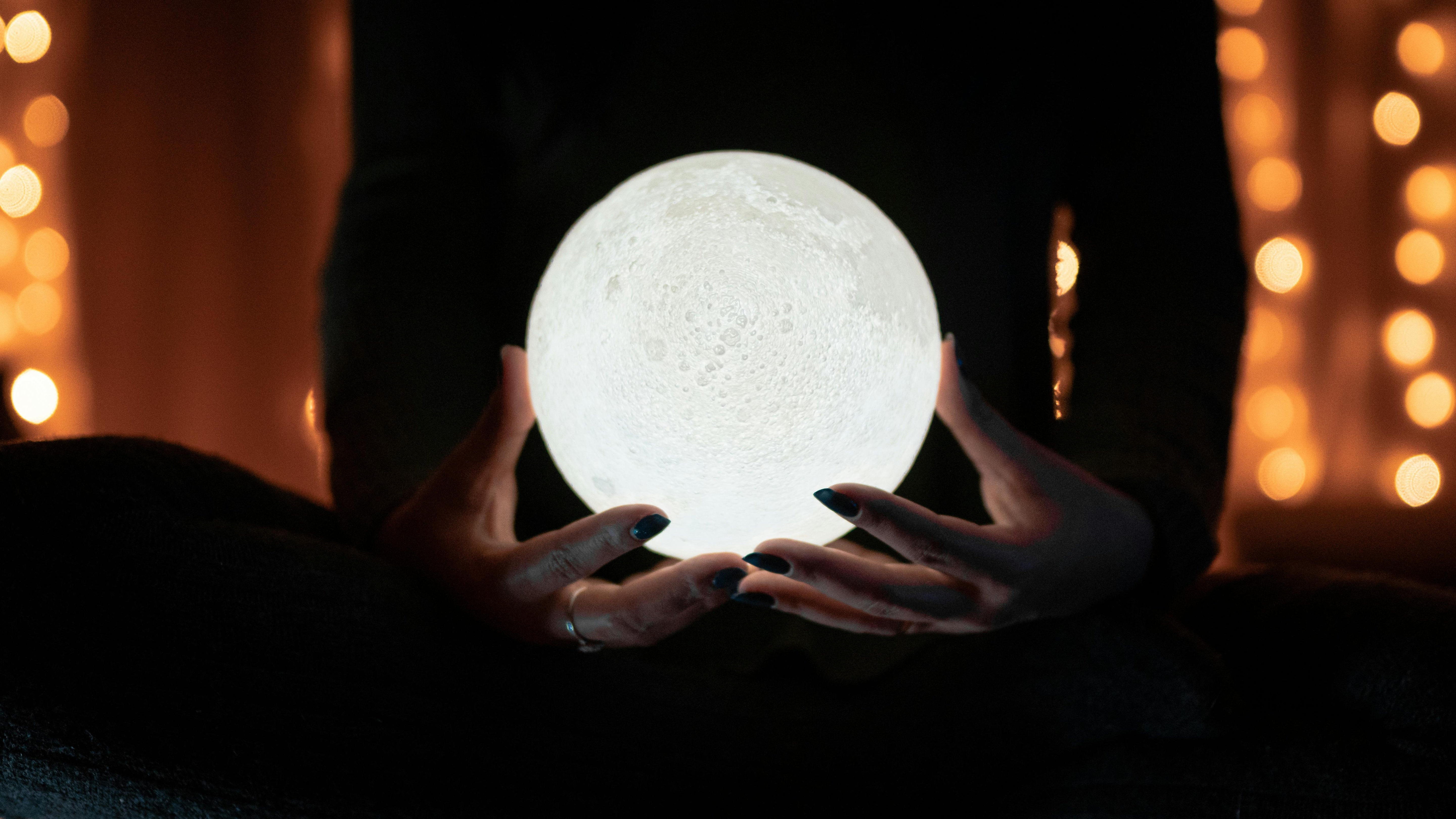
Surely you have seen the flying lamps before. The light bodies that hang weightlessly in the air are usually designed as planets or moons. The light shines calmly as the body rotates and moves above the base.
Particularly popular are forms such as:
- Spherical glass body, which act like planets
- Metallic discs in a puristic design
- Geometric shapes, which are reminiscent of spaceships
This type of lamp seems to be an idea from science fiction films and thus awakens real emotions. However, the idea of floating lamps is not new to the lighting industry. The first flying table lamps were available in specialty shops a good ten years ago. Today we are experiencing a huge leap not only in technology, but also in the use of this extravagant lighting.
Induction as an energy source
The next puzzle lies in the flow of electricity. How can a lamp receive power when it hangs freely in the air with no wire in sight? The answer lies in a technology we all know: inductive energy transfer, like that used in wireless smartphone charging, only much more sophisticated.
A coil in the base of the lamp base generates an electromagnetic field. When the receiver coil in the floating luminous body approaches this field, current is generated in it, through the air, so to speak. This technology works over several centimeters away, meaning the lamp is constantly supplied with energy even as it gently rotates.
The Psychological Effect: The Brain and the Illusion of Gravity
What actually happens in our brain when we see a floating lamp? Neurological research suggests that we experience a momentary cognitive illusion, a situation in which what we see contradicts what we know about the world. An object floats when it should be falling. This brief confusion breeds attention, and attention leads to fascination.
Scandinavian elegance meets technical virtuosity
Among all the floating lights available on the market today, the stands out Flying Lys out, and not without reason. This product embodies a simple philosophy: technology should not take center stage; it should elegantly retreat into the background and only make the miracle visible.
The Flying Lys works with an electric magnet that repels the LED bulb with precise force. The walnut look base, available in a round or square shape, looks like a simple, minimalist design object. No one would suspect that there is a highly sensitive magnetic control system hidden inside.
With only 3 watts of power, the Flying Lys is surprisingly energy efficient. The integrated LED provides enough brightness to pleasantly illuminate a bedside table or create a relaxing work corner. Operation is very easy: a touch sensor on the base is enough to switch it on and off.
This makes a flying lamp perfect for this sleep- and Living room, as it provides a pleasant, warm light. But the special thing is that if you lightly push the lamp, it starts to rotate. Due to the lack of friction, it then rotates gently in circles. A hypnotizing effect that many users describe as almost meditative.
Smart home system and light management
Many of these models can be integrated into a smart home system and also feature smart accents: you can adjust the color and brightness of the lamp using your smartphone or tablet. You don't even have to touch the lamp. It can also be dimmed easily.
The floating lamps are particularly suitable as Table lamp. Here, the impressive lights create a special eye-catcher that immediately catches the eye. Integrated into a smart home system, a lamp can be switched on as a sudden light source in the event of a break-in, scaring the burglar away. Or you can set it up after sunset so that the lamp casts this subtle and relaxed beam of light after dark.
Light, movement and emotions
Imagine you have a lamp that moves silently and as if by magic. The movement stimulates, while the calm, gentle light ensures relaxation.
The gentle floating can have an influence on well-being and creativity and has a calming effect, and so I positioned a floating lamp on my work desk. She seems to me to be deeply relaxed at all times, allowing me to focus on my thoughts while creatively writing.
This makes the flying lamp more than just a piece of furniture for a modern and extravagant living room. It can also be used as a source of energy in a study for your own creativity. Or as a sleep aid on the bedside cabinet in the bedroom.
Use in the professional sector
Floating lamps are extremely popular in commercial areas such as restaurants and hotels. Because if you want to present yourself as a trendsetter and modern brand and want to stay in the conversation, these eye-catchers are an absolute must-have. Of course, these lighting accents don't just attract attention. They also make statements such as “We are modern or we live creativity”.
Some companies are therefore experimenting with floating lamps in conference rooms, offices and reception areas. And for special events, such as a wedding or a moon festival, these lamps provide that extra kick.
From trend to everyday life
The future for floating lamps has just begun. With the table lamps, this new technology is being introduced to a broad market for the first time. Ceiling lamps are also being planned. Many lamp lovers can hardly wait to bring the technology of the next century home.
But patience is required here: Researchers are already experimenting with floating lamps that draw their energy from integrated solar panels. Imagine: a completely self-sufficient, floating lamp that collects energy during the day and lights up in the evening, without a power connection, without cables, completely independent. It is a dream that makes sense not only aesthetically but also ecologically.
Scientists are already working on special lamps that work with artificial intelligence and are voice-controlled. Combinations of speakers and lamps are also already being tested.
And since a lamp should no longer just be placed statically in a room, floating lamps are perhaps the first step towards moving lamps that even follow people.
Conclusion
In the home office, the floating lamp creates an inspiring work environment that inspires creativity. In the bedroom, the Flying Lys can help you relax before going to bed with its warm LED light. It is a highlight in living rooms. Your guests will notice them immediately, and explaining the technical phenomenon becomes a fun mini-lesson in physics and design.
Flying table lamps like this Flying Lys are just the beginning of a series of new developments. In the field of static lamps, however, it stands out because of its special nature, as it can rotate and is always a special eye-catcher.
Innovations often have a hard time asserting themselves on the market, and yet the floating table lamps are exactly the futuristic accent that makes us dream. About distant worlds, the moon and just the relaxation that we so often seek.
The Flying Lys table lamp combines Scandinavian design philosophy with the latest technology, creating spaces that not only look good but also feel good. Spaces in which innovation becomes noticeable and the future can already be experienced today.