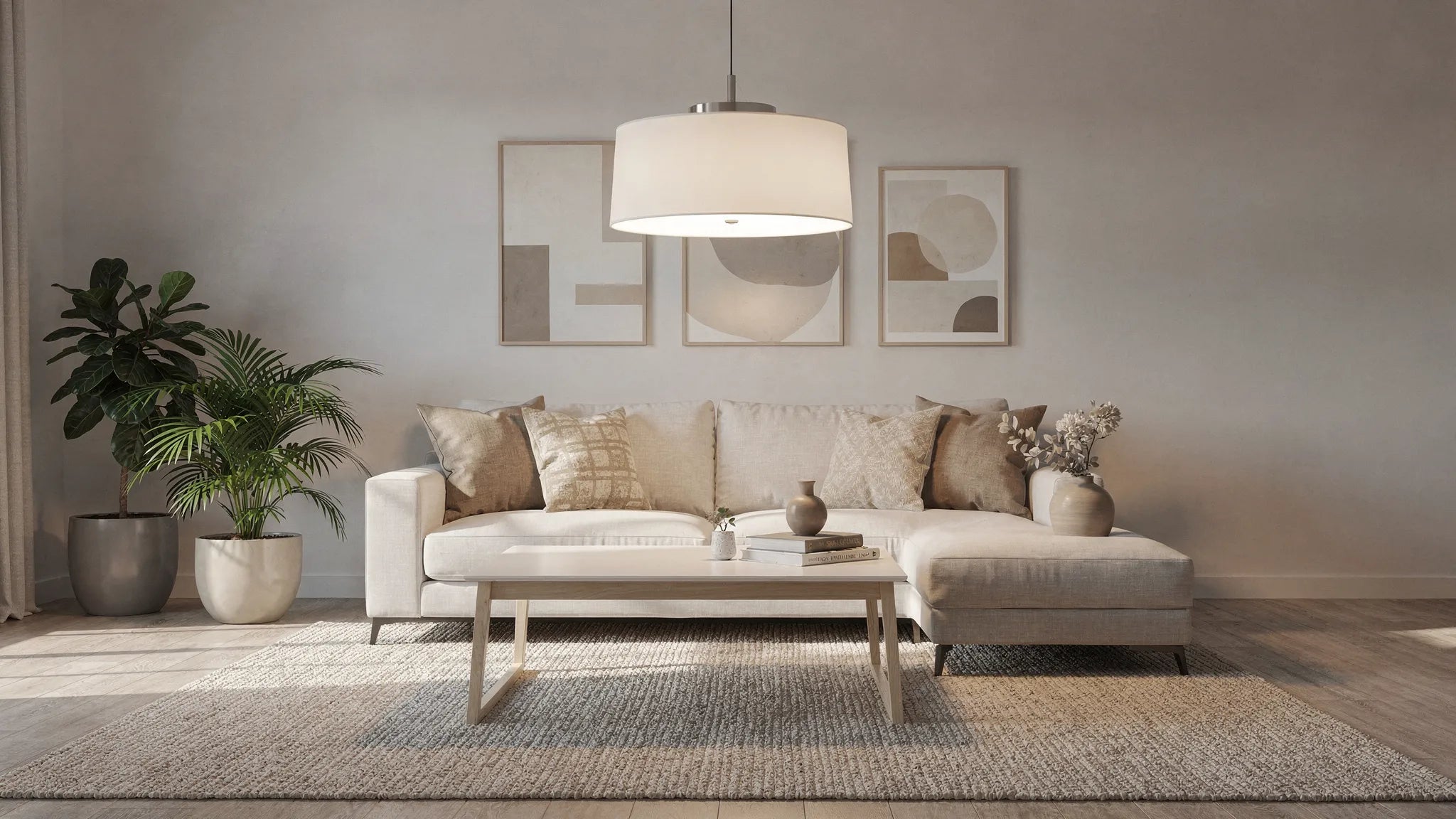
Living room ceiling lamp: How to find the perfect size
A ceiling lamp in the living room is more than “just light”: it determines how large the room appears, whether corners remain dark and whether the furnishings look harmonious. The most common disappointment when buying is therefore not the color or the material, but the wrong size: too small seems lost, too big overwhelms the room.
In this guide you will get tried and tested rules of thumb, tables and a short checklist so that you can find the perfect size for your Ceiling lamp in the living room choose safely.
Why the size is so important for a ceiling lamp in the living room
The “right” size is always a combination Proportion and Function:
- Proportion: A light that is too small will make even a nice design look cheap because it looks like a random dot on the ceiling. A light that is too large can visually depress the room, especially if the ceiling is low.
- Function: Depending on the cover and design, a larger luminaire often distributes the light more evenly. If the lights are too small, they are often compensated with very bright bulbs, which then leads to glare or harsh light.
Step 1: Measure your space (and decide whether to light “the room” or “the zone”)
Before you do the math: clarify what the ceiling lamp should provide.
- A living room as a room (classic, closed): Then you base the size primarily on the area of the room.
- Open plan living (living room + dining area + kitchen): Then the ceiling light in the living room should be used frequently the seating area define (sofa, coffee table, carpet), not the entire floor space.
Practical rule of thumb: If a large part of the room is “empty space” (passage, open kitchen), then size according to that Residential zone.
Step 2: The most important rule of thumb for the diameter (round or square)
This size works very reliably for round or square ceiling lights:
Recommendation (metric):
- Diameter in cm ≈ (room length in m + room width in m) × 8.3
This is the metric version of an internationally common furnishing formula (converted from feet and inches). It provides a very good starting point, which you then fine-tune with ceiling height and furniture.
Quick table: ceiling lamp size by living room area
The table is deliberately kept as an area because the cover, design (e.g. opal glass vs. open light) and room height change the “correct” impression.
| Living room size | Typical spatial effect | Recommended diameter ceiling lamp |
|---|---|---|
| 10 to 14 m² | compact | approx. 35 to 50 cm |
| 15 to 20 m² | Default | approx. 45 to 65 cm |
| 21 to 28 m² | generous | approx. 60 to 80 cm |
| 29 to 40 m² | very large / loft | approx. 75 to 100 cm |
If you fluctuate between two sizes, the following design rule applies: Better slightly larger, as long as ceiling height and furniture are acceptable.

Step 3: Correctly size rectangular ceiling lights (and when they make sense)
Rectangular or elongated ceiling lamps (e.g. LED panels or linear designer lights) are ideal if:
- your living room elongated is,
- you one Seating landscape or want to evenly illuminate a large coffee table,
- you want a very modern, architecturally-emphasized photograph.
Rule of thumb for length
Orientate yourself on the zone you are illuminating:
- Length of the lamp: about 1/2 to 2/3 of the carpet length (if carpet defines the living zone)
- or about 2/3 of the sofa length (if sofa is the strongest reference point)
This means that the lamp appears to be “intentionally” placed and not like an element that is too small in the middle of the ceiling.
Step 4: Consider ceiling height (decides on design and size effect)
The same light can have completely different effects depending on the height of the ceiling. Two points are important:
- Optics: With low ceilings, large, voluminous lights quickly become dominant.
- Comfort: The lower the lamp hangs or is built, the faster you feel “crouched”.
Practical values for comfortable headroom
- In walking areas, the lower edge of a light should be used when in doubt not less than approx. 210 cm hang.
- With classic ceiling lights (flush or semi-flush), headroom is usually not a problem, but it plays a role height one role: the lower the ceiling, the flatter the lamp should be.
If you want a more eye-catching designer ceiling lamp but have a low ceiling, these solutions often make sense:
- Flat ceiling light with a large diameter (appears high-quality and quiet)
- Multi-flame ceiling light with compact height (more light points, less “block”)
Step 5: Match the size to the furnishings (so it looks like it's made from a single piece).
The space alone is not enough if your furniture is very present. Three quick checks:
1) Sofa and coffee table
If the seating area is your visual focus, the ceiling light should be “in balance” with it.
- Large sofas (e.g. 3-seater or corner sofa) tolerate larger diameters or multi-flame designs.
- With delicate furniture, a lamp that is too massive can quickly seem like a break in style.
2) Carpet as a zone
A carpet is often the real “stage” of the living room. If you have a large area rug, size the light fixture based on the zone rather than the room.
3) Dining table in the same room
If the living and dining areas are close to each other, make sure that the lights are aligned not compete with each other.
- Living room lamp: rather wide and quiet
- Dining table lamp: more directional (and usually lower) so that it emphasizes the table
If you want to go deeper into this: In “The art of room lighting” it's more about complete lighting concepts and distribution in the room.
Step 6: Does the light output match the size? (otherwise the perfect proportion won't help you)
The most beautiful ceiling lamp is of little use if it is too dark or blinding. For the basic brightness in the living room are often used approx. 100 to 200 lux Used as a rough guide, you will need more at certain points for reading or working.
Since lux is a value “on the surface”, you can roughly calculate:
Required lumens ≈ area (m²) × target lux
Quick table: Rough lumen recommendation for the living room
| Living room space | Cozy basic brightness (approx. 100 lux) | Brighter / flexible (approx. 150 to 200 lux) |
|---|---|---|
| 12 m² | approx. 1,200 lm | approx. 1,800 to 2,400 lm |
| 18 m² | approx. 1,800 lm | approx. 2,700 to 3,600 lm |
| 25 m² | approx. 2,500 lm | approx. 3,750 to 5,000 lm |
| 35 m² | approx. 3,500 lm | approx. 5,250 to 7,000 lm |
Important: These are Orientation values. Dark walls, dark ceilings, large windows (strong change in daylight) and lampshades that absorb light change the need.
If you are still confused about the terms, this article will help “Watts and lumens, what’s the difference?” as a brief classification.
Two recommendations that almost always work
- Dimmability: This allows you to make a “slightly too bright” selection immediately comfortable.
- Warm white for coziness: Many living rooms have an in-between effect approx. 2,700 K and 3,000 K particularly pleasant. (Neutral white can work if your style is very purist or you read and work a lot.)
You can also find background information about light quality and color rendering here licht.de (Industry platform for light and lighting).
Step 7: How to test the size before buying (without making a mistake)
You can simulate the effect surprisingly well before you order:
- Tape the circle/outline onto the ceiling: Use painter's tape, string or paper (e.g. wrapping paper) and mark the diameter.
- Cardboard template: Particularly good with round lights, you can see immediately whether it seems “too little” or “too much”.
- Photo test: Take a photo of the ceiling and digitally place the planned size as a circle over it (this can even be done in simple cell phone apps if necessary).
Extra tip: Don’t just test from one position. The lamp must look good from the sofa, but also when entering the room.
Common mistakes with ceiling lamps in the living room (and how to avoid them)
- Diameter too small: The classic. Result: selective brightness, but no “room light”, and visually it looks unfinished.
- Too much glare: Open lamps or clear shades can be annoying when sitting. Look for diffusers or a design where light doesn't hit the eye directly.
- Wrong scale for setup: Minimalist furniture plus a massive, sculptural lamp can work, but only if it is deliberately chosen as a statement.
- Light output misjudged: “It looks small” is then compensated for with extremely bright lamps. Better: choose the right size and dim it.
Mini checklist: Find the right size in 60 seconds
If you just want to make a quick decision, answer these questions:
- Do you orient yourself? space or at the Residential zone (carpet/sofa)?
- Is your target diameter (rule of thumb) within your range? Ceiling height and the height of the light?
- Does it fit? Lumen output to the surface and is ideal dimmable?
- Avoids the design Glarewhen you sit on the sofa?
Frequently Asked Questions
What size should a ceiling lamp be in the living room? A tried and tested rule of thumb is: diameter in cm ≈ (room length in m + room width in m) × 8.3. For 15 to 20 m², many living rooms are around 45 to 65 cm.
Can a ceiling lamp in the living room be too big? Yes, especially with low ceilings or very delicate furnishings. Check the height, headroom and whether the lamp visually “overshadows” the furniture.
How many lumens do you need for the ceiling lamp in the living room? Around 100 to 200 lux is often used as a guide for basic brightness. Roughly calculated: Lumen ≈ m² × Lux. For 18 m² that is approx. 1,800 to 3,600 lumens, depending on the desired brightness.
Round or square: which shape is better in the living room? Round usually looks softer and fits many floor plans. Angular or elongated is strong for long rooms or if you want a clear, architectural line of light over the living area.
What if my living room is open (living area + kitchen)? Then you often don't size based on the entire area, but rather based on the living area. The carpet or seating area is the best reference point.
Discover modern ceiling lamps for the living room (no guesswork)
If you now have a clear size direction, the selection becomes much easier. At BUYnBLUE you will find a curated selection Designer lights Made of high-quality materials, suitable for modern living spaces, included free worldwide shipping and 14 day return policy.
Check out the selection and filter by style and space: BUYnBLUE Discover lights.