Plan LED ceiling lights in a modern way without glare
A ceiling light is rarely just a light source. It shapes the feeling of space, colors, shadows and the question of whether a room appears pleasant in the evening or is tiring for the eyes. If one LED ceiling light modern If you want it to look good and be comfortable at the same time, the highest wattage or a particularly flat design is not enough. What matters is how light is distributed, shielded and tailored to the use of the room.
Glare usually occurs when a bright LED surface is directly in the field of vision, when selective LEDs hit shiny surfaces or when the contrast between the light and the surroundings is too strong. The good news: With a little planning, this can be avoided without sacrificing clear shapes, elegant materials or bright rooms.
What does glare-free mean for a modern LED ceiling light?
Anti-glare does not mean dark. A room can be brightly lit and still appear calm. Lighting planning is about reducing the luminance in the direct field of vision and allowing light to reach where it is needed: on the table, on the wall, on work surfaces or in movement zones.
This is particularly important with LED lights because LEDs can produce a lot of light from small areas. A visible LED can therefore appear more unpleasant than a larger, diffusely illuminated surface with the same brightness. Modern lights often solve this problem using opal glass, satin diffusers, deep-seated light sources, indirect light components or reflective shades.
In practice, there are three typical types of blending. Direct glare occurs when you look directly at the light source. Reflected glare appears on shiny surfaces such as glass, high-gloss kitchens, marble, polished tables or screens. Contrast glare occurs when a very bright point of light dominates an otherwise dark room. Good planning reduces all three.
If you would like to first deepen the basics of lumens, lux and types of glare, you will find additional information in the guide Plan LED ceiling lamp without glare. In this article, the focus is more on modern design, spatial effect and selection of the appropriate lamp shape.
The most important rule: Not one light should be able to do everything
Many rooms appear restless because a single ceiling light has to do too much work. It should illuminate the entire room, be comfortable, work at the dining table, be bright enough when cleaning and not be blinding in the evening. This often leads to oversized LED lights that are technically bright but atmospherically harsh.
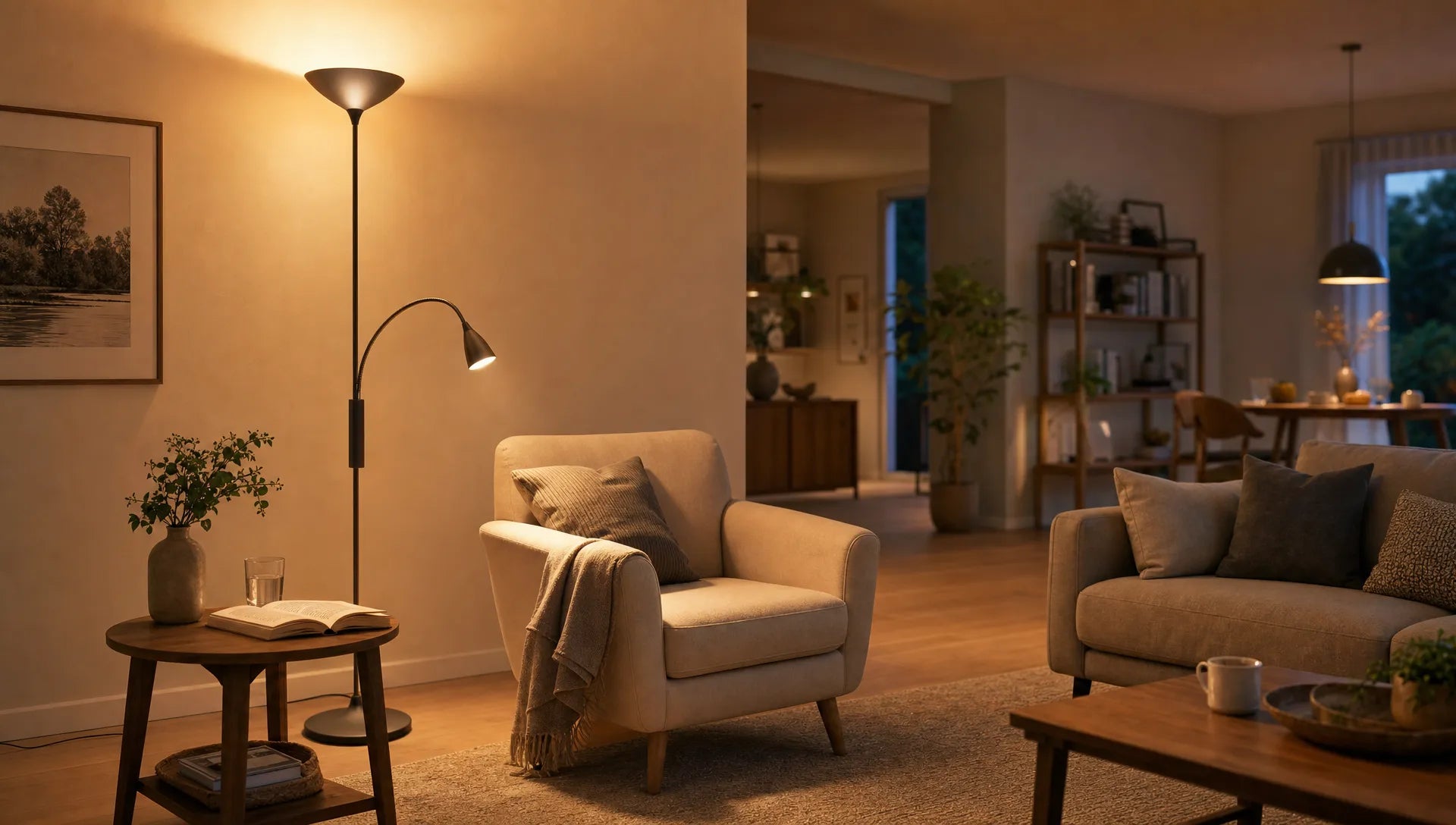
A layering principle is better. The modern LED ceiling light takes over the basic brightness, and additional light sources supplement it depending on use. In the living room this can be an indirect wall lamp or floor lamp. In the kitchen, good work surface lighting complements the ceiling light. In the bedroom, a soft ceiling light can be combined with bedside lights.
The advantage: The ceiling light does not have to shine as brightly as possible. It may be even, quiet and well shielded. This is exactly what makes it look more modern and high quality.
Plan room by room: Which LED ceiling light fits where?
The right solution depends largely on the space. A hallway needs orientation, a kitchen needs functional light, a living room needs flexibility and a bedroom needs peace. The following table shows realistic orientation values and practical planning approaches for living spaces. The values are not mandatory standards, but rather useful guidelines for private interior spaces.
| space | Sensible basic brightness | Suitable modern solution | Tip against glare |
|---|---|---|---|
| Living room | approx. 100-150 lux as basic light | Ceiling light with diffuser, indirect light or flat light with wide beam | Do not place directly above the main position, plan to be dimmable |
| Dining area | approx. 150-300 lux at the table | Pendant light, subtle ceiling light or a combination of both | Shield the light source so that no one at the table looks into the LED |
| Kitchen | approx. 200-300 lux in the room, more on work surfaces | Ceiling light plus separate under-cabinet or work lighting | Check reflections on fronts and worktops |
| bedroom | approx. 100-200 lux | Warm, diffuse ceiling light with additional reading light | Avoid very bright central LED surfaces |
| hallway | approx. 50-100 lux | Compact ceiling light, several small light points or linear lights | Even distribution instead of a single bright spot |
| bathroom | approx. 150-250 lux in the room, more at the mirror | Ceiling light suitable for damp rooms plus mirror light | Avoid shadows on your face and observe the type of protection |
| Home office | approx. 300 lux basic light, approx. 500 lux at the workplace | Low-glare ceiling light plus desk lamp | Pay attention to screen reflections and low UGR values |
Especially in open living areas, it makes sense not to plan based on square meters alone. First question: Where do people sit? Where is work being done? Where are shiny surfaces? What directions of view arise when entering, sitting or cooking? A modern lamp only looks really high quality if it remains pleasant from these perspectives.

Correctly assess lumens without over-illuminating the room
With LEDs, watts is no longer a reliable planning factor. The decisive factor is the luminous flux in lumens. The rough formula is: room area in square meters times the desired lux number gives the required amount of lumens on the relevant areas. A living room with 20 square meters and 150 lux needs around 3,000 lumens for bright basic lighting.
In practice, not every lumen reaches where you need it. Dark walls, high ceilings, large screens or indirect lighting reduce the perceived brightness. For dark surfaces, a surcharge of around 20-30 percent can make sense. On very light walls, however, the same light appears stronger.
Nevertheless, you shouldn't just choose the brightest LED ceiling light. A lamp that is too strong is often permanently dimmed, but if the shielding is poor, it can still be blinding even when dimmed. It is better to have a sufficiently bright, wide-beam and dimmable lamp that allows different light levels for everyday life, cleaning and the evening mood.
The right light color for modern rooms
Light color influences whether an LED ceiling light appears homely, functional or cool. Warm white light of around 2,700 to 3,000 Kelvin is usually pleasant for living and sleeping areas. It supports wood, textiles, warm wall colors and a relaxed evening atmosphere.
In kitchens, hallways, bathrooms or work areas, 3,000 to 4,000 Kelvin can be useful if a clearer lighting effect is desired. Very cool light colors above 4,000 Kelvin quickly appear technical in private living spaces, especially if the luminaire is installed over a large area and centrally.
In addition to Kelvin, color rendering plays an important role. A high color rendering index, often stated as CRI or Ra, makes materials, skin tones, wood and textiles appear more natural. For high-quality interiors, a value of Ra 90 or more is ideal, especially in dining areas, dressing rooms, living rooms and anywhere where colors are important.
Lamp shape and shielding: This makes the difference
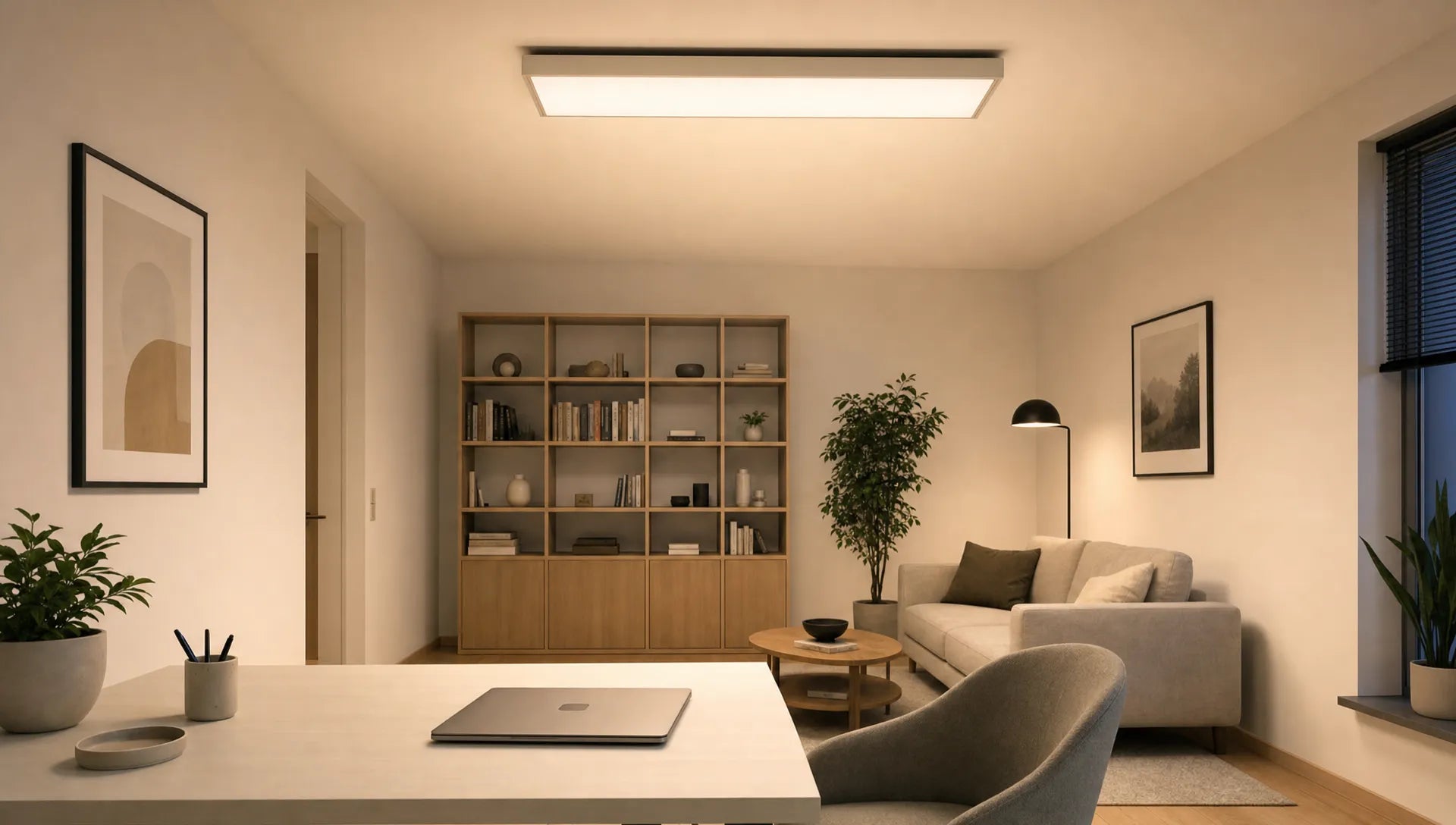
A modern LED ceiling light can be minimalist, sculptural, flat, round, linear or decorative. However, freedom from glare depends less on style than on optical construction. A very elegant lamp can cause unpleasant glare if the LED source is visible. A simple lamp, on the other hand, can appear high-quality if it distributes light in a soft and controlled manner.
Lights with satin glass, opal acrylic, textile shades, indirect light components or low-lying light sources are particularly low-glare. A larger light fixture can also be more pleasant than a small, extremely bright point because the light is distributed over a larger area.
| feature | Effect on glare | Practical tip |
|---|---|---|
| Opal diffuser | Distributes LED light softly and reduces visible light spots | Ideal for living, bedroom and hallway areas |
| Indirect light component | Brightens ceilings or walls and reduces contrasts | Particularly pleasant in low evening light |
| Deep reflector | Shields the LED from the side | Good for downlights and directional ceiling lights |
| Wide beam angle | Distributes light more evenly throughout the room | Usually better for basic lighting than narrow spots |
| dimming | Adjusts brightness based on time of day and usage | Pay attention to compatible lamps, drivers and dimmers |
| Matte room surfaces | Reduce annoying reflexes | Important for tables, kitchen fronts and floor coverings |
A common mistake is choosing many small, visible points of light. This often looks modern in product images, but can appear restless in everyday life. If spotlights are used, they should be oriented to emphasize walls, art, shelves or countertops and not shine directly at eye level.
Consider installation height, position and viewing axes
The best LED ceiling light is of little use if it is in the wrong place. With low ceilings, flat lights or indirect concepts are often more pleasant than low-hanging elements. If the ceiling is high, the lamp can be larger and more present, but should always fit the proportions of the room.
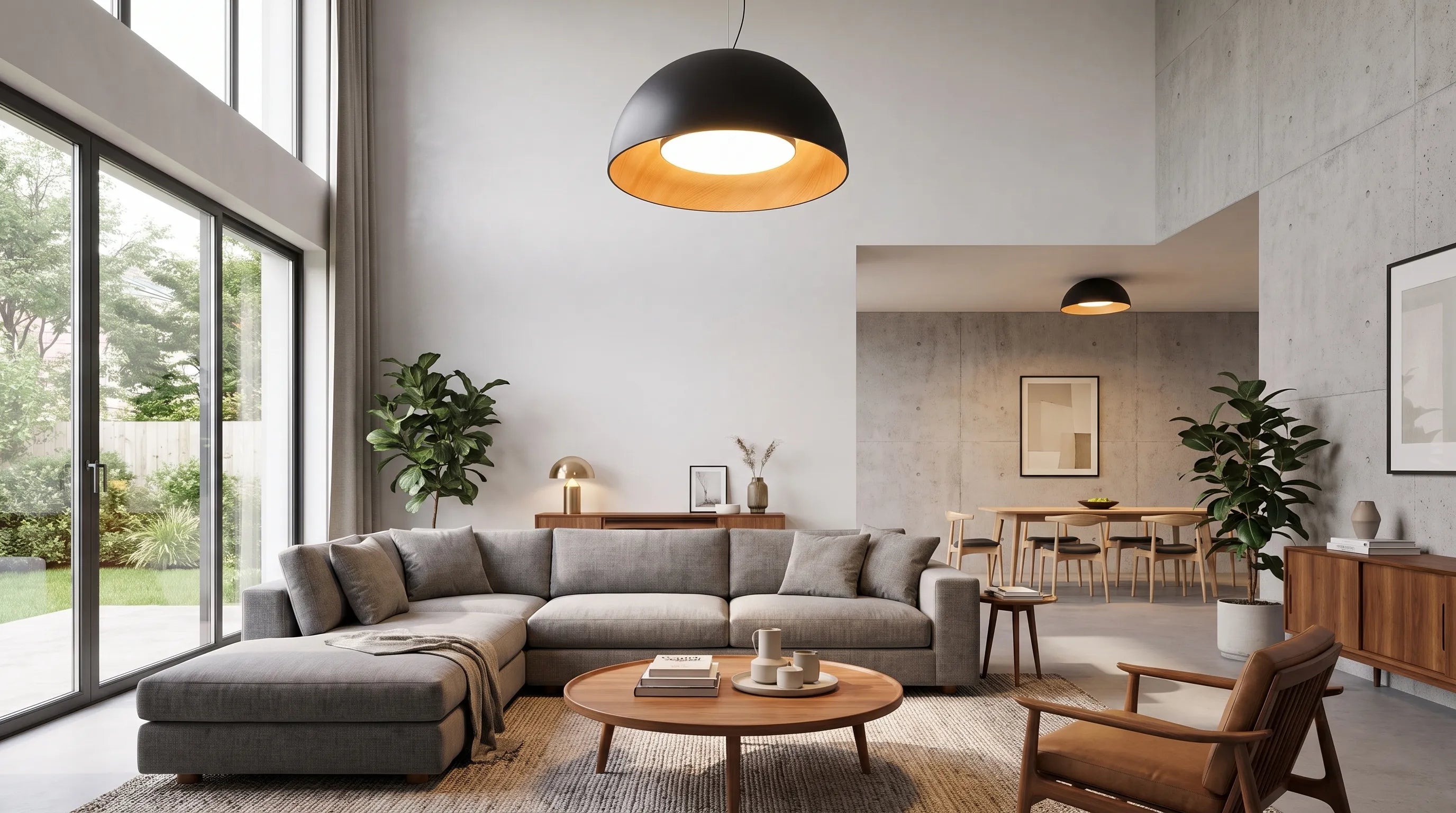
Pay particular attention to lines of sight. A lamp that catches the eye when entering the room should be very well shielded. Caution is advised over sofas, armchairs and beds because people often look upwards or at an angle to the ceiling. A pendant lamp can be very pleasant in the dining area if it hangs low enough, illuminates the table well and does not visibly glare from the light source.
For pendant lights above dining tables, a distance of around 60-75 cm is often used between the table top and the lower edge of the light. This is a tried and tested starting point, but it must match the size of the luminaire, the height of the room and the direction of view. For very high ceilings, sloping ceilings or unusual table positions, individual adjustment is worthwhile.
This is exactly where custom work plays a big role. If standard lengths don't fit the room, even a nice lamp can quickly seem improvised. At BUYnBLUE Chandeliers and pendant lights can be adjusted free of charge, for example in terms of cable length, canopy or color. This means that modern lighting can be tailored to the height of the room, the position of the furniture and the furnishings.
Think about material, surface and room style together
Modern does not automatically mean cold or ultra-minimalist. A modern LED ceiling light can also appear warm, organic or luxurious. What is crucial is that the shape, material and lighting effect fit together.
Brass, smoked glass, opal glass, black metal, chrome, natural stone look or clear lines can create very different moods. In bright, minimalist rooms, a ceiling light can become an architectural accent. In rooms that are already rich in details, a quieter, flat light often works better.
The ceiling itself is also part of the design. A matte white ceiling reflects light softly and supports glare-free lighting. Dark ceilings create atmosphere, but usually require more light output or additional light sources. For exposed concrete, wooden ceilings or structured surfaces, you should check how the light emphasizes shadows and material.
Dimming and scenes: comfort instead of uniform brightness
Glare is not the same at all times of the day. Bright light can be practical in the morning, but the same light level can be unpleasant in the evening. That's why dimming is one of the most important comfort factors for modern LED ceiling lights.
Different scenes make sense in the living room: bright for cleaning or everyday life, medium-bright for conversations, dimmed for movie nights. In the kitchen, bright light may be necessary when working, while a softer level is more comfortable when eating or late in the evening. In the bedroom, the ceiling light should be dimmable as gently as possible so that it does not look like a work light.
Technical compatibility is important. Not every LED light works with every wall dimmer. With integrated LED lights, the built-in driver is crucial. Anyone who is renovating or building a new building should plan dimming, switch positions and possible light groups early on, not just after installation.
Common planning mistakes with modern LED ceiling lights
The first mistake is overbrightness. Many buyers choose a light that is impressive on paper but is too dominant in the room. The second mistake is a beam angle that is too narrow for the basic lighting. This then creates bright spots and dark zones, which makes the room uneasy.
The third mistake is the wrong light color. A cool ceiling light can clearly emphasize modern architecture, but it can quickly become uncomfortable in living spaces. The fourth mistake is ignoring reflections. Glass or stone tables, shiny kitchen fronts and screens immediately show whether a light is well placed.
The fifth mistake is the late decision. Lighting should not only be decided based on furniture, colors and electrical planning. If you plan early, you can coordinate ceiling outlets, pendant lengths, light groups and luminaire sizes.
Short checklist before purchasing
Before you choose a modern LED ceiling light, it's worth a quick reality check. It prevents bad purchases and helps to bring together design and visual comfort.
- Is the LED light source directly visible or shielded by glass, diffuser, reflector or screen?
- Does the lumen output match the room size, wall color and desired use?
- Is the light color pleasant for the room, especially in the evening?
- Can the light be dimmed and is the dimmer compatible?
- Is the lamp located outside the disturbing lines of sight of the sofa, bed, dining table or screen?
- Will shiny surfaces in the room reflect unpleasantly?
- Does the size of the lamp match the ceiling height and furniture?
If several points are uncertain, the solution is often not a stronger light, but a better combination of basic light, accent light and targeted work light.
Frequently asked questions about modern LED ceiling lights without glare
Which LED ceiling light is the least dazzling? Lights with opal diffusers, satin glass, indirect light components or deeply shielded LEDs are particularly low-glare. It is crucial that the LED light source is not directly in the field of vision and that the light is distributed widely.
How many lumens does a modern LED ceiling light need in the living room? As a guide, around 100-150 lux is often sufficient for basic lighting. For 20 square meters, this roughly corresponds to 2,000-3,000 lumens, depending on the wall color, ceiling height and lamp shape. For more flexibility, a dimmable solution makes sense.
Is warm white or neutral white better against glare? The color of the light does not directly prevent glare, but it does influence perception. Warm white light with 2,700-3,000 Kelvin usually has a softer effect in living rooms. Neutral white can be useful in the kitchen, bathroom or home office, but should be well shielded.
Are flat LED ceiling lights automatically glare-free? No. Flat designs can be very pleasant if they have a high-quality diffuser. If individual LEDs are visible or the illuminated surface is very bright, even a flat lamp can be dazzling.
Which is better: a large ceiling light or several small spots? For uniform basic light, a larger, diffusely lit area is often more pleasant. Spotlights work well for accents or workspaces, but should not be aimed directly at seats, screens, or shiny surfaces.
Plan modern lighting precisely
A glare-free LED ceiling light is created through the interaction of brightness, shielding, light color, position and room design. If you check these points before buying, you will not only get more visual comfort, but also a higher quality feeling of space.
At BUYnBLUE you will find a curated selection of modern lights made from high-quality materials that combine timeless design with a functional lighting effect. Particularly practical for demanding rooms: chandeliers and pendant lights can be adjusted free of charge, for example in length, canopy or color. There is also free worldwide shipping, a 14-day return option and convenient ordering from selection to delivery.