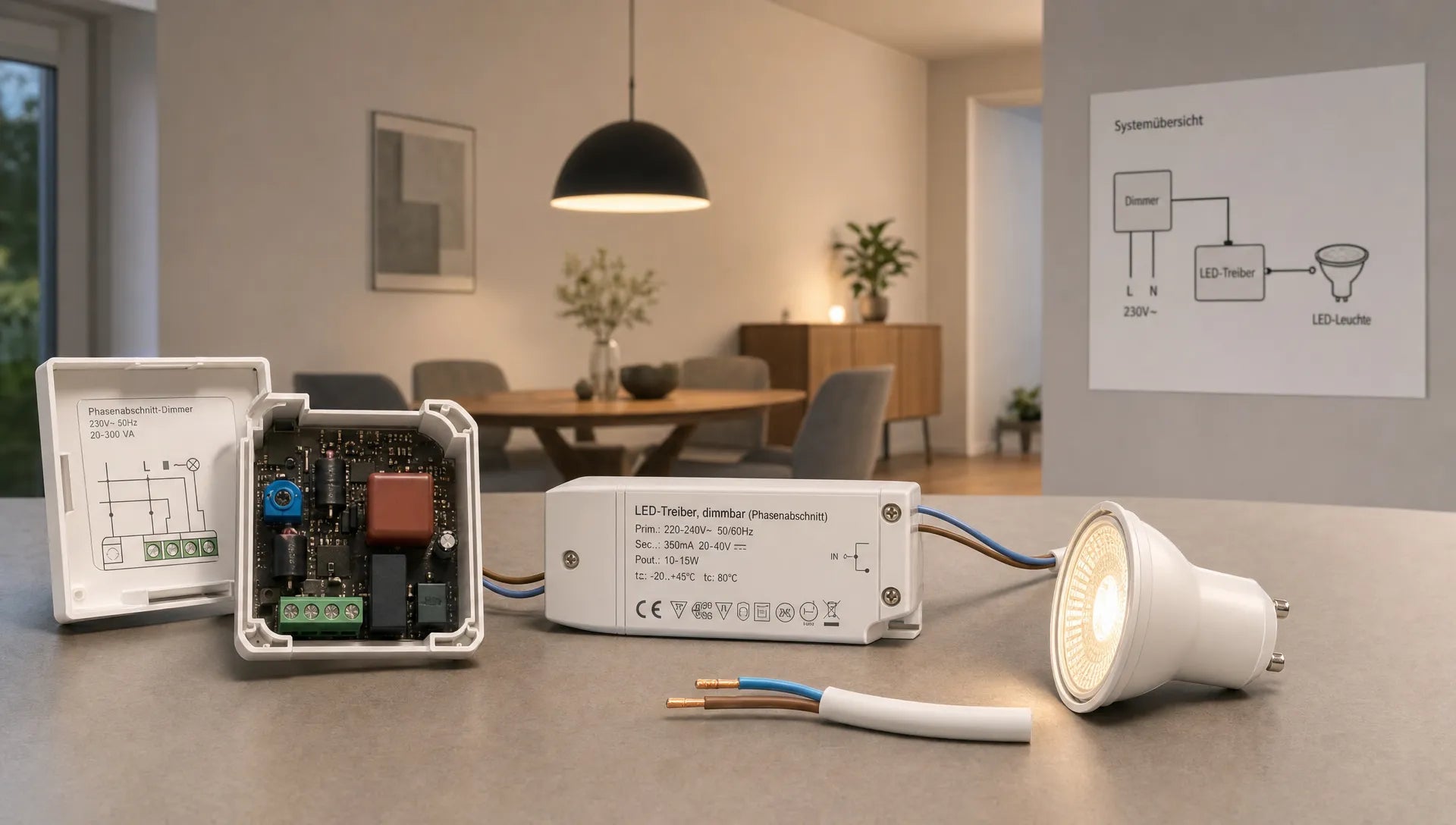
Choose a dimmable lamp without flickering or humming
Choosing a dimmable lamp is much more challenging today than it used to be. With classic light bulbs, a simple rotary dimmer was often sufficient. Modern LED lights are more efficient, more versatile and more exciting in terms of design, but react more sensitively to incorrect dimmers, poor drivers, loads that are too low or unsuitable light sources. The result may be flickering, flickering, buzzing, or an audible hum.
The good news: In most cases this can be avoided if you don't just pay attention to the word dimmable, but look at the entire system. What is crucial is the interaction between the luminaire, light source or LED module, driver, dimmer and installation.
Why simply saying dimmable is not enough
Dimmable initially only means that a lamp or lamp can be technically dimmed. It does not automatically mean that every combination works flicker-free and noiselessly with every existing wall dimmer.
There are several ways to regulate brightness, especially with LED technology. Some LED lamps require a leading edge dimmer, others work better with a leading edge dimmer, others need their own LED driver, a radio control or a professional control signal such as DALI. If these components do not fit together, the lamp may visibly flicker, dim only in a small range, turn off when turned down, or make noise.
Flickering is also not always immediately visible. Some light fluctuations can only be recognized through the smartphone camera, when you move your hand quickly or when you get tired while reading. The IEEE Recommended Practice 1789 therefore deals with the possible effects of light flickering and recommendations for reducing it. In practical terms, the following applies to living rooms: the quieter and more even the light, the more pleasant the room appears.
The most common causes of flickering and humming
Flickering and humming are rarely caused by a single factor. Most often it is a combination of electronics, load and mounting environment.
When it comes to a lamp with a replaceable light bulb, the light source is often the first suspect. Not every LED bulb is dimmable, and not every dimmable LED harmonizes with every dimmer. If you are specifically looking for the right bulb, the separate guide will help Dimmable light bulb without flickering further.
With integrated LED lights, the crucial electronics are usually located in the LED driver. This converts mains voltage into the appropriate current for the LED module. A high-quality driver can dim very cleanly, but an unsuitable or poorly tuned driver can flicker or buzz.
The dimmer itself is also crucial. Older wall dimmers were often designed for halogen lamps or incandescent lamps. They expect higher electrical loads and cannot always cope with very economical LED lights. A typical example: A modern LED pendant light only requires 18 watts, but the existing dimmer only works stably from 40 watts. The light can then become unsettled in the lower dimming range.
Humming also has a mechanical component. Electronic components can vibrate at certain frequencies. This oscillation can be audibly amplified in a large metal rosette, a hollow canopy, a loosely mounted transformer or a highly resonant lamp body.
Dimmer types at a glance: Which technology is suitable?
If you buy a dimmable lamp, you should always check which dimming technology is recommended by the manufacturer of the lamp or bulb. The following table provides guidance, but does not replace the technical information of the respective product.
| Dimming technology | Typical application | advantage | Possible cause of problems |
|---|---|---|---|
| phase section, RC | Lots of modern LED lights and electronic transformers | Often quieter and more LED friendly | Not suitable for some older transformers or special drivers |
| Phase control, RL | Classic incandescent lamps, halogen, some magnetic transformers | Robust in older installations | LEDs can tend to hum or flicker if not enabled |
| Universal LED dimmer | Mixed living situations with LED loads | Often adjustable and more flexible | Must be configured correctly, observe minimum load |
| 0 to 10 V, DALI, KNX | Architecture, smart home, larger projects | Can be planned very precisely and professionally | Requires compatible drivers and suitable control cables |
| Integrated touch, radio or app dimmer | Table lamps, floor lamps, some pendant lamps | The system is often tuned at the factory | Exchange or combination with wall dimmers is not always possible |
For living spaces with new LED lights, a good LED trailing edge dimmer is often the best starting point. However, the manufacturer's approval remains crucial. If a light can only be dimmed using the integrated driver, it should not also be controlled using an unsuitable wall dimmer.
You can also find a more in-depth overview of the technical connections in the article on the question, which works really flicker-free when dimming LED lamps.
The load range: correctly assess small wattages
Many flickering problems arise because the electrical load is too low. LED technology uses significantly less electricity than halogen. What is an advantage in terms of energy can become a problem for old dimmers.
Therefore, pay attention to the LED load range of the dimmer, not just the general wattage rating. For example, a dimmer may be rated at 20 to 300 watts for incandescent bulbs, but only 5 to 100 watts for dimmable LEDs. The LED value counts for your planning.
A simple example: A chandelier with six LED bulbs of 4 watts each has a total load of 24 watts. An LED dimmer with a range of 5 to 100 watts is generally plausible for this. An old dimmer with a minimum load of 40 watts, on the other hand, is risky, even if it worked without any problems with previous halogen lamps.
If you have several bulbs in one lamp, you should also use models that are as identical as possible. Different LED bulbs may contain different electronics and respond differently to the dimmer. This can lead to uneven dimming behavior, for example if one bulb goes out earlier than the others.
Integrated LED or replaceable light source?
Both variants can be a good choice if they are properly coordinated. The decision depends on the space, design requirements and maintainability.
A lamp with replaceable bulbs offers flexibility. You can change the light color, brightness and beam angle more easily later. This makes sense if you don't yet know exactly whether the room should appear warm and cozy or brighter and more functional.
A luminaire with integrated LED, on the other hand, often offers a particularly slim design, homogeneous light lines or complex shapes that would be difficult to achieve with standard sockets. The driver is particularly important here. When purchasing, ask whether the light is dimmable, what type of dimming it uses and whether the driver is designed for quiet operation.
System consideration is particularly worthwhile for high-quality pendant lights, chandeliers or large ceiling lights. A strong designer lamp only becomes truly convincing when the quality of light, installation height and operation all match.

Avoid humming: What you should pay attention to acoustically
A quiet humming noise in the technical room is hardly noticeable. However, it can be annoying above the dining table, next to the sofa or in the bedroom. That's why low noise should be just as important as brightness and design when choosing a dimmable lamp.
Rooms in which it gets quiet in the evening are particularly sensitive. These include bedrooms, reading nooks, dining areas, home offices and open kitchen-living rooms. Here you should not choose a combination that only works technically, but hums audibly at 20 or 30 percent brightness.
Pay attention to these points before you commit:
- The dimmer should be expressly suitable for LED loads and match the recommended dimming method.
- The LED driver should belong to the luminaire or be approved by the manufacturer.
- The total load should be within the specified LED load range.
- The canopy, transformer and lamp body should be firmly installed so that no resonances occur.
- In very quiet rooms, a test in the lower dimming range is particularly important.
Another point is often underestimated: Some lights do not hum at full brightness, but only when dimmed. Therefore, don't just test on and off, but rather test several dimming levels, especially the area that you use most often in everyday life.
Choose the right dimmable lamp for your room
Not every room needs the same dimming curve. Choosing a dimmable lamp also means adapting the lighting mood to the use of the room.
A wide dimming area is ideal in the living room. During the day or when tidying up you need bright basic light, in the evening you need warm, reduced light. Pendant lights, ceiling lights or floor lamps with quiet dimming are particularly useful here.
In the dining room, glare is important. The lamp should hang low enough to pleasantly illuminate the table, but not disturb the view. If the ceiling height or table position differs from standard dimensions, adjusting the cable length can be crucial. At BUYnBLUE Pendant lights and chandeliers can be individually adjusted in terms of length, canopy and color, among other things, so that they fit the room concept.
In the bedroom, the lowest dimming level should be really comfortable. Residual light that is too bright appears unsettling, while flickering or humming is particularly noticeable in the evening. A very careful combination of light, driver and operation is worthwhile here.
Low-flicker light is particularly important in the home office because you work under the same light source for longer. A dimmable lamp should not only appear cozy, but also enable concentrated work. A combination of indirect general lighting and focused work lights is often better than a single, very bright light source.
Buying checklist: How to recognize a good dimmable lamp
Before purchasing, you should check technical information and practical requirements together. This short checklist helps to avoid typical bad purchases.
- Clarify dimming type: Does the product information say trailing edge, leading edge, DALI, 0 to 10 V, touch dimmer or another technology?
- Check compatibility: Does the light fit the existing dimmer or does the dimmer need to be replaced?
- Calculate load range: Is the total output of all LED modules or lamps within the LED load range?
- Choose light color: Warm light colors are often more pleasant for living rooms, while work areas tolerate more neutral light.
- Note the dimming range: A good lamp should not only dim from 100 to 70 percent, but also be noticeably adjustable in everyday life.
- Evaluate low noise: Operation should be quiet when dimmed, especially in the bedroom, dining table and reading area.
- Plan installation height: For pendant lights, the correct cable length is crucial for glare-free and spatial effect.
- Returns and use support: A practical test can be useful, especially for existing dimmers.
It is also important for architects and interior designers to include dimming technology in the electrical planning early on. If a decision is only made after completion, control cables, flush-mounted dimmers or smart home interfaces may be missing.
Troubleshooting: What to do if the lamp flickers or buzzes?
If a dimmable lamp that has already been installed is causing problems, you should proceed systematically. Do not replace all parts at random, but narrow down the cause.
| Symptom | Probable cause | Sensible next step |
|---|---|---|
| Lamp only flickers in the lower area | Minimum load or dimmer not suitable | Check a dimmer suitable for LEDs and have the minimum brightness set |
| Lamp hums when dimming | Dimmer, driver or resonance in the housing | Check dimming type, check fastening, use appropriate driver |
| Lamp suddenly goes out when dimming down | Dimming range or driver limit reached | Set the lower dimming limit on the dimmer, select compatible components |
| Individual lamps behave differently | Mixed LED models or batches | Use identical dimmable lamps |
| Flickering even at full brightness | Contact problem, unsuitable driver or network malfunction | Have the installation checked by a qualified electrician |
Important: Work on 230-volt installations should be done by a qualified electrician. This particularly applies to permanently installed ceiling lights, flush-mounted dimmers, drivers in canopies and changes to the house installation. Safety always comes before quick troubleshooting.
What is particularly important when it comes to designer lights?
When it comes to designer lights, it's not just the technical function that counts, but the interaction of light, material and spatial proportions. A high-quality lamp can be visually perfect, but lose its effectiveness if it hangs too low, shines too coldly or makes noise when dimming.
Therefore, you should answer three questions before purchasing: How will the space be used? What mood should the lamp create? What electrical environment already exists? Once these points have been clarified, a dimmable lamp can be selected much more specifically.
Pendant lights and chandeliers also need to be adjusted to the height of the room and the furniture. A shortened or extended cable, a matching canopy or a coordinated color can make the difference between almost right and perfectly integrated. This is a big advantage, especially in open living areas, old buildings or projects with special ceiling heights.
Frequently asked questions about dimmable lamps
Can every LED lamp be dimmed? No. LED lamps must be expressly marked as dimmable. In addition, the dimmer must match the LED and the required dimming technology.
Why does my dimmable lamp flicker despite having a dimmable LED? Dimmers, minimum load and LED electronics often do not fit together. Mixed lamps, bad contacts or an unsuitable driver can also cause flickering.
Is trailing edge always better than leading edge? Not always, but for many modern LED lights, trailing edge is the more suitable choice. The information provided by the lamp or bulb manufacturer is crucial.
Why does the lamp only buzz when it is dimmed? When dimming, the electrical control changes. This can cause dimmers, drivers, transformers or components in the lamp housing to vibrate mechanically and become audible.
Can I connect a dimmable lamp myself? You can usually use mobile lights with plugs yourself. Permanently installed ceiling and wall lights as well as flush-mounted dimmers should be installed or checked by a qualified electrician for safety reasons.
Which is better: integrated dimmer or wall dimmer? An integrated dimmer is often well coordinated with the lamp. A wall dimmer is convenient for ceiling and pendant lights, but must be technically compatible. Professional control can make sense in demanding projects.
Conclusion: Quiet dimming starts before you buy
If you want to choose a dimmable lamp, pay attention to more than just design and brightness. Check the dimming type, driver, load range, lamps, installation and room acoustics as a coherent system. This way you avoid the typical problems with flickering and humming and get light that feels really high quality in everyday life.
At BUYnBLUE Find curated designer lighting for modern living spaces, including free customization on pendants and chandeliers, free worldwide shipping, and 14-day returns. This means that your new lamp can be planned not only visually, but also spatially.