Use the height-adjustable dining table pendant light correctly
One Height-adjustable pendant lamp above the dining table Using it is more than just a practical convenience function. Used correctly, it changes the character of the room: bright and functional when working, pleasantly focused during dinner, relaxed and open when the table is used for games, conversations or guests.
The most common mistake is to only use the height adjustment once during assembly and then forget it. The real advantage lies precisely in adapting the lamp to everyday situations. Three questions are crucial: How high does the lamp hang in relation to the table top? How glare-free is the light when sitting? And does the lighting effect match the activity at the table?
Why a height-adjustable pendant light at the dining table makes so much sense
The dining table is rarely just a place to eat. In many households it is a workplace, homework area, meeting place, craft area and focal point for guests. A fixed hanging height can work for this, but is often a compromise. A height-adjustable pendant light creates more freedom because you can move the light source closer to the table or further up depending on use.
When eating, a slightly lower position usually seems more comfortable because the light is concentrated more on the table surface. When working, sorting or decorating, a higher position can make sense so that the light is distributed more widely and the lamp is less in the field of vision. When the table is not in use, the pendant light can often be adjusted higher so that the room appears more open.
This is particularly important in open living and dining areas. The lamp should visually mark the dining table without blocking the room. A flexible height helps to find the balance between zoning and lightness.
The right base height: a good starting point
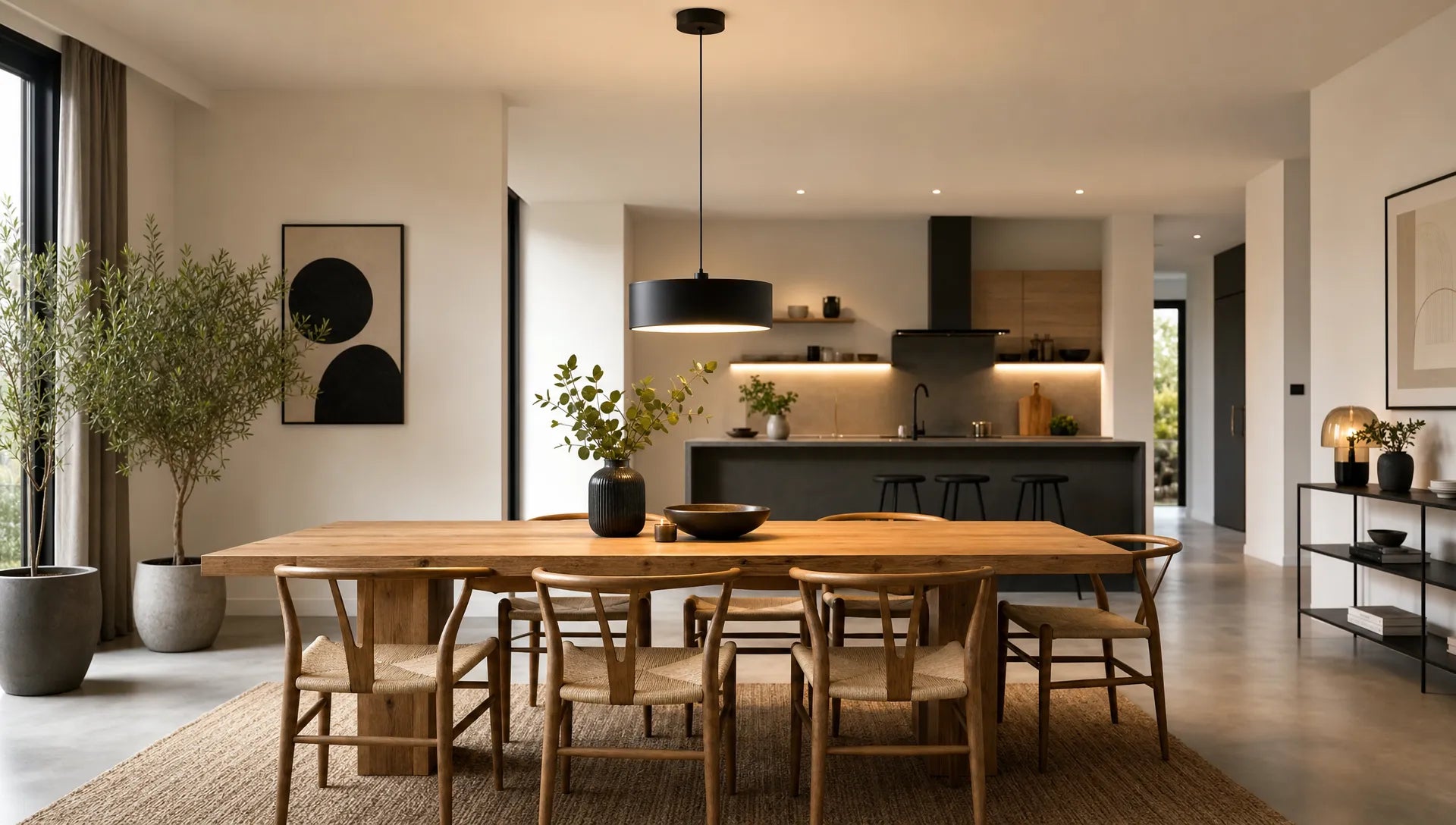
As a guide, the lower edge of the pendant light often hangs above the dining table 60 to 75 cm above the table top. This is not a hard and fast rule, but it is a proven area because it combines three requirements well: the table surface is visibly illuminated, people sitting are not blinded, and eye contact remains free.
For very large lights, low ceilings or particularly tall people, a slightly higher position may be more comfortable. Small, narrow or very focused lights, on the other hand, can sometimes hang a little lower if they do not dazzle or disturb the view.
If you would like to plan the basic dimensions of your lamp in more detail, it is worth taking a look at the guide correct height, width and distance of a pendant light above the dining table. However, it remains crucial for daily use: the best height is the one at which light, visibility and feeling of space fit together.
This is how you test the ideal height in everyday life
The height adjustment should not be adjusted based on feel alone. A short practical test is better, ideally at the time of day when you use the dining table most often.
Sit in all typical places at the table and check whether the light source is shining directly into your eyes. Then look at the table surface: Is it illuminated evenly enough? Are harsh shadows caused by glasses, bowls or decorations? Does the light appear too dominant in the room or too far away?
A simple test: First adjust the light to about 70 cm above the table top. Then lower or raise them in small 5cm increments. After each step, check glare, line of sight and light distribution. Often a few centimeters are enough to feel the difference between “beautiful” and “really pleasant”.
| Usage situation | Sensible tendency in height | What you should pay attention to |
|---|---|---|
| Dinner | rather deeper | Cozy island of light, no glare when sitting |
| Working or reading | rather higher | Wider illumination, fewer shadows on documents |
| Guests and long conversations | medium height | clear view, warm atmosphere |
| Decorate or serve the table | higher | Freedom of movement over the table surface |
| Room appears empty or restless | a little deeper | better visual zoning of the dining area |
Think height and table shape together
A height-adjustable pendant light only works well if it fits the shape of the table. Above a round table, a single central pendant light often looks harmonious because the light cone follows the shape of the table. For oval or long rectangular tables, linear lights, multiple pendants or elongated shapes are often more harmonious.
The height adjustment cannot completely compensate for proportion errors. A lamp that is too small will remain lost over a large table, even if it hangs lower. A lamp that is too large can visually overwhelm the table if it is also mounted very low. Therefore, height, width and shape should always be considered together.
The selection is particularly sensitive for round and long tables. If you are unsure which shape of lamp suits your table, you can find additional guidance in the article on Dining table pendant light for round and long tables.
Lighting mood: it's not just the height that counts
The correct hanging height has a strong influence on the lighting effect, but is not a substitute for suitable lighting quality. Warm to neutral warm light is usually ideal for the dining table. Many living areas look particularly inviting at around 2700 to 3000 Kelvin. If you often work at the dining table, you may prefer more neutral lighting, but you should make sure that the dining area does not appear cool or uncomfortable.
The brightness should also match the size of the table. A lamp that hangs very low has a more intense effect on the table surface. If it hangs higher, the light is distributed more widely, but often less concentrated. That's why a dimmable solution is particularly practical if the dining table fulfills multiple functions.
Freedom from glare is crucial. Luminaires with a well-shielded light source, diffusely diffused shades or indirect light components are usually more pleasant at the dining table than very open models. If you have shiny table tops made of glass, polished stone or painted wood, you should also check for reflections.

Three furnishing styles and how to use the height adjustment
A height-adjustable pendant light is not only technically practical, but also creatively effective. Depending on the design style, a lower or higher position can enhance the desired expression.
Calm and natural: Wabi-Sabi above the dining table
Wabi-Sabi thrives on organic shapes, natural materials and a serene, imperfect beauty. A lamp in this style can hang more prominently above the table because its shape often acts as a calm focal point. The Wabi-Sabi dining table lamp Goes particularly well with wood, ceramics, linen and reduced color palettes.
With an organically shaped lamp, you should choose the height so that the silhouette remains clearly visible without disturbing the view over the table. A medium to slightly lower position can pleasantly ground the dining area.
Clear and warm: stage Japandi correctly
Japandi combines Scandinavian clarity with Japanese restraint. The style works best when the lamp is not hung too low or too dominant. The Japandi dining table lamp can create a calm, balanced light zone above a simple wooden table.
A clean, precise hanging height is usually recommended for Japandi interiors. Check the lamp from several angles: from the entrance to the room, from the sofa and from the seat at the table. This creates a harmonious overall picture that doesn't just work when you're sitting.
Reduced and functional: LED pendant light in the dining area
Modern LED lights go particularly well with clean floor plans, kitchen-dining areas and minimalist furnishings. One Modern LED Pendant Lamp Dining table is particularly interesting if you are looking for a linear lighting solution that combines design and function.
For elongated LED pendant lights, it is important to align them parallel to the edge of the table. The height adjustment helps to place the light line exactly where it is needed. Over a long table, the lamp should neither be too high, otherwise it loses its clear effect, nor too low, otherwise it can disrupt the line of sight.
Common mistakes with height-adjustable pendant lights
Many problems arise not from the luminaire itself, but from small planning and usage errors. These are easy to avoid if you catch them early.
A common mistake is setting it too low. This can look comfortable, but it quickly disrupts eye contact. Nobody should have to look around the lamp, especially during family dinners or conversations with guests. A setting that is too high is just as problematic: then the pendant light loses its effect as an island of light and the dining table appears less defined.
Table decoration is also often underestimated. Tall vases, candlesticks or large branches can compete with a lower hanging light fixture. If you decorate seasonally, you should readjust the light fixture occasionally.
Another point is the mounting position. The pendant light should usually hang in the middle above the table, not necessarily in the middle of the room. If the dining table is not exactly under the ceiling outlet, a suitable canopy solution can help. BUYnBLUE According to the service description, offers free adjustments, such as cable length, canopy or color, which allows a lamp to be better adapted to the room height and table position.
Care, safety and suitability for everyday use
A height-adjustable pendant light should be easy to use, but should not have to be constantly adjusted. It's best to determine two to three favorite positions: a eating height, a working height and a higher position for more freedom of movement. This way you can make conscious use of your flexibility without having to constantly readjust it in everyday life.
Make sure that cables, counterweights or adjustment mechanisms run cleanly. If something feels stiff, you should not pull with force. If you are unsure, professional installation makes sense, especially with heavy lights or complex ceiling connections.
Dust and fingerprints are more noticeable on pendant lights above the dining table because they are in direct view. Clean the screen and visible cables regularly with a soft, dry or slightly damp cloth, depending on the material. Before each cleaning, the light should be switched off and cooled down.
When individual adaptation is particularly worthwhile
Not every dining area conforms to standard dimensions. Old apartments often have high ceilings, new buildings sometimes have open floor plans with staggered connections, and sloping ceilings bring additional challenges. In such cases, a pendant light is particularly valuable if the cable length, canopy or color can be coordinated with the room.
Individual adjustment is particularly worthwhile if the table is permanently in a certain position but the power outlet is not ideally located. Even very high or very low ceilings benefit from an adapted solution. This means that the lamp does not look like a subsequent compromise, but rather like a planned part of the interior.
FAQ: Pendant light dining table height adjustable
How high should a height-adjustable pendant light hang above the dining table? A good starting value is around 60 to 75 cm between the table top and the lower edge of the lamp. Depending on the height of the room, the size of the luminaire, glare and personal preference, the ideal height may vary slightly.
When should I adjust the pendant light lower? A lower position is particularly suitable for cozy dinners, quiet lighting and a greater emphasis on the dining table as the focal point. It is important that the light does not dazzle and that the view remains clear.
When is a higher setting better? A higher position is practical when working, serving, decorating or when the table is not in use. It creates more freedom of movement and makes the room appear more open.
Does a height-adjustable pendant light also suit low ceilings? Yes, but the proportions have to be right. For low ceilings, flatter, more compact or visually lightweight models are often more suitable. The light should not protrude too deep into the room.
Should the pendant light hang in the middle of the room or in the middle above the table? The center of the table is usually crucial. The dining table is the reference point for light and proportion. If the ceiling outlet does not fit ideally, an adapted canopy or cable solution can help.
Conclusion: Use flexibility consciously
A height-adjustable pendant light above the dining table only reveals its value when you actively adapt it to the room, table and everyday life. Start with a base height of around 60 to 75 cm, test glare and lines of sight while sitting and change the height depending on use.
Whether Wabi-Sabi, Japandi or modern LED light: The important thing is that the pendant light not only looks beautiful, but also makes your dining area better in everyday life. At BUYnBLUE Find curated designer lighting for modern living spaces, with free customization on select details, free worldwide shipping, and 14-day returns.