DALI dimmable lights for the home explained clearly
If a light as DALI dimmable is described, it initially sounds like professional building technology. In fact, DALI comes from lighting planning for offices, hotels, shops and public buildings. The system is now also becoming more and more interesting for sophisticated living spaces, especially in new buildings, renovations and modern smart home concepts.
The most important point first: DALI is not just a particularly good rotary dimmer. It is a digital control system for light. This allows individual lights, groups and scenes to be addressed precisely, for example for eating, reading, cooking, watching TV or creating a gentle evening atmosphere. If you just want to make a single pendant light brighter or darker, you don't necessarily need DALI. However, if you want to neatly coordinate several lights in the room, you should understand the principle.
What does DALI dimmable mean?
DALI stands for Digital Addressable Lighting Interface. The standard is described in the IEC 62386 series of standards and is used by the DALI Alliance further developed. To put it simply: A DALI dimmable light has a suitable LED driver or a ballast that understands digital commands.
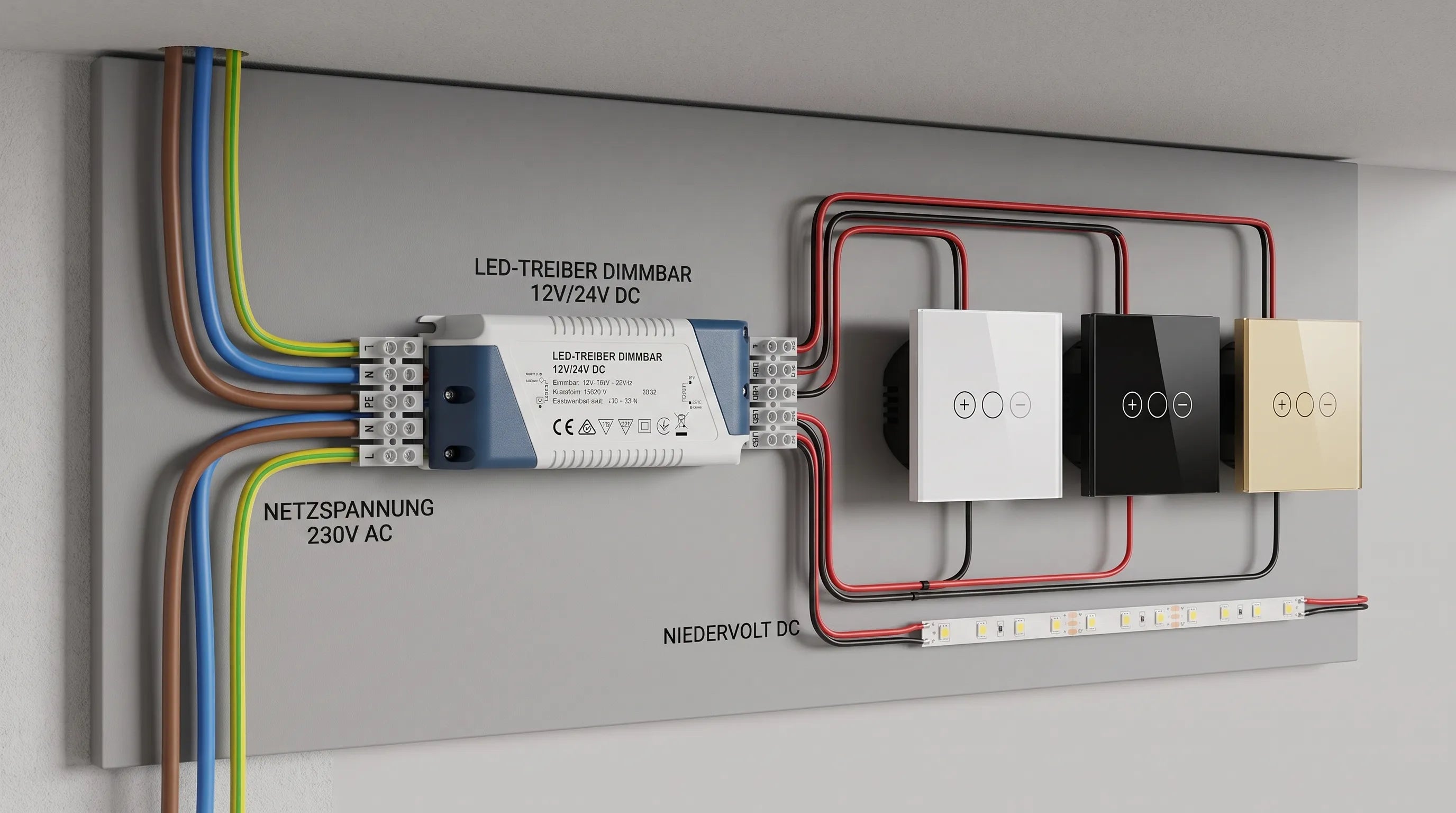
With a classic phase dimmer, the mains voltage is switched on or off. The lamp reacts to this by becoming brighter or darker, provided the bulb and dimmer are compatible. With DALI the control works differently. The power supply and the control information are separated from each other. Digital commands are sent via an additional control line, for example 40 percent brightness, activate scene 2 or switch on the kitchen group.
The advantage is accuracy. A DALI light is not only approximately dimmed, but also receives specific control values. In addition, each light can have its own address. This makes much finer lighting concepts possible than with a simple wall switch.
DALI compared to other types of dimming
The distinction is important for the home because the term dimmable alone says little. A light can be dimmable without supporting DALI. It can be designed for trailing edge, leading edge, 1-10V, Zigbee, Bluetooth or a proprietary system. These systems are not automatically compatible with each other.
| Dimming type | How it works | Typical use | Important for home |
|---|---|---|---|
| Phase control or phase control | The dimmer changes the mains voltage curve | Individual LED lights, retrofit bulbs | Simple, but dependent on dimmer and bulb compatibility |
| DALI | Digital commands via separate control line | Multiple lights, groups, scenes, sophisticated lighting planning | Very precise and flexible, requires appropriate planning and components |
| 1-10V | Analog control voltage regulates the brightness | Older or simple dimmable systems | Less flexible than DALI, usually not the first choice for new residential projects |
| Radio-based systems | Control via app, gateway or radio protocol | Smart home, retrofitting | Practically in existence, but dependent on the respective ecosystem |
If you are still unsure whether a classic LED dimmer is sufficient for your ceiling lighting, the guide is also worth reading Dimmable LED ceiling light: This is what really matters. There it's more about the interaction between the LED module, driver and dimmer.
Why DALI dimmable lights can be useful in the home
DALI shows its strength wherever light not only needs to be switched on and off, but should also be designed consciously. In modern living spaces there is often no longer just one central ceiling lamp. Instead, pendant lights, spots, indirect LED strips, wall lights and accent lights are combined. This is exactly where DALI becomes interesting.
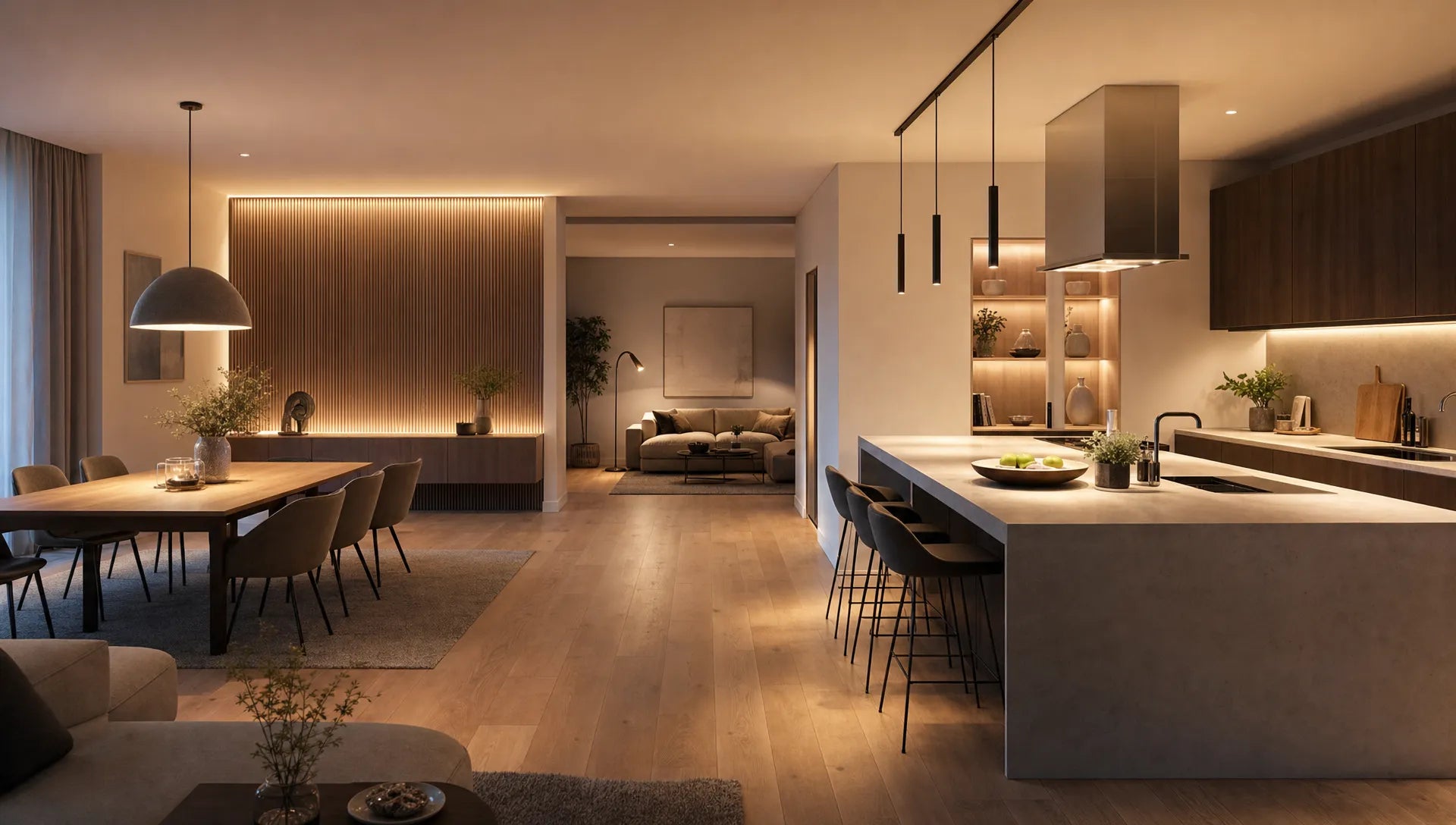
For example, a living room can have multiple lighting zones: a pendant light above the coffee table, indirect light on the wall, a reading light and accent lighting for a shelf. With DALI, these lights can be addressed individually, combined into groups and saved in scenes. The movie night scene could set indirect lighting to 20 percent, turn off the pendant light and activate a warm accent light. The scene guests could illuminate the room more evenly and brightly.
This is also helpful in open-plan kitchens. When cooking, the work surface needs bright, clear light. When eating, it can be warmer and more subdued. Everything should be visible when tidying up. When several lights work together, a digital system is often more convenient than several separate dimmers.
DALI is also interesting if you are planning for the long term. When renovating or building a new building, control lines and driver positions can be neatly planned. This increases flexibility if additional lights, scenes or control points are to be added later.
What components does a DALI system need?
A DALI system does not just consist of the luminaire. In order for it to work reliably, several components must fit together. Planning should therefore not only begin once the lamp has already been purchased.
| component | task | What you should pay attention to |
|---|---|---|
| DALI-capable luminaire or DALI driver | Converts digital DALI commands into light output | Not every dimmable light is DALI-capable. The product data must explicitly mention DALI. |
| DALI bus supply | Supplies the DALI control line | The power supply may not be expanded arbitrarily per DALI line. Planning by a specialist company makes sense. |
| Control device, button or gateway | Sends commands to the lights | Depending on the system, this can be done locally via a button, via an app or via a smart home center. |
| Wiring | Connects lights and control devices | DALI requires a suitable control line in addition to the mains supply. Electrical installation belongs in specialist hands. |
| Commissioning and programming | Assigns addresses, groups and scenes | Without a proper configuration, the advantage of DALI remains unused. |
Technically, a DALI line can support up to 64 addressable operating devices. There are also groups and scenes. This limit is usually not even close to being reached in a single-family home, but it shows that DALI is designed for more complex lighting structures.
It is also important: work on 230-volt installations should always be carried out by a qualified electrician. This is especially true when new cables, flush-mounted devices, drivers or ceiling connections are planned.
DALI, DALI-2 and DT8 explained clearly
When comparing lights and drivers, you will often come across the terms DALI, DALI-2 and DT8. For private developers, this quickly sounds more complicated than it has to be.
DALI basically refers to the digital lighting control protocol. Many older or simple DALI components work reliably, but in practice the interoperability between different manufacturers was not always perfect.
DALI 2 is the further developed certification. Among other things, it places more emphasis on tested compatibility, including for control devices and sensors. If you are planning new plans today, DALI-2 is often the more future-proof choice, provided all relevant components fit.
DT8 is particularly interesting for color-changing lights. For example, tunable white lights, i.e. lights with an adjustable color temperature, can be easily controlled. This can be exciting for living spaces if you want activating light in the morning and warmer light in the evening. However, the prerequisite is that the light, driver and control support this function.
Where DALI fits particularly well in the home
DALI is not the best solution for every lamp. In some rooms, a simple switch or a classic LED dimmer is completely sufficient. DALI is particularly useful when several light sources are planned together or when lighting moods play a major role.
| space | Typical lighting idea | Why DALI can help |
|---|---|---|
| Living room | Combination of pendant light, indirect light and accent lighting | Scenes for reading, watching TV, guests and relaxation can be saved precisely |
| Dining area | Pendant lamp above the table plus ambient ambient light | Brightness and atmosphere can be tailored to eating, working or celebrating |
| Kitchen | Work light, island lighting and indirect lighting | Bright functional lighting and a homely atmosphere can be separated |
| bedroom | Ceiling light, bedside light and indirect lighting | Gentle evening and morning scenes are more convenient than a single switch |
| Hallway and stairwell | Basic lighting and orientation light | Low dimming values can provide orientation at night without causing glare |
If you have high ceilings, open floor plans or large pendant lights, mechanical planning is also important. Cables, canopy, driver position and light distribution must fit the room. This is exactly where it is helpful if lights not only look beautiful, but can also be selected and adapted to suit the project.

What you should check before buying a DALI dimmable light
The most common mistake is the assumption that every high-quality LED light is automatically DALI capable. That's not true. DALI must be clearly mentioned in the technical information, either on the luminaire itself or on the installed driver. If a light is only described as dimmable, you should ask more closely.
Before you buy, check these points in particular:
- DALI capability: Does the technical data specifically say DALI or DALI-2?
- Driver access: Is the LED driver accessible if it needs to be serviced or replaced later?
- Dimming behavior: How far can the light be dimmed, for example to 1 percent, 5 percent or 10 percent?
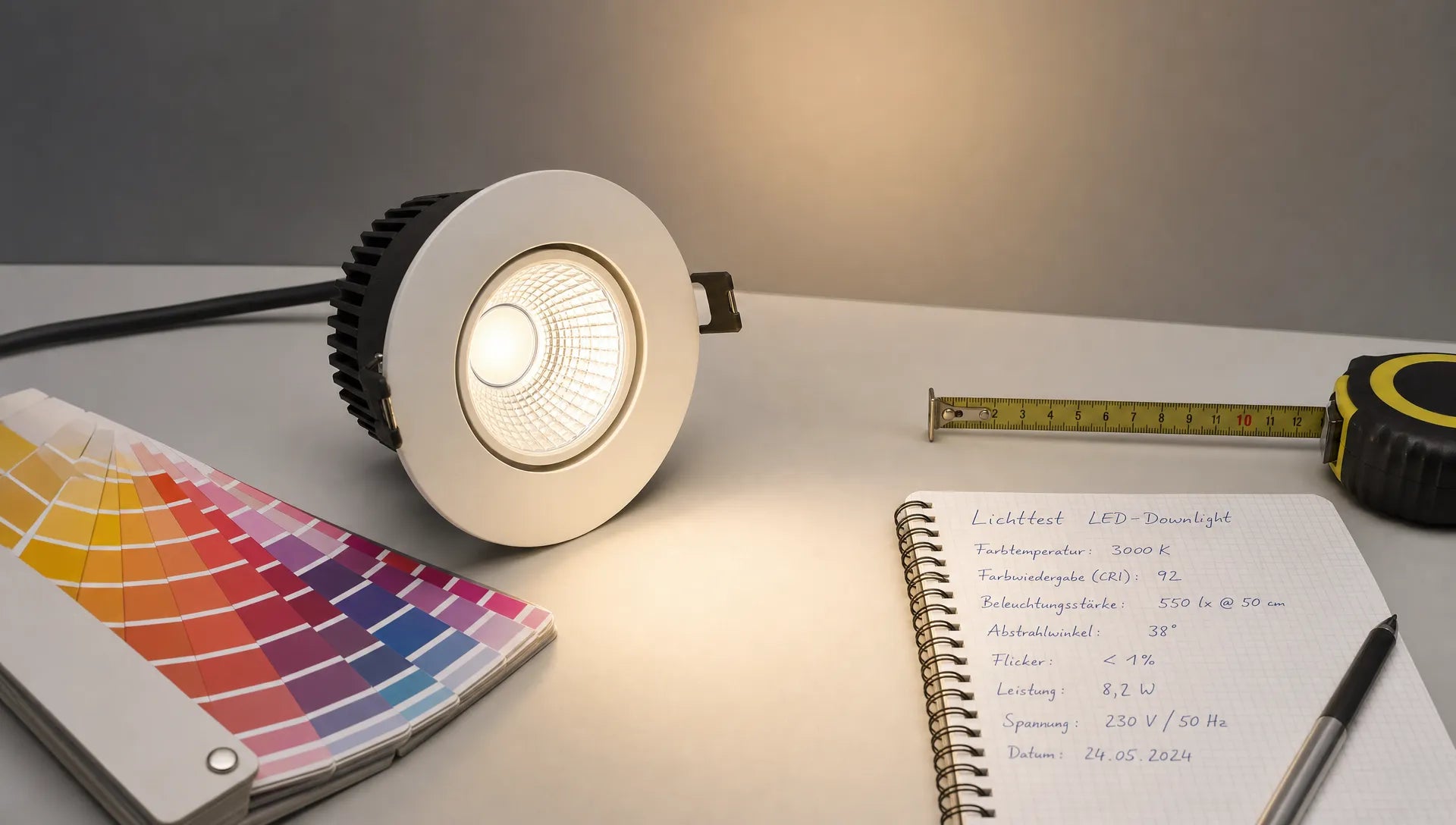
- Color temperature: Is the light color fixed, warm white, neutral white or adjustable using Tunable White?
- Control: Should it be operated via a wall button, app, smart home center or multiple control points?
- Space planning: Are there enough cables, space for drivers and a sensible grouping of the lights?
DALI is often not the obvious solution, especially for retrofit lamps. If you want to use an existing light with replaceable bulbs and avoid flickering, this is the article Choose a dimmable light bulb without flickering the more appropriate entry.
DALI and Smart Home: competition or complement?
DALI and Smart Home are not mutually exclusive. On the contrary: in many high-quality installations, DALI provides reliable lighting control, while a smart home system enables higher-level operation. A scene can then be activated via a wall button, an app, a time control or central home automation.
You can imagine DALI as a lighting language. The smart home is the user interface or the logic above it. A gateway then translates between both worlds, for example between DALI and KNX or another building system. Whether this makes sense in a single-family home depends on the project. It would be oversized for a single light. For an entire ground floor with lots of light zones, it can be very comfortable.
If you are not planning a complete DALI system but want to operate light more conveniently, other solutions may be more practical. This Light switch panel smart home is interesting, for example, if you want to connect light sources to a device such as a smartphone and use schedules. It does not replace professional DALI planning, but can play a useful role in a mixed smart home concept.
For classic LED dimming without DALI infrastructure, a high-quality wall switch may be the easier choice. The Smart touch dimmer is developed for LED lights and is available in gold, white and black, which makes it particularly interesting for modern living concepts. It is also important here: Before installation, compatibility with the respective light and the existing connection should be checked.
When is DALI not worthwhile?
DALI is powerful, but not automatically the best solution for every home. If you only want to dim a single ceiling light in the bedroom, a classic LED dimmer is usually cheaper, easier and quicker to install. DALI is also often difficult in rented apartments because additional cabling or interventions in the electrical installation are not easily possible.
DALI is particularly worthwhile if at least one of these points applies: You are planning a new project or doing a comprehensive renovation, you want to control several lights in groups, you want saved light scenes, you value exact brightness values or you want to integrate light into a larger smart home system.
In existing homes, a wireless-based system may be more practical because it requires fewer structural changes. That doesn't mean that DALI is impossible there, but the costs and benefits should be realistically weighed up.
Planning tips for renovation and new construction
If DALI is an option for your home, lighting planning should start early. Ideally before ceilings are closed, cables are laid or lights are finally selected. A beautiful designer lamp only develops its full effect if the control, installation height, light color and room function match.
Don't start with the question of which technical system you want to buy. Start with everyday situations. Where do you read? Where is the cooking done? Where would you like to relax in the evening? Where do you need bright cleaning light? This creates light zones and scenes. Only then is it decided which lights require DALI and which do not.
The mounting height is particularly important for pendant lights and chandeliers. A light looks different above a dining table than in an open staircase or above a kitchen island. If the cable length, canopy or color can be adjusted, the light can be integrated much better into the room. At BUYnBLUE Chandeliers and pendant lights can be adjusted free of charge, for example in terms of cable length, canopy or color. This is particularly helpful when designer lights need to fit precisely to the height of the room, table position and furnishings.
Common errors with DALI dimmable lights
Many problems arise not from DALI itself, but from incorrect combinations. A DALI driver should not simply be dimmed with a normal trailing edge dimmer before power supply if the system is not designed for this. With DALI, dimming is done via digital commands, not by cutting off the mains voltage.
Another mistake is making a decision too late. If you only notice that DALI is required after the electrical installation has been completed, control cables or suitable installation locations for drivers may be missing. Then the implementation becomes significantly more complex.
The operation is also often underestimated. An app alone is not always convenient. In everyday life, many people would like to continue to use a wall button, especially at the entrance to a room. Good lighting planning therefore combines technical flexibility with intuitive operation.
Ultimately, the quality of light should not take a backseat to the control. DALI does not solve poor color rendering, unsuitable light color and unfavorable positioning. A DALI dimmable light should still fit the room, the furnishings and the desired atmosphere.
FAQ: DALI dimmable lights for home
What does DALI dimmable mean for a light? DALI dimmable means that the luminaire or its LED driver can process digital DALI control commands. This allows brightness, groups and scenes to be precisely controlled, provided the entire system is planned appropriately.
Can I dim any LED light with DALI? No. An LED light must explicitly have a DALI-capable driver or be able to be operated with a suitable DALI driver. Simply stating that it is dimmable is not enough.
Does DALI make sense for a single-family home? Yes, if several lights, light zones and scenes are planned. DALI is often too complex for individual lights. It is particularly useful for new buildings, renovations, open living areas and high-quality lighting planning.
Do I need an electrician for DALI? Yes. The installation of lights, drivers, control cables and 230-volt connections belongs in the hands of a qualified electrician. Commissioning should also be carried out professionally.
What is the difference between DALI and DALI-2? DALI-2 is the further developed and more tested certification of the DALI standard. It improves interoperability between components from different manufacturers, especially for control devices and sensors.
Can DALI be combined with Smart Home? Yes. DALI often takes over lighting control, while a smart home system provides scenes, schedules or app operation. A suitable gateway or control device is usually required for this.
Conclusion: DALI is ideal if you want to plan light instead of just switching it
DALI dimmable lights are particularly exciting for the home if you see light as part of the architecture. They enable precise brightness, cleanly coordinated scenes and flexible group control. However, this requires suitable drivers, well thought-out cabling, suitable controls and professional installation.
If you only want to dim a single light, classic LED dimming is often the simpler solution. If, on the other hand, you are planning a modern lighting concept for the living room, kitchen, dining area or an entire house, DALI can be a very high-quality basis.
At BUYnBLUE You will find a curated selection of modern designer lights for different living areas. Particularly when it comes to pendant lights and chandeliers, it is worth careful coordination of room height, lighting effect and furnishings so that technology and design really fit together in the end.