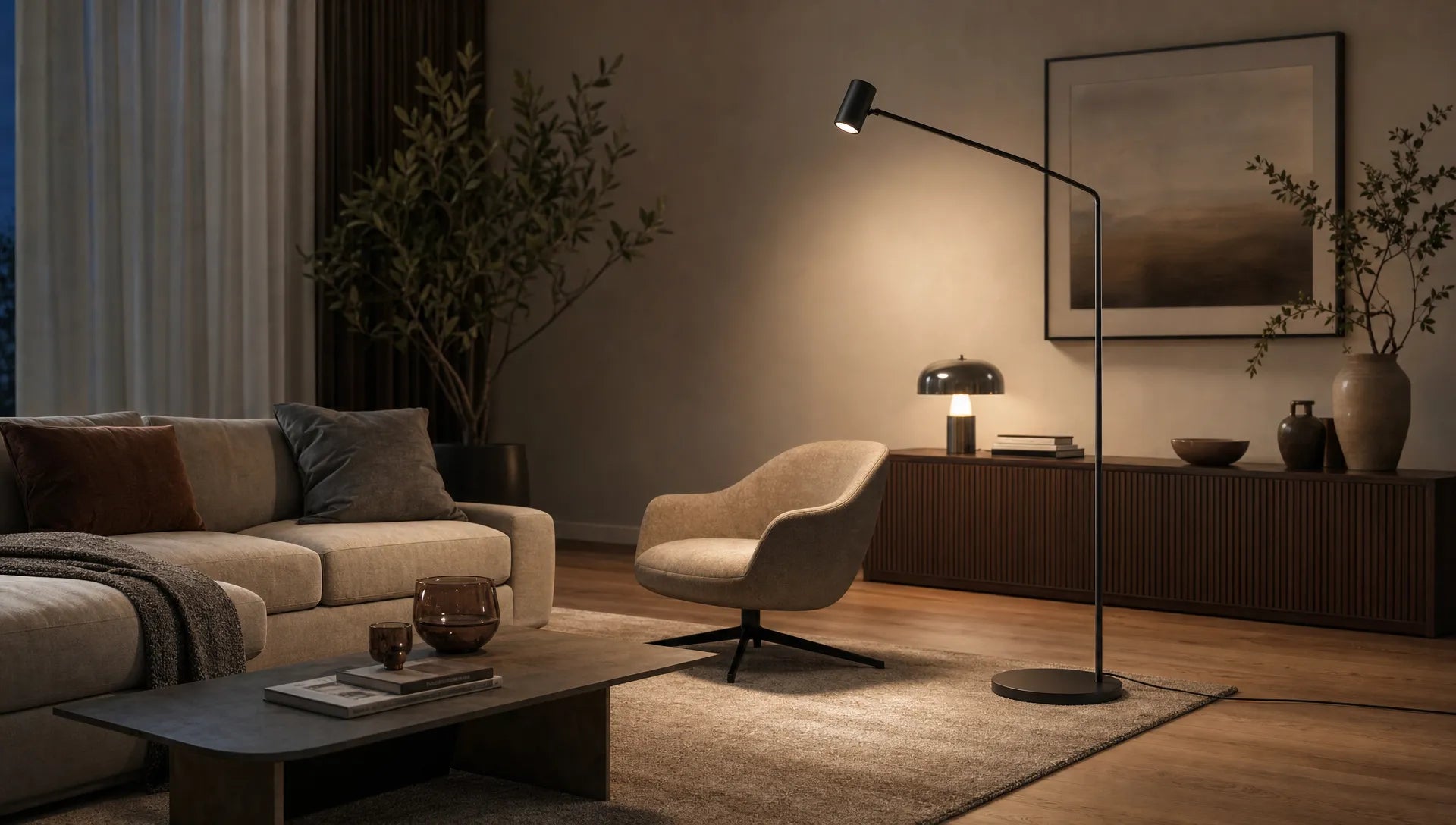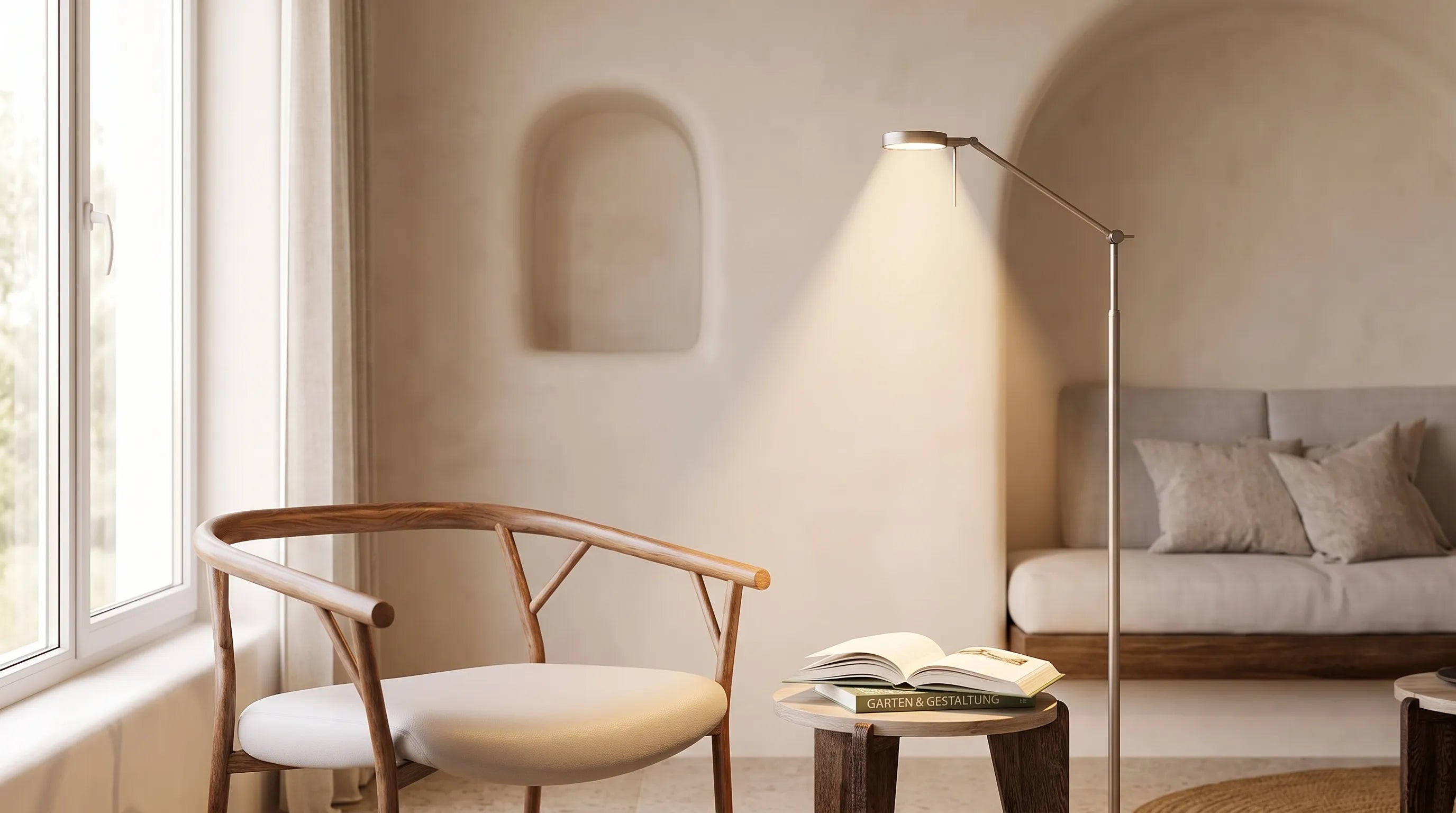
Floor lamps Choose the right dimmable reading lamp
One Floor lamps Choosing the right dimmable reading lamp sounds simple at first: it should look good, be bright enough and be able to be turned down. In practice, however, the interaction between light distribution, height, dimming, reading arm and spatial effect determines whether the lamp is really convincing in everyday life.
Such a lamp has to fulfill two tasks at the same time, especially in living rooms, bedrooms and reading corners. It is intended to create a pleasant atmosphere and at the same time provide a clear, low-glare beam of light on a book, newspaper or tablet. Those who buy solely based on design often only realize later that the reading arm is too short, the dimmer is impractical or the light is too cold.
Why a dimmable one? Floor lamps planned differently with a reading lamp
A classic floor lamp is usually intended for atmosphere. It brightens up a corner, makes walls appear softer and complements ceiling lights or pendant lights. A reading lamp, on the other hand, is functional light. It should fall specifically on a small area without tiring the eyes or disturbing other people in the room.
With a combined luminaire, both requirements meet. The ambient light can be wide and soft, the reading light should be narrower, more precise and easy to align. Dimming is not a nice extra, but rather a central comfort feature. In the evening, when watching a film, a very low light level is sufficient; reading requires significantly more brightness.
It is important to note that a dimming function cannot completely compensate for poor light. If the reading head is blinding, is too far away from the seat or can only be aligned inaccurately, even the best dimmer will only be of limited help. That's why it's worth checking in a structured manner before buying.
The most important selection criteria at a glance
The following table shows which points are particularly relevant when selecting and how you can recognize good models.
| criterion | What you should pay attention to | Why it matters |
|---|---|---|
| Poor reading | Movable arm or rotating lamp head | The light cone can be aimed precisely at the book or handicraft |
| dimming | Ideally, separate dimming for the main light and reading light | Atmosphere and function can be controlled independently |
| brightness | For the reading light, often around 400 to 800 lumens as a guide | Too little light tires the eyes, too much light can be blinding |
| light color | Warm white around 2,700 to 3,000 Kelvin for comfort, more neutral when close to work | The light color influences mood, concentration and spatial effect |
| Color rendering | CRI or Ra at least 80, higher quality often 90 and more | Colors of fabrics, wood and furnishings appear more natural |
| Stand | Sufficiently heavy and stable | The light remains secure even if the reading arm is adjusted |
| Height | Main light above the seat line, reading light at approximately shoulder to book height | This creates comfort without direct glare |
| Service | Switches are easily accessible, dimmers can be used intuitively | The lamp is used more frequently and more pleasantly in everyday life |
These values are not rigid rules, but rather practical points of reference. The combination of sitting position, room size, shape of the umbrella and distance to the reading zone is always crucial.
Brightness: Not just lumens, but light in the right place
Many buyers first pay attention to the lumen rating. That makes sense, but not enough. Lumen describes the luminous flux of the lamp or lamp, but does not say exactly how much light reaches your book page. Distance, beam angle, shade shape and orientation play a major role.
A bright but soft beam of light is ideal for relaxed reading in a living environment. Several hundred lux are often used on the usable surface as a guide for concentrated visual tasks. In living rooms it doesn't have to look like a desk, but the light should be significantly stronger than purely decorative lighting.
Therefore, check not only the maximum brightness, but also the lowest dimming level. A good one Floor lamps Dimmable with a reading lamp should be able to glow very softly in the evening without flickering or suddenly going out completely. Proper dimming is particularly important with LED lights because inferior dimmers can flicker at low levels.
If you would like to delve deeper into the light image, height and dimming behavior, the additional guide on the topic will help Check the photo, height and dimming in advance.
Dimmer and operation: comfort is crucial in everyday life
There are different operating concepts for combined floor lamps. Some models have a common dimmer, others control the main light and reading light separately. For most living situations, separate controls are more practical because you can keep the room light low and increase the reading light.
If you use replaceable bulbs, make sure that both the bulb and the dimmer are suitable for LEDs. Not every LED is dimmable, and not every dimmer works properly with every LED. For permanently installed LED modules, you should check which type of dimming is intended and whether the operation suits your everyday life.
The position of the switch is also important. A foot switch can be practical if the lamp is free standing next to the sofa. A switch on the reading arm is convenient if you often want to adjust while sitting. Touch surfaces appear modern, but should react clearly and not be triggered accidentally.
The right light color for reading and relaxing
Warm white light is usually preferred in living rooms. A light color of around 2,700 Kelvin looks cozy and goes well with wood, fabrics and warm wall colors. For concentrated reading, 3,000 Kelvin can seem a little clearer without appearing too cold.
Neutral white light around 4,000 Kelvin can be useful in work areas, but is not always pleasant in the living room. If you have one Floor lamps If you use it next to the sofa or bed, a reading light that is too cool is often annoying, especially late in the evening.
Some lights offer adjustable light colors. This can be practical if the lamp is used for reading as well as for manual work, home office or quiet evening hours. However, it is important that operation remains simple. Too many modes quickly become cumbersome in everyday life.
Selection by room: living room, bedroom and reading corner
It's in the living room Floor lamps often next to a sofa, armchair or side table. Here the reading head should be positioned slightly to the side or behind the shoulder so that the light falls on the page and does not shine directly into the eyes. The main light can gently outline the room instead of illuminating everything evenly.
Freedom from glare is particularly important in the bedroom. The lamp should remain pleasant even at a low dimming level so that it doesn't appear too harsh when reading in the evening. An easily accessible switch is crucial here. Nobody wants to get up to turn off the lights before they go to sleep.
In a separate reading corner, the reading light can be stronger and more precise. A stable foot is particularly relevant here because the arm is adjusted more often. If you're knitting, drawing, or taking notes, good color reproduction is also helpful.

Design and material: How the lamp fits into the interior
One Floor lamps is not only a light source, but also a piece of furniture. It takes up vertical space, influences proportions and can deliberately stage a corner. Therefore, the design should match the furnishings without displacing the function.
Fabric shades usually produce a soft, diffuse light and are well suited for cozy living areas. Metallic shades direct light more and can appear more modern or graphic. Arc lights provide light over a table or armchair without the need for a ceiling connection. Slim lights with a separate reading arm appear more functional and fit well into smaller rooms.
If your focus is more on soft ambient lighting and a sculptural form, the designers can Floor lamps Modern Lino can be an interesting stylistic reference. It combines a Nordic-influenced design language with an elegant fabric shade and a reserved base. For intensive reading, you should also check for each lamp whether there is a specific reading light or whether a separate reading light should be added.
For spacious living areas in which the lamp can deliberately act as an eye-catcher, the bowFloor lamps Aranciohow retro charm and modern lightness can work together. An arch shape can elegantly bring light over the sofa or coffee table. However, if a precise reading function is important to you, always pay attention to how close and how glare-free the light point is actually to your sitting position.
Correctly assess dimensions and proportions
Before purchasing, you should measure the planned location. Not only the height and width of the lamp are crucial, but also the swivel range of the reading arm and the size of the base. A foot that is too large can be annoying in tight corners, while a foot that is too small will lose stability if your arms are extended.
As a rough guide, the main light should not be directly at eye level when you are sitting. The reading head should be able to be positioned so that it can reach the book page without you having to move the chair. The projection is also crucial for arc lights. A nice shape is of little use if the light point at the end is behind the reading zone instead of above it.
Also think about cable routes. A dimmable one Floor lamps with a reading lamp is often used daily, so the cable should be routed safely and not create a tripping hazard. In open living areas, an orderly cable routing is also visually important.
Avoid frequent bad purchases
Many bad purchases occur because the lamp looks different in the shop or in pictures than in your own room. A large model can look perfect in an old building with high ceilings, but look dominant in a low living room. Conversely, a very delicate lamp can have too little presence in a large room.
Above all, avoid these typical mistakes:
- Decide only based on design and ignore light values.
- Choose a stationary reading head even though the seat is used variably.
- Accept common dimming, even though the main light and reading light should have different brightness.
- Choose too cold light for bedrooms or cozy living areas.
- Underestimating the stability of the base when your arms are outstretched.
- Not checking whether LED bulbs and dimmers are really compatible.
Another mistake is the wrong expectation of a single light. One Floor lamps can achieve a lot, but does not always replace a complete lighting concept. In large rooms it works best together with ceiling lights, wall lights or table lamps. If you later want to optimize the placement and lighting zones in the room, you can find additional ideas on how to a dimmable one Floor lamps Use cleverly with a reading lamp.
Short purchase checklist before making a decision
Before you order, it's worth making a final comparison with your room. This way you can quickly see whether the lamp only looks good or whether it also fits functionally.
- Where exactly is the light located and how far is the reading head from the book?
- Can the reading light be dimmed or switched independently of the ambient light?
- Does the light color suit evening use, reading and furnishings?
- Is the base stable enough for the design?
- Is the lamp blinding when sitting or looking at the television?
- Can it be operated while sitting?
- Are the lamps, LED modules and dimmers suitable for the desired use?
If you can answer these questions clearly, there is a significantly higher chance that the lamp will be a pleasure to use in the long term.
FAQ
How bright should one be? Floor lamps be with a reading lamp? For the reading light, around 400 to 800 lumens is often a sensible orientation range, depending on the distance, beam angle and personal visual comfort. It is crucial that enough light reaches the book page without causing glare.
Is warm white or neutral white light better for reading? For living rooms and bedrooms, warm white light of around 2,700 to 3,000 Kelvin is usually more pleasant. Neutral white can be helpful for concentrated activities, but often appears cooler in cozy living areas.
Do I need separate dimmers for the main light and reading light? Separate dimmers are recommended if you want to use the light flexibly. This means that the room light remains soft, while the reading light can be set brighter if necessary.
Can I use any LEDFloor lamps dim? No. If the bulbs are replaceable, the LED and dimmer must be compatible. The dimming function should be explicitly provided for permanently installed LED modules.
What is particularly important in small rooms? In small rooms, a slim base, an easily adjustable reading arm and low-glare light are important. The lamp should not take up too much floor space and still be stable.
Conclusion: First check function, then choose design
A good one Floor lamps Dimmable reading lamp combines atmosphere and visual comfort. First, pay attention to light intensity, light color, separate controls, stability and ergonomics. The shape, material and style can then be selected specifically for the room.
At BUYnBLUE find curated designer lighting for modern living spaces. In addition to high-quality materials and timeless design, customers benefit from free worldwide shipping, secure payment options, tracking and a 14-day return policy. If you also complement your lighting concept with pendant lights or chandeliers, the free adjustment service for length, canopy or color can be particularly helpful.