Modern dining table lamp to suit the shape and size
A modern dining table lamp only looks really high-quality if it matches the table. It's not the middle of the room, not just the style or the trend that decides, but rather the combination Table shape, table size, hanging height and lighting effect.
A wrong ratio is immediately noticeable, especially in the dining area: a lamp that is too small is lost over a long table, one that is too large appears heavy, and the wrong light output is blinding when eating. The good news: With a few clear measures, you can plan a dining table lamp that is modern, harmonious and suitable for everyday use.
Why the shape of the table is more important than the center of the room
Many dining room lights are selected based on the existing ceiling outlet. This is understandable, but often leads to unsettling results. The dining table is the real center of the zone. The lamp should therefore first be matched to the table and only then to the room, ceiling and connection.
A modern dining table lamp takes on three tasks at the same time: it illuminates food and faces, marks the dining area as a separate area and makes a visible design statement. These three tasks only work if the lamp speaks visually to the table. A round table usually needs a different lamp shape than a long rectangular table. An extendable table requires more flexibility than a small breakfast table.
The right light helps to clearly define the dining area, especially in open living-dining areas. It creates an island of light without the need for walls or room dividers. That's why it's worth looking at the selection not just as a lamp purchase, but as a small lighting plan.
First measure, then choose
Before you decide on a shape, you should write down a few measurements. This prevents bad purchases and makes later selection much easier.
What is particularly important is the table length, table width or diameter, ceiling height, distance to walls and walkways and the position of the power outlet. For extendable tables, you should also know the everyday size and the maximum size. Don't just plan for the rare holiday table, but don't ignore it completely either.
The basic rule is: the lamp should visibly accompany the table, but not protrude beyond its edges. There should usually still be some optical space between the lamp body and the edge of the table. For long pendant lights, a distance of around 30 to 50 cm from the ends of the table is a good starting point. With round lights, it looks harmonious if the diameter remains significantly smaller than the table diameter.
Which dining table lamp suits which table shape?
The following overview shows which lamp shapes are suitable for typical dining tables. The values are not rigid standards, but practical guidelines for a balanced effect.
| Table shape | Matching modern dining table lamp | Size rule | Effect |
|---|---|---|---|
| Round | Round pendant light, ball light, small chandelier, cluster pendant | Lamp diameter about a third to half of the table diameter | Communicative, centered, soft |
| Oval | Elongated pendant lamp, organic shape, two to three pendulums | Lamp length approximately half to two thirds of the table length | Elegant, flowing, homely |
| Rectangular | Linear pendant light, bar light, several individual pendants | Lamp length approximately 50 to 70 percent of the table length | Clear, architectural, modern |
| Square | Round, square or compact multi-bulb light | Width of the lamp about a third to half of the table width | Calm, symmetrical, balanced |
| Extendable | Multi-bulb pendant light, elongated system, dimmable light | Orientate yourself to everyday size, plan the light field with reserve | Flexible, practical, sociable |
This classification also explains why some lamps look beautiful in the shop or showroom but don't work at home. A sculptural ball lamp can look perfect over a round table, but look lost over a 240 cm long table. Conversely, a long linear pendant light may be too dominant over a small round table.
Round dining tables: prefer centered and soft
Round tables thrive on uniformity. Everyone sits at eye level, no one sits at the head of the chair. The lamp should emphasize this center. That's why round pendant lights, opal glass balls, compact chandeliers or small clusters work particularly well.
For a table with a diameter of 100 to 120 cm, a lamp with a diameter of around 40 to 60 cm is often suitable. For larger round tables, the lamp can be correspondingly more powerful. It is important that it does not protrude too far outwards, otherwise it will feel cramped when standing up or serving.
If you want a particularly modern effect, transparent or semi-transparent materials are interesting. Smoked glass, opal glass or delicate metal structures appear lighter than solid, closed shades. This allows the light to be larger without weighing down the dining area.
Long rectangular tables: Record the length visibly
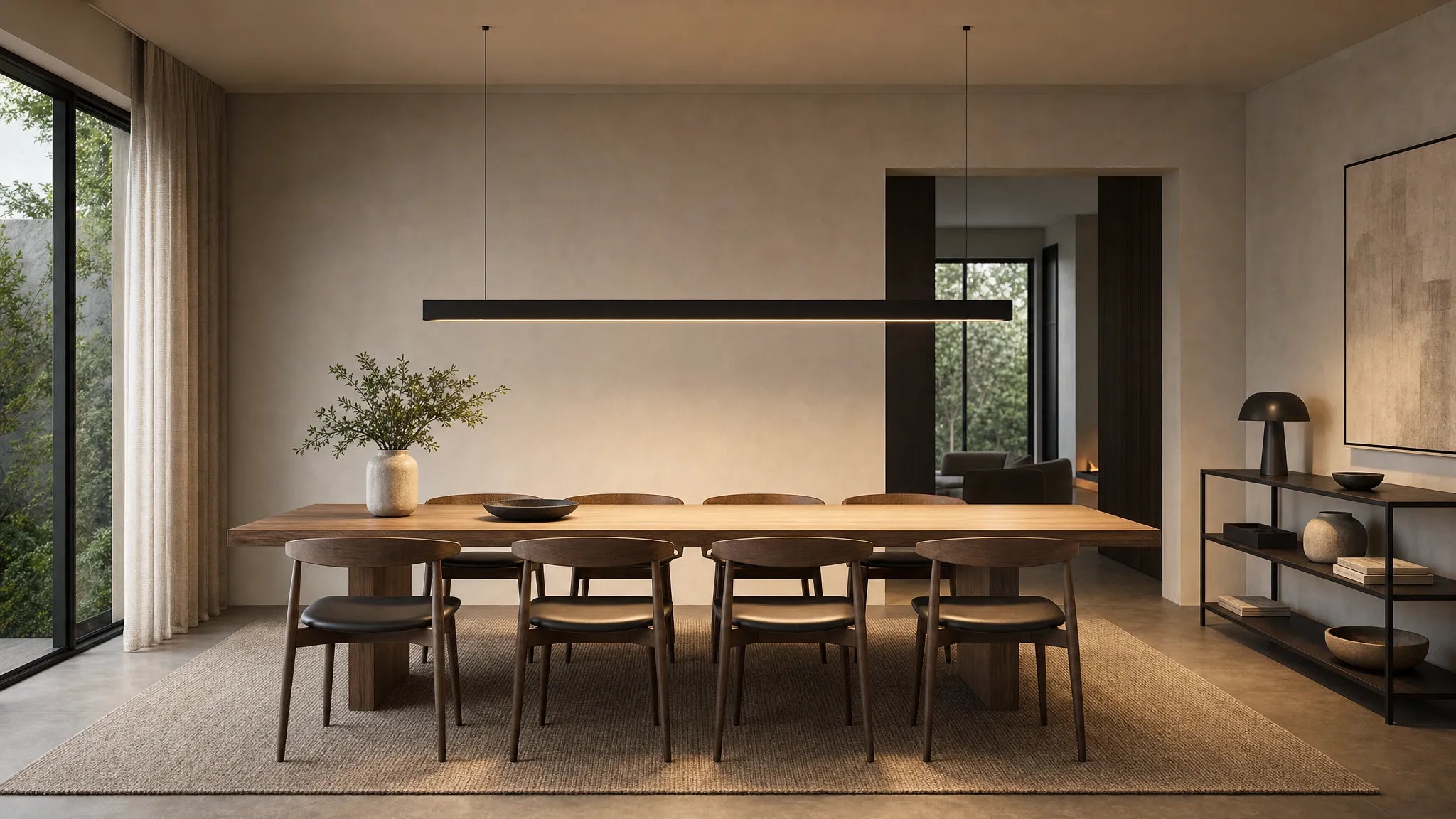
A long table needs light along its axis. A single small pendant light in the middle often creates bright centers and dark ends. Linear pendant lights, elongated chandeliers or several individual pendants in a row are better.
For a table that is 180 to 220 cm long, a lamp that is around 90 to 140 cm long often works well. For very long tables, three pendants or a multi-light system may make more sense than a single lamp body. It is crucial that the entire table surface is pleasantly illuminated without the lamp visually exceeding the table edges.
With rectangular tables, the dining table lamp can appear modern and graphic. Sleek black lines, brushed metal, brass accents or reduced LED profiles go well with minimalist and architectural interiors. If you prefer something more homely, you can combine clear shapes with warm materials such as wood, linen or opal glass.
Oval tables: plan between soft and linear
Oval tables are particularly grateful because they combine the length of a rectangular table with the softness of a round table. The right lamp should reflect this balance. Lights that are too angular can appear harsh, and lights that are too compact lose their length.
Elongated pendant lights with rounded shapes, several glass pendants or asymmetrical, organic-looking lights work very well. A modern chandelier with a horizontal orientation can also look elegant above an oval table.
Make sure that the light is not only bright in the middle. Especially with oval tables, people often sit further out on the curves. A longer light distribution ensures that the entire table remains inviting.
The right size: examples of typical dining tables
If you are unsure, a simple guide based on table dimensions helps. The following table shows practical starting points. Depending on the material, transparency and room height, the ideal size may vary slightly.
| Table size | Recommended lighting solution | Note |
|---|---|---|
| Around 90 to 100 cm | Single pendulum with a diameter of around 30 to 45 cm | Ideal for small dining areas or kitchen islands |
| Around 110 to 130 cm | Pendant lamp or small chandelier with a diameter of around 45 to 65 cm | Make sure there is no glare as everyone sits close to the center |
| Rectangular 140 x 80 cm | Compact linear lamp or two small pendants | Don't choose too long, otherwise the table will look smaller |
| Rectangular 180 x 90 cm | Linear lamp with around 90 to 120 cm or three small pendants | Good standard solution for four to six people |
| Rectangular 220 x 100 cm | Luminaire with around 120 to 160 cm or a multi-bulb system | Plan for dimming as the amount of light should vary |
| Extendable 160 to 240 cm | Flexible multi-point solution or longer pendant light | Prioritize everyday size, consider fixed size |
A common mistake is that the light is too small. Many people choose carefully because they are afraid of dominance. However, the lamp can show its presence in the modern dining room. It's not just the diameter that's important, but also the visual mass. A transparent glass lamp appears lighter than a solid black metal lampshade of the same size.
Hanging height: only what doesn't bother you looks modern
Above the dining table, the lower edge of the pendant light is usually around 60 to 75 cm above the table top. This is low enough to create a cozy light zone, but high enough to allow views over the table. For very tall people, large umbrellas or transparent lights, a little more distance may make sense.
The ceiling height primarily changes the cable length, not the relationship to the table top. Even with high ceilings in old buildings, the luminaire should not suddenly float two meters above the table, otherwise it will lose its zoning effect. For low ceilings, flatter or visually light pendant lights are better than tall, solid bodies.
A simple test helps: Sit at the table and imagine the lower edge of the lamp. It should not hang in your field of vision during the conversation. At the same time, it should be clearly visible as the center of the dining area when entering the room.

Light quality: warm, low-glare and dimmable
A beautiful shape is not enough. The dinner table is about food, conversations, homework, game nights and sometimes home office. That's why the light quality should be flexible.
Warm white light between 2,700 and 3,000 Kelvin is usually pleasant for living and dining areas. It makes wood, textiles and food appear warm without appearing yellowish. If you often work at a table, a slightly more neutral lighting atmosphere can make sense, ideally using dimmable or controllable lights.
Color reproduction is also important. A high CRI value, ideally 90 or more, makes colors appear more natural. This is clearly visible in food, flowers, dishes and materials. With modern LED lights, it is also worth taking a look at dimmability and compatibility. If you want to go deeper, you can find it in BUYnBLUE-Guide to Flicker-free dimming of LED lamps additional information.
When it comes to brightness, it is better to have enough light with a dimmer than too little light without control. For a small dining table, around 800 to 1,500 lumens are often sufficient as the lamp's total luminous flux. Medium tables are often 1,500 to 2,500 lumens. Large panels can require 2,500 to 4,000 lumens, especially if dark shades, high ceilings, or matte surfaces absorb light.
More important than a perfect number is the light distribution. A closed shade with a diffuser prevents glare. Opal glass diffuses softly. Light directed directly downwards emphasizes the table, but should not fall into the eyes. Open lamps can appear decorative, but they quickly dazzle if they are too bright or positioned incorrectly.
Material and color: this is how the dining table lamp remains modern
Modern does not automatically mean cool or minimalist. A modern dining table lamp can appear graphic, organic, luxurious or calm. It is crucial that the material, color and shape match the furnishings.
Black lights create clear contours and go well with light walls, wood, stone and minimalist interiors. Brass, champagne or gold tones bring warmth and look particularly beautiful with dark wood, natural stone or warm wall colors. Chrome and nickel appear more technical and fresh, especially in modern kitchen-dining areas. Opaline glass is a classic for soft light and works in many styles.
If the table itself is very present, for example made of solid wood or with a striking stone top, the lamp should not compete with it. Then clear lines or transparent materials make sense. If the table is simple, the lamp can be more sculptural.
The chairs also play a part. A very delicate lamp above heavy upholstered chairs can appear too weak. A massive light above light chairs can weigh against this. Therefore, always view the dining area as an ensemble consisting of a table, chairs, carpet, wall color and light.
What to do if the power outlet is not in the middle?
In many homes, the ceiling outlet is not exactly above the dining table. This is no reason to choose the wrong lamp or to place the table in an awkward position. There are several solutions: an offset canopy, a decentralized suspension, longer cables or a custom-made ceiling rose.
Especially with pendant and hanging lamps, adjustment is often the difference between “almost right” and really suitable. BUYnBLUE offers free customization for chandeliers and pendant lights, for example in terms of cable length, canopy or color. You can find out more about this in the guide Buy a configurable lamp: These options are worth it.
If electrical connections need to be changed, a specialist electrician should be involved. In the case of purely mechanical adjustments such as length, position and canopy, it is worth clarifying before purchasing so that the lamp fits the room directly.
Common mistakes with modern dining table lamps
Many wrong decisions are not caused by bad taste, but by a lack of proportions. This overview helps with quick control.
| Error | Why it's problematic | Better solution |
|---|---|---|
| Luminaire chosen too small | The table appears incomplete and the ends remain dark | Orientate size to table length or diameter |
| Light hangs too high | The dining area doesn't look comfortable and loses focus | Usually plan the bottom edge 60 to 75 cm above the table top |
| Open lamps are dazzling | Conversations and meals become awkward | Choose a diffuser, opal glass or shielded light sources |
| Cold light in the evening | The dining area looks unusual | Prefer warm white with 2,700 to 3,000 Kelvin |
| Only oriented towards the ceiling outlet | Lamp visually hangs next to the table | Prioritize table position and check adjustment |
| Extending table ignored | When there are guests, part of the table remains dark | Select light field with reserve or several light points |
Short purchase checklist
Before you decide, carefully consider these points:
- Does the lamp shape match the table shape?
- Is the lamp large enough for the table length or diameter?
- Is there enough distance from the table edges?
- Is the planned lower edge about 60 to 75 cm above the table top?
- Is the light warm white, low-glare and, if possible, dimmable?
- Does the color of the lamp match the table, chairs and other metal tones in the room?
- Can the cable length or canopy be adjusted if the connection is not ideal?
If you can answer these questions, you'll be much closer to a dining table lamp that not only looks modern, but works every day.
Frequently asked questions about modern dining table lamps
Which dining table lamp looks modern over a round table? Round pendant lights, ball lights, compact chandeliers or small clusters look particularly harmonious above a round table. They emphasize the center and support the communicative effect of the round table.
How big should a lamp be above the dining table? For long tables, a lamp length of around 50 to 70 percent of the table length is a good guideline. For round tables, the lamp diameter is often around a third to half of the table diameter.
How high should a dining table lamp hang? The lower edge of the lamp usually hangs about 60 to 75 cm above the table top. It is important that no one is blinded and that the view of the people opposite remains clear.
Which light color is ideal for the dining table? 2,700 to 3,000 Kelvin is suitable for a homely atmosphere. If you also use the table for work, you should pay attention to dimmability or flexible lighting control.
Which is better: one long pendant light or several small pendants? Both solutions work for long rectangular tables. A long pendant lamp appears calmer and more architectural, several pendants appear more lively and can often be better distributed over the length of the table.
Can a modern dining table lamp be customized? Yes, at BUYnBLUE Pendant lights and chandeliers can be customized free of charge depending on the model, for example in terms of cable length, canopy or color. This allows the lamp to be better adapted to the ceiling height and room layout.
Conclusion: The best dining table lamp follows the table
Choosing a modern dining table lamp doesn't mean simply choosing the most striking design. The best lamp takes into account the shape and size of the table, hangs at the right height, provides warm, glare-free light and fits the style of the room.
If you plan your dining area precisely, the lamp will not look like an afterthought, but rather like a natural focal point. Discover at BUYnBLUE modern designer lights for dining rooms and living areas, with curated selection, high-quality materials, free customization, free worldwide shipping and 14-day return policy.