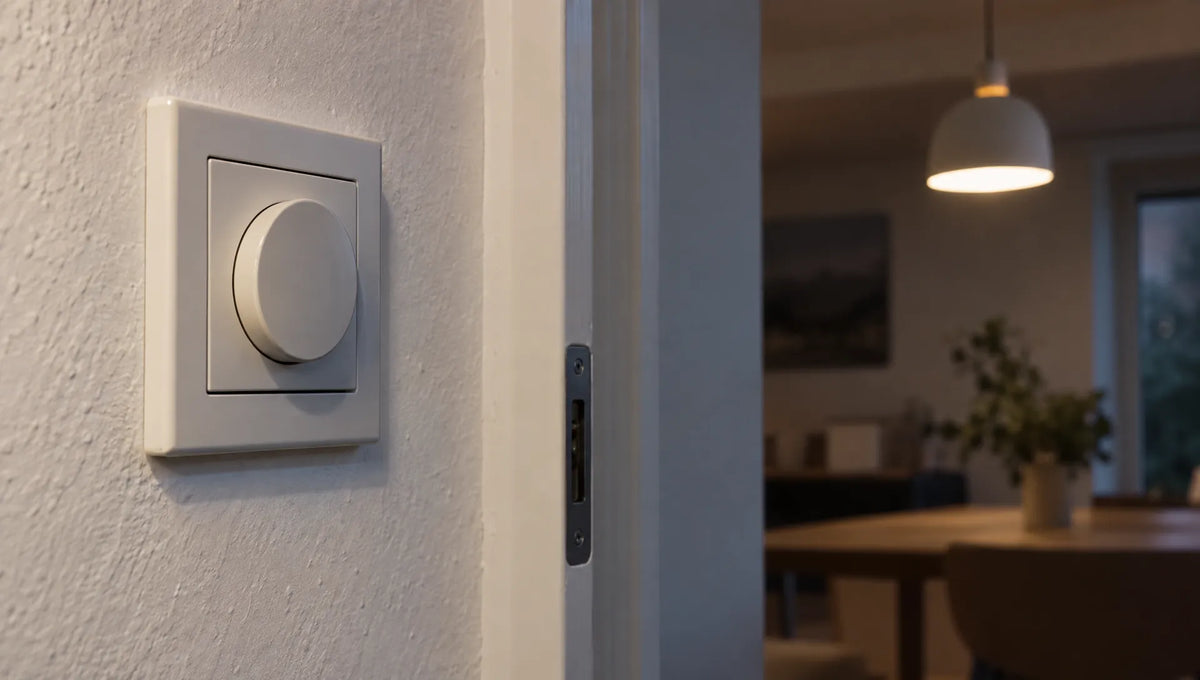
Why a dimmable lamp flashes briefly when switched on
If one Dimmable lamp flashes briefly when switched on and only then the desired brightness is reached, the cause is often the interaction of the LED driver and dimmer. Some combinations require a higher starting value than the brightness set later. Others react to unsuitable dimming technology or a minimum brightness that is too low.
A single light pulse does not automatically mean that the lamp is defective. But it is also not blanket proof of harmless operation. The decisive factor is whether the behavior is intended, whether it occurs again and whether further abnormalities arise. The following observations can be used to narrow down the cause without opening the electrical installation.
First, classify the switch-on behavior correctly
First, observe when and how often the light pulse occurs. A one-off light when switched on has other possible causes than regular flashing when switched off.
| Observation | Possible explanation | Sensible next step |
|---|---|---|
| A short bright pulse, then stable dimmed light | Start behavior of the driver or switch-on aid of the dimmer | Check manufacturer information and switch-on settings |
| Only flashes at very low brightness | Driver start limit is undershot | Switch on at a higher dimming setting and compare |
| Several light pulses before the light remains stable | Unstable interaction between dimmer and driver | Have compatibility and load range checked |
| Repeated flashing when light is off | Small residual currents or capacitive coupling may be involved | Consult an electrician for diagnosis |
| Flashing along with crackling, smell or skipping | Possible defect or contact error | Stop operation and have it checked |
This assignment provides information, not a remote diagnosis. Also note whether the problem has existed since installation or only started after changing the bulb. If the flickering doesn't just occur at startup, a more detailed classification will help flickering lamps and their possible causes.
Why a dimmable lamp flashes briefly when switched on
The LED driver must first start up
LEDs require a suitable power supply. The LED driver takes on this task, either in the replaceable light source or as a separate or integrated component of the luminaire.
When switching on, the supply to the electronics is initially established. The driver then begins to regulate the LED current. Depending on the design and input signal, more light may briefly be produced during this transition than in later dimmed operation. Not every driver shows this behavior.
It is important to differentiate between Inrush current: Charging capacitors can cause a brief power surge on the grid side. This alone does not explain a visible flash of light. What is crucial is how the driver controls the LEDs during startup.
The dimmer temporarily releases more power when starting
Some dimmers work with a switching aid or an adjustable start brightness. They start above the selected low dimming setting so that the connected driver can start up reliably. Only then is the brightness reduced.
This function can be useful if an LED would otherwise not start at all at a low setting. A clearly visible jump in brightness can still be annoying, for example in the bedroom or above the dining table.
If a dimmable lamp briefly becomes brighter each time it is started and then lights up steadily, it is worth taking a look at the dimmer's operating instructions. Look for terms like “startup brightness,” “switch-on brightness,” or “boost.” Not every model offers such a setting.
Dimmer and driver do not fit together electrically
The label “dimmable” does not mean that an LED lamp works with every dimmer. For LEDs dimmed on the mains voltage side, the dimming technology and the permissible load range must, among other things, match.
Phase control and phase control control the voltage curve differently. Which technology is suitable depends on the manufacturer's instructions for the lamp or driver. Even a universal dimmer is no guarantee for every combination.
Especially after switching from halogen bulbs to LEDs, an older dimmer may operate outside of its intended load range. What is important is the actual electrical output of the LEDs, not an advertising claim such as “replaces 60 watts”. Also note the explicitly stated LED load, which may differ from the permissible light bulb load.
The set brightness is below the safe starting limit
A lamp can continue to shine stably at low brightness, even though it does not start reliably when switched off at precisely this setting. The lowest usable operating brightness and the lowest reliable switch-on brightness do not have to be identical.
The following pattern is typical: At a higher setting, the light starts inconspicuously. At a very low setting there is a light pulse, several start attempts or initially no light at all.
If a dimmable lamp only flashes at the lower end of the dimming range, the minimum brightness is a useful test point. A slightly higher lower limit can help if the dimmer explicitly provides for this setting.
This way you can safely narrow down the cause
Observe the behavior under the same conditions
Compare several switch-on processes and only change one setting at a time. Note the previous dimming setting, the approximate duration of the light pulse and whether the light continues to glow afterwards.
The pause in switching off can also be informative: Does the light behave differently after a longer pause than when it is switched on again after a short time? Such differences may be related to the condition of the driver electronics, but do not prove a specific error.
A short video can document the starting behavior for dealers, manufacturers or electricians. However, camera footage may show additional streaks or flickering effects that are not visible to the naked eye. Therefore, always describe your direct observation.
Switch on at higher brightness
Use the normal controls to set a medium or high brightness and compare the next time you turn it on. Some dimmers save the last selected value, others use a fixed switch-on level. Consider this behavior according to the instructions.
If a dimmable lamp starts cleanly at a higher setting, this indicates a problem in the lower dimming range or with the start control. It doesn't prove that all components are error-free, but it narrows down the search.
You should only change a minimum brightness if this is possible via an accessible operating function described by the manufacturer. Do not remove any cover behind which live parts could become accessible.
For replaceable lamps, check the exact design
Check the model name, dimming release and actual power consumption of the lamp used. If there are several lamps on one dimmer, their total load is also relevant. Different LED models can react differently to the same dimmer despite similar brightness.
If you change a lamp for comparison, switch off the voltage to the lamp beforehand and allow it to cool down. For a plug-in lamp, pull the power plug. Do not open a permanently connected light or change any wiring.
The criteria for selecting a suitable replacement are: Dimming approval and compatibility of a dimmable light bulb helpful. With permanently installed LEDs, changing the bulb is usually not an easy comparison option for users.
Have the operation without a dimmer compared professionally
A comparison without an upstream dimmer can show, with suitable lights, whether the flashing comes from the driver or only occurs through the combination. If the light is permanently installed, this test should be carried out by a qualified electrician.
A dimmable lamp that flashes even on a suitable undimmed supply may exhibit abnormal driver start-up behavior. However, if the effect disappears without a dimmer, its interaction with the driver comes to the fore.
Do not bypass the dimmer yourself. An additional resistor, a so-called compensation module or changes to the neutral conductor are also not universal DIY solutions. Whether such measures are permissible and sensible must be assessed based on the specific installation.

Which solution fits the respective cause
The most sensible measure depends on the findings. If a documented switch-on aid is responsible, a permitted adjustment of the starting brightness can help. If the dimming setting is below the reliable starting limit, a higher minimum brightness is an option. However, if there is electrical incompatibility, a suitable combination of dimmer and driver is necessary.
An exchange based on suspicion does not always lead to the desired result. Before making a purchase, check the specific name of the lamp or bulb, the dimming technology supported and the minimum and maximum load. For permanently installed LEDs, the information about the integrated driver is particularly important.
If a dimmable lamp is to be operated with a different dimmer switch in the future, LED suitability is only the first selection point. The Smart touch dimmer from BUYnBLUE is specifically designed for LED lights and is available in gold, white and black. Whether it fits the existing luminaire and installation still needs to be clarified based on the respective technical requirements.
An attractive design or the name “LED dimmer” does not replace a compatibility check. Likewise, it cannot be deduced from a single switch-on flash that a new dimmer is fundamentally needed.
When you should stop using the light
Stop operation if there are clear warning signs in addition to the flashing. These include in particular:
- Crackling or clicking noise from switch, connection point or light
- scorched smell, discoloration or deformation
- unusually strong warming
- repeated failures or the tripping of a protective device
Switch off the affected system, as far as it is safe to do so, and have it checked. Do not repeatedly switch on a tripped protective device to test its behavior.
A flash of light that suddenly appears after a long period of inconspicuous use should also be clarified. A loose connection or an aging component cannot be confirmed or ruled out through observation alone. There is no general flash duration below which any installation would automatically be safe.
Frequently asked questions
Is a short flash of light normal when switching on? It can be part of the design-related start behavior of a driver or a switch-on aid for the dimmer. Whether it is intended for your combination can only be clarified based on the manufacturer's information. New or additional abnormalities should be checked.
Why does this only happen at low brightness? The driver may require a stronger input signal to start than for subsequent dimmed operation. If a dimmable lamp starts unobtrusively at a higher setting, the starting brightness, minimum brightness and dimmer compatibility should be checked.
Does another dimmer always help? No. If the cause lies in the driver itself, the flashing can persist even with a different dimmer. A replacement is particularly useful if an unsuitable dimming technology or an unsuitable load range has been identified.
Why does the lamp flash even though it is turned off? This is a different error pattern. Small currents through certain switches or dimmers as well as capacitive coupling can slowly charge the electronics and trigger repeated light pulses. An electrician should check the specific cause.
Can I eliminate the effect by using longer cables? Changing the cable length is not a specific solution to a switch-on problem. The decisive factors are the electrical control, the driver and the permissible combination of components.
Clarify the combination before exchanging
Have the luminaire model, light source, dimmer name and a short description of the switch-on behavior ready. This makes it easier to search for a solution more specifically than by saying “the light is flashing”. If you have a new light BUYnBLUE Select, clarify the desired dimming control before purchasing so that the design and electrical requirements match.