Choose a dimmable living room ceiling light sensibly
A dimmable ceiling light in the living room is more than a practical light source. It decides whether the room appears clear and activating in the morning, becomes comfortable in the evening and does not blind you while watching TV. That's exactly why it's worth not just buying based on design, but also considering brightness, light color, dimmer technology and spatial effect together.
If you want to choose a dimmable living room ceiling light, you should first ask: What tasks does the light perform in everyday life? A living room is rarely just a place to sit. It is a reading area, TV zone, play area, home office corner, guest room or open transition to the dining area. A sensible selection therefore does not start with wattage, but rather with usage, light distribution and ease of use.
Why a dimmable ceiling light makes so much sense in the living room
The living room needs variable light. A bright, even light is pleasant when tidying up or playing. When having dinner, listening to music or relaxing, the same brightness quickly becomes uncomfortable. A dimmable ceiling light solves exactly this problem because it can switch between functional lighting and an atmospheric atmosphere.
Dimmability is particularly useful if the ceiling light is the main lighting in the room. Then it should not be chosen too weak. A common wrong decision is a lamp that looks nice when dimmed, but does not provide enough light at full power. It is better to have a sufficiently powerful lamp with a clean dimming range so that it remains pleasant and has little flicker even at 20 to 40 percent.
Dimmability is also valuable from a design perspective. Bright light makes contours visible and makes modern architecture appear clear. Dimmed light reduces contrasts, makes materials appear warmer and makes the room quieter. A single ceiling light can support several living situations without the room appearing technically overloaded.
First plan your everyday life, then choose the lamp
Before you decide on shape, color or diameter, it's worth carrying out a brief light analysis. Mentally walk through a normal day in the living room. When do you need bright light? When should the light only create a background atmosphere? Are there areas that need targeted lighting, such as a sofa, a coffee table, a shelf or a picture on the wall?
This overview helps with the classification:
| Living situation | Recommended lighting effect | What you should pay attention to |
|---|---|---|
| Television | Low brightness, as glare-free as possible | Do not allow the ceiling light to be reflected directly in the screen |
| Reading on the sofa | Medium to high brightness, supplemented in spots | Ceiling light alone is often not enough, so plan a floor or wall lamp |
| Receive guests | Warm, even light | Dimming at about a medium level looks inviting |
| Tidying up and everyday life | Bright basic light | Choose enough lumens and wide light distribution |
| Open living-dining area | Zones can be controlled separately | Combine ceiling light with other light sources |
If you want to go deeper into space planning, the guide to detailed planning of a dimmable ceiling light in the living room a good addition, especially for lumens, lux and light zones.
Brightness: Compare lumens instead of watts
With modern LED lights, watts is not a reliable guide for brightness. The decisive factor is the luminous flux in lumens. For a living room, around 100 to 150 lumens per square meter often works as basic light. This is not a rigid law, but a practical guideline. Dark walls, high ceilings, matt surfaces and large rooms usually require more reserves.
Example: A 20 square meter living room needs around 2,000 to 3,000 lumens for pleasant basic lighting. If the ceiling light is dimmable, it should be on the higher end because you can reduce the brightness at any time. Too little light, on the other hand, can hardly be compensated for later, except with additional lights.
| Room size | Useful area for basic light | Note |
|---|---|---|
| 12 to 15 m² | approx. 1,200 to 2,250 lm | Often sufficient for small living rooms if walls are light |
| 16 to 22 m² | approx. 1,600 to 3,300 lm | Typical area for many living spaces |
| 23 to 30 m² | approx. 2,300 to 4,500 lm | Combine better with multiple light sources |
| Over 30 m² | plan individually | Zone lighting is usually more useful than just one strong light |
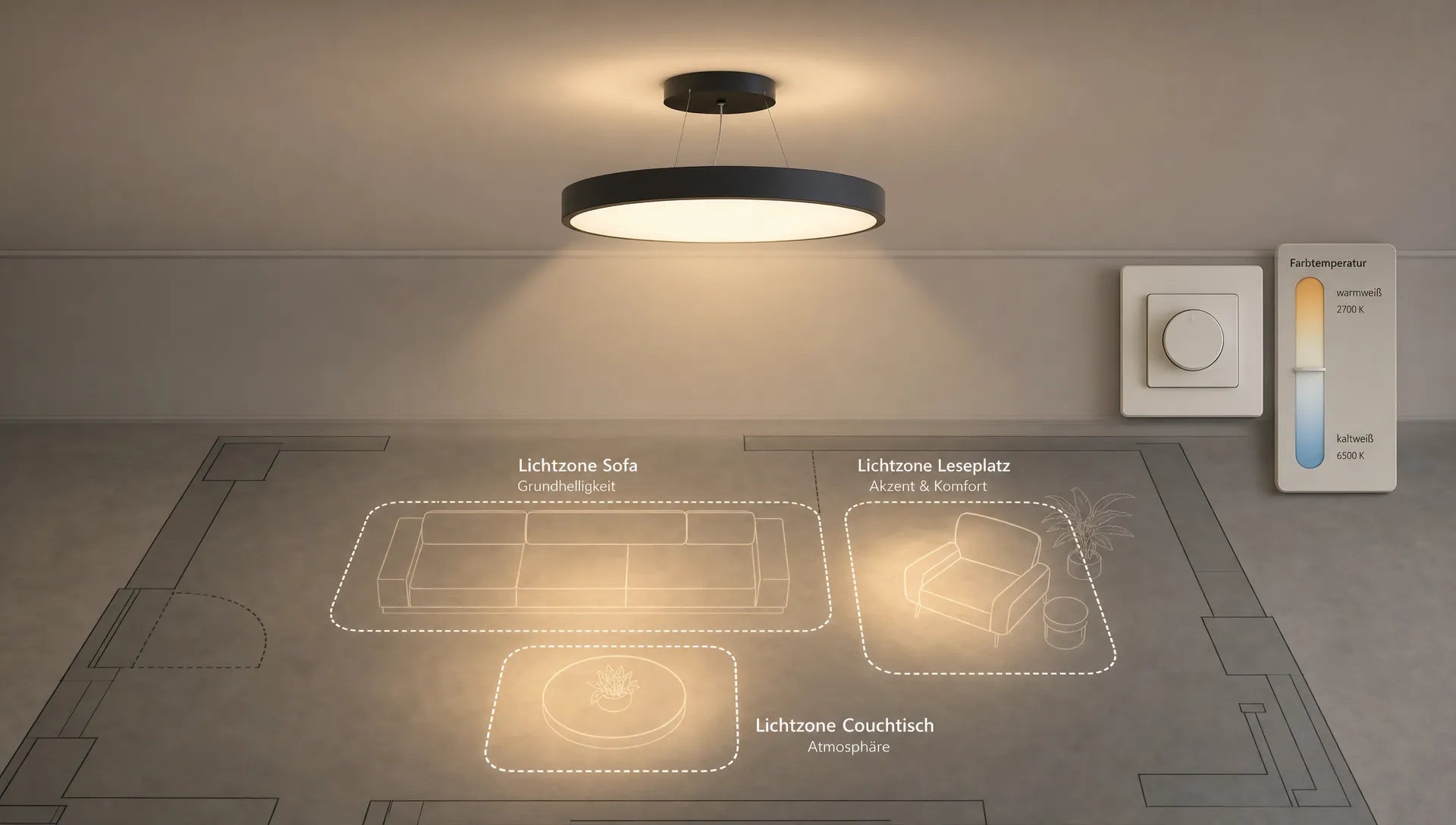
The light distribution is also important. A very directional light with a high number of lumens can still appear unsteady if it only hits individual surfaces. A diffuse ceiling light distributes the light more softly, while spotlights create targeted accents. A combination is often ideal for living rooms: a dimmable basic light plus accent light for atmosphere.
Light color: warm, neutral or flexible?
The light color is given in Kelvin. Warm white light is usually the best choice for living rooms. It looks cozy, flatters wood, textiles and warm wall colors and supports a relaxed atmosphere in the evening.
As a rough guide: 2,700 Kelvin has a classic, warm and homely effect. 3,000 Kelvin is a little clearer, but still pleasant. 4,000 Kelvin can be useful in work areas, but quickly appears matter-of-fact in the living room, especially in the evening. If the room is also used as a home office, a lamp with adjustable color temperature can be interesting. In many cases, warm white remains more harmonious for purely residential areas.
Also pay attention to color reproduction. The CRI or Ra value describes how natural colors appear under the light. Ra 80 is a common minimum value for living spaces; Ra 90 or higher appears visibly more natural for art, textiles, wood and high-quality surfaces. This is particularly relevant for interior designers and design-focused homeowners because light greatly influences the perceived quality of materials.
Dimmer compatibility: the technical point that is often underestimated
Not every LED ceiling light works with every dimmer. This is one of the most common reasons for humming, flickering, afterglow or a dimming range that is too small. Therefore, before purchasing, check whether the lamp is expressly stated as dimmable and which type of dimmer is supported.
Trailing edge dimmers are often suitable for LED ceiling lights, while older leading edge dimmers do not always work properly. For integrated LED modules, the driver is also crucial. It must match the dimming technology. With replaceable bulbs, the ability to dim also depends on the LED bulb used.
If you want to continue using existing switches or dimmers, you should check compatibility particularly carefully. This becomes even more important if there are several lights on one dimmer, because the minimum load, maximum load and lamp type must match. The separate guide is worth reading for the technical details dimmable LED ceiling lights and dimmer compatibility.
Another point is flickering. Some lights appear quiet at first glance, but can flicker visibly or invisibly at low dimming levels. This can be particularly annoying for sensitive people, video recordings or long evenings. High-quality drivers and suitable dimmers reduce this risk.
Shape and lighting effect: Which ceiling light suits the living room?
The right shape depends on the ceiling height, furnishings and the desired lighting effect. Flat ceiling lights are particularly suitable for low rooms because they visually take up little space. Round shapes appear soft and calm, while angular shapes emphasize clear architecture. Spots provide flexibility, but can be blinding if aligned incorrectly. Sculptural lights become a design element in themselves and should be consciously coordinated with furniture, carpets and wall colors.
For minimalist living rooms with low or normal ceiling heights, a very flat, circular lamp can be a good design direction. The Ceiling lamp Modern Ambito As an example, it fits this approach because, according to the description, it relies on an ultra-flat profile and a clear, circular design. For each specific selection, also check the information on dimmability, light output and the desired light color.
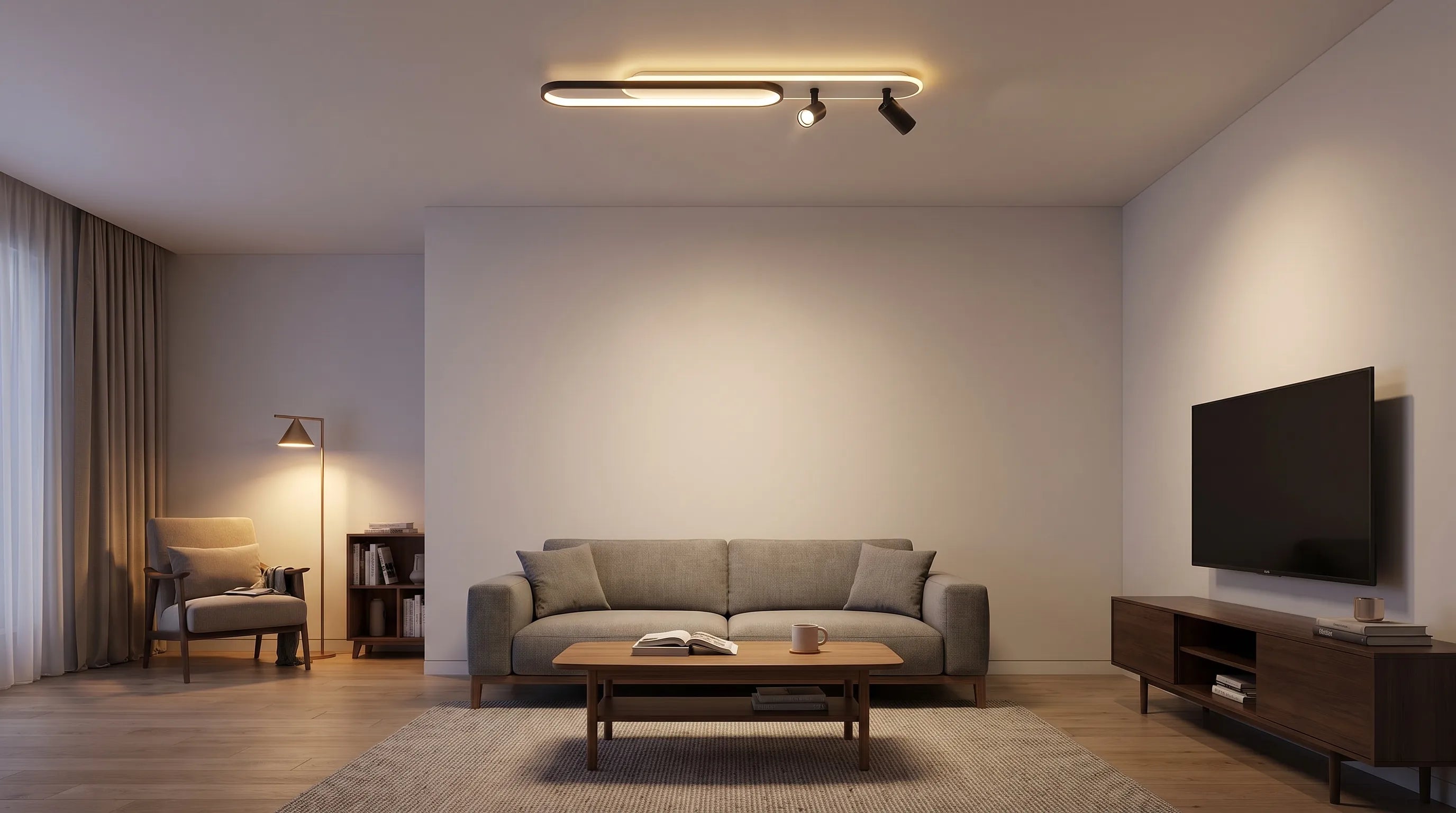
If you want to emphasize certain areas, such as a wall picture, a shelf or a seating area, adjustable spots are interesting. The Ceiling lamp Modern Ustrala is a suitable example of flexible light alignment because, according to the product description, its spotlights can be rotated 360 degrees in the X-axis and 180 degrees in the Y-axis. Such lights are particularly useful if the living room not only needs to appear uniformly bright, but also spatially structured.
Anyone looking for a central light that combines functional lighting with an elegant appearance can look to timeless designs. The Halo Modern ceiling lamp is described as an elegant, timeless ceiling lamp with high-quality workmanship and is therefore suitable as inspiration for living spaces in which the ceiling light can deliberately be visible. The same applies here: design, light output and dimming technology should be checked together.

Correctly consider ceiling height and room size
The ceiling height not only affects the appearance, but also the quality of light. In low rooms, large, low-hanging lights quickly appear dominant. Flat ceiling lights or compact designs are usually more harmonious here. In high rooms, the luminaire can be larger, more sculptural or more present because there is more vertical space available.
For very large living rooms, a single ceiling light is rarely the best solution. Even if it provides enough lumens, the room can appear flat or uncomfortable. A lighting concept with several levels is better: ceiling light for orientation, floor lamps or table lamps for cozy islands, indirect light for depth and, if necessary, spots for accents.
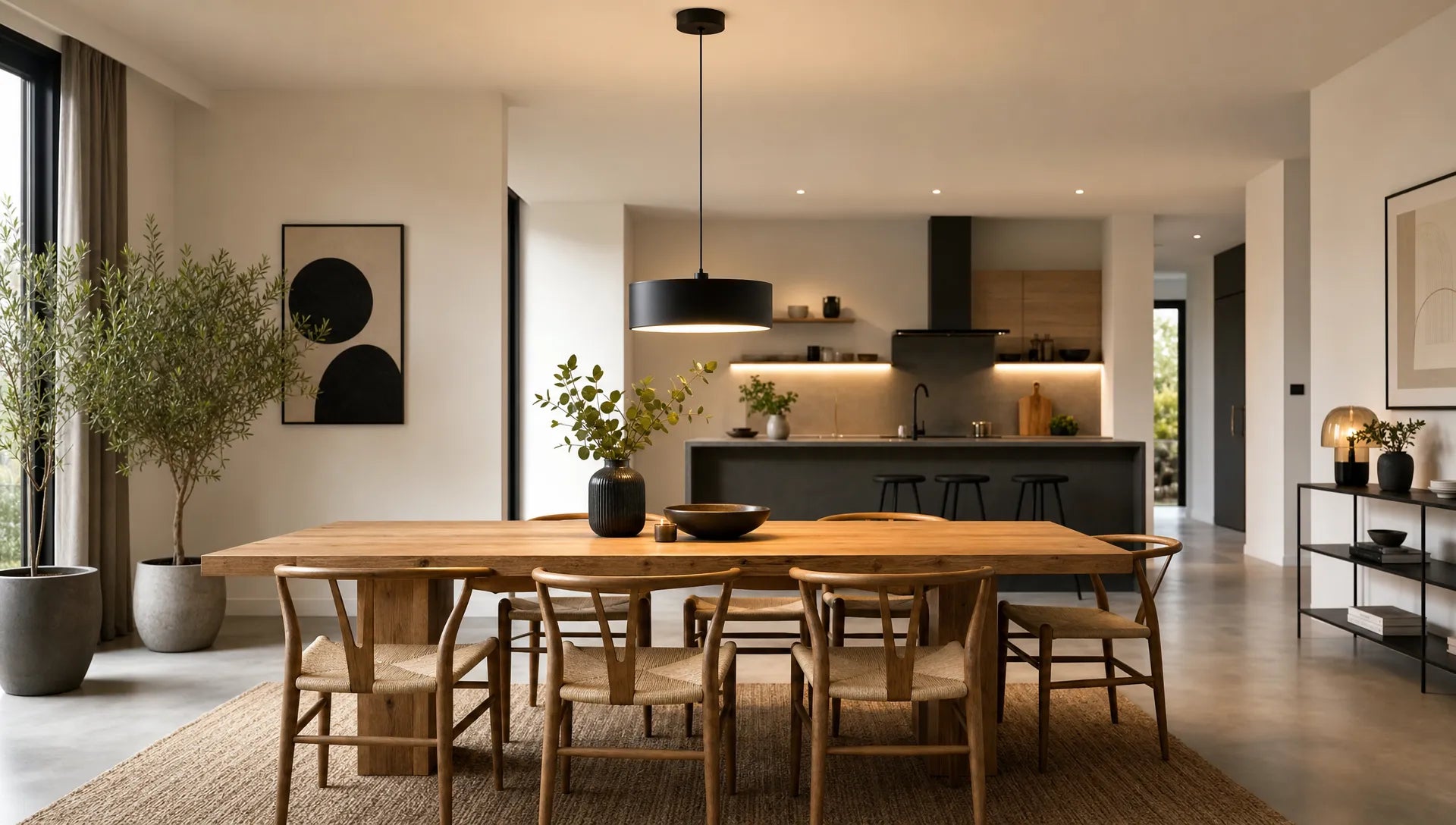
In open floor plans, the ceiling light should not be viewed in isolation. The living room, dining area and kitchen often share a line of sight. Therefore, make sure that shapes, surfaces and light colors match. If a pendant light is used in the dining area, adjusting the cable length, canopy or color can be crucial to ensure the proportions are correct. BUYnBLUE offers free customization for chandeliers and pendant lights, which can be helpful for special room heights or floor plans.
Avoid glare: Dimming alone is not enough
Many buyers think that a dimmable ceiling light can automatically solve glare. That's only partially true. If a light is positioned awkwardly or shines directly into your eyes, it will remain unpleasant even when dimmed. Coverage, beam angle, mounting position and reflections are crucial.
In the living room, glare is particularly relevant when watching TV. A glossy screen surface can reflect overhead light, even if the light is set to a relatively dim setting. Therefore, do not place highly directional spots directly in front of or above the TV area. Diffused lights with an opal cover are often more pleasant if the ceiling light is intended to serve as general ambient light.
Bright, high-gloss furniture, glass surfaces and polished stone slabs can also reflect light. In such rooms, a softer light image is worthwhile. Matte surfaces, indirect light and multiple lower light sources create a quieter atmosphere than a single very bright light source.
Smart dimming or classic wall dimmer?
Whether a smart dimmer or a classic wall dimmer is better depends on everyday life. A wall dimmer is intuitive, quickly accessible and easy to understand for guests. Smart controls offer more convenience if you want to save scenes, such as “Movie Night,” “Reading,” or “Guests.” It can also be useful if several light sources need to be controlled together.
What is important, however, is that smart does not automatically mean compatible. Smart lamps or smart LED drivers must also match the luminaire, the installation and the desired operation. Anyone who is building a new building or undergoing extensive renovations can plan the control system early on. In existing apartments, the simplest solution is often the best, as long as it works reliably and does not cause any visible problems.
For rented apartments, we recommend taking particular care with permanently installed dimmers. Changes to the electrical installation should only be carried out professionally. If you are unsure, a qualified electrician is the right person to contact, especially if existing switches, older dimmers or multiple circuits are involved.
Realistically assess energy efficiency and quality
LED technology is now the obvious choice for dimmable living room lighting because it is efficient, long-lasting and versatile. Nevertheless, you shouldn't just pay attention to a low watt value. The ratio between light output, light quality, dimming range and workmanship is crucial.
Since the rescaling of the EU energy label, light sources are again rated on a scale from A to G. The Information from the European Commission on the energy label for lighting help to better classify efficiency information. However, factors such as color rendering, glare limitation and uniform dimming behavior also count for the quality of living.
A high-quality ceiling light can be particularly worthwhile if it is used daily and is designed to last a long time. Timeless design, good materials and clean workmanship ensure that the lamp does not have to be replaced after just a few furnishing trends.
Purchase check: How to make the better decision
Before purchasing, you should systematically check the most important points. This way you can avoid a visually attractive lamp not being convincing in everyday life.
- Measure the size of the room and roughly calculate the required lumens.
- Define uses: TV, reading, guests, everyday life, home office.
- Choose warm white or adjustable light color to suit your living style.
- Check dimmability and compatible dimmer type in the product information.
- Make sure there is sufficient dimming range without flickering or humming.
- Take into account the ceiling height, diameter and installation height of the luminaire.
- Plan for glare and possible reflections on TV or glass surfaces.
- Coordinate the design of the lamp with furniture, materials and other light sources.
If several points are uncertain, it is worth not immediately deciding on the most striking design. A living room lamp is used every day and has a strong impact on the room. The best choice is almost always a light that is technically reliable, visually harmonious and flexible enough for different situations.
Frequently asked questions about the dimmable living room ceiling light
How bright should a dimmable ceiling light be in the living room? Around 100 to 150 lumens per square meter often makes sense as basic light. If you have dark walls, high ceilings or large rooms, you should plan for more reserve, as you can reduce the brightness of a dimmable lamp at any time.
What color light is best for the living room? Warm white light of around 2,700 to 3,000 Kelvin is ideal for most living rooms. It looks cozy and goes well with wood, fabrics and warm wall colors. Neutral white can be useful in work areas, but often appears more objective in living areas.
Can I dim any LED ceiling light? No. The luminaire must be expressly dimmable and the dimmer used must match the LED technology or driver. Otherwise, flickering, humming, afterglow or a limited dimming range may occur.
Is a central ceiling light in the living room sufficient? It can be sufficient as basic lighting for small to medium-sized rooms. To create more atmosphere, additional light sources such as floor lamps, table lamps or indirect light are recommended because they create depth and cozy lighting zones.
Which ceiling light suits low ceilings? Flat ceiling lights with diffuse light distribution are usually the best choice. Visually, they take up little space, reduce headroom problems and appear quieter than low-hanging or very voluminous models.
Conclusion: The best choice combines lighting technology and a feeling of living
Choosing a dimmable living room ceiling light means thinking about comfort, technology and design together. Make sure you have enough lumens, a homely light color, appropriate dimmer compatibility, low glare and a shape that matches the architecture of the room. Then the ceiling light not only becomes brighter or darker, but also becomes a real design element.
At BUYnBLUE You will find a curated selection of modern designer lighting for different living areas, including high-quality materials, free worldwide shipping and a 14-day return policy. If your living room has special proportions, high ceilings or an open concept, it's also worth taking a look at the customization options for pendant lights and chandeliers.