Plan your living room dimmable ceiling light correctly
A dimmable ceiling light in the living room is more than a practical light source. It decides whether the room appears cozy in the evening, offers enough brightness when reading and remains flexible when visitors come. If you plan it correctly, you can avoid typical problems such as glare, flickering LEDs, light that is too cold or a lamp that looks nice but does not illuminate the room in a meaningful way.
The most important thought in advance: There is rarely just one lighting task in the living room. Good planning combines basic brightness, atmosphere and targeted lighting zones. The ceiling light often forms the basis, but should be selected so that it suits the size of the room, ceiling height, furnishings and dimming technology.
First understand the room, then choose the lamp
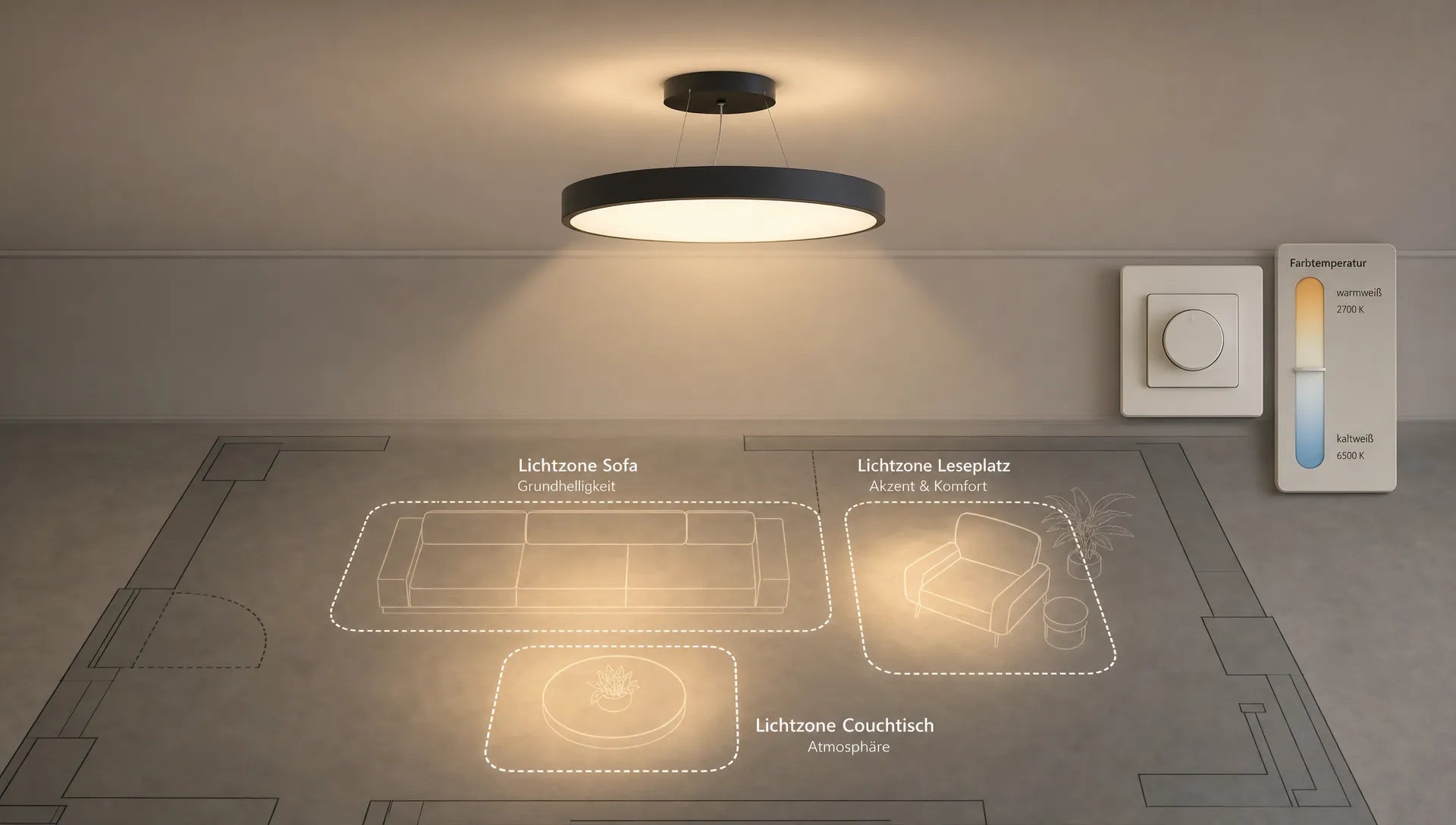
Before you look for design, color or material, it's worth taking a quick look at everyday life in the room. Is the living room primarily used for relaxing? Is there a dining table, a reading nook, a lowboard, art on the wall or an open transition to the kitchen? Each of these zones has different requirements for light.
A dimmable ceiling light in the living room does not always have to provide maximum brightness. Rather, it should have enough reserves and be able to be dimmed down far enough. It is precisely this dimming range that later decides whether the light is just practical or really homely.
| Living area | Typical lighting task | Meaningful lighting effect |
|---|---|---|
| Sofa zone | Relaxing, watching TV, talking | Warm, low-glare, rather indirect or diffuse |
| Coffee table | Orientation, games, guests | Even, but dimmable and not too hard |
| Reading place | Reading, needlework, working | Brighter, more directional, best complementary to the ceiling light |
| Wall surfaces and shelves | Atmosphere, depth, decoration | Accent light instead of pure brightness |
| Open living area | Connecting multiple zones | Multiple light circles or dimmable scenes |
If the ceiling light is the only permanently installed light source, it should radiate as broadly as possible and not just illuminate a small area under the light. In larger living rooms, a combination of central lights, wall lights, floor lamps or dimmable spots is often more pleasant than a single, very strong light source.
How bright should a dimmable ceiling light be in the living room?
The brightness of modern LED lights is measured in lumens, not in watts. Watt only describes the power consumption, lumen the amount of light emitted. A range of around 100 to 200 lux is often used as the basic brightness for living rooms. Lux means lumens per square meter.
A simple approximation is: room area in square meters times the desired lux number gives the approximate amount of light required. A living room with 25 square meters requires around 3,750 lumens at 150 lux for solid basic lighting. In practice, dark walls, high ceilings, lampshades and indirect lighting influence the result. That's why it's better to choose a dimmable light with some reserve instead of constantly operating a light that's too weak at full power.
Distribution is also important. A lamp with 4,000 lumens can have a pleasant effect if it emits a diffuse, wide beam. The same amount of light can be unpleasant if it glares downwards at certain points. If you want to go deeper into diameter, height and light distribution, this will help BUYnBLUE Guide to Diameter, height and light distribution of a ceiling lamp as a supplementary planning basis.
Not all dimming is the same
With LED lights, being dimmable does not automatically mean being dimmable without any problems. The system consisting of a light, LED driver or light source and wall dimmer must fit together. Otherwise, flickering, humming, delayed switching on or a dimming range that is too small may occur.
Three questions are particularly important: Is the lamp expressly dimmable? Which type of dimmer is needed? Does the minimum load of the dimmer match the LED power? Many modern LED lights use trailing edge dimmers, but this is not a general rule. The technical details of the lamp and dimmer are always crucial.
| Dimming variant | Suitable for | What you should pay attention to |
|---|---|---|
| phase section | Lots of LED ceiling lights in the living area | Check compatibility and minimum load |
| Phase control | Some older systems and certain bulbs | Not automatically suitable for modern LEDs |
| Smart dimmer | App, voice control, scenes | Check neutral conductor, radio standard and luminaire compatibility |
| Lamp with remote control | Easy retrofitting without a wall dimmer | Pay attention to operating logic and memory function |
| DALI or 0-10V | High-quality planning, larger projects | More suitable for new buildings, renovations or professional lighting planning |
If you already have a wall dimmer, you should not only check the appearance of the new light, but also the technical side. A seemingly small detail such as the minimum load of the dimmer can determine whether the new LED ceiling light dims properly. For a targeted purchase decision, the contribution you make is also worthwhile Correctly choose a ceiling light with a dimmer.
Light color: Plan to be warm, but not too yellow
In most cases, warm white light is the best choice for living rooms. Typical values are around 2,700 Kelvin to 3,000 Kelvin. 2,700 Kelvin looks cozy and homely, 3,000 Kelvin seems a little clearer and more modern. Very cool light of 4,000 Kelvin or more can quickly appear matter-of-fact in the living room, unless it is deliberately used for work areas.
Lights with a warm dimming function are interesting. When dimmed down, the light not only becomes darker, but also warmer. This is similar to the behavior of classic light bulbs and is particularly pleasant in the evening. If you also use your living room as a workplace during the day, you can alternatively think about adjustable color temperature. Then the operation should remain simple so that the room does not appear technologically overloaded.
In addition to color temperature, color rendering plays a major role. A high color rendering index makes wood, textiles, wall colors and skin tones look more natural. A good CRI value is particularly useful for high-quality living spaces because light significantly changes the effect of the furnishings.

Correctly determine the position and size of the ceiling light
Many living rooms only have one ceiling outlet, often in the geometric center of the room. This is practical, but not always ideal. What matters is where the light is needed. In a classic living room, the lamp can work better above the sofa area or above the coffee table than in the exact middle of the room. In open floor plans, however, a central light can seem lost if the sofa, dining area and kitchen are far apart.
For low ceilings, flat ceiling lights or compact lights with a low suspension usually make sense. If the ceiling is higher, the lamp may be larger and more sculptural so that it does not appear too small in the room. A pendant light can be very elegant in the living room, but it should be hung in such a way that it does not disturb lines of sight and no one bumps into it in everyday life.
The diameter is also important. A small lamp in a large room quickly appears random, while a lamp that is too large can visually depress the room. As a rough guide, you can add the length and width of the room in meters and derive a sensible order of magnitude from this. A room measuring 5 by 4 meters equals 9, which in many living spaces can indicate a light in the range of around 70 to 90 centimeters. This is just a rule of thumb, because the shape of the lamp, transparency and lighting effect change the perception significantly.
Individual adjustment can be crucial here. At BUYnBLUE Chandeliers and pendant lights can be adjusted free of charge, for example in terms of cable length, canopy or color. This is particularly helpful if the ceiling outlet does not fit perfectly, the ceiling height is unusual or the light needs to fit exactly into the room concept.
Plan a light scene for every moment
The biggest advantage of a dimmable living room light is not evident when you switch it on, but in everyday life. You need different light in the morning than on a movie night. The room can be brighter when guests are staying, but it should be softer when relaxing. That's why it makes sense to think in terms of scenes before you buy.
| situation | brightness | Light color and effect |
|---|---|---|
| Tidying up and orientation | High to medium | Clear, even, with as little shadow as possible |
| Guests and conversations | Means | Warm, friendly, not blinding |
| Television | Low | Very soft, ideal with additional indirect light |
| Read | Medium to high | Additional directed light at the seat |
| Evening mood | Very low | Warm, calm, can be combined with accent lighting |
A single ceiling light can partially cover these scenes, but not always completely. A heavily dimmed ceiling light is more pleasant, especially when watching TV, if there is also a small accent light or indirect light in the room. This reduces the contrast between the bright screen and the dark surroundings.
If you want to work with spots, they should not be randomly distributed across the room. Spotlights work well on walls, shelves, pictures or certain zones, but can be blinding if placed incorrectly. The article is for additional planning dimmable LED spots on the ceiling and wall helpful.
Avoid glare before it occurs
Glare is one of the most common reasons why a ceiling light in the living room appears unpleasant despite good brightness. It occurs when LEDs shine directly into the eye, reflect shiny surfaces or the contrast between the light and the surroundings is too strong.
Sitting positions are particularly critical. On the sofa, you often look up slightly, lean back or look towards the television. A lamp whose light points are visible from this perspective can quickly become annoying. Diffusers, opal glass, indirect light components or low-lying LED elements reduce this risk.
The surface in the room also plays a role. Glass tables, high-gloss fronts, dark screens and polished floors can reflect light. That's why you shouldn't just look at the ceiling light from below, but also mentally examine it from the most important sitting positions.
Planning for renovation or new construction
When renovating, you have the chance to make the lighting much more comfortable. Instead of operating all the lights via one switch, separate circuits make sense. A ceiling light, accent light and reading lights should be able to be controlled independently if possible. This creates flexibility without complicated operation.
If smart home technology is planned, you should check early on whether the desired dimmers need a neutral conductor and whether there is enough space in the flush-mounted box. The location of the switches also counts. In the living room, control points at the entrance and near the sofa are particularly convenient.
It is also important for interior designers and planners not to view the lamp in isolation. Materials, wall colors and furniture change light. A dark green living room with matt surfaces needs different reserves than a bright room with white walls and light floors. Lighting planning and interior design should therefore be thought of in parallel.
Common planning mistakes in the living room
Many mistakes can be avoided if you check a few points before purchasing. Particularly common are insufficient light reserves, incorrect dimmers, light colors that are too cool or a lamp that was selected solely based on design.
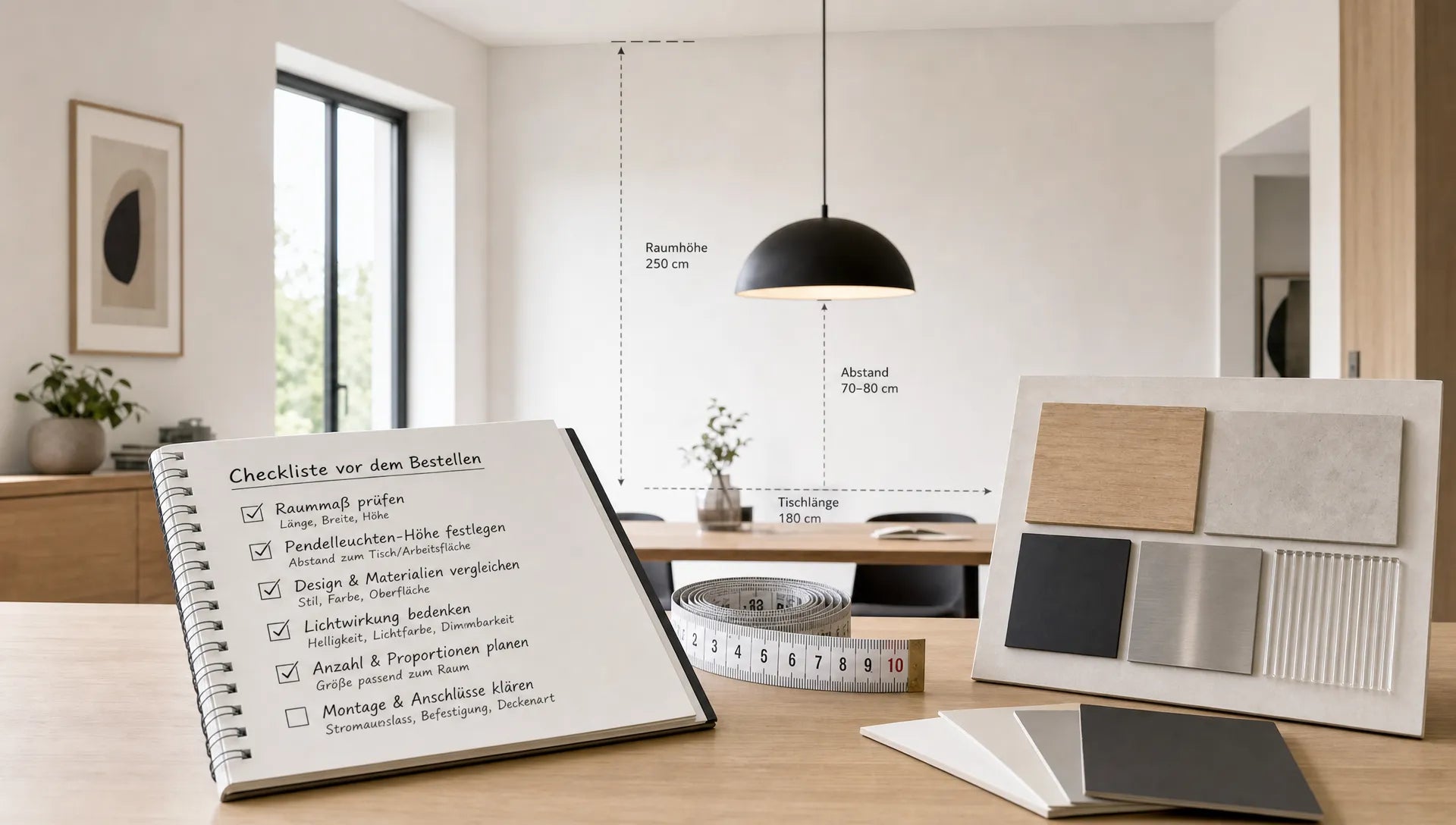
You should clarify these points before ordering:
- Measure room size, ceiling height and most important usage zones.
- Roughly estimate the desired basic brightness in lumens.
- Check whether the light is really dimmable.
- Compare dimmer type, minimum load and LED compatibility.
- Choose the light color to suit the usage, usually 2,700 to 3,000 Kelvin.
- Check the visual axes of the sofa, dining table and television for possible glare.
- For pendant lights, plan the cable length and suspension exactly.
- In open living areas, provide multiple light sources instead of just one light.
A good test is the question: Would I still like to use this light even at 20 percent brightness? If the answer is no, there is probably a lack of atmosphere or the dimming range doesn't fit the room.
Which ceiling light suits which living room style?
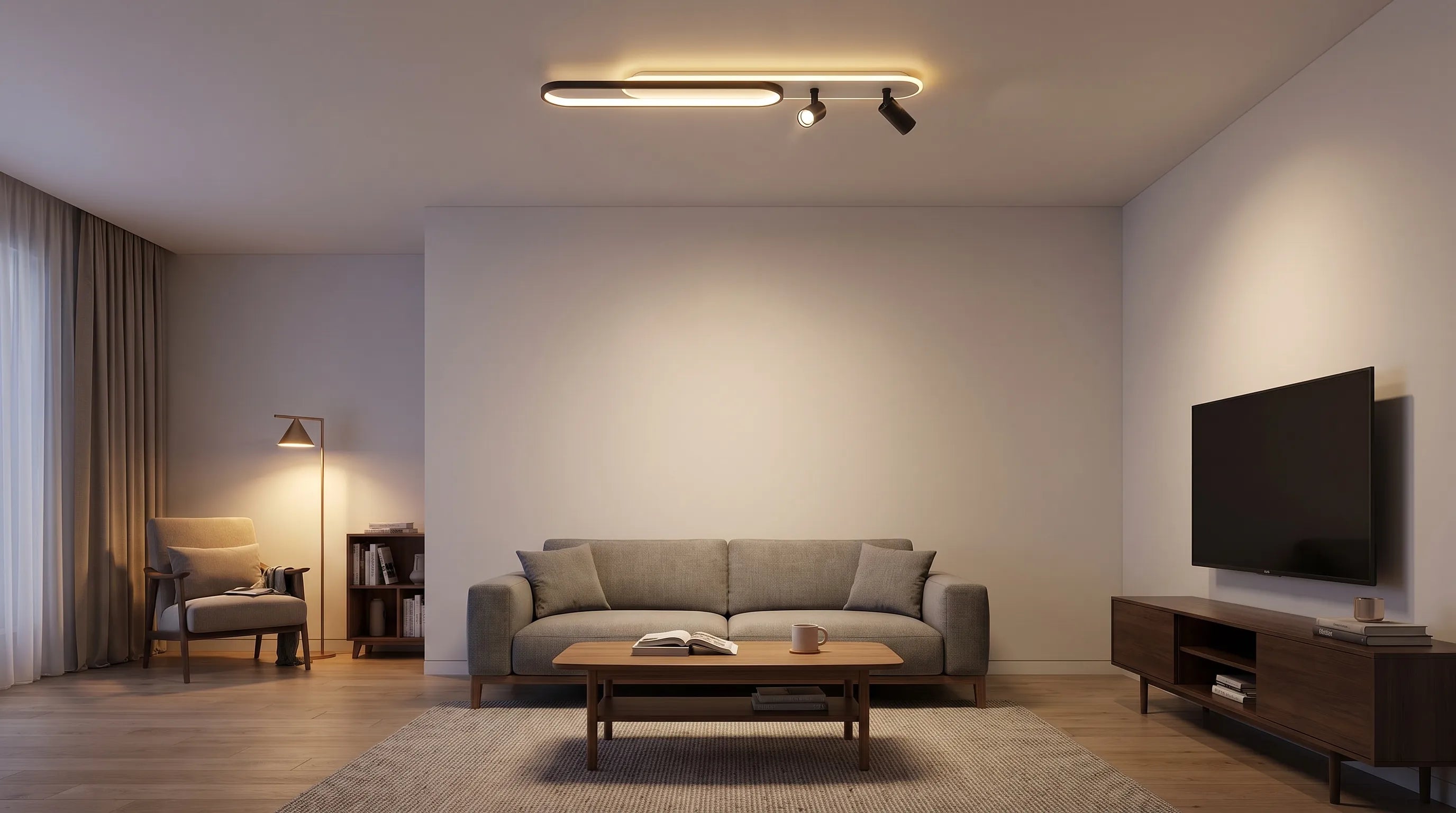
Clear shapes, high-quality metal surfaces, glass, natural stone, wooden details or sculptural designs work particularly well in modern living rooms. Minimalist rooms often benefit from lamps with a reduced shape and soft light. In spacious rooms, however, an expressive ceiling light can become the design focal point.
In classic or luxurious interiors, a modern chandelier can have a strong impact as long as it is dimmable and is planned not only decoratively but also functionally. With low ceilings, flat, multi-bulb or ring-shaped lights are often more harmonious. If the ceiling is high, the luminaire may have more volume so that it remains architecturally present.
What matters is not whether the lamp is eye-catching or subtle. What is crucial is whether design, light distribution and dimming work together. A beautiful lamp that is blinding or only looks good at one level of brightness will rarely impress in everyday life.
FAQ: Dimmable ceiling light in the living room
How many lumens does a dimmable ceiling light need in the living room? As a rough guide, you can expect around 100 to 200 lux for basic lighting. For 25 square meters, this results in approximately 2,500 to 5,000 lumens, depending on wall colors, ceiling height, lamp shape and desired atmosphere.
Which light color is most pleasant in the living room? For most living rooms, 2,700 Kelvin to 3,000 Kelvin is ideal. 2,700 Kelvin looks particularly comfortable, 3,000 Kelvin seems a little clearer and more modern. Very cool light should only be used specifically.
Can every LED ceiling light be dimmed? No. An LED light must be expressly marked as dimmable. In addition, the dimmer, LED driver and luminaire must technically fit together, otherwise flickering, humming or an uneven dimming area can occur.
Is a ceiling light alone enough for the living room? In small living rooms, a good dimmable ceiling light can be sufficient. In larger or open rooms, a combination of ceiling lights, accent lights and reading lights is usually more pleasant and flexible.
Should the ceiling light hang in the middle of the room? Not always. It often makes more sense to align it with the most important living area, such as a sofa or coffee table. For existing ceiling outlets, adjusted cable lengths, canopies or a specific lamp shape can help.
Conclusion: Good planning makes living room lighting flexible
Properly planning a dimmable ceiling light for the living room means looking at design and technology together. Room size, lumens, light color, dimmer compatibility, position and lack of glare must match. This then creates light that not only makes it bright, but also accompanies the room at any time of day.
At BUYnBLUE Find curated designer lighting for modern living spaces, including ceiling lights, pendant lights and chandeliers made from high-quality materials. Particularly practical for sophisticated floor plans: Many pendant lights and chandeliers can be adjusted free of charge, for example in terms of cable length, canopy or color. There is also free worldwide shipping, a 14-day return policy and convenient ordering from selection to delivery.