Choose LED lamps with remote control sensibly
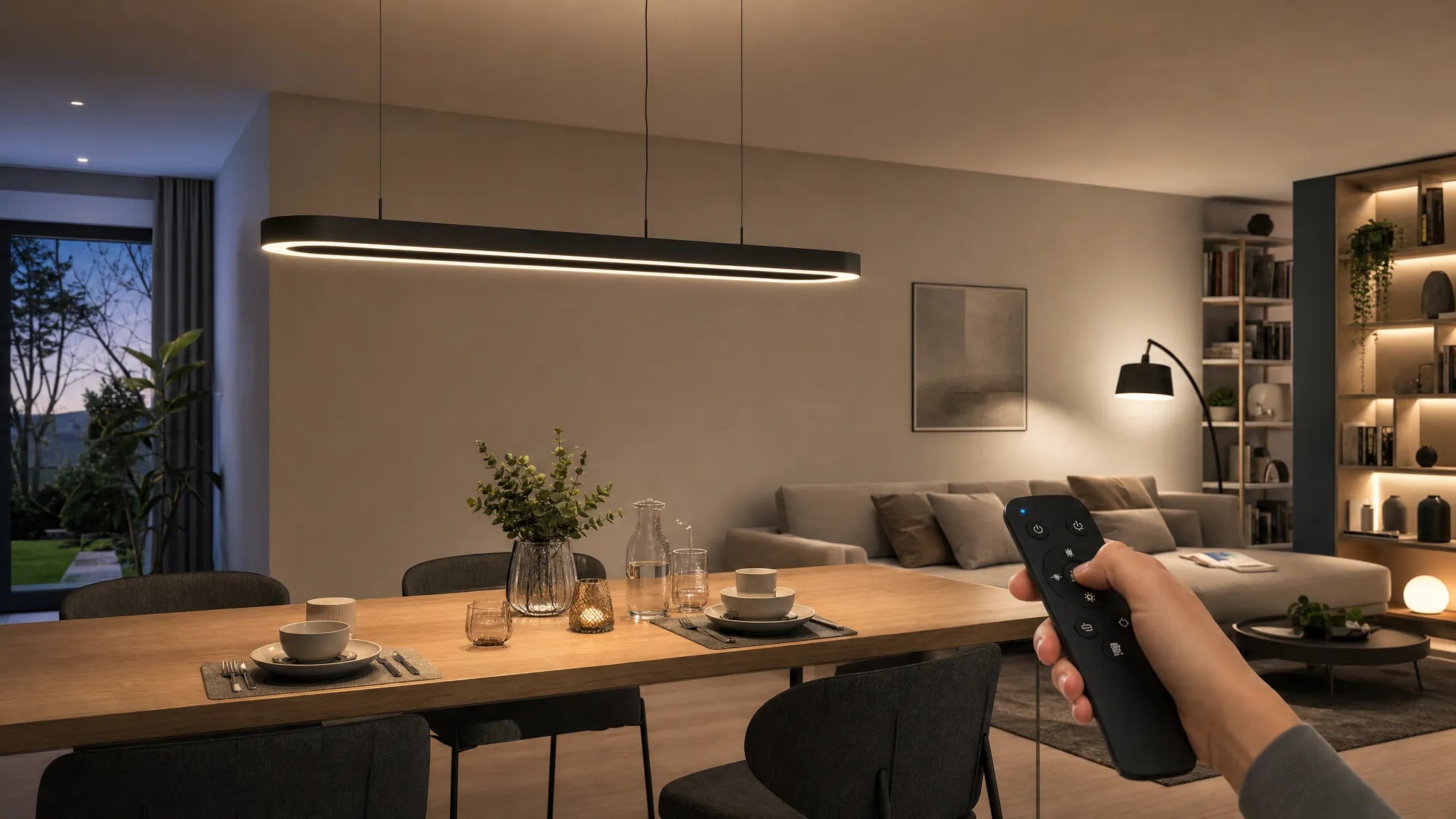
At first glance, LED lamps with remote control seem like a purely comfort issue. In practice, however, they often decide whether a lamp is actually used in everyday life: dimmed for a movie night, brighter when reading, warmer when eating or more neutral when working. The right controls can make all the difference, especially with high ceilings, pendant lights above the dining table and open living areas.
At the same time, not every remote-controlled LED light is automatically a good choice. If the light quality is not right, the remote control only works from a certain angle or the lamp forgets its setting every time it is switched off, comfort quickly turns into frustration. It makes sense to choose LED lamps with remote control not based on the number of functions, but rather based on space, light requirements, type of control and design.
When a remote control really makes sense
A remote control is particularly worthwhile where you often want to adjust light to specific situations. In the living room, the needs often change several times a day: bright and clear during the day, soft and dimmed in the evening, and specifically stronger when reading. In the bedroom, controlling it from your bed is practical because you don't have to walk to the switch in the dark. In the dining room, a remote control helps to change the pendant light between work light, family meal and cozy dinner depending on the occasion.
It is less important in rooms with a clear individual function, such as a storage room, guest toilet or hallway. Motion detectors, simple switches or robust ceiling lights are often more useful than a feature-rich remote control. So the most important question is: Is the lamp adjusted regularly or is stable on-off operation sufficient?
This distinction is also useful for renovations. If no additional control lines are to be laid, an LED light with a remote control can enable many convenient functions without having to open walls. Nevertheless, the classic wall switch should still work as a reliable basis.
The type of control determines everyday life
Not all remote controls are the same. Depending on the technology, range, ease of use and reliability differ significantly. For living spaces, radio solutions are usually more practical than pure infrared models because they do not necessarily require visual contact with the light.
| Control type | Advantages | What you should pay attention to |
|---|---|---|
| Infrared | Simple, cheap, often intuitive | Requires visual contact with the lamp and is less comfortable if the position is unfavorable |
| Radio remote control | Good range, usually works even without direct visual contact | Check range, channels and whether several lights can be controlled separately |
| Bluetooth with remote control or app | Practical for individual rooms, often usable without a gateway | Range may be limited, check app dependency |
| WiFi or smart home system | Scenes, schedules and voice control possible | Setup is more complex, data protection, gateway and compatibility should be taken into account |
| Wall remote control | Looks like a switch, can be placed flexibly | Must match the lamp and should be replaceable if necessary |
For most households, a radio remote control is the uncomplicated middle ground. It is quickly understood, works without a smartphone and is particularly suitable for ceiling lights, pendant lights and chandeliers. If you use a smart home system anyway, you can also look for compatible solutions, but you should always check whether the lamp can still be operated without an app.
Light quality first, remote control second
The best remote control is of little use if the light is too dark, too cold or difficult to dim. That's why you should first check the basic values: brightness in lumens, light color in Kelvin, color rendering and radiation behavior. If you are still at the beginning of the selection, the detailed one will help you LED purchasing advice for the right model, which explains these values systematically.
When it comes to brightness, it is not the wattage that counts, but rather the luminous flux in lumens. Lower values are sufficient for cozy ambient lighting, but you need significantly more light for kitchen islands, dining tables and work areas. The dimming range is also important: a lamp that can only be dimmed from very bright to slightly less bright does not create a real evening atmosphere.
The light color should match the room. Warm white with around 2,700 to 3,000 Kelvin looks homely and is ideal for the living room, bedroom and dining area. Neutral white around 3,500 to 4,000 Kelvin is suitable for the kitchen, dressing room or home office because it appears clearer and more activating. Cold white can quickly appear technical in living spaces and should be used consciously.
When an LED lamp can switch between warm and cooler light via remote control, it is often referred to as CCT control or tunable white. This is particularly useful in rooms with multiple uses. But make sure that the warm settings really feel cozy and are not just slightly less cool.
Color reproduction is also important. The CRI or Ra value describes how natural colors appear under the light. For general living areas, a value of 80 or more is common; for dining tables, kitchens, art, textiles and high-quality materials, a higher value, around 90, is often the better choice. Especially with designer lights, the light should not only be controllable, but also beautiful.
You can find more background on LED technology, light color and dimming in the guide Lamp with LED: advantages, light color and dimming explained.
Which functions are really useful
Many LED lamps with remote control advertise numerous modes. What matters, however, is which functions you actually use in everyday life. For living spaces, continuous dimming, a memory function and good light color control are usually more important than flashing effect programs.
| Function | Useful for | Check question before purchasing |
|---|---|---|
| Stepless dimming | Living room, bedroom, dining area | Can the lamp really be dimmed very gently and low? |
| Change light color | Open living areas, kitchen, home office | Is there pleasantly warm light for the evening? |
| Memory function | Rooms that often have the same use | Does the lamp remember the last setting after switching off? |
| Scene buttons | Living room, dining room, media rooms | Are scenes suitable for everyday use available or freely assignable? |
| Group control | Multiple pendulums, open floor plans | Can lights be controlled together and separately? |
| Timer or night light | Bedroom, children's room, hallway | Is the lowest brightness really comfortable and glare-free? |
For pendant lights above the dining table, a combination of warm light, good color rendering and precise dimming is often ideal. Scenes are helpful for the living room if one lamp is intended to cover several lighting moods. In the bedroom, on the other hand, a remote control that is as simple as possible is more important than many buttons.

Choose sensibly room by room
Every room has different requirements for LED lights with remote control. A central ceiling light in the living room has to fulfill different tasks than a pendant light above the kitchen island or a bedside lamp.
| space | Useful remote control functions | Light recommendation |
|---|---|---|
| Living room | Dimming, scenes, warm light color, group control | Warm white, low-glare, multiple light levels |
| Dining room | Dimming, memory function, possibly height or group planning | Warm white, high CRI, even light on the table |
| bedroom | Night light, switch off from bed, low dim level | Very warm, soft light without harsh contrasts |
| Kitchen | Bright mode, more neutral light color, clear operation | Good illumination of work surfaces, easy to clean |
| Home office | Brightness adjustment, neutral white, low-glare orientation | Promotes concentration, but not bright |
| hallway | Easy to use, possibly timer | Reliable orientation light, often a switch or sensor is enough |
In the living room, the lamp should not be thought of alone. A ceiling light with a remote control is practical, but does not always replace floor, table or wall lights. It becomes particularly comfortable when you combine basic lighting, accent lighting and functional lighting.
In the dining area, position is crucial. The lamp should illuminate the table evenly without dazzling people sitting. With high or low ceilings, the cable length quickly becomes the most important detail, because perfect control doesn't help if the pendant light is hanging visually incorrectly.
A remote control is particularly worthwhile in the bedroom if it is easy and quiet to use. Too many small buttons, bright status LEDs or loud beeps can be more annoying than helpful. Also make sure that the lowest dimming level is not still too bright.
Installation and operation: details that avoid trouble
Before purchasing, you should check how the lamp reacts to the wall switch. Ideally, it can still be switched on and off using the switch and also controlled via remote control. Some models always start with a standard brightness after switching on, others save the last setting. Both can make sense, depending on the room.
A memory function is nice in the bedroom so that bright lights don't suddenly come on in the evening. In the kitchen or hallway, a defined start mode can be better because you want enough light immediately. If several people in the household use the lamp, the operating logic should be as easy to understand as possible.
Compatibility with existing dimmers is also important. Many remote-controlled LED lights have their own driver for dimming. An old wall dimmer can then cause flickering, humming or malfunctions. If in doubt, an electrician should check whether the switch, dimmer and light fit together.
If you have multiple LED lights hanging in a room, you should pay attention to channels or grouping. Otherwise it can happen that one remote control controls several lamps at the same time, even though you want to operate them separately. This is particularly relevant in open living areas, for example when the dining area and sofa need different lighting moods.
Simple everyday questions also count: Which battery does the remote control use? Is it easy to replace? Is there a way to pair a replacement remote? Can the lamp be used at least basicly without a remote control? Such details seem insignificant when buying, but become crucial after a few years.
When it comes to energy consumption, it helps to take a look at efficiency and energy labels. The European Commission on the energy label for light sources explains how light sources are classified according to efficiency classes. Remote-controlled lamps can have a low standby consumption, which is usually small in everyday life. Nevertheless, efficient LED technology makes sense, especially for frequently used lights.
Don't forget design, proportion and customization
An LED lamp with a remote control should not only work technically, but also fit the room. Especially in modern interiors, material, shape, finish and proportion are just as important as the controls. A lamp that is too small appears lost above a large dining table, while a ceiling lamp that is too dominant can visually depress a low room.
When it comes to pendant lights and chandeliers, it's worth taking a closer look at the ceiling height, table size, line of sight and canopy. If cables are too long, too short or placed inappropriately, the overall spatial effect suffers. This is especially true with open floor plans, galleries and asymmetrical dining areas.
Configurable lights can solve a lot here. At BUYnBLUE Chandeliers and pendant lights can be adjusted free of charge, for example in terms of cable length, canopy or color. If you want to go deeper into this topic, the guide shows you useful options for configurable lampswhich adjustments are really worth it.
The remote control should complement the design, not distract from it. A high-quality luminaire with quiet operation, suitable light color and clean installation looks more convincing in the long term than a model with many effects but weak light quality.
Short purchase checklist
Use these points as a quick decision-making aid before choosing an LED lamp with a remote control:
- Does the brightness in lumens match the room size and usage?
- Is the lowest dimming level really comfortable enough?
- Does the light color provide warm light for living areas?
- Is the CRI sufficiently high for the dining table, kitchen or design surfaces?
- Does the remote control work without direct line of sight if necessary?
- Does the lamp respond sensibly to the wall switch?
- Does it save the last setting or does it always start straight away?
- Can several lights be controlled separately or together?
- Are replacement batteries and, if necessary, replacement remote controls available?
- Does the design, size, cable length and canopy match the room?
If you are unsure about several points, it is often better to choose a technically quieter, higher quality model instead of a lamp with as many modes as possible. Good lighting comes naturally in everyday life because it does exactly what you need.
Frequently asked questions
Are LED lamps with remote control better than normal LED lamps? Not fundamentally. They are better if you want to change brightness, light color or scenes regularly. For simple functional rooms, a normal LED light with a switch is often sufficient.
Can I still use an LED lamp with a remote control via the wall switch? Mostly yes, but the behavior differs depending on the model. Check whether the light saves the last setting or switches to a standard mode every time it is switched on.
What is more important: remote control or app control? For many households, a classic remote control is more suitable for everyday use because it works without a smartphone. An app is worth it if you want to use scenes, schedules or smart home functions.
What color light is best for the living room? Warm white light of around 2,700 to 3,000 Kelvin is usually pleasant in the living room. If the room is also used for work, a changeable light color can make sense.
Can I subsequently make any LED light remotely controllable? In some cases, for example with smart lamps or compatible control components. With integrated LED lights, it depends on the driver and electronics installed. If in doubt, a specialist company should check what is possible.
What should I pay particular attention to when it comes to dimmable LED lamps with remote control? Pay attention to low-flicker dimming, a low minimum brightness and compatibility with existing wall dimmers. Good dimming is more important than many effect modes.
Plan comfortable lighting to suit your room
LED lamps with remote control are a sensible choice when technology, light quality and interior design go together. First plan what mood and function the room needs, then decide on controls, design and adjustments.
At BUYnBLUE you will find a curated selection of modern designer lights for different living areas. Particularly practical: pendant lights and chandeliers can be adjusted free of charge, for example in terms of cable length, canopy or color. Plus free worldwide shipping, 14-day returns, and a shopping experience designed for convenience from selection to delivery.