Use dimmable bulbs from different brands together
You can use dimmable bulbs from different brands together if they fit the same dimmer and are designed for the same dimming process. The brand name is less important than the electronics in the lamp. Two LED lamps with the same socket and the same wattage can still behave differently when dimmed down.
For a multi-flame pendant light or several spots on a wall dimmer, it is worth taking a closer look at the technical information. This guide shows which combinations are possible, how you can recognize differences and when uniform lamps or separate light groups are the better choice.
When dimmable bulbs from different brands fit together
A common base is not proof of dimming compatibility. E27, E14 or GU10 describe the mechanical and electrical connection to the luminaire. You don't say whether the built-in LED electronics work with your dimmer.
When it comes to a mix of brands, three things have to fit together: the expressly stated dimmability of each lamp, the dimming method supported and the permissible load of the dimmer. In addition, the lamps should shine stably over the desired brightness range.
Distinguish between two situations. If several lamps are powered by a single wall dimmer, they have to cope with its output signal. However, if you use separately controlled lights in the same room, each can have its own suitable dimmer. Then it's all about matching brightness and light color.
For dimmable lamps, a combination with the specific dimmer model documented by the manufacturer is the most reliable basis. However, if two lamp models are listed individually as compatible, this does not automatically confirm their mixed use on a common dimmer.
Check the technical information before purchasing
Dimmable must be explicitly stated
Look for a clear statement such as “dimmable” on the packaging or data sheet. An ordinary LED lamp cannot be dimmed because it is placed in a lamp with a dimmer. Warm white light, a filament construction or high-quality workmanship do not allow any conclusions to be drawn about dimmability.
Also pay attention to the type of control. Some lamps change their brightness by repeatedly pressing a normal switch. Others are controlled via app. Neither of these necessarily means that they work with a conventional wall dimmer.
For lights with permanently installed LEDs, the driver is often crucial. The following instructions cannot simply be applied here as with replaceable E27 lamps. Check the information about the entire luminaire and its operating device.
Distinguish between leading edge and trailing edge
Many mains-operated LED lamps are dimmed via leading edge or trailing edge. Both methods change the supply voltage, but in different ways. The electronics of the lamp must be suitable for the process used.
Trailing edge is common in many LED applications, but is not a blanket guarantee for trouble-free operation. Some lamps support both methods, others only support one. Even a universal dimmer does not automatically work with every LED combination; its operating mode and the manufacturer's approvals remain relevant.
If dimmable bulbs flicker on your existing wall dimmer, you should first check the exact dimmer model and the supported lamp types. A mere statement such as “suitable for LEDs” is less meaningful than a compatibility list with specific article numbers.
For low-voltage spots, such as those with a GU5.3 base, another component is added: the transformer or power supply must also match the LED load and dimming. Checking just the lamps is not enough here.
Pay attention to the minimum load, maximum LED load and number of lamps
A dimmer can specify both a minimum load and a maximum LED load. In addition, the manufacturer may limit the permitted number of connected lamps. This information cannot be interchanged at will.
A calculation example: Three LED lamps with 7 watts each and three more with 5 watts each result in a total of 36 watts. Whether this combination is permissible cannot be determined from the sum alone. Inrush current and electrical characteristics of the LED drivers can also play a role.
The power rating for incandescent lamps is not automatically the permissible LED power. An older dimmer with a high wattage rating may be unsuitable for LED lamps or may only function to a limited extent with them. Use the limits and instructions specifically stated for LEDs.
You should only operate different types of load, for example LED lamps and halogen lamps, together if the dimmer manufacturer expressly allows this mixed load. Work on the wall dimmer or on the fixed electrical installation should be done by a qualified electrician.
The same technology does not mean the same light
Even if dimmable bulbs fit together electrically, they can appear visibly different in an open light. For a calm overall picture, the most important things are luminous flux, color temperature, color rendering and, if necessary, the beam angle.
Compare brightness based on luminous flux in lumens, not just wattage. Two lamps with the same power consumption do not have to be equally bright. In the case of spots, a narrow light cone can appear significantly brighter on a surface than a wide one, even though the specified luminous flux is similar.
Even the specification “2,700 Kelvin” does not guarantee a completely identical light color between different models. Small color deviations are particularly noticeable when several lamps are visible close to each other or illuminate the same white wall.
Finally, pay attention to “dim-to-warm.” Such lamps become warmer in color when dimmed. If you combine them with LEDs whose color temperature remains constant, the light pattern changes differently when you turn it down. In a chandelier this quickly appears inconsistent; In the case of spatially separated lights, however, it can be designed consciously.
Systematically test a brand mix
A practical test helps to assess the behavior of the intended combination. However, it does not replace manufacturer information on permissible loads and dimming methods. Check these first and only test a combination that is within the specified limits.
Only change replaceable bulbs when the power is switched off, not just when the light is dimmed. Allow hot lamps to cool down and follow the lamp instructions. You will need a qualified electrician to make any changes to the wiring, dimmer or driver.
- Note models: Record the exact article numbers of the lamps and the dimmer. Similar product names can indicate different versions.
- Check complete equipment: Test the actual planned combination. A single lamp can behave differently than several lamps connected together and can also be below the minimum load.
- Dim down slowly: Observe the lamps at full brightness, in the middle range and near the lowest usable setting.
- Compare switch-on behavior: Turn the light off and on again at a low setting. Make sure that all lamps start reliably.
- Check again after heating: Repeat the comparison after some operating time. Abnormalities may change with temperature.
Note at what setting individual lamps flicker, go out or remain significantly brighter than the others. The position of the rotary knob is not a reliable percentage value for the actual luminous flux.
If dimmable lamps only show problems at very low settings, a minimum brightness setting provided by the dimmer manufacturer can help. Whether and how this can be adjusted is stated in the instructions. Such a setting makes a fundamentally incompatible combination incompatible.

Correctly classify flickering and uneven dimming
Not every problem with dimming is caused by the brand mix. An unsuitable dimmer, a load that is too low or an unsuitable control gear can also be the cause. Conversely, trouble-free operation at full brightness does not prove that the combination works across the entire dimming range.
The following overview will help you narrow things down. It describes possible causes, not a remote diagnosis.
| Observation | Possible cause | Sensible next step |
|---|---|---|
| All lamps flicker when dimmed down | Inappropriate dimming method, minimum load not met or incompatible combination | Check dimmer data and manufacturer approvals |
| Only one lamp model flickers | Different driver electronics or other usable dimming range | Check the affected model using its article number |
| Individual lamps go out earlier | Different lower dimming limits | Determine common stable minimum brightness |
| Lamps do not start reliably at low settings | Different start behavior of the drivers | Have the switch-on behavior and possible dimmer settings checked |
| Lamps glow when switched off | Small residual currents, for example from certain switches or electronic controls | Have the cause clarified by a qualified electrician |
If the lamps are stable but have different levels of brightness, this is not necessarily an electrical fault. Different luminous fluxes and dimming curves are sufficient explanation. An identical dimmer setting does not necessarily lead to the same relative brightness level for different LED models.
If dimmable bulbs from different brands cannot be controlled uniformly, switching to a standard model is often the easiest solution. Even then, you should check the specific combination with the dimmer. If you notice any noticeable crackling, a burning smell or unusually strong heating, stop operation and have the cause checked by a specialist.
Smart home switching is not automatic dimming
With smart lighting, dimming does not have to be done at the wall connection. Many networked lamps regulate their brightness internally and require a permanently suitable power supply to do this. An upstream conventional dimmer can disrupt their operation. The specifications of the respective manufacturer are decisive, for example the instructions in the Philips Hue support information.
If smart lamps from different brands are to be controlled together, the radio standard, control center and supported functions must also match. Joint operation in one app does not guarantee identical dimming curves or the same light colors.
This Light switch panel smart home offers a solution for switching lights via smartphone and setting up schedules. However, these functions are not proof of a dimming function or compatibility with a specific LED mix. To do this, check the technical specifications of the panel and the connected lighting.
If dimmable lamps are supposed to fulfill different tasks, separate groups often make more sense than a common dimmer. Reading light, indirect light and the lighting above the dining table can be adjusted independently. The contribution to Lighting of the living room and gallery shows how such light zones can interact spatially.
Frequently asked questions about the brand mix
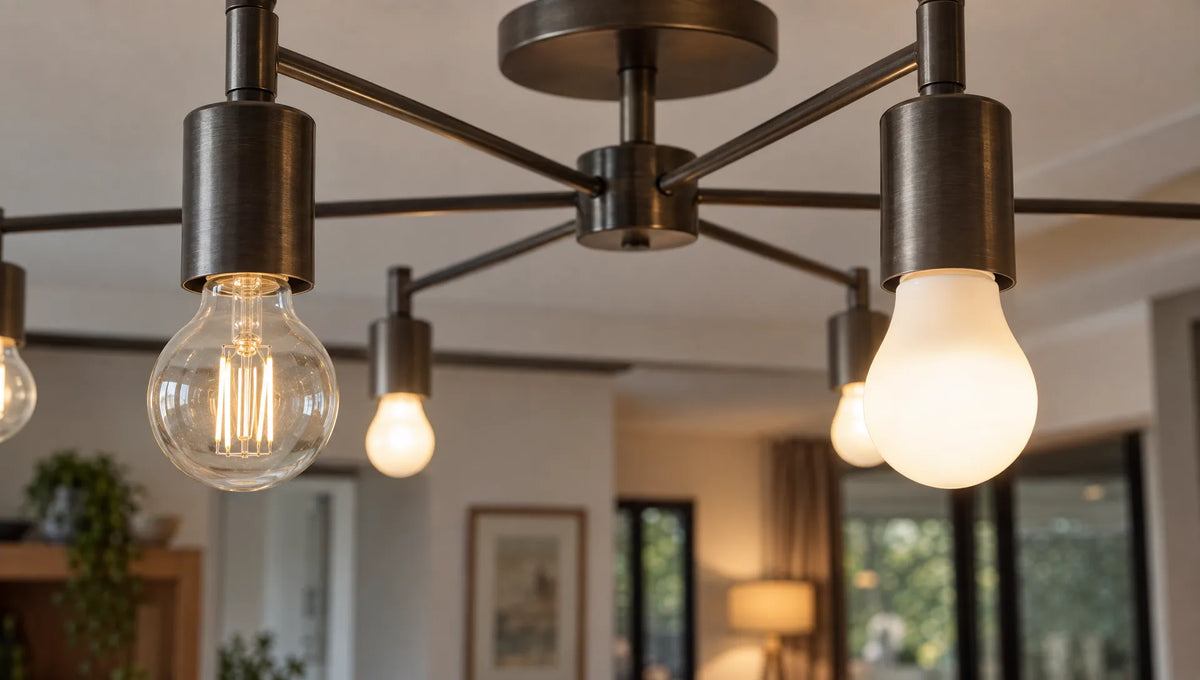
Can I use dimmable LED lamps from different manufacturers in a chandelier? Basically yes, as long as the socket, permitted luminaire equipment, dimming method and dimmer limits are suitable. For uniform light, a uniform lamp model is often the better choice, especially if the bulbs are clearly visible.
Is it enough if all packaging says “dimmable”? No. The information does not confirm that every model works with every dimmer. What is crucial is the dimming method supported and the compatibility of the specific combination.
Do all lamps have to have the same wattage? Not necessarily. Different wattages may be permitted if all manufacturer requirements are met. For similar brightness, you should primarily compare lumen values and light distribution. The same wattages also do not guarantee uniform dimming behavior.
Can I replace a defective bulb with another brand? Yes, if the replacement model is technically suitable. Then check that the equipment is complete, even at low brightness. Even with the same socket, power and color temperature, the replacement lamp can dim differently.
Can identical lamps always be dimmable without any problems? No. A uniform model reduces differences between lamps, but does not replace testing the dimmer. An unsuitable dimming method or load limits that are not adhered to remain possible sources of error.
Plan luminaires and lamps together
Dimmable lamps work most reliably if you check the entire combination before purchasing: lamp, lamp model, dimmer and, if necessary, control gear. For openly visible multiple configurations, it is also worth comparing the lighting effect.
If you are looking for a new pendant light or chandelier BUYnBLUE If you choose, the cable length, canopy and color can be adapted to your room situation free of charge. You should independently determine the appropriate lamps and their dimming compatibility based on the respective technical information.