Correctly place chandeliers for the gallery
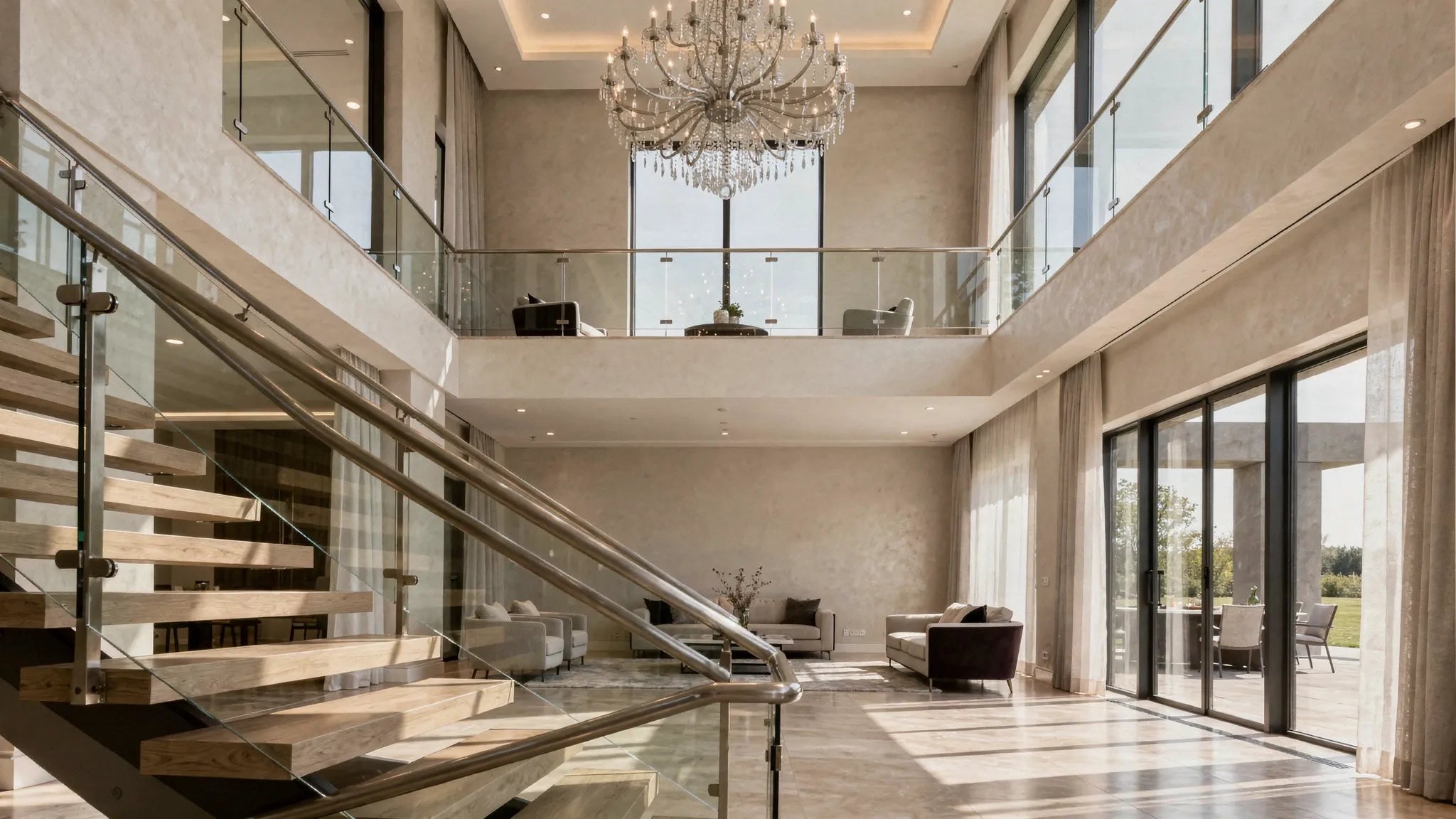
A gallery is a special place in the home: open, high, often visible from several levels and architecturally much more striking than a normal hallway. That's exactly why a chandelier looks so powerful here. When placed correctly, it connects the ground floor and upper floor, emphasizes the height of the room and becomes an elegant eye-catcher. If placed incorrectly, it hangs too high, dazzles on the stairs or appears lost in the large air space.
If you are planning a chandelier for the gallery, you should not just look at the center of the ceiling. The decisive factors are room volume, lines of sight, walkways, railings, stairs and the question of whether the lamp should be decorative, functional or both.

First clarify: what type of gallery are you lighting?
The term gallery can mean several spatial situations. This makes a big difference in terms of placement, because a chandelier above a staircase follows different rules than a chandelier in a long gallery hallway.
Typical situations are:
- Open living gallery with air space between two floors
- Stair gallery with landing, railing or spiral staircase
- Narrow gallery hallway on the upper floor, often with a view downwards
- Private art gallery or picture wall in the living area
In an open gallery, the chandelier is usually a vertical design element. It should make the height visible and look good from below and above. In a stair gallery, safety is more important because no one should be blinded while walking or come too close to the lamp body. In an art gallery, on the other hand, the chandelier is more of an atmospheric background light, while works of art should be accentuated separately.
The most important rule: think in terms of the volume of the room, not just the floor plan
Many placement errors arise because the light is simply hung under the existing ceiling outlet. This can work, but it doesn't have to. In a gallery, the visible center of the airspace counts more than the geometric center of the ceiling.
Before assembly, ask yourself:
- Where do you first see the chandelier?
- Does it appear central from the entrance area?
- Is it nicely proportioned from the upper gallery level?
- Is it hanging freely enough in the airspace?
- Will the view of art, windows, stairs and architecture be preserved?
A good test is a simple template: mark the planned location on the ground and temporarily hang a light balloon, string, or cardboard model at the desired height. Then consider the position from the entrance, stairs, upper railing, and adjacent rooms. If the chandelier appears to be deliberately placed from all important angles, the position is usually correct.
Guidelines for height, position and distance
The ideal height depends on the height of the ceiling, the shape of the lamp and the use of the area below. A chandelier can be dramatic in a gallery, but it shouldn't restrict walkways. Especially on stairs, the lowest point should remain comfortably above head height.
| Room situation | Recommended position | Minimum distance and height |
|---|---|---|
| Open air space in the entrance area | In the visual center of the airspace or on the main line of sight | Lower edge usually at least 2.30 m above the accessible area |
| Chandelier above a staircase | Via the landing, stairwell or axis of the stairs | Lower edge at least 2.10 m above the highest relevant step |
| Gallery hallway on the upper floor | In the middle of the aisle or slightly facing the open side | Bottom edge at least 2.10 m above the ground |
| Above a console or fixed furniture | Centered over the piece of furniture | More freedom because there is no direct walking zone underneath |
| Art gallery or picture wall | Not directly in front of the main work of art, but in space or in the axis | Sufficient distance so that no reflections or shadows arise |
These values are practical reference points. For very tall people, public areas, low ceilings or complex staircases, you should plan more generously. You should also always take the specific shape of the lamp into account: a slim, vertical chandelier can hang lower than a wide chandelier with sweeping arms.
Calculate the appropriate size of the chandelier
A chandelier for the gallery can be larger than a normal ceiling light in the hallway. The most common mistake is not a chandelier that is too big, but rather a chandelier that is too small. In high rooms, a small light quickly loses its effect because it appears to stick to the ceiling and does not fill the air space.
As a first rule of thumb for the diameter you can calculate:
Diameter in cm = room length plus room width in meters x 8 to 10
Example: A gallery is 4 m long and 3 m wide. 4 plus 3 equals 7. Multiplied by 8 to 10, this gives a reasonable diameter of around 56 to 70 cm. If you have a very high gallery, you can plan about 10 to 20 percent larger, as long as there is enough distance to walls, railings and walkways.
The height of the luminaire body does not mean the entire cable length, but rather the visible chandelier itself. Particularly in galleries with a room height of more than 4 m, multi-tiered or cascade-shaped models often appear more harmonious than flat luminaires.
| Ceiling height or airspace height | Suitable lighting effect | Rough height of the lamp body |
|---|---|---|
| Up to approx. 2.80 m | Compact chandelier or mid-height ceiling light | 25 to 50 cm |
| Approx. 3 to 4 m | Medium sized chandelier with visible depth | 50 to 90 cm |
| Approx. 4 to 6 m | Cascade lamp or multi-tiered chandelier | 80 to 160cm |
| Over 6m | Large statement model, often individually planned | From 150 cm, depending on the room |
Important: A large chandelier does not necessarily need extreme brightness. Size first describes the spatial presence, not automatically the light output. That’s why dimmability and good light distribution are particularly important.
Distance to walls, railings, doors and windows
A chandelier in the gallery must appear free. If it hangs too close to the wall, it loses its lightness and casts harsh shadows. If placed too close to the railing, it can be distracting from the upper level or make cleaning difficult.
As a guide, there should ideally be at least 50 to 80 cm between the outermost part of the lamp and the wall, railing or window area. For very large chandeliers or delicate glass details, more distance makes sense. Also check whether window sashes, interior doors, closet doors or tall decorative elements could touch the chandelier.
The distance to stairs is particularly important. The chandelier should not protrude into the natural movement zone. Don't just measure at the floor, but along the line of the stairs. The lowest point of the light must remain safe even where people are highest on the stairs.
Placement by room type
Open gallery in the entrance area
In the entrance area, the chandelier is usually the first design element that guests notice. Central placement in the airspace works particularly well here if the architecture is symmetrical. However, for asymmetrical floor plans, it may be better to align the chandelier with the front door, the axis of the stairs or a large window.
In two-story entrances, it often looks harmonious if the chandelier's center of gravity is not directly under the ceiling, but rather floats deeper in the room. This way it visually connects both floors. From the upper gallery you should be able to view the lamp body without it dazzling directly at eye level.
Chandelier above the stairs
Placement is more challenging over stairs. The chandelier should emphasize the verticality of the stairwell, but should not hang over the area where people climb or use the railing. Positions above a stairwell, above a landing or in the middle of a spiral staircase are particularly suitable.
Make sure that the lamp looks beautiful from below and above. On open stairs you can often see the underside of the chandelier. A model with clean workmanship, harmonious lighting and non-glaring light sources is crucial here.
Narrow gallery hallway
In a long gallery hallway, a single round chandelier can quickly appear too dominant or out of place. Elongated models, linear pendant lights or several smaller hanging elements that rhythmically structure the hallway are better. If one side is open to the air space, the light may be oriented slightly towards the open side so that it does not stick to the wall.
If the ceiling height is lower, you should choose flat or slim models. The hallway must remain pleasant to walk on. An opulent chandelier only makes sense here if the width, height and furniture leave enough space.
Gallery with works of art
If your gallery also displays paintings, sculptures or collectibles, the chandelier should not be the only source of light. It creates atmosphere and a representative basic brightness, but art needs targeted, controlled light. Reflective surfaces, glass frames and shiny colors can create annoying reflections due to incorrectly placed lights.
Lights with good color rendering are important for works of art. A CRI value of at least 90 is recommended so that colors appear natural. You can find more information about this in BUYnBLUE Guide to Lighting for works of art.
Lighting effect: The chandelier is part of the lighting concept
A chandelier in the gallery is a statement, but rarely the complete solution. High rooms absorb light more than low rooms. There are also shadows caused by railings, stair stringers, offset ceilings or art objects. The chandelier should therefore be combined with other light sources, such as wall lights, indirect light or accent spots.
You can work with the following guidelines for planning:
| area | Orientation value | Recommendation |
|---|---|---|
| Gallery hallway and stairs | Approx. 100 to 200 lux | Uniform, low-glare, safe to walk on |
| Entrance area with air space | Approx. 100 to 150 lux | Dimmable for time of day and mood |
| Art wall | Basic light approx. 50 to 150 lux | Plan accent lighting specifically and with a high CRI |
| Pedestal with console or bench | Approximately 150 to 300 lux locally | Can be supplemented with a wall lamp or table lamp |
The simple formula is: Lumen = Lux x Square Meter. In the case of high galleries, however, you should take a planning factor into account because part of the luminous flux reaches the floor or walls less directly. Depending on the room height, wall color and lamp shape, a factor of around 1.3 to 1.8 can make sense.
If you want to go deeper into systematic lighting planning, it's worth it BUYnBLUE Contribution to 3-layer principle of LED lighting. This combination of basic light, zone light and accent light works particularly well in galleries.
Choose the right color temperature and glare
For living areas, 2,700 to 3,000 Kelvin is usually ideal. This warm white light looks inviting and goes well with wood, natural stone, warm wall colors and decorative materials. In modern, very clear galleries, 3,000 to 3,500 Kelvin can also work, especially if a lot of white, glass, concrete or metal is used.
More important than the pure Kelvin number is the lack of glare. A chandelier often hangs in a direct line of sight in a gallery. Open lamps, reflective crystals or very bright LED points can be dazzling when you look at the lamp from above or on the stairs. Therefore, pay attention to diffuse covers, well-shielded light sources or dimmable technology.
Dimmability is particularly valuable in galleries. During the day, a little additional light is often enough; in the evening, the lamp should create an atmosphere and, when guests are present, it can be used to create a stronger impression. A dimmable chandelier offers this flexibility without having to replace multiple lights.
Installation: Think about technology, cable length and ceiling rose
The most beautiful placement is of little use if the technology isn't right. Before buying, you should check where the power outlet is, how load-bearing the ceiling is and whether a special ceiling rose is necessary. Especially in galleries, the electrical connection is often not located exactly where the chandelier would be visually ideal.
Important points before assembly:
- Check the load-bearing capacity of the ceiling and suitable fastening
- Determine cable length based on actual hanging height
- Choose a ceiling rose to match the connection, light weight and style
- Plan for maintenance, cleaning and lamp access
- Consider switching from below and above
- Check dimmer, drivers and lamps for compatibility
Work on 230 V connections should be carried out professionally. If you are unsure, consult a qualified electrician. For basic security aspects you can also use the BUYnBLUE Guide to Connecting a lamp safely read.
A big advantage BUYnBLUE is the free adjustment of many chandeliers and pendant lights. Cable length, ceiling rose or color can be tailored to the room. This is particularly valuable in galleries because standard lengths often do not match the actual ceiling height or the desired focal point.
Style and proportion: Which chandeliers look particularly good in galleries?
The style should match the architecture. A high gallery often tolerates more presence than a normal hallway. Nevertheless, the chandelier must harmonize with railings, stair material, wall colors and furniture.
| Gallery type | Suitable chandelier | Effect |
|---|---|---|
| Modern open gallery | Slim cascade light, glass, metal, clear shapes | Airy, vertical, high quality |
| Classic entrance area | Multi-arm chandelier with warm light | Representative and inviting |
| Minimalist architecture | Reduced design, linear or geometric shape | Quiet, precise, architectural |
| Gallery with art | Understated chandelier plus separate accent lighting | Elegant without overpowering art |
| Narrow stair gallery | Vertical pendulum group or narrow model | Room high, but not bulky |
A good chandelier is not only bright but proportioned. It should be large enough to remain visible in the airspace, but not so large that it dominates the architecture or obstructs movement areas.
Common mistakes with gallery chandeliers
Many problems can be avoided if you measure and check multiple angles before purchasing. Height, glare and a lamp body that is too small are particularly critical.
| Error | Effect | Better solution |
|---|---|---|
| Chandelier hangs directly under the ceiling | The air space remains empty, the light appears lost | Bring the light deeper into the room and adjust the cable length |
| Light hangs too low over stairs or hallway | Unsafe, disruptive, uncomfortable | Maintain minimum head height and measure walking distances |
| Placed only after ceiling outlet | Looks crooked from important perspectives | Check position based on entrance, stairs and railings |
| The lamp chosen was too small | No statement effect in a high gallery | Adjust the diameter and body height to the room volume |
| No dimmability | Light is too harsh in the evening or unnecessarily bright during the day | Choose a dimmable model or suitable control |
| No additional lights | Shadows, uneven brightness | Add wall lights, spotlights or indirect light |
Checklist before purchase
Before ordering a chandelier for the gallery, you should note all relevant dimensions. This includes ceiling height, length and width of the air space, position of the power outlet, height of the railing, route of the stairs and the desired lower edge of the luminaire.
Also, check whether the chandelier looks good from multiple levels. In galleries, the light is not only visible from below. It is often viewed from the side, from above and from a distance. This is exactly what differentiates a gallery placement from a normal ceiling installation.
If you are torn between two sizes, the slightly larger model is often the better choice for high galleries. The prerequisite is that the distances are correct and the lamp is dimmable or pleasantly low-glare.
Frequently asked questions about placing chandeliers in the gallery
How high should a chandelier hang in a gallery? In walkable areas, the lower edge should usually be at least 2.10 to 2.30 m above the floor or the highest relevant step. In high air spaces, the chandelier can hang lower as long as walkways remain clear and the light appears harmonious from multiple angles.
Does the chandelier have to hang exactly in the middle of the gallery? Not always. What is more important is the visual center of the airspace. With symmetrical galleries, the middle is often right. For stairs, windows or asymmetrical floor plans, aligning them with the main visual axis can work better.
How big can a chandelier be for the gallery? A rough rule of thumb is: room length plus room width in meters x 8 to 10 equals the diameter in centimeters. In the case of very high galleries, the luminaire may be larger or higher as long as there is sufficient distance from walls, railings and walkways.
Is a chandelier enough as the only lighting in the gallery? In small galleries this can be enough. In high, winding or art-focused galleries, you should plan additional light sources, such as wall lights, spotlights or indirect lighting. This will help you avoid harsh shadows and improve safety on stairs.
What to do if the ceiling outlet is not in the ideal location? Then a suitable ceiling rose, an offset suspension or an individual solution can help. At BUYnBLUE Many pendant lights and chandeliers can be adjusted free of charge, for example in terms of cable length, ceiling rose or color.
Find the right chandelier for your gallery
A chandelier in the gallery is more than a light source. It structures the airspace, guides the eye and gives the home a representative focal point. What is crucial is the right height, appropriate proportions, secure installation and a lighting effect that fits the architecture.
At BUYnBLUE You will find a curated selection of modern designer lights and chandeliers for sophisticated living areas. Particularly practical for galleries: Many lights can be adjusted free of charge, for example in terms of cable length, ceiling rose or color. Plus free worldwide shipping, a 14-day return policy, secure payment options, real-time tracking and 24/7 customer service.
If your gallery has a special ceiling height, a staggered connection or an unusual room layout, an individually tailored solution is worthwhile. So the chandelier doesn't just hang somewhere, but exactly where it perfectly combines space, light and architecture.