Understanding light luminaires: which types are suitable for what
When you look for light fixtures, you usually mean more than just a beautiful object on the ceiling. What is meant is the practical question: Which type of luminaire produces which light, solves which task and really fits the room? This is exactly where many bad purchases occur. A spectacular pendant light can look perfect above the dining table, but can be blinding in the hallway. A spot can illuminate a work surface precisely, but can quickly look uncomfortable in the living room.
The most important thought first: good lighting is rarely created by a single lamp. It is created by several layers of light that complement each other. Only when the basic brightness, zone lighting, accent lighting and atmosphere match does a room appear harmonious and can be used pleasantly in everyday life.
If you are still unsure whether the term lamp means the light source or the entire lamp, a quick look at it will help Difference between lamps and lights. This article is primarily about types of lights, i.e. about the visible light objects and their appropriate use.
First clarify the lighting task, then choose the type of luminaire
Before you decide on design, color or material, you should define the lighting task. A room often needs different types of light. In the living room you want to orientate yourself, read, relax and perhaps highlight a work of art. In the kitchen, however, you need clear light for cutting, cooking and cleaning. In the bedroom, the focus is on calm, while in the home office, focus is on concentration.
The following overview shows which types of luminaires typically suit which task:
| Light task | Why it is important | Suitable types of lights |
|---|---|---|
| Basic light | Uniform orientation in space | Ceiling lights, recessed spots, track systems, indirect wall lights |
| Zone light | Lighting of individual areas such as the dining table, kitchen island or reading area | Pendant lamps, floor lamps, table lamps, directional spots |
| Accent light | Emphasis on pictures, shelves, plants or architecture | Wall lights, spotlights, picture lights, small table lamps |
| Mood lighting | Coziness in the evening and a soft spatial effect | dimmable pendant lights, wall lights, indirect lights, decorative table lights |
| Orientation light | Safety in hallways, stairs or at night | Wall lights, base lights, small ceiling lights, indirect light |
This classification is particularly helpful for renovations and new buildings because it prevents luminaires from being selected solely based on their appearance. Design remains important, but it should support function.
The most important types of lights and what they are suitable for
Ceiling lights for uniform basic brightness
Ceiling lights are the classics for basic lighting. They sit centrally or flat on the ceiling and distribute light as evenly as possible throughout the room. They are particularly practical in hallways, children's rooms, utility rooms, bathrooms and kitchen areas where clear orientation is more important than a dramatic lighting effect.
In low rooms, flat ceiling lights are often a better choice than long pendant lights. In large rooms, however, a single ceiling light is rarely enough. Then several light points, a rail system or a combination with wall and floor lamps look more harmonious.
Make sure ceiling lights are glare-free. A very bright, naked light source in the middle of the room can appear unpleasant, even if it technically provides enough brightness. Diffusers, opal glasses or indirect light components make the light softer.
Pendant lights and hanging lamps for tables, islands and focal points
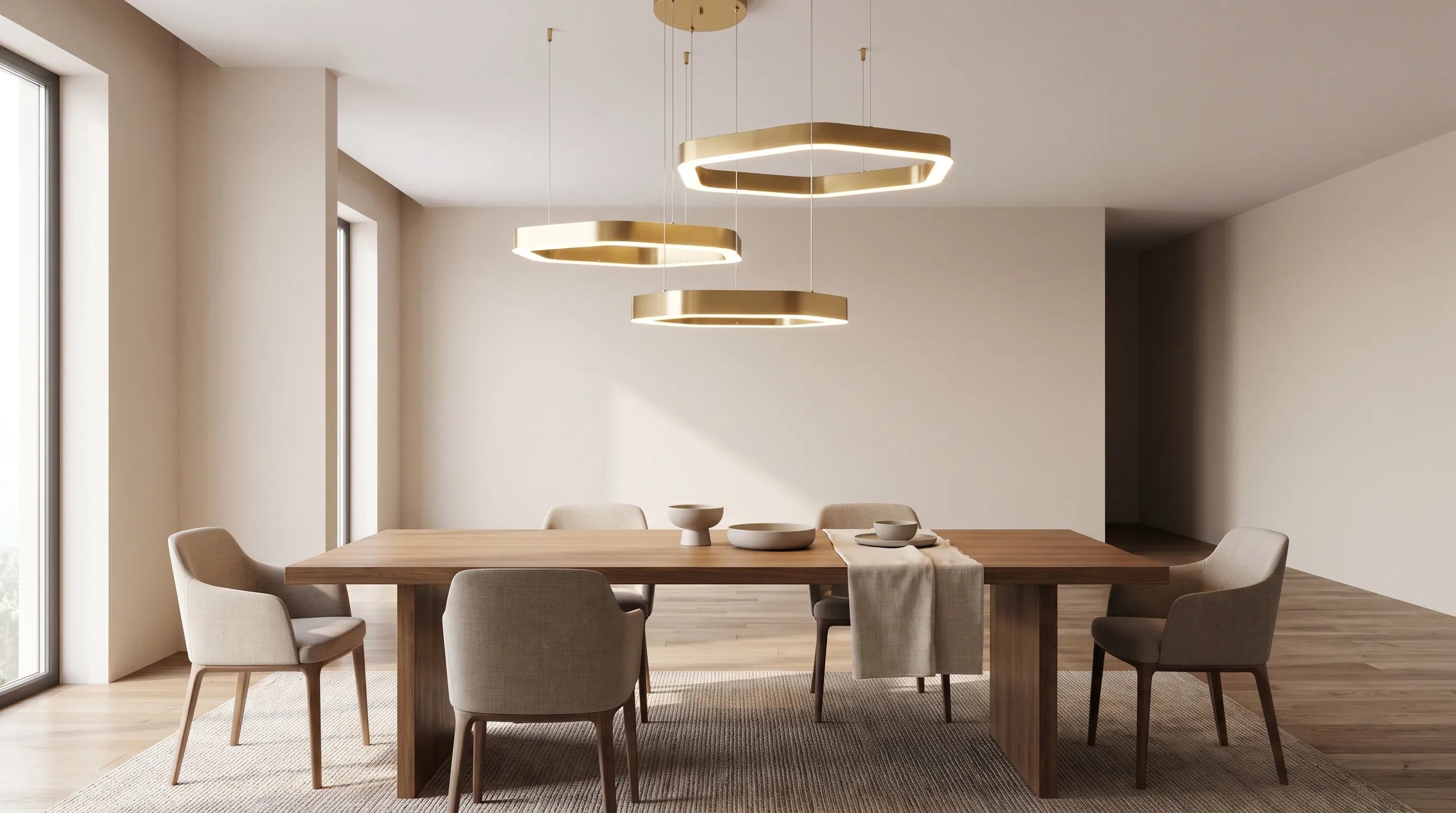
Pendant lights are ideal if light needs to be directed downwards. They create a clear focal point above the dining table, kitchen island, coffee table or counter. They zone the room and give furniture visual support.
Above the dining table, the lamp should hang low enough to pleasantly illuminate the table, but not so low that it disrupts eye contact. A distance of around 60 to 80 cm between the table top and the lower edge of the lamp often works well. For very high ceilings, open galleries or unusual table formats, individual adjustment of the cable length can be crucial.
Pendant lights are also strong design elements. A single large lamp appears calmer and more sculptural, several small pendants appear rhythmic and are particularly suitable for long tables or kitchen islands.
Chandeliers and statement lights for atmosphere
Chandeliers are not just classic. Modern chandeliers can appear minimalist, organic, geometric or luxurious. They are suitable for rooms in which the lamp is deliberately intended to become part of the architecture: dining rooms, entrance areas, stairwells, high living rooms or representative bedrooms.
The proportion is important. A chandelier that is too small will get lost in a large room. One that is too big dominates everything and can have an overwhelming effect. In addition to the diameter, the suspension also plays a major role, especially with high ceilings. The chandelier should be visible without blocking paths or visually cutting up the room.
Statement lights often need less competition. If a chandelier is the focal point, other lights can be more reserved and complement it more functionally.
Wall lights for light from the side
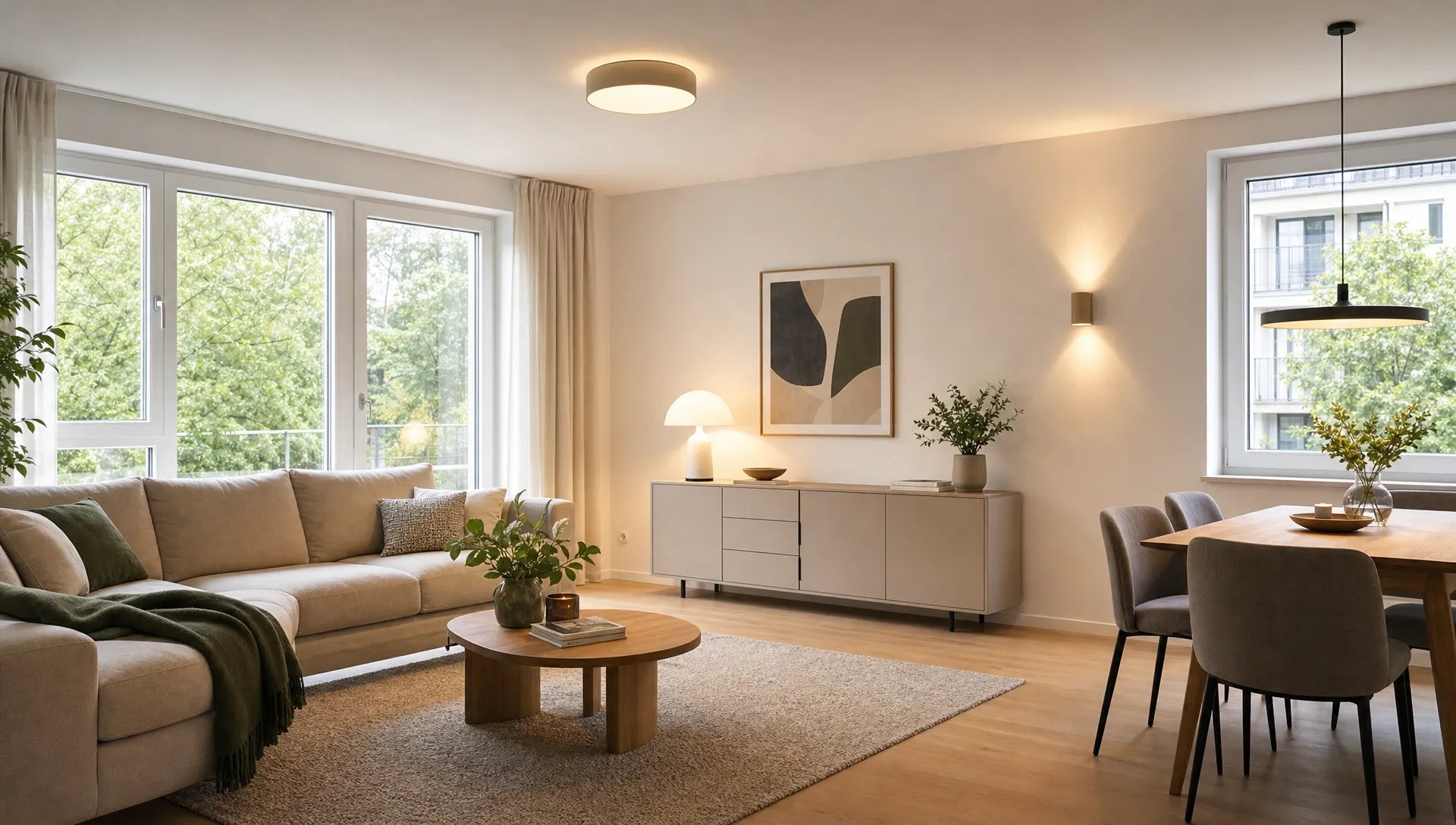
Wall lights are often underestimated, even though they make rooms particularly comfortable. Light from the side appears softer than light from above and brings depth to the room. In the hallway it provides orientation, in the bedroom it often replaces the bedside lamp, in the living room it emphasizes wall surfaces or art.
A wall light can shine directly downwards, upwards, up and down or diffusely into the room. Up-and-down lights place graphic beams of light on the wall, while indirect models create a calm atmosphere. For mirror areas, such as in the bathroom or dressing area, light from the side is often advantageous because it illuminates faces more evenly than a single spot from above.
If you would like to go deeper into this topic, see the article above Wall lights as inviting light from the side further information on locations and positioning.
Floor lamps and table lamps for flexible islands of light
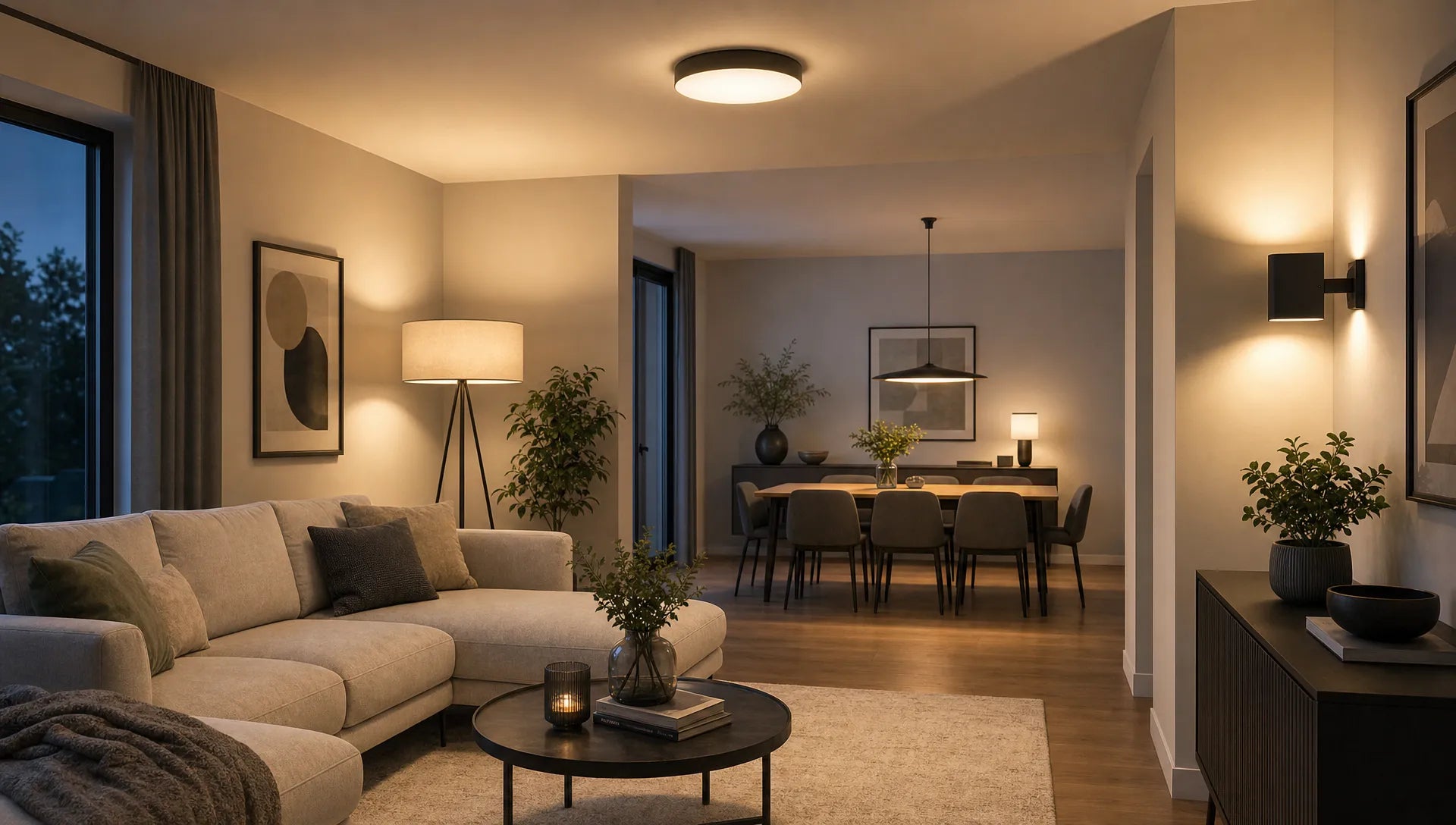
Floor and table lamps are particularly flexible because they do not require fixed ceiling planning. They are ideal for rental apartments, subsequent improvements and areas that change in everyday life. A floor lamp next to the sofa creates a reading zone. A table lamp on a sideboard or console provides a warm accent light. In the bedroom, small table lamps can be a soft alternative to ceiling lights.
The biggest advantage is the atmosphere. While ceiling light activates the entire room, portable lights create small islands of light. It is precisely these islands that make living spaces comfortable in the evening.
Spots, recessed spotlights and track systems for precise lighting
Spots are useful if light needs to be directed specifically. They illuminate countertops, art, cabinets or specific zones. Recessed spotlights appear calm and architectural, but require appropriate ceiling or drywall planning. Surface-mounted spots are easier to retrofit and can also look very modern.
Rail systems are particularly versatile. They allow for multiple points of light in one line and can often be realigned when furniture is moved. They are a practical solution for open living areas, galleries, kitchens and work spaces because they can combine basic light and accent light.
The disadvantage: Too many spots can make a room uneasy. It's better to consciously plan what should be illuminated instead of filling the ceiling evenly with points of light.
Which light fits which room?
Each room has its own requirements. Therefore, the type of luminaire should not be considered in isolation, but always together with usage, room size, ceiling height, furniture and the desired mood.
| space | Main goal | Good combination of lights |
|---|---|---|
| Living room | Flexibility and atmosphere | Ceiling or wall lamp plus floor lamp, table lamp and accent light |
| Dining room | Focus on the table | Pendant lamp or chandelier, complemented by soft wall or sideboard light |
| Kitchen | Precise work light | Ceiling lights or spots plus pendant lights over the island or counter |
| bedroom | Peace and quiet and low-glare light | Wall lights or bedside lights plus a soft ceiling light |
| hallway | Orientation and inviting first impression | Ceiling lights, wall lights or linear light points |
| bathroom | Safety and clear visibility | suitable ceiling light plus mirror lighting, depending on the protection area |
| Home office | Concentration without glare | Uniform basic light plus desk lamp or directed zone light |
In the living room it is worth having a mix of at least three light sources. A central ceiling light alone often appears flat. If you combine them with a floor lamp on the sofa and a small lamp on the sideboard, depth is created. For interior designers, it is precisely this graduation that is a central tool for making rooms appear more high-quality.
In the dining room, the pendant light is usually the most important light point. It should fit the table format. A round or compact lamp looks harmonious above a round table. Linear lights or several pendants often work better over a long table.
In the kitchen, function comes first. Work surfaces should be lit with little shadow. If you only have one light behind you on the ceiling, you will quickly cast shadows on the surface while you work. This is why spots, under-cabinet lights or well-positioned pendants over islands are so effective.

Correctly assess proportions, height and spatial effect
A lamp can technically fit and still appear wrong if the size or height is incorrect. Pendant lights, chandeliers and large ceiling lights in particular must fit the proportions of the room.
In small rooms, transparent materials, slim shapes and indirect light appear lighter. In large rooms, lights can have more volume, otherwise they will visually disappear. In open floor plans, a light fixture can help define areas. A pendant light above the dining table marks the dining area, while a floor lamp calms the living area.
The ceiling height is also crucial. Long suspensions can look spectacular in old apartments or houses with air space. In rooms with low ceilings, flat lights, wall lights or indirect solutions are often more pleasant.
This is exactly where individualization becomes valuable. At BUYnBLUE Chandeliers and pendant lights can be adjusted free of charge, for example in terms of cable length, canopy or color. This is particularly helpful if standard dimensions do not match the ceiling height, table or room layout.
Light quality: The type of luminaire alone is not enough
The type of light determines where the light goes. The quality of light determines how pleasant it appears. That's why you should also pay attention to technical values when buying. Brightness, light color, color rendering, beam angle, dimmability and, if necessary, IP protection are particularly important.
Warm white light is often perceived as cozy in living spaces. More neutral light can be useful in the kitchen, bathroom or home office because it appears clearer and more activating. Good color reproduction is important if you want materials, skin tones, food or art to look natural.
Dimmability is also a great convenience factor. A dining room light that is bright while you work or play and can be dimmed in the evening is more versatile than a model with just a fixed light level. If you would like to deal with LEDs, lumens, Kelvin and other purchasing criteria in more detail, the guide on the subject is worth it Buy LED lamp.
Typical mistakes when choosing light and luminaires
Many lighting problems arise not from bad products, but from inappropriate planning. People often buy the most beautiful lamp first and only then consider whether it provides enough light or fits the ceiling height.
Above all, avoid these mistakes:
- Only plan one central light per room, even though there are several lighting tasks.
- Hanging pendant lights too high or too low, especially over dining tables and kitchen islands.
- Using light that is too cold in living rooms and bedrooms makes the room appear uncomfortable.
- Distribute spots randomly instead of specifically illuminating surfaces, furniture or paths.
- Underestimating the size of the light, especially in high or open rooms.
- Plan bathrooms, outdoor areas or damp areas without suitable IP protection.
A good approach is to first think of space in everyday situations. What do you do in this room morning, day and evening? Where do you need brightness, where peace, where an eye-catcher? This almost automatically determines which types of lights make sense.
A simple decision-making aid
If you want to quickly narrow down which lamp is suitable, you can use three questions as a guide. Should the whole room be brighter? Then start with ceiling lights, spots or indirect light. Do you want to highlight a specific area? Then pendant lights, floor lamps or directed spots are obvious. Should the room appear more comfortable and deeper? Then add wall lights, table lamps or dimmable accent lights.
This logic is straightforward enough for private developers to make better decisions themselves. For architects and interior designers, it is also precise enough to integrate lighting into room concepts without pitting design and function against each other.
Frequently asked questions about light and luminaires
Which light is best for the living room? In the living room, a combination of basic lighting, zone lighting and mood lighting usually works best. A ceiling or wall light provides orientation, a floor lamp for the reading area and table or accent lights create atmosphere.
Are pendant lights only suitable for the dining room? No. Pendant lights also fit over kitchen islands, bedside tables, coffee tables, stair areas or reception areas. The decisive factors are suspension, freedom from glare and the question of whether the luminaire zones an area sensibly.
When are wall lights better than ceiling lights? Wall lights are ideal if you want light to appear softer, more lateral or more atmospheric. They are suitable for hallways, bedrooms, living rooms, stairs and mirror areas. They are not always enough as a sole source of light, but they are very effective as a supplement.
Which lights suit low ceilings? Flat ceiling lights, surface-mounted lights, wall lights and indirect lighting solutions are suitable for low ceilings. You should only use long pendant lights where no one will walk under them, for example above a table.
How many lights does a room need? This depends on size and usage. A small hallway often needs a good light. A living room, kitchen-living room or bedroom usually looks better with multiple light sources because different situations require different levels of brightness.
Conclusion: The right type of lighting makes the room usable and beautiful
Light and luminaires are not just decoration. They determine how you move in the room, how colors appear, how comfortable an evening will be and how well you can work, cook or read. Those who understand the most important types of lighting make more targeted purchases and plan rooms that work in everyday life.
At BUYnBLUE you will find a curated selection of modern designer lights made from high-quality materials, suitable for different living areas. It is particularly practical to customize chandeliers and pendant lights free of charge so that the length, canopy or color really suits your room. With free worldwide delivery, a 14-day return option and secure ordering, lighting planning becomes a much more relaxed step on the way to a harmonious home.