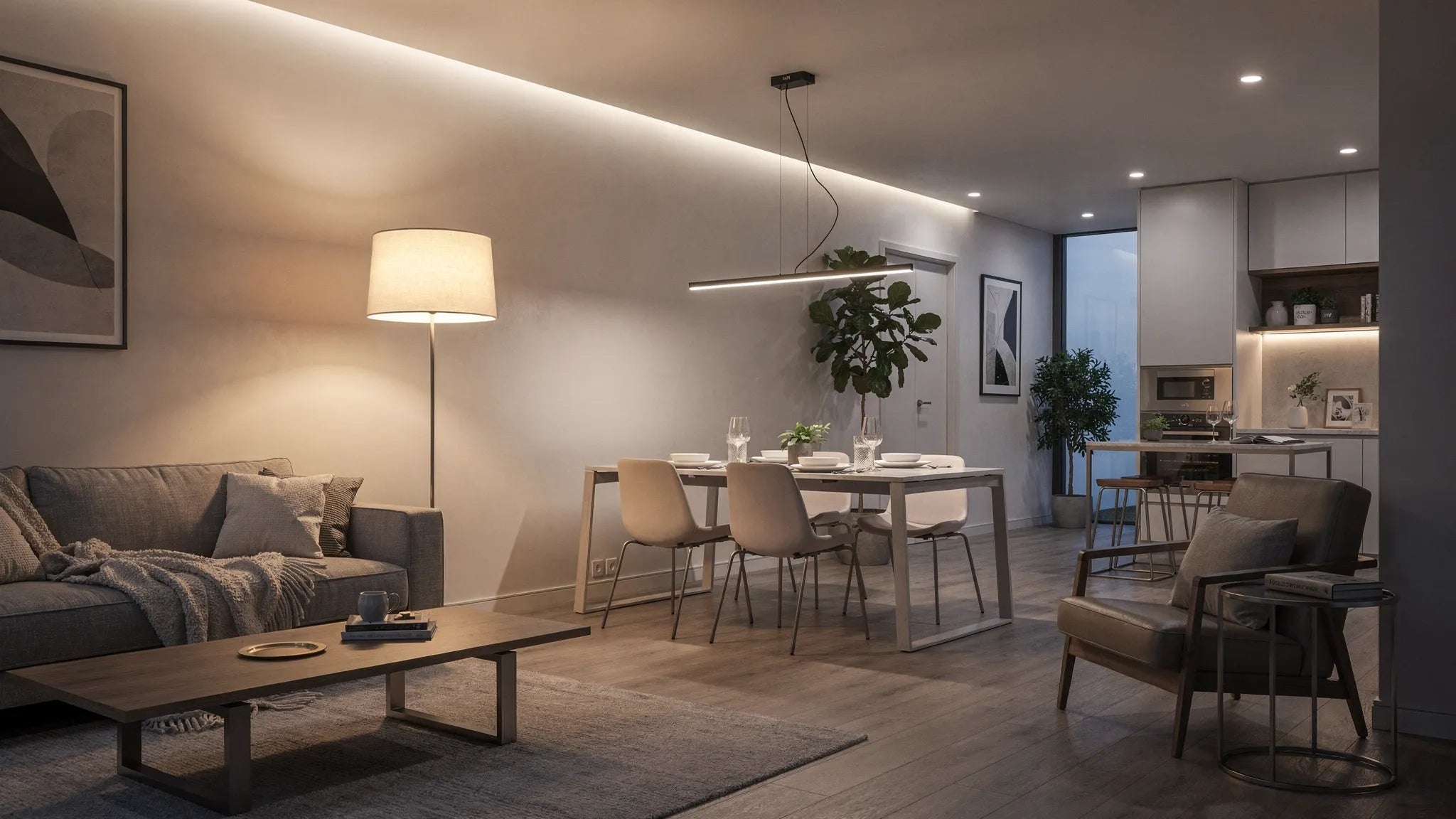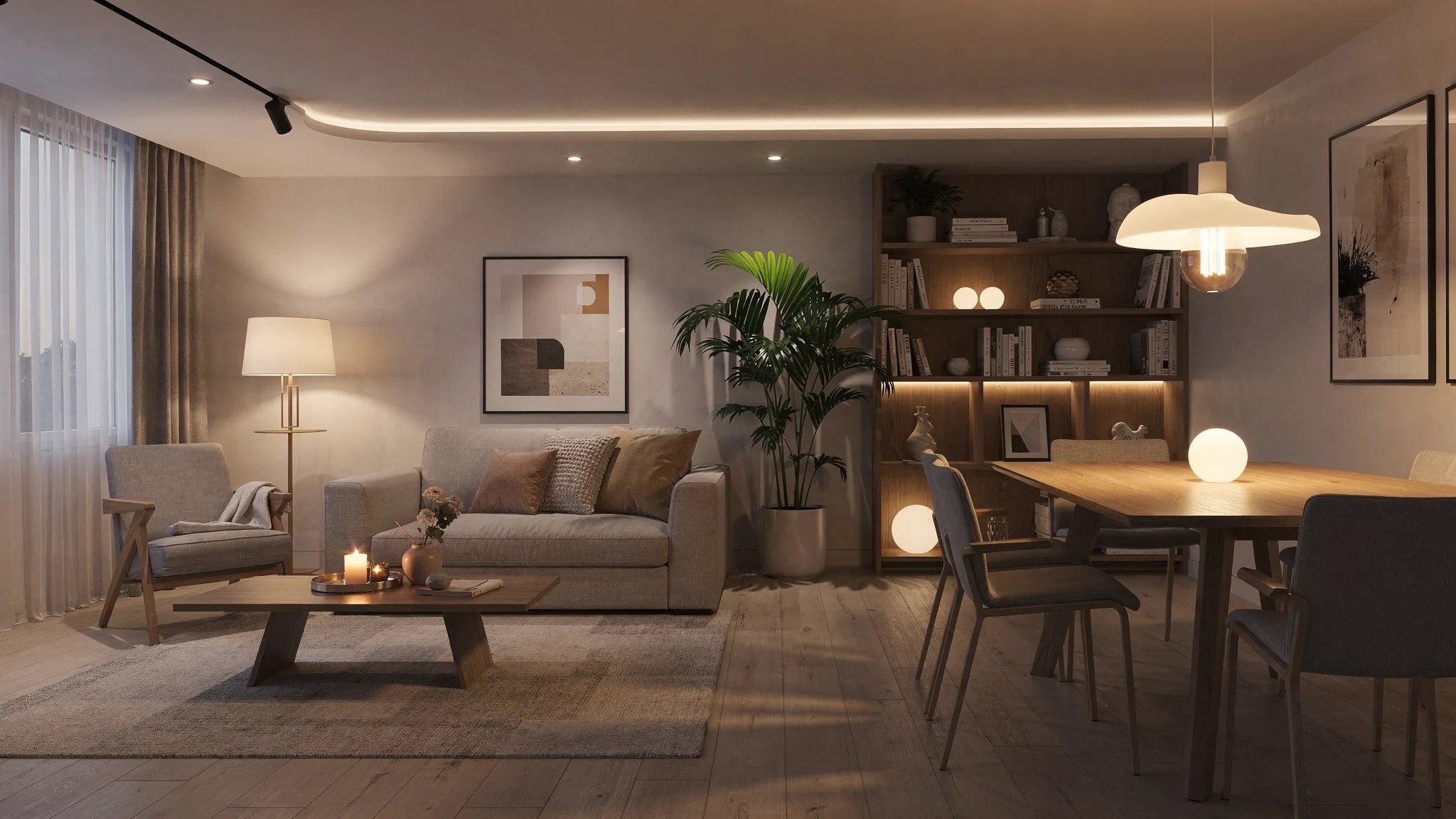
Buy an LED lamp: This is how you find the right model
Anyone today Buy LED lamp wants to have more choice than ever before, from warm living light to precise work light, from E27 classics to smart systems. However, it is precisely this variety that often leads to bad purchases: too cold, too dark, the dimmer flickers or simply does not fit the lamp.
In this guide you will get clear help in deciding which technical values are really important and how you can link them to your space, your use and your style.
LED lamp or LED light: what do you actually buy?
In everyday life, “LED lamps” are often used for both. The distinction is helpful for the selection:
- LED lamp (bulb): The replaceable “bulb” element with base (e.g. E27, E14, GU10). You need them if your lamp has a replaceable bulb.
- LED light: The complete product (e.g. pendant light, ceiling lamp, wall light) with a permanently integrated LED or with a socket.
If you are planning a designer pendant light or a chandelier, the light (look, proportions, suspension) is often the first deciding factor, followed by the right LED bulb.
The 8 most important criteria when buying LED lamps
1) Brightness: Lumens instead of Watts
Watt only tells you how much power is being used, not how bright it will be. What is crucial is Lumens (lm).
As a quick guide:
- 400 to 500 lm: more of an accent, bedside table, small zones
- 800 to 1,000 lm: typical “all-round” lamp for many rooms
- 1,500 lm and more: large rooms, multiple light points or very bright zone lighting
If you want to clearly understand the difference, this article will help: Watts and Lumens: Difference & Rules of Thumb.
2) Light color: Kelvin to match the room
The light color is in Kelvin (K) specified. It influences whether a room appears cozy or “awake”.
- 2,200 to 2,700 K: very warm, homely (living room, bedroom)
- 3,000K: warm white, more neutral (dining area, hallway)
- 4,000K: neutral white (kitchen, bathroom, housekeeping, work)
Tip: In open living areas it often appears more harmonious if you limit yourself to a maximum of two Kelvin ranges (e.g. 2,700 K in the living room, 4,000 K in the kitchen).
3) Color rendering: Do not underestimate CRI/Ra
The CRI (Color Rendering Index), often as Ra specified, describes how natural colors appear under a lamp.
- CRI 80: Standard, ok for many purposes
- CRI 90+: visibly better, ideal for living, art, wood, textiles and high-quality interiors
If you want to specifically stage images, materials or art, CRI 90+ is worth it. This also fits: Lighting for works of art: so everything stays colorfast.
4) Beam angle: spotlight or room light?
The Beam angle (Degree) decides whether light is concentrated or distributed over a wide area.
- 15 to 40 degrees: spot, accent, pictures, showcases
- 60 to 120 degrees: General light, more flat
Error pattern: You use a narrow-beam GU10 spot lamp in a ceiling light and wonder why the room appears “spotty”.
5) Dimmability: “Dimmable” is not always enough
Many LEDs are dimmable, but not every LED harmonizes with every dimmer.
Pay attention to:
- “dimmable” as a clear indication
- Notes on Dimmer compatibility (leading edge/leading edge)
- If in doubt: replace the dimmer or use system solutions (e.g. Smart).
If an LED on the dimmer flickers or buzzes, it is often due to incompatible electronics, not a “bad LED”.
6) Base and design: does the lamp really fit?
Classics are E27 and E14, in the spot area GU10.
It is also important that Design:
- A60/A67 (classic pear shape)
- Globes (G95, G125) for statement lights
- Candle mold for chandeliers
Measure before purchasing:
- maximum Length of the lamp
- diameter (otherwise it will collide with the screen or glass)
7) Protection class (IP): particularly crucial in the bathroom and outside
This counts for wet rooms IP protection class (e.g. IP44). Which IP is required depends on the zone and position.
As a safe basic logic:
- Splash water near the sink or shower: at least splash-proof
- Outdoor area: Select IP to suit rain and installation location
When it comes to outdoor solutions, it’s worth taking a look at: Lamps for the garden and outdoors: planning & safety.
8) Energy efficiency label (EU): read correctly
Since the EU changeover, many LEDs have been back in class C to F, although they are efficient. This is not a step backwards, but a step backwards rescaled rating.
If you want to go deeper: The EU explains the new scale and product information about light sources on the website European Commission on Light Sources.
Room-by-room: Which LED lamp fits where?
There is no “DIN for all apartments” for living spaces. In practice, many planners work together Lux fist values (Lux = lumens per square meter on the surface) and then set safety reserves depending on the room height, wall color and lamp position.
| space | Typical target brightness (rule of thumb) | Recommendation for selection |
|---|---|---|
| Living room | approx. 100 to 200 lx (basic light) | warm white (2,700 to 3,000 K), dimmable, preferably CRI 90+ |
| Dining area | approx. 150 to 300 lx at the table | Pendant lamp with low-glare light, possibly 2,700 to 3,000 K |
| Kitchen | approx. 300 to 500 lx on work surfaces | Neutral white (4,000 K) for better visibility, high lumens, clear shielding |
| bathroom | approx. 200 to 500 lx, more on the mirror | Note IP, neutral to warm white depending on style, good CRI |
| Home office | approx. 500 lx at the workplace | neutral white (4,000 K), low-glare, low-flicker, good glare control |
| Hallway/stairs | approx. 100 to 200 lx | even distribution, sensors if necessary |
Practical tip: Instead of using a single, very powerful LED lamp, it often appears to be of higher quality, multiple light sources to combine (basic light plus accent plus zone light). This fits as a concept article: The art of room lighting: planning light layers correctly.

Common bad purchases (and how to avoid them)
“It’s bright enough, but the room still seems dark”
This often happens with:
- too narrow beam angle
- too little indirect light
- very dark wall and ceiling colors that “swallow” light
Solution: wider beam LEDs, additional indirect light sources or wall lights. Inspiration: Indirect lighting in the living room: ideas & avoid mistakes.
“The LED is warm white, but seems somehow uncomfortable”
Warm white is not the same as warm white. 3,000 K can seem pleasant in a minimalist setting, but too neutral in a cozy bedroom.
Solution: choose 2,200 to 2,700 K in the sleeping area and definitely plan it to be dimmable.
“It flickers on the dimmer”
Mostly it is compatibility between LED driver and dimmer.
Solution: choose a dimmable LED, design the dimmer to be compatible or switch to a smart solution.
“The bulb doesn’t fit into the lamp”
Very common with globe bulbs, narrow shades or glass covers.
Solution: measure length and diameter in advance, check product data sheet.
If you buy an LED light (not just a bulb): this is also important
When it comes to pendant lights and chandeliers, it's not just the light that counts Architecture of the room.
Pay particular attention to:
- Suspension and proportions: Above dining tables, the height is crucial for eye contact and freedom from glare.
- Canopy/ceiling rosette: must remove cover and cable guide cleanly.
- Ceiling outlet and assembly: Planning is particularly worthwhile for old buildings, concrete ceilings or sloping roofs.
These guides are helpful for special cases:
- Which lighting in rooms with sloping ceilings?
- Connecting a lamp: instructions for beginners (safely)
- How do you move lamps correctly?
advantage BUYnBLUE: Have your lights adjusted free of charge
If you can't plan "off-the-shelf" pendant lights or chandeliers, customizing is often the difference between "fits somehow" and "fits perfectly".
BUYnBLUE offers one free customization for selected chandeliers and pendant lights, for example:
- Adjust cable length to your ceiling height
- Customize your canopy/canopy
- Choose color variant as desired
This is particularly practical for high ceilings, sloping ceilings or if the ceiling outlet is not ideally positioned.

Mini pre-purchase checklist
If you only save one thing, it's these questions:
- Where is the LED lamp used (basic light, zone light, accent)?
- Which light color is suitable for use (2,700 K, 3,000 K, 4,000 K)?
- How much brightness do I need (lumens) and how is it distributed (beam angle)?
- Does it have to be dimmable and is the dimmer compatible?
- Which color rendering makes sense (CRI 80 or better 90+)?
- Base and dimensions checked?
- IP protection necessary (bathroom, outdoor area)?
Frequently Asked Questions
Which LED lamp is the best for the living room? Warm white light (2,700 to 3,000 K) usually works best, ideally dimmable. Make sure you have enough lumens and a wide beam angle for even basic light, plus additional accent lights.
How many lumens do I need per square meter? This depends on the room, wall colors and usage. As a rough guideline, around 100 to 200 lux is often used for the living room, 300 to 500 lux for the kitchen and around 500 lux at the desk.
How do I recognize an LED with good color rendering? At the CRI/Ra value. CRI 80 is standard, CRI 90+ appears much more natural, especially with wood, art, textiles and high-quality interiors.
Why does my LED on the dimmer flicker? Dimmers and LED electronics are often not compatible or the LED is not dimmable. A suitable dimmable lamp or a suitable dimmer (or a smart control) can help.
Which light color makes sense in the kitchen? Many people prefer neutral white light around 4,000 K for work surfaces because it shows details more clearly. For dining areas within the kitchen, warm white can be more pleasant.
Find suitable LED lights for your home
If you don't just want to replace a light source, but are looking for a lamp that fits the room concept, it's worth taking a look at the curated range from BUYnBLUE. There you will find modern designer lights made from high-quality materials and you can purchase pendant lights and chandeliers if required Customized to your dimensions free of charge.
Browse by space and style buynblue.com or contact support if you are unsure about lumens, suspension or selection.