Living room lamps: These light zones make the room cozy
If a living room doesn't seem "cozy", it's rarely due to furniture or colors. Very often it is simple lit too evenly or too hard. A single ceiling light quickly turns a living space into a functional space, but is far from a place to arrive.
The solution are Light zones: clearly defined areas, each with its own task (orientation, relaxation, reading, accent). Once these zones work together, the room will feel warmer, calmer and more upscale without having to remodel.
Why light zones work so well in the living room
Our eyes automatically look for hierarchy in space: Where is “the center”? Where can I retire? What is important? A single, central lamp does not answer these questions. It illuminates everything equally, often throws shadows on the face and causes reflections on TV or pictures.
Instead, light zones create depth: brighter islands where activity takes place and softer transitions where calm should arise. The result appears “as planned” instead of “random”.
The 5 most important light zones in the living room (with suitable lamps)
Most living rooms can be made much more comfortable with five zones. You don't have to implement all of them, but the combination of at least three zones almost always works.
1) Basic zone: Orientation without a hospital feeling
Basic lighting ensures that the room feels safe and paths are visible. She becomes comfortable when she low-glare and dimmable is.
- Typical lamps: Ceiling light, flat LED ceiling light, rail system with wide-spreading spots
- Practical tip: It's better to do it indirectly or diffusely downwards, rather than directly into the eye
If you are unsure what size your ceiling light should be, this guide will help: Living room ceiling lamp: How to find the perfect size.
2) Sofa zone: the heart of relaxation
This is where coziness develops most quickly because we spend most of our time there. Goal is one soft, side or indirect light, which illuminates faces in a flattering way and “hugs” the room.
- Typical lamps: Floor lamps (preferably with a shade), wall lights Left and right, LED strip behind the sofa or in a shadow gap
- Rule of thumb: Light from the side or behind rather than from above
For more inspiration about soft lighting effects, you can find many ideas here: Indirect lighting in the living room.
3) Reading zone: focused but not bright
A reading corner needs light directed at the book or magazine, but without harsh contrasts. One is ideal adjustable lamp with clear light control.
- Typical lamps: Arc lamp, reading floor lamp, wall lamp with arm, table lamp on side table
- Important: The beam of light should fall on the sides, not on the face
4) TV zone: fewer reflexes, less tired eyes
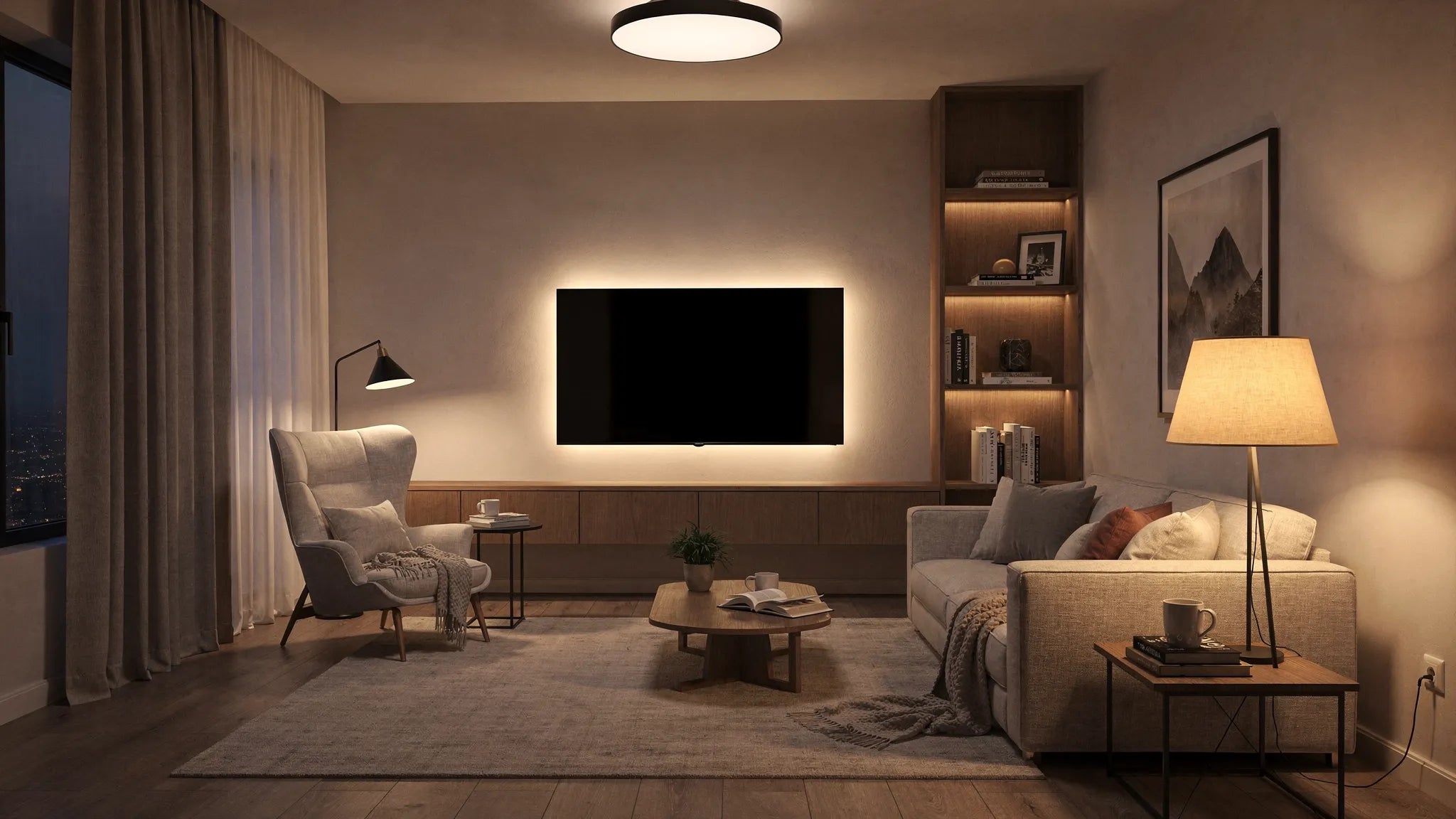
The most common mistake in the living room is strong light behind the seat or reflective lights that reflect on the screen. One is better gentle background brightness behind or next to the TV (bias lighting) so that the eye doesn't have to constantly jump between light and dark.
- Typical lamps: LED strip behind the TV, small table lamp on the side, indirect wallwasher
- Goal: No “black hole” around the screen, but no spotlight on the TV either
5) Accent zone: Make pictures, shelves, materials visible
Accent lighting is the quickest way to make the room appear “designed”. It highlights textures (wood, stone, fabric), highlights art or decoration and creates depth.
- Typical lamps: Spotlights, small wall lights, shelf lights, up and down lights
- Tip: It's better to have 1 to 3 clear accents than a little everywhere
If you want to illuminate artwork or photo walls, this article is worth it: Lighting for works of art.
Which color of light makes a living room really cozy?
For living rooms is usually warm white light perceived as pleasant. Technically this is the color temperature in Kelvin.
- 2,700 to 3,000K: classic warm, very homely (ideal for sofa, accents, evening)
- 3,000 to 3,500K: a little clearer, good for basic light if you don't like it too yellow
If you want to go deeper: What is Kelvin and what does this number mean?.
Also important for feel-good light in the evening: blue, very cool light can delay tiredness. The background to this describes, for example Harvard Health Publishing in the context of blue proportions and sleep.
How bright should it be? (Lumen rough, but practical)
There is rarely “one” right level of brightness in the living room. What matters is that you Scenes can produce: bright enough to tidy up, soft enough to switch off.
Helps as a guide:
- Basic light: rather moderate, but dimmable
- Reading zone: significantly brighter in place, but locally limited
- Accents: less lumens, but targeted
To calculate by area (lux and lumens), this article is helpful: Lumen briefly explained.
Plan light zones in 20 minutes (without floor plan perfection)
You don't need a professional tool. Take 20 minutes in the evening when it's dark outside.
- Sofa, TV, reading area, mark passages: Where are you really sitting? Where do you run? Where does glare bother you?
- Define a light source per zone: First function, then design. A good floor lamp can do more than the third decorative lamp.
- Consider dimming as a requirement: If there's only one upgrade, it's dimmability. This immediately turns “bright” into “atmosphere”.
- Test hard shadows: Sit on the sofa. Are you looking into a light source? Do shadows appear on the face? Then change the light position (sideways, higher, more indirect).
- Accents last: Only when the basic, sofa and functional lighting are right do accents make the room truly elegant.
Before and after: This is how a living room changes with light zones
Here is a typical scenario from practice that affects many apartments.
Before: a ceiling lamp, everything was equally bright
- The ceiling light is in the middle and shines strongly downwards.
- The sofa and walls appear flat, corners disappear dark.
- TV evenings are exhausting because either everything is too bright or the room is completely dark.
- The room feels “unfinished” even though furniture is high quality.
After: three zones are enough for comfort
- Basic zone: Ceiling light dimmed to 30 to 50 percent for orientation.
- Sofa zone: Floor lamp with shade (warm white) on the side behind the sofa for soft light.
- TV zone: Indirect light behind the TV (LED strip or small light) for relaxed eyes.
The effect is immediate: the living room gains depth, faces appear more pleasantly lit, and the room automatically feels quieter in the evening.
| aspect | Before (ceiling light only) | After (light zones) |
|---|---|---|
| spatial effect | flat, “functional” | deep, homely, structured |
| Comfort in the evening | often too light or too dark | dimmable, scenically controllable |
| TV | Reflexes, strong contrasts | gentle background brightness |
| mood | little atmosphere | warm islands and accents |

Common mistakes with lamps in the living room (and the quick fix)
Mistake 1: “A strong lamp is enough”
Correction: It is better to combine several weaker light sources. This is almost always more comfortable than a single, dominant light.
Error 2: Light sources in the field of vision
Correction: Change screens, indirect radiation or position. When you see the light source, it rarely feels comfortable.
Mistake 3: No light hierarchy
Correction: Determine what the star is (sofa, art, fireplace, statement light). The rest are supportive.
Mistake 4: Pendant light hangs “somehow”
Correction: Adjust height and canopy to suit room and furniture. Particularly with high ceilings or offset seating areas, the suspension determines proportion and effect.
If you need to reposition lamps, here is a safe way to do it: How do you move lamps correctly?.
Which types of lamps suit which zones? (brief overview)
| Light zone | Target | Suitable lamps | Recommended mood |
|---|---|---|---|
| Base zone | Orientation, “base” | Ceiling light, flat LED, spots | warm white to neutral-warm, dimmable |
| Sofa zone | Relaxation, conversations | Floor lamps with shade, wall light | warm white, soft, lateral/indirect |
| Reading zone | focused light | Reading floor lamp, arc lamp | warm white to neutral-warm, directed |
| TV zone | relaxed eyes | indirectly behind TV, small light | warm white, low brightness |
| Accent zone | Depth, highlights | Spotlights, shelf lights, up/down | warm white, targeted, little glare |
If the lamp is perfect but “doesn’t fit”: adaptation instead of compromise
In real living rooms, beautiful lamps often collide with reality: ceilings that are too high, crooked connections, open floor plans, awkward furniture positions.
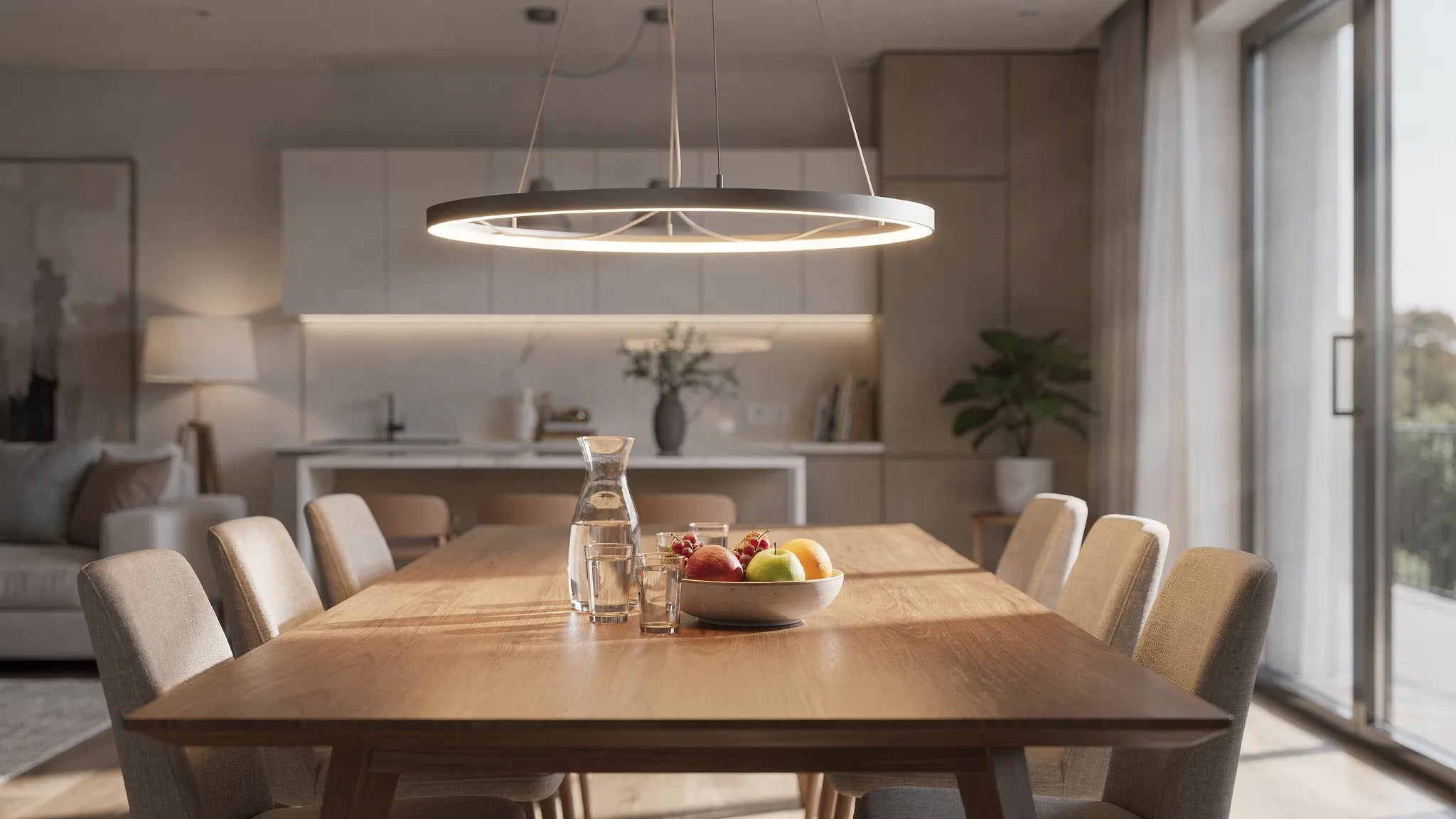
Just at Pendants and chandeliers It is therefore not only the design that decides, but also whether details can be adjusted, for example cable length, canopy or color. BUYnBLUE offers one here free customization for selected models so that the luminaire fits the room height and the planned zone (instead of the other way around). Additionally there is free shipping worldwide and a 14 day return policy. Details can be found directly in the shop: BUYnBLUE.
Conclusion: Coziness does not come from more light, but from better light
When you look at “living room lamps”, you are probably not looking for just any lamp, but rather a result: relaxing in the evening, being flexible during the day, and a feeling of space that is right.
Sit up first 3 light zones (Reason, sofa, function such as reading or watching TV). Then add accents. With this order, the living room almost always immediately appears calmer, warmer and more high-quality, without any renovation.