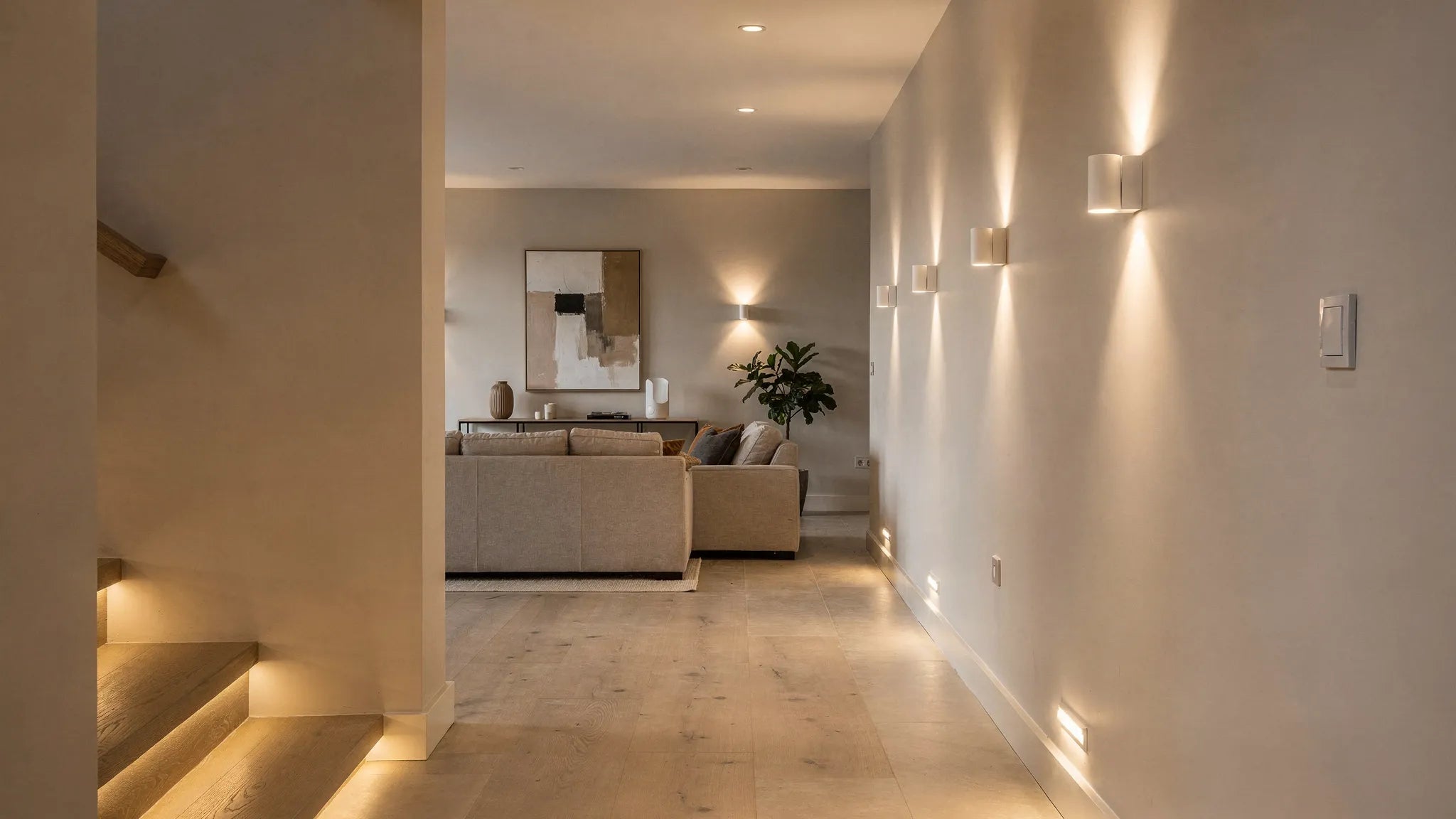
Bathroom ceiling light: warm white or neutral white better in everyday life?
The short answer: For the central bathroom ceiling light, neutral white is usually the more practical choice in everyday life, especially in the morning, when cleaning, shaving, applying makeup and in bathrooms without much natural light. Warm white is better for relaxation, for example when bathing in the evening or if you want the bathroom to look more like a small wellness area.
However, the best solution is rarely either/or. In a modern bathroom, the combination of neutral white ceiling light, high-quality mirror lighting and warm white, dimmable accent light often works most pleasantly. This means the bathroom remains functional, but does not appear cold or clinical.
Warm white and neutral white: what does that mean in the bathroom?
The light color is given in Kelvin (K). The lower the Kelvin value, the warmer and yellower the light appears. The higher the value, the cooler and whiter it becomes. If you want to go deeper into the topic, he explains BUYnBLUE-Guide what Kelvin means for lamps the basics in detail.
These areas are particularly relevant for bathrooms:
| light color | Typical Kelvin range | Effect in the bathroom | Particularly suitable for |
|---|---|---|---|
| Warm white | approx. 2,700 to 3,000 K | cozy, soft, relaxing | Bathtub, evening routine, guest toilet, spa atmosphere |
| Neutral white | approx. 3,500 to 4,000 K | clear, fresh, natural | Ceiling light, close to mirrors, family bathroom, windowless bathrooms |
| Cool white or daylight white | from around 5,000 K | very bright, objective, activating | rarely in the bathroom, more for technical rooms or special applications |
Important: Light color is not the same as brightness. A warm white light can be very bright, a neutral white one can be too dark. For a good bathroom ceiling light, color temperature, lumens, color rendering, radiation and safety must match.

Why neutral white often works better in everyday life
Neutral white light between around 3,500 and 4,000 K comes closer to natural daylight than classic warm white, without appearing as harsh as cold white light. This is precisely why it is particularly suitable for activities where you have to recognize details.
In the morning, neutral white ceiling light helps you wake up more quickly and perceive the room clearly. This is practical in the bathroom because many routines require precise vision: inserting contact lenses, applying skin care, checking beard contours, styling hair or adjusting make-up. When the light is too warm, colors can appear more yellowish, causing skin tones, foundation or clothing to look different than they would later in daylight.
Neutral white is also beneficial for cleaning. Limescale stains, water residue and dust on light-colored tiles are usually more easily visible under 3,500 to 4,000 K than under very warm, muted light. Especially in windowless bathrooms or small indoor bathrooms, a neutral white ceiling light creates more freshness and orientation.
Neutral white is therefore the pragmatic choice if the bathroom is used daily as a functional room. It looks clean, activating and reliable, without automatically having to be uncomfortable. It is crucial that the lamp is low-glare and does not work with excessive brightness.
When warm white is the better choice
Warm white light between 2,700 and 3,000 K brings comfort to the bathroom. It makes materials such as wood, natural stone, brass, beige and sand tones appear particularly homely. If you use your bathroom less as a functional space and more as a place to retreat, warm white is often more pleasant.
This is especially true in the evening. Bright, blue light can activate the body more. Harvard Health Publishing points out that blue light in the evening can influence the sleep-wake cycle. Warm white, dimmed light is usually more comfortable for a late shower, brushing your teeth before going to bed or a relaxing bath.
Warm white is also ideal if your bathroom already has good daylight and the ceiling light is primarily intended to create atmosphere. In a bright, daylight bathroom, 3,000 K can appear very natural. In a small guest bathroom that is only used for a short time, the light does not have to be as analytical as in the main bathroom.
The limit of warm white becomes apparent in precision tasks. If there is only one central warm white ceiling light, the bathroom can appear cozy in the evening, but appear too yellowish and not fresh enough in the morning. That's why warm white in the main bathroom is best combined with a separate mirror light or a dimmable solution.
The best solution: neutral white on top, warm white for atmosphere
If you are planning a new bathroom or replacing an existing light, you should not just look at the individual ceiling light. A good lighting concept in the bathroom consists of several tasks: general orientation, good visibility in the mirror, safety in wet areas and a pleasant atmosphere.
This principle works well for many households:
| area in the bathroom | Recommendation | Why it works |
|---|---|---|
| Central ceiling light | 3,500 to 4,000 K, low-glare | ensures clear basic brightness in everyday life |
| Mirror area | 3,500 to 4,000 K, CRI/Ra at least 90 | shows skin tones and tones more naturally |
| Bathtub or niche | 2,700 to 3,000 K, dimmable | creates calm and wellness effect |
| Night orientation | very warm, dimmed low | prevents bright light at night |
If you only want to install one light, a dimmable or color temperature-adjustable model is particularly useful. Depending on the version, tunable white lights allow you to switch between warm white and neutral white. This means you can use clearer light in the morning and softer lighting in the evening.
Even better is a separate circuit: the ceiling light takes care of the basic brightness, the mirror lighting takes care of the precision, and the accent light takes care of the mood. This thinking in layers of light is also reflected in... BUYnBLUE-Contribution Plan LED lighting: 3-layer light for the entire home explained.
Which light color suits which bathroom?
The right decision depends largely on the room. A large bathroom with natural light has different requirements than a small interior bathroom with white tiles.
Windowless bathroom
In a windowless bathroom, neutral white is almost always the better basis. Without daylight, warm white can quickly appear heavy, yellowish or somewhat dark. A bathroom ceiling light with around 3,500 to 4,000 K brings more clarity to the room. To prevent it from becoming sterile, warm white wall lights, indirect LED strips or dimmable niche lighting can be added.
Small bathroom or guest toilet
In small bathrooms, every detail counts. A light color that is too cold can create harsh shadows and an uncomfortable effect. A good midpoint is often 3,000 to 3,500 K. For a guest toilet that is used less for care tasks, warm white light is often sufficient and particularly inviting.
Family bathroom
A family bathroom needs to function in the morning and relax in the evening. Neutral white is very practical as a ceiling light here because several people have different routines. Add warm white, dimmable lighting for the evening routine so that the bathroom doesn't look the same all day.
Designer bathroom with stone, wood or dark surfaces
Dark materials absorb more light than light tiles. That's why a designer bathroom with dark stone, wooden fronts or matt surfaces often needs more lumens and a clear light color. Neutral white can appear elegant and precise here. Warm white is also suitable for accents to give natural materials depth.
Wellness bath
If relaxation plays the main role, warm white can dominate. Nevertheless, there should at least be a more neutral, true-color light on the mirror. A pure 2,700K bath looks beautiful in the evening, but can be inconvenient when it comes to skin care and makeup in the morning.
Brightness, CRI and glare are just as important as Kelvin
Many bad purchases occur because people only choose warm white or neutral white. In practice, three other values are at least as important.
First: the brightness. For general bathroom lighting, around 200 to 300 lux often makes sense as a guide. The required lumens are roughly calculated from the room area times the desired lux number. A 6 m² bathroom requires around 1,500 lumens for 250 lux. Since the luminaire cover, room colors and beam angle can absorb light, a planning surcharge makes sense.
Second: color reproduction. A high CRI or Ra value is crucial for mirror proximity, make-up and skin care. If possible, look for CRI 90 or higher. A neutral white light with weak color rendering is less helpful for the mirror than a good LED with natural color rendering.
Third: glare. Ceiling light in the bathroom can be particularly unpleasant if you look up sleepily in the morning or lie in the bathtub. Opal covers, indirect light components, wide beam angles and dimmability help to avoid harsh light spots.
Don't forget security: IP protection before design issues
Electricity, moisture and splash water come together in the bathroom. That's why the light color is not the first safety criterion. It is crucial that the lamp is suitable for the respective area. Depending on the distance and zone, different requirements may apply over the shower, bathtub and sink than in drier areas of the room.
If you are unsure, check the appropriate IP protection rating before purchasing and, if in doubt, have electrical work carried out professionally. The provides helpful guidance BUYnBLUE-Article too IP protection classes in the bathroom. The guide is also worthwhile for holistic planning Which bathroom lighting is the right one?.
Decision support: warm white or neutral white?
If you want to make a quick decision, this simple rule will help: Neutral white is better for everyday life and precision, warm white is better for calm and atmosphere.
| Usage situation | Better choice | Justification |
|---|---|---|
| Get ready in the morning | Neutral white | appears clearer and supports precise nursing tasks |
| Putting on makeup or shaving | Neutral white with high CRI | Colors and contours appear more natural |
| Relaxation bath in the evening | Warm white | calms and appears more homely |
| Windowless bathroom | Neutral white | replaces daylight better and looks fresher |
| Guest toilet | Warm white or 3,000 K | short stay, inviting effect counts |
| Family bathroom | Neutral white plus warm additional light | flexible for different routines |
If you don't want to commit, choose 3,000 to 3,500 K as a compromise or a light with adjustable color temperature. 3,000 K appears more homely, 3,500 K appears a little clearer. 4,000 K is very functional, but should be combined with good materials and a low-glare design so that the bathroom does not appear too objective.
Common mistakes with bathroom ceiling lights
A common mistake is a single bright ceiling light in the middle of the room. Although it creates brightness, it often creates shadows on the face, especially when you stand in front of the mirror. This makes the bathroom appear brighter than it is actually usable.
A second mistake is too warm light throughout the room. This looks cozy in photos, but can be inconvenient in the morning. Especially for make-up, skin care and colored textiles, 2,700 K is often too yellow as the sole light color.
A third error is cold white light over 5,000 K in the bathroom. It can be very activating, but also hard, flat and uncomfortable. Cold white is rarely necessary for private bathrooms.
Just as important: Dimmability and circuits are often planned too late. If you can switch ceiling lights, mirror lights and accent lights separately, you get significantly more comfort from the same lights.
Conclusion: What is better in everyday life?
For everyday bathroom ceiling light is Neutral white between 3,500 and 4,000 K is the better choice in most cases. It provides clear visibility, supports care tasks and brings freshness to windowless or heavily used bathrooms.
Warm white is still important. It makes the bathroom more homely, fits into the evening routine and creates a wellness atmosphere. A flexible lighting concept is therefore ideal: neutral white, low-glare ceiling light as a functional basis, true-color mirror light for details and warm white, dimmable light for relaxed moments.
This means you don't have to choose between practical and comfortable, but you get a bathroom that works at any time of the day.
Frequently asked questions about bathroom ceiling lights
Is warm white wrong in the bathroom? No. Warm white is particularly pleasant in the bathroom for relaxation, guest toilets and evening routines. However, as the only light color in the main bathroom, it can appear too yellowish when grooming, shaving or making up.
Which Kelvin number is ideal for a bathroom ceiling light? For everyday use, 3,500 to 4,000 K usually makes sense. If you like it more comfortable, choose 3,000 to 3,500 K or a dimmable lamp with adjustable color temperature.
Is 4,000 K too cold in the bathroom? Not necessarily. 4,000 K appears clear and functional, especially in windowless bathrooms. To ensure that it does not appear sterile, the lamp, materials and additional warm light sources should be well coordinated.
Which light color is suitable for the mirror? On the mirror, 3,500 to 4,000 K with high color rendering is ideal. If possible, pay attention to CRI or Ra 90 and to lateral or even lighting so that no harsh shadows are created.
Does every bathroom light need a high IP protection class? Not every luminaire needs the same type of protection. The requirements depend on the position in the bathroom and the distance to the shower, tub or sink. In wet areas you should carefully check the appropriate IP class.
Find the right light for the bathroom
Whether warm white, neutral white or flexibly adjustable: at BUYnBLUE You will find a curated selection of modern designer lights for stylish living areas. When choosing for the bathroom, pay particular attention to light color, brightness, color rendering, lack of glare and appropriate protection class.
If you are planning a harmonious lighting concept for your bathroom or adjacent living areas, discover the modern lights BUYnBLUE. You benefit from high-quality workmanship, free worldwide shipping, secure payment options, tracking and a 14-day return policy.