Ceiling lamp design: What matters when it comes to shape and light
A ceiling lamp is rarely just a light source. It sits in one of the most visible places in the room, shapes the line of sight and decides whether an interior appears calm, spacious, homely or deliberately dramatic. That's exactly why it's worth considering the topic Ceiling lamp design Not just looking for a beautiful object, but also looking at shape and lighting effect together.
A good design always answers two questions at the same time: Does the lamp fit the room formally, and does it produce the light that you really need there? A sculptural pendant lamp can look spectacular above the dining table, but be distracting in the hallway. A flat ceiling light can be ideal in low rooms, but look visually lost in a tall old building. The key lies in the balance between proportion, material, light distribution and suitability for everyday use.
Why form and light are inseparably linked
Many purchasing decisions start with the look: round or linear, minimalist or eye-catching, black, brass, glass or white. This is understandable, because a ceiling lamp is part of the furnishings. But the shape not only determines the style, but also how light enters the room.
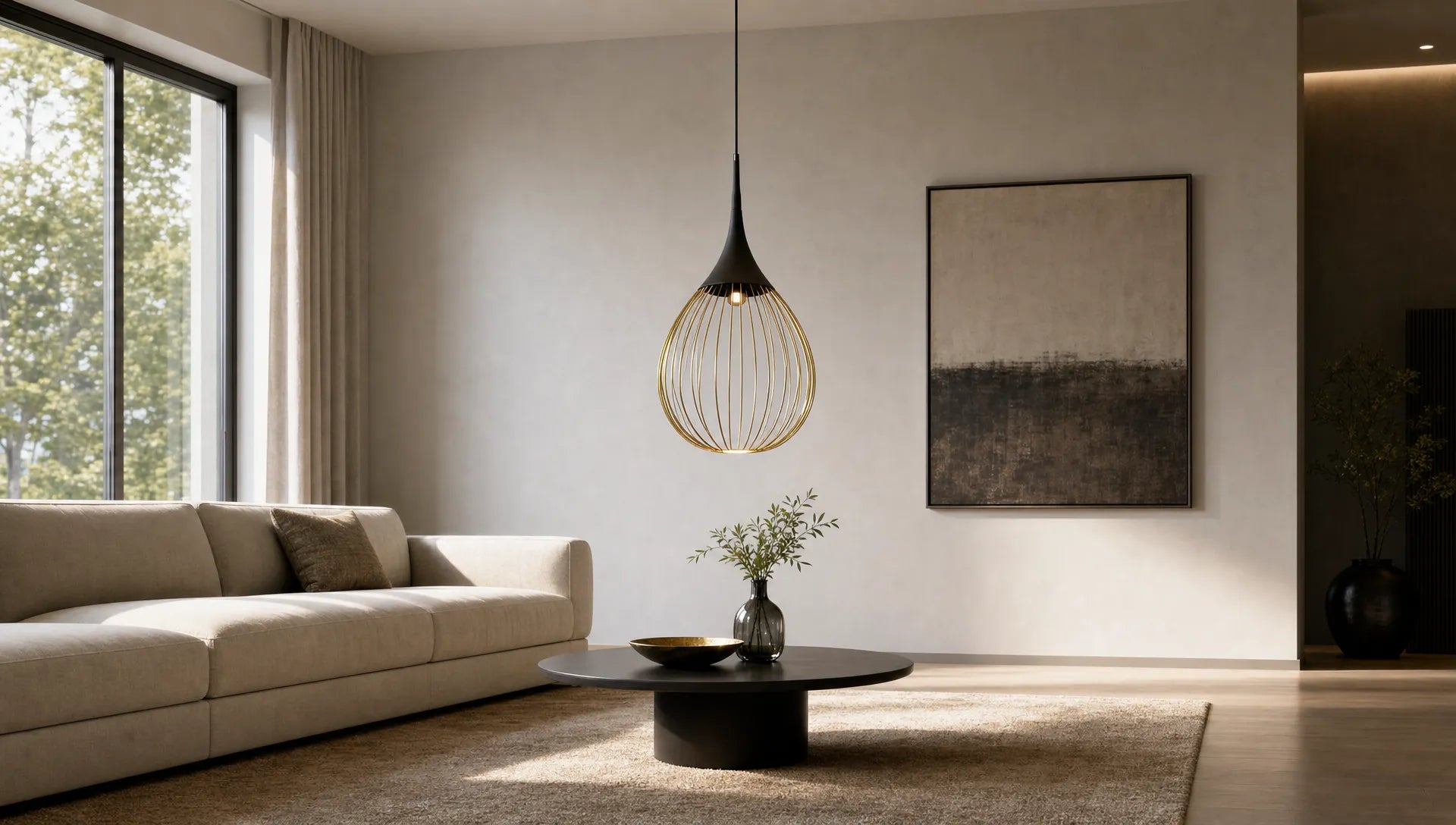
A closed, opal sphere diffuses light softly in all directions. A narrow, downward-facing shade concentrates light onto a surface. A linear lamp body emphasizes long tables, kitchen islands or hallways. A multi-light chandelier creates spatial depth and can structure a high room. The design is not a decorative addition, but rather a functional part of the lighting planning.
This connection is particularly important in open living areas. There, a ceiling lamp often takes on several tasks: it marks a zone, complements the furnishing concept and provides basic or accent light. If you look at form and light separately, you risk either a beautiful but impractical lamp or a functional solution that weakens the feeling of space.
The most important shapes and their effect in space
The right shape depends on the size of the room, ceiling height, furniture arrangement and the desired atmosphere. There is no universally best ceiling lamp, but there are shapes that support certain rooms particularly well.
| Shape of the ceiling lamp | Typical effect | Suitable for | Light character |
|---|---|---|---|
| Flat and close to the ceiling | Quiet, unobtrusive, space-saving | Hallway, bedroom, low rooms | Even, often diffuse |
| Round or spherical | Soft, harmonious, homely | Living room, bedroom, dining area | Spread all around or gently bundled |
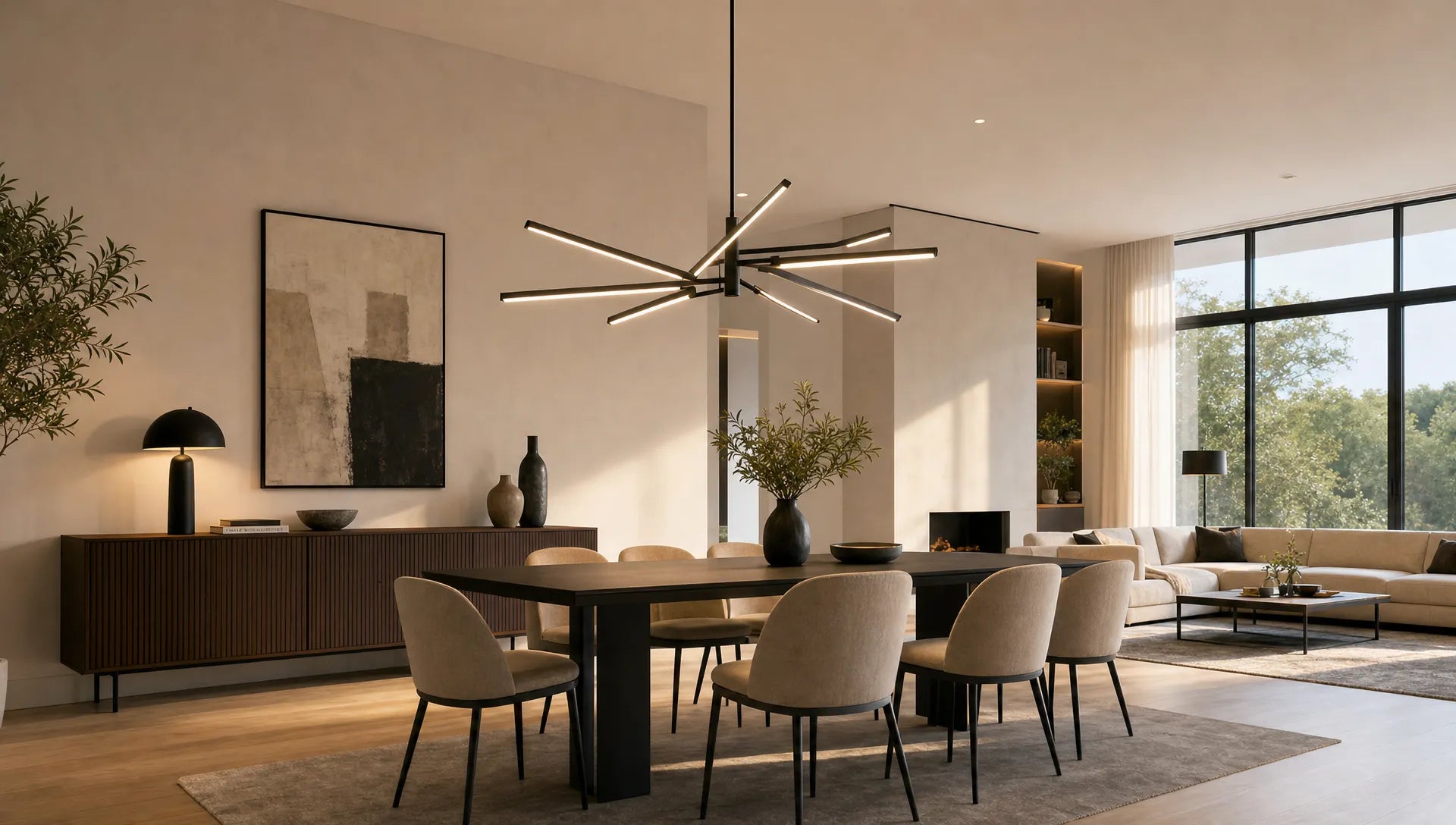
| Linear | Modern, orderly, architectural | Dining table, kitchen island, long hallway | Directed light along an axis |
| Multi-flame | Expressive, dynamic, decorative | Living room, high ceilings, dining room | Multiple points of light, often spatially vivid |
| Sculptural | Striking, art object-like, individual | Representative living areas | Depending on the design, diffuse, direct or mixed |
Round shapes often have a balancing effect, especially in rooms with lots of straight lines. Linear lights create order and are ideal when furniture is also clearly aligned. Sculptural designs work best when they are given enough space and don't compete with too many other eye-catchers.
A common mistake is to only judge the luminaire in isolation. A model can look perfect in the showroom or online shop, but appear too small, too large or too dominant in your own room. Therefore, always check what role the ceiling lamp should take on: should it be reserved, divide the room or consciously act as the focal point?
Light quality: These values make the difference
You can recognize good light not only by its brightness. Several properties are crucial for living spaces, which together shape the visual result.
Brightness is usually described using lumens. As a rough guide, living rooms require less light than kitchen work surfaces or home office areas. However, it is not just the lumen specification of the lamp that is important, but also how much light actually reaches where it is needed. Dark wall colors, high ceilings, highly directional shades or tinted glasses can significantly change the perceived brightness.
The color temperature influences the mood. Warm white light around 2700 to 3000 Kelvin has a homely and relaxing effect. Neutral white light around 3500 to 4000 Kelvin appears more objective and can be useful in kitchens, work areas or dressing rooms. Very cool light is often perceived as technical in living areas, but can be used consciously in functional rooms.
The color rendering index, often given as CRI or Ra, describes how natural colors appear under a light source. For living spaces, at least Ra 80 is common; for high-quality interiors, art, textiles, wooden surfaces or make-up areas, Ra 90 or higher is recommended. Especially with designer lights, the quality of light should match the quality of the material.
Glare also plays a big role. A lamp can be bright and still appear unpleasant if the light source falls directly into the eye. Diffusers, shielded LEDs, indirect light components or correctly positioned suspensions significantly improve visual comfort.
Use direct, indirect and diffuse light correctly
Direct light falls specifically on a surface. It is useful above dining tables, kitchen islands, work zones or reading areas. The advantage lies in the precision: the light reaches where it is needed. The disadvantage: If the height is wrong or the contrast is too strong, it can dazzle or create harsh shadows.
Indirect light is reflected via the ceiling or wall. It appears soft, spacious and pleasant, especially in living rooms or bedrooms. However, indirect light needs bright reflection surfaces and sufficient power, otherwise the room remains too dark.
Diffused light is distributed evenly. It is well suited for basic lighting, hallways, children's rooms and rooms where no single surface needs to be emphasized. Diffused light is comfortable, but can appear a bit flat without additional accents.
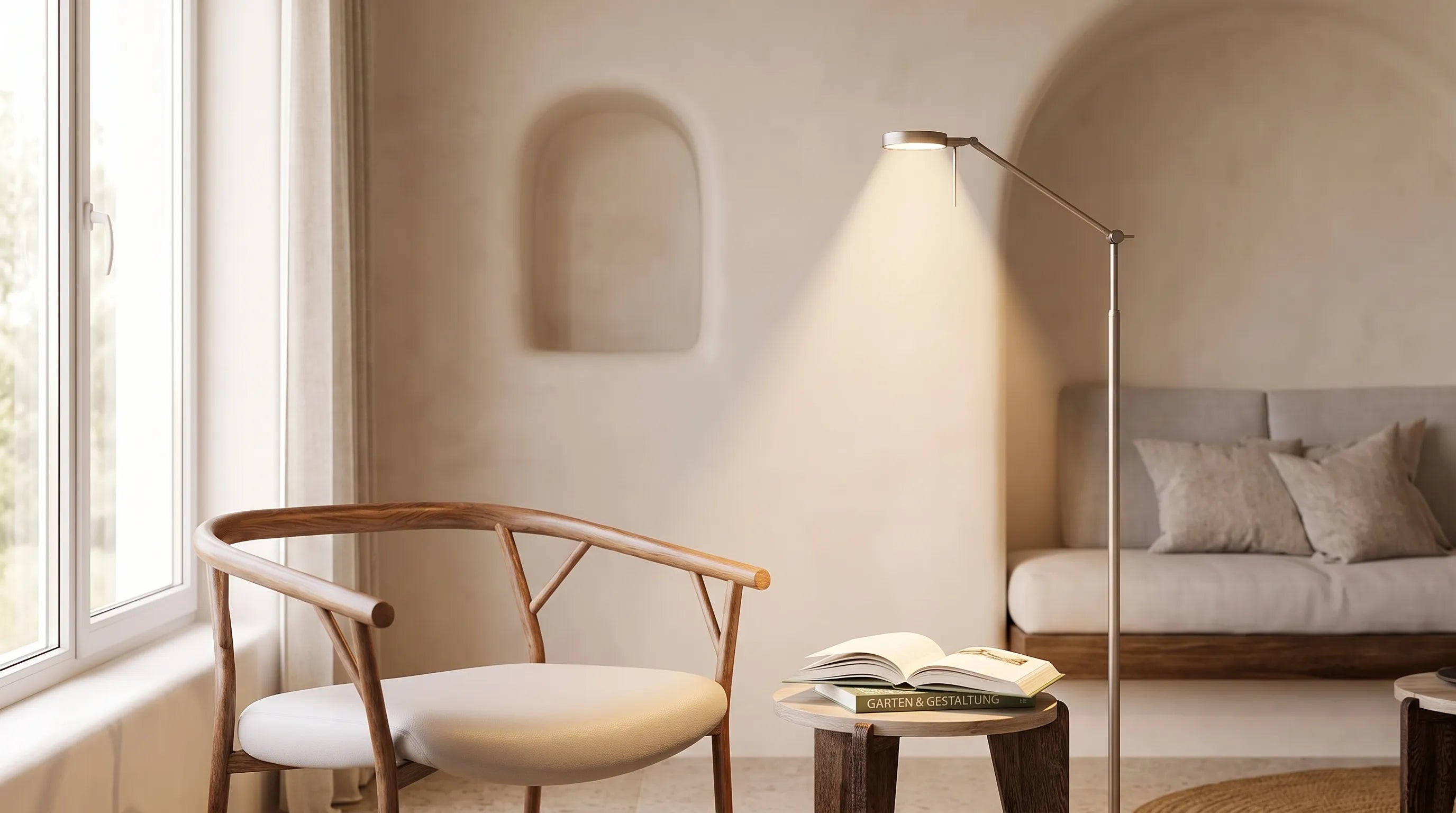
In high-quality living concepts, the best effect is usually achieved through combination. A ceiling lamp provides basic light or sets a focus, while floor, table or wall lamps add depth. This creates a light image with several levels, instead of just one bright center on the ceiling.
Proportions: When does a design appear harmonious?
Even the most beautiful lamp loses its effect if the proportions are not right. A ceiling lamp that is too small appears random, while one that is too large can visually overwhelm the room. The suspension is also crucial, especially for pendant lights.
A lamp can be more present above a dining table because the table and lamp together form a zone. On the other hand, there should be enough headroom in walking paths. In low rooms, flat or half-height designs are often better than long pendants. In high rooms, lower suspension can help make the room more comfortable.
If you would like to calculate specific dimensions, diameters and suspensions, the additional guide on how to do one is worth it Choose a lamp for the ceiling based on diameter, height and light distribution. The following also applies to the design itself: A lamp should not only fit mathematically, but also visually harmonize with the width of the furniture, the volume of the room and the visual axes.

Materials and surfaces: How they change light
When it comes to ceiling lamp design, materials are more than just a question of style. They filter, reflect or absorb light and thereby change the atmosphere.
Glass can appear light and elegant. Clear glass shows the light source and is suitable for decorative lamps or delicate designs, but dazzles more quickly. Opal glass diffuses light more softly and is ideal when a calm, even effect is desired.
Metal brings precision and contour. Matt surfaces appear more reserved, shiny surfaces reflect more and can add luxurious accents. Black lights emphasize the graphic shape, while light or metallic surfaces often integrate more easily into bright rooms.
Textile shades create a soft, homely light. They go well with bedrooms, dining areas or cozy living areas. Natural materials such as wood, rattan or bamboo bring warmth, but often create shadow patterns and let in less light than glass or open structures.
When it comes to designs that heavily emphasize materials, you should always ask: Should the lamp provide a lot of light, or is its atmospheric effect the main focus? Both are possible, but not every material fulfills both tasks equally well.
Room by room: Which design decision makes sense
Every room has different requirements in terms of shape and light. A ceiling lamp in the bedroom must calm, one in the dining room can set the scene, one in the hallway should provide orientation.
| space | Design goal | Recommended lighting effect | Common mistake |
|---|---|---|---|
| Living room | Atmosphere and zoning | Warm, dimmable, often combined with accent lighting | Use only a central light source |
| Dining room | Focus on the table and socializing | Directly downwards, low-glare, warm white | Choose a light that is too high or too small |
| Kitchen | Function and clear view | Brighter, even, complementary to work light | Designer lighting does not completely replace work lighting |
| bedroom | Peace and comfort | Soft, warm, low-glare | Light that is too cool or too direct |
| hallway | Orientation and spatial effect | Uniform, sufficiently bright | Too decorative, but not enough light |
| bathroom | Safety and function | Clear, low-glare, observe appropriate protection class | Choose a luminaire without taking moisture areas into account |
In the living room, an eye-catching ceiling lamp is particularly effective if it is part of a lighting concept. In the dining room, the shape should reflect the table: round to round, linear to rectangular is a simple but often convincing rule. In the kitchen, design must not come at the expense of visibility. Here it makes sense to combine decorative ceiling lighting with targeted work light.
Visible lights and harsh contrasts should be avoided in the bedroom. Hallways benefit from clear shapes that do not hang too low and are illuminated evenly. In the bathroom, additional requirements apply to the protection class and installation area, which is why technical suitability must be checked in addition to design.
Style: Modern does not automatically mean minimalist
Modern ceiling lamp design is often equated with reduced lines. That's only part of the truth. Modern can be minimalist, organic, luxurious, industrial or soft and homely. What is crucial is that the lamp consciously communicates with the room.
In minimalist rooms, a very simple lamp can have a consistent effect, but a sculptural individual piece can also create tension. Modern lights work particularly well in classic old apartments if they do not imitate the historical setting, but rather contrast it. In warm, natural interiors, organic shapes and matt surfaces are often more harmonious than high-gloss, technical designs.
Anyone who considers modern ceiling lighting as a design element will find further inspiration in the article above modern ceiling lamps for stylish living spaces. But it remains important: style should never be chosen in isolation. A luminaire must suit the space, use and lighting requirements.
Adjustment: The underestimated factor in designer lights
Especially with high-quality ceiling lamps, the adjustment often determines whether a design really looks perfect. Standard dimensions do not always fit real spaces. Ceiling heights differ, power outlets are not always exactly in the middle, dining tables are placed differently than originally planned, and color concepts evolve during renovation.
That's why customization is a real advantage. At BUYnBLUE Chandeliers and pendant lights can be adjusted free of charge, for example in terms of cable length, canopy or color. This is particularly helpful if a lamp above a table needs to be adjusted exactly to eye level, furniture position and room proportions.
Before purchasing you should check the following points:
- The actual ceiling height and the desired lower edge of the light.
- The position of the power outlet in relation to the table, sofa or kitchen island.
- The desired lighting effect, i.e. direct, indirect, diffuse or combined.
- The surfaces in the room, as light walls reflect light more than dark ones.
- The existing lights so that the new ceiling lamp becomes part of an overall concept.
Adjustment does not replace lighting planning, but it turns a good luminaire into a tailor-made solution. This is a big difference, especially with open floor plans and individual room layouts.
Checklist for choosing a designer ceiling lamp
Before you decide on a model, a quick reality check will help. It prevents a design from only being convincing in photos but not working in everyday life.
| Question | Why it is important |
|---|---|
| What task does the light perform? | Basic light, focus light and decoration require different forms. |
| How high is the ceiling? | The height determines comfort, proportion and headroom. |
| What furniture is underneath? | Tables, sofas or islands often dictate the shape and size. |
| Is the light dimmable? | Dimming increases flexibility between everyday life, work and atmosphere. |
| How does the material work when the light is switched on? | Some materials change color, shadow and glare significantly. |
| Does the lamp fit other light sources? | A harmonious feeling of space is created by multiple levels of light. |
A good purchase does not begin with the question “Which lamp do I like?”, but rather with “What effect should the room have?” The design, size and lighting technology can then be selected much more clearly.
Frequently asked questions
Which ceiling lamp suits a modern living room? Depending on the height of the room, flat designer ceiling lights, sculptural pendant lights or multi-bulb models are suitable for modern living rooms. It is important that the lamp does not remain the only source of light. Ideally combine them with floor, table or wall lamps to create depth and atmosphere.
Which light color is ideal for a ceiling lamp in the living area? In living and sleeping areas, warm white light of around 2700 to 3000 Kelvin usually has a pleasant effect. Neutral white light around 3500 to 4000 Kelvin can be useful for kitchens, dressing rooms or work areas if clarity and concentration are more important than comfort.
Should a designer ceiling lamp be dimmable? Yes, if the room is intended to cover multiple situations. Dimmable light is particularly helpful in the living room, dining room and bedroom because you can switch between bright general lighting and a relaxed evening atmosphere. Make sure that the lamp, bulb and dimmer are compatible.
How do I avoid glare from a ceiling lamp? Glare can be reduced using opal diffusers, shielded light sources, suitable suspension and indirect light components. Especially over dining tables, the light source should not shine directly into your eyes when you are sitting.
Is a large ceiling lamp a mistake in small rooms? Not always. A larger, flat lamp can even appear high-quality in small rooms if it leaves enough headroom and is designed to be quiet. It becomes problematic if the lamp hangs too low, creates too much glare or visually competes with the furniture and size of the room.
Conclusion: Good design starts with light
A successful ceiling lamp combines aesthetics and function. The shape gives the room character, the light makes it usable and atmospheric. Only when the two fit together does a design emerge that is not only convincing at first glance, but also remains pleasant every day.
Therefore, pay attention to proportions, light distribution, material, lack of glare and adjustment options. A modern ceiling lamp can be a statement, but it should also provide the right quality of light for your everyday life.
If you are looking for a high-quality design lamp that adapts to your space, discover the curated selection at BUYnBLUE. Many chandeliers and pendant lights can be customized in length, canopy or color for free, complemented by free worldwide shipping, secure payment options, tracking and a 14-day return policy.