Choose flat dimmable LED recessed spotlights correctly
Flat, dimmable LED recessed spotlights are ideal if light needs to be integrated unobtrusively into the architecture. They almost disappear into the ceiling, create clear lines and go particularly well with modern living concepts, renovations and rooms with low construction heights. But this is exactly where the challenge lies: the flatter a spotlight is, the more precisely the installation depth, heat dissipation, dimmer, light output and placement have to match.
If you only choose based on wattage or design, you later risk areas that are too dark, annoying flickering, glare or a lamp that simply doesn't fit into the ceiling. The good news: With a few clear criteria, flat dimmable LED recessed spotlights can be planned very reliably.
What does “flat” mean for LED recessed spotlights?
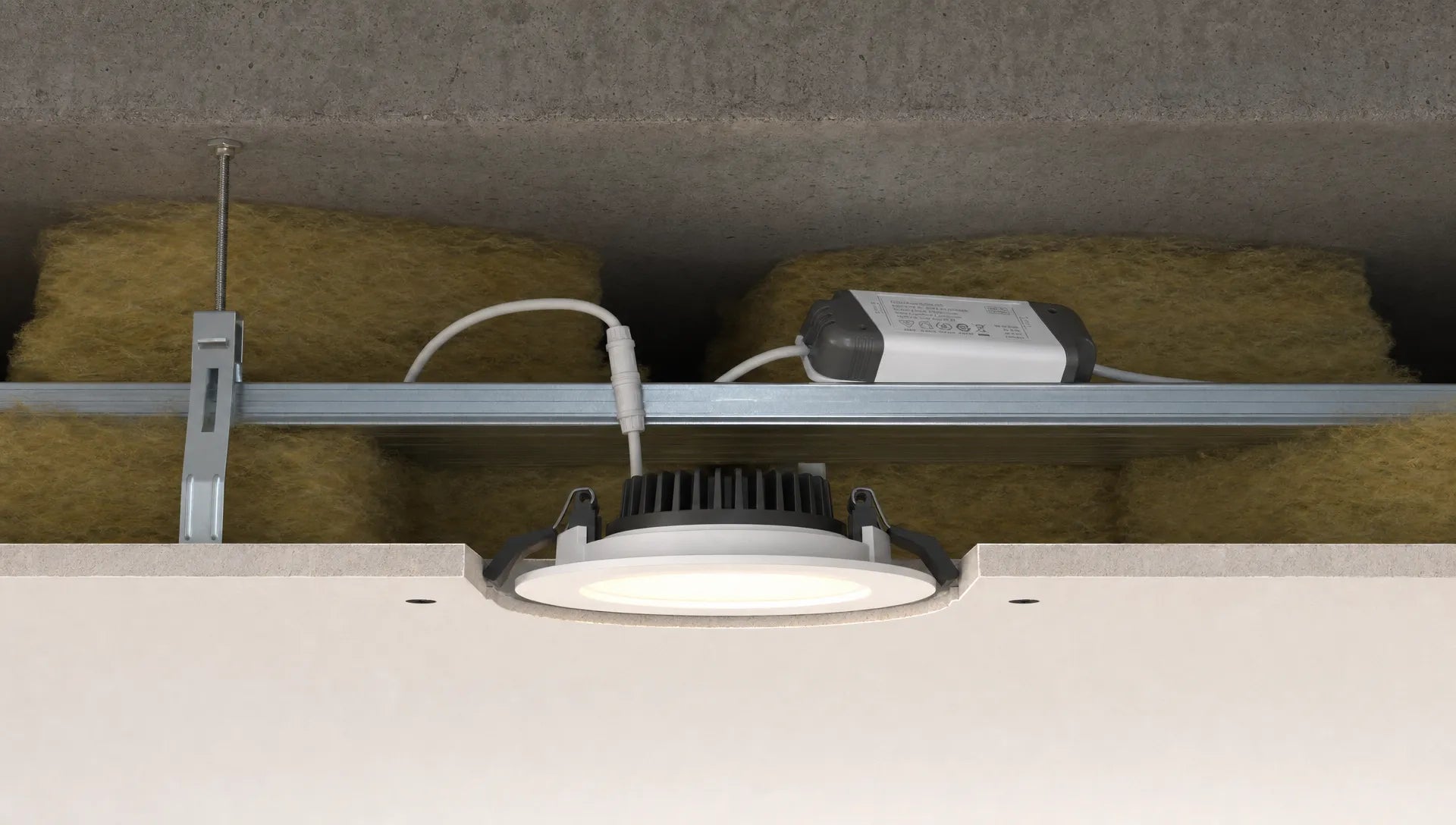
A flat LED recessed spotlight is designed for small ceiling voids. This is particularly relevant for suspended plasterboard ceilings, renovated old buildings, low room heights or furniture and niche lighting. However, “flat” does not automatically mean “can be installed anywhere”. In addition to the visible height, the space for connection terminals, drivers and air circulation also counts.
Many very flat models work with integrated LED technology. Others consist of a mounting frame, a separate light source and, if necessary, an external driver. Both variants can make sense if they suit the installation situation.
The manufacturer’s information on the minimum installation depth is important. You should also plan for some reserve, because cables must not be crushed and LED components need sufficient heat dissipation. Especially with insulated ceilings, it should be clarified in advance whether a built-in box or a special spacer is necessary.
The most important purchasing criteria at a glance
When it comes to flat dimmable LED recessed spotlights, you shouldn't just pay attention to the appearance. What is crucial is the interaction between mechanical fit, electrical compatibility and lighting effect.
| criterion | What you should pay attention to | Why it matters |
|---|---|---|
| Installation depth | Housing height, driver location, ventilation reserve | Prevents assembly problems and heat build-up |
| Ceiling cutout | Exact diameter according to manufacturer | Sections that are too large are difficult to correct |
| Luminous flux | Compare lumens instead of just watts | LEDs vary greatly in efficiency and brightness |
| Beam angle | Narrow, medium or wide depending on the application | Determines whether the light appears at points or across areas |
| light color | 2700K, 3000K or 4000K | Affects atmosphere and functionality |
| Color rendering | At least CRI 80, higher quality often CRI 90 | Colors appear more natural and of higher quality |
| Dimmability | Matching dimmer and driver required | Avoids flickering, humming and failures |
| Protection class | IP20, IP44 or higher depending on the room | Relevant for bathrooms, kitchens and wet areas |
These values should not be viewed in isolation. For example, a flat spot with a high lumen output can generate more heat than a weaker model. A very wide beam angle can appear pleasantly even, but create less of an accent. High color rendering improves the spatial effect, but can limit the product selection.
Check installation depth correctly
The installation depth is the central planning criterion for flat spotlights. Don't just measure the visible ceiling suspension, but also the actual usable cavity. Pipes, substructures, insulation and vapor barriers can significantly reduce the available space.
For a suspended ceiling with a 40 mm cavity, a spotlight with a 38 mm installation depth is often too tight in practice. They require space for connection, movement during insertion and heat dissipation. It is better if the luminaire remains well below the available depth or is explicitly approved for very small cavities.
Also pay attention to the height of the driver. Some LED recessed spotlights have an external driver that may be flat but wider than the opening. Then it must fit through the ceiling cutout before insertion or remain accessible separately. This is particularly important for subsequent maintenance.
How much brightness do flat recessed spotlights need?
The appropriate brightness depends on the room, the ceiling height, the surface colors and the desired use. White walls reflect light better than dark, matte materials. A kitchen needs more functional light than a cozy living area.
As a rough guide, you can work with the following values:
| room or area | Typical lighting effect | Meaningful planning |
|---|---|---|
| hallway | Orientation and consistent routing | Multiple spots with wide to medium angles |
| Living room | Basic light plus atmosphere | Plan to be dimmable and supplement it with floor or pendant lights |
| Kitchen | Work light and basic lighting | Higher lumen values, good color rendering, suitable position above work surfaces |
| bathroom | Bright, safe light | Pay particular attention to the type of protection and installation zones |
| bedroom | Quiet, low-glare light | Prefer warm white and good dimmability |
| Home office | Concentration and visual comfort | Uniform lighting, often neutral white makes sense |
Warm white light colors around 2700 K to 3000 K are usually pleasant for living rooms. 4000 K appears more objective and is more suitable for work areas, utility rooms or very modern kitchens. In open floor plans, a uniform light color can help create a calm overall appearance.
Beam angle and placement: How to avoid light spots
The beam angle determines how wide a recessed spotlight distributes its light. Narrow angles create accents, for example on pictures, shelves or wall surfaces. Wide angles are better for basic lighting. With flat spots, the light control is sometimes less glare-free than with larger downlights, which is why glare plays a big role.
In normal living spaces, distances of around 1 to 1.5 meters between the spots often appear harmonious, depending on the ceiling height and beam angle. The distance to the wall is often around 50 to 80 centimeters if the wall needs to be slightly illuminated. These values are only a guide, not a replacement for specific lighting planning.
Particularly important: Do not place spotlights directly above seats, sofa edges or head areas if they shine strongly downwards. Otherwise unpleasant direct glare will occur. A combination of recessed spotlights and decorative lights can be a better solution for dining tables, kitchen islands or reading areas.

Dimmability: Not every LED spot fits every dimmer
“Dimmable” on the packaging only means that the LED recessed spotlight can generally be dimmed. It does not automatically mean that it will work with every existing wall dimmer. LED technology reacts more sensitively to incorrect load ranges and unsuitable dimming methods than classic incandescent lamps.
Common types of dimming are leading edge, trailing edge, 1 to 10 V, DALI or smart controls. In private renovations, trailing edge dimmers are often the better choice for many modern LED lights, but the manufacturer's approval is always crucial. If you use external control gear, it's worth taking a look at the basics of how to use one Select the dimmable LED transformer correctly.
Also pay attention to the minimum load of the dimmer. Several very economical LED spots together can still be below the required load. This leads to flickering, uneven dimming or residual glow. If you want to avoid exactly this problem, the additional guide like you will also help Select LED recessed spotlights without humming.
Good dimming behavior is not only evident at full brightness. Check whether the lamp remains quiet even in the lower area, does not flicker and the light color is pleasant. Some LEDs do not get warmer in light color when dimmed, others offer a so-called dim-to-warm function. This is particularly attractive in the living room and bedroom, but must be selected specifically.
Protection class and wet rooms: Do not ignore the IP value
The protection class is specified with IP plus two code numbers. The first number describes the protection against foreign bodies, the second describes the protection against water. The system is internationally standardized, including the IP code according to IEC 60529, which the International Electrotechnical Commission explained.
IP20 is often sufficient for dry living spaces. Different requirements apply in bathrooms, washrooms or protected outdoor areas. IP44, IP65 or even higher protection may be required there, depending on the exact position to the shower, bathtub or water source.
Especially in the bathroom, you shouldn't plan the installation based on feeling. The electrical protection areas and the permitted luminaires depend on standards, distance and installation location. If in doubt, have the selection and installation checked by a qualified electrician, especially if new cables are to be laid or existing connections are changed.
Replaceable light source or integrated LED module?
Flat LED recessed spotlights are available in two basic versions. In the first variant, you use a mounting frame with a replaceable light source, often GU10 or another suitable format. In the second variant, the LED module is permanently integrated.
Interchangeable bulbs are practical if you later want to change the light color, brightness or beam angle. However, you need enough installation depth for the socket and bulbs. Very flat constructions are therefore often more difficult to implement.
Integrated LED modules can be particularly flat, efficient and visually quiet. The subsequent exchange is less flexible. Pay particular attention to quality, service life, color rendering and warranty conditions. The driver should also remain accessible, as it is often the component that is subjected to the greatest stress in LED systems.
Light Quality: Why CRI, Glare and Surface Matter
The quality of light determines whether a room appears high-quality or restless. A high luminous flux alone does not create good light. Especially in living rooms, flat dimmable LED recessed spotlights should offer pleasant glare control, clean color rendering and a suitable light color.
The CRI value, often called Ra, describes the color rendering. CRI 80 is sufficient for many standard applications. For kitchens, dining areas, cloakrooms, art, wooden surfaces or high-quality materials, CRI 90 or higher is worth it because colors appear more natural.
The aperture or reflector also plays a role. White frames visually disappear into light ceilings. Black or dark reflectors can reduce glare and add a more modern accent. Swivel spots are useful if you want to specifically illuminate walls, pictures or furniture. Rigid spots appear calmer when used as uniform basic lighting.
When recessed spotlights are not the best solution
As elegant as flat recessed spotlights look, they are not automatically the right choice for every room. If there is not enough installation depth, the ceiling should not be opened or a very even light surface is desired, other types of luminaires may make more sense.
For large, quiet room lighting, for example, you can use one Dimmable LED panel for even room light fit better. On the other hand, if a decorative, visible ceiling light is required, a slim surface-mounted light can emphasize the architecture without requiring a suspended ceiling.
A good example of such an alternative is the Ustrala ceiling lamp. Its elongated, graphic shape with gently rounded corners goes well with modern interiors if you are looking for a purist ceiling solution but do not want to create installation openings. In a lighting concept, it can also be combined with recessed spotlights, for example as calm basic lighting in the living area and targeted spots along a wall.
Planning by room: avoid typical mistakes
Many mistakes occur because recessed spotlights are planned too late. Ideally, you determine positions, switching groups and dimming zones before the ceiling is closed. This is particularly true for renovations where pipe routes, substructure and furniture are already specified.
In the living room, spots should not alone carry the entire atmosphere. A combination of basic lighting, accent lighting and decorative lights looks more homely. In the kitchen, spots must be positioned so that they do not cast shadows on the work surface while working. In the hallway, the light should provide orientation without appearing like a tunnel made up of individual points of light.
Particularly gentle planning is recommended in the bedroom. Spotlights directly above the bed can be blinding when you lie down. Indirect light components, positions close to the wall or separately dimmable zones are better. In the bathroom, mirror lighting and ceiling light should work together so that faces are illuminated evenly.
Checklist before purchase
Before you order flat dimmable LED recessed spotlights, you should check the most important points. This saves rework and reduces the risk that lights, dimmers or ceilings do not fit together.
- Measure available installation depth including reserve
- Compare the ceiling cutout and outside diameter with the plan
- Plan the number of spots based on room size, usage and luminous flux
- Choose a uniform light color for all spots in the room
- Set the CRI value to match the room quality
- Select beam angle according to basic light or accent light
- Check dimmer, driver and minimum load for compatibility
- Choose the correct protection type for the bathroom, kitchen or wet rooms
- Consider the accessibility of the driver and connection in the long term
- Plan to have installation carried out by a qualified electrician if fixed connections are involved
This checklist is particularly helpful when renovating multiple rooms at the same time. It prevents different light colors, different dimming behavior or inappropriate cutouts from occurring in every room.
Frequently asked questions
How flat should dimmable LED recessed spotlights be? This depends on the available ceiling void. It's not just the housing height that's important, but also space for drivers, connection terminals and heat dissipation. If possible, choose a model with sufficient reserve for the actual installation depth.
Can I simply replace existing halogen recessed spotlights with LEDs? Sometimes yes, but not always. Socket, transformer, dimmer, minimum load and installation depth must fit. Old halogen transformers and dimmers in particular are often not ideal for LEDs.
Which light color is best for living spaces? For living rooms, bedrooms and dining areas, 2700 K to 3000 K usually seems pleasantly warm. For the kitchen, study or utility room, 3000 K to 4000 K can make sense if more objectivity and concentration are desired.
Why do dimmable LED recessed spotlights flicker? Common causes are an unsuitable dimmer, an incorrect driver, a minimum load that is not met or incompatible LED lamps. Always check the manufacturer's approvals and, if possible, test the dimming behavior before final assembly.
What type of protection do I need in the bathroom? That depends on the exact position. In dry areas, a lower degree of protection may be sufficient; in areas with splash water, a higher degree of protection is usually necessary. Have bathroom installations professionally inspected because of the electrical protection areas.
Conclusion: Flat is good, fitting is better
Flat dimmable LED recessed spotlights are an elegant solution for modern rooms if they are carefully planned. The best choice is not automatically the thinnest spot, but the spotlight that suits the ceiling, the dimmer, the room function and the desired lighting mood.
If you want to create a harmonious overall picture, don't think of recessed spotlights in isolation. Combine them with matching ceiling, pendant or accent lights if the room needs more depth and atmosphere. At BUYnBLUE Find curated designer lighting for modern living spaces, including high-quality materials, free worldwide shipping, and customization options on select lights.