Dimmable ceiling lamp: This is really worth it
A ceiling lamp is often the most important source of light in the room. It decides whether a living room looks cozy, whether the kitchen is functionally lit and whether a bedroom allows you to relax in the evening. That's exactly why it's worth asking: Is a normal light enough, or should it be? Ceiling lamp dimmable be?
The short answer: In many living areas, a dimmable ceiling lamp is definitely worth it, but not in every room and not at every price. The biggest advantage is not just that the light becomes brighter or darker. It's about flexibility, living comfort, atmosphere and the ability to use a room differently depending on the time of day.
What does “dimmable” really mean for a ceiling lamp?
A dimmable ceiling lamp can change its light output. So it doesn't just say "on" or "off", but can be regulated continuously or in fixed levels. Depending on the model, this works via a wall switch, a rotary dimmer, a remote control, an app, a touch sensor or a smart home system.
It is important to note that not every LED ceiling lamp is automatically dimmable. With LEDs, the lamps, drivers and dimmers must technically fit together. If this combination is incorrect, you may experience flickering, humming, uneven dimming, or a very small dimming margin. Especially with high-quality ceiling lights, it is not only the design that is crucial, but also the built-in dimming technology.
A dimmable ceiling lamp is particularly interesting for living rooms if a room fulfills several functions. This is almost always the case today. The living room is a cinema in the evening, a workplace during the day and a meeting place with guests at the weekend. The kitchen is not only a work area, but often also a dining area. The bedroom needs bright light in the morning and soft lighting in the evening.
When is a dimmable ceiling lamp particularly worthwhile?
A dimmable ceiling lamp is particularly worthwhile where the lighting mood changes frequently. If you only need constant brightness in a room, such as a storage room, dimmability is less important. But as soon as a room combines living, working, eating, relaxing or presenting, the dimming function quickly becomes a real comfort gain.
It is particularly useful in open living areas. Ceiling light that is too bright can quickly appear cool or restless. Dimming can be used to reduce the basic brightness, while accent lights, pendant lights or wall lights create additional depth. The result is a space that not only appears illuminated, but also appears consciously designed.
Dimming is also worthwhile in large rooms. A bright ceiling lamp must have enough power to illuminate the entire area. However, without a dimming function it can be too dominant in the evening. With dimming, the strong light output remains available, but only works when it is really needed.
| space or situation | Is dimmable worth it? | reason |
|---|---|---|
| Living room | Very common | Switch between everyday life, relaxation, guests and TV evenings |
| Dining room | Very common | Bright light for serving, warmer atmosphere while eating |
| bedroom | Frequently | Soft light in the evening, more brightness when getting dressed |
| Kitchen | Frequently | Flexibility between work light and a homely atmosphere |
| hallway | Depending on usage | Practical at night or in open floor plans |
| bathroom | Depending on the concept | Good for a wellness mood, less important for purely functional use |
| Storage room | Rare | Clear, constant light is usually enough |
The biggest advantage: one room, several lighting moods
Dimmable ceiling lights are particularly valuable because they make the room adaptable. Instead of switching on several separate lights or living with light that is too bright, you can fine-tune the basic lighting.
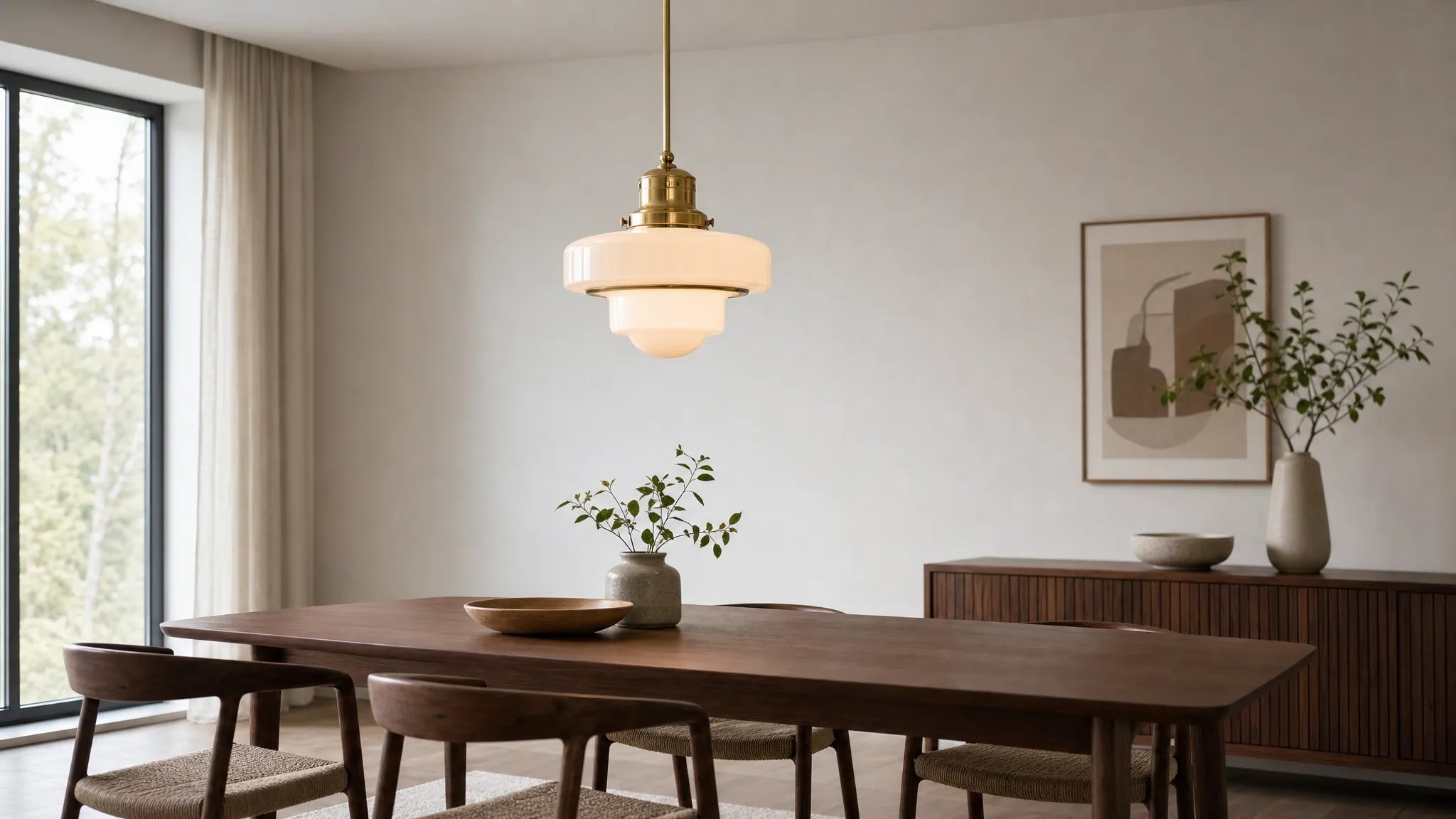
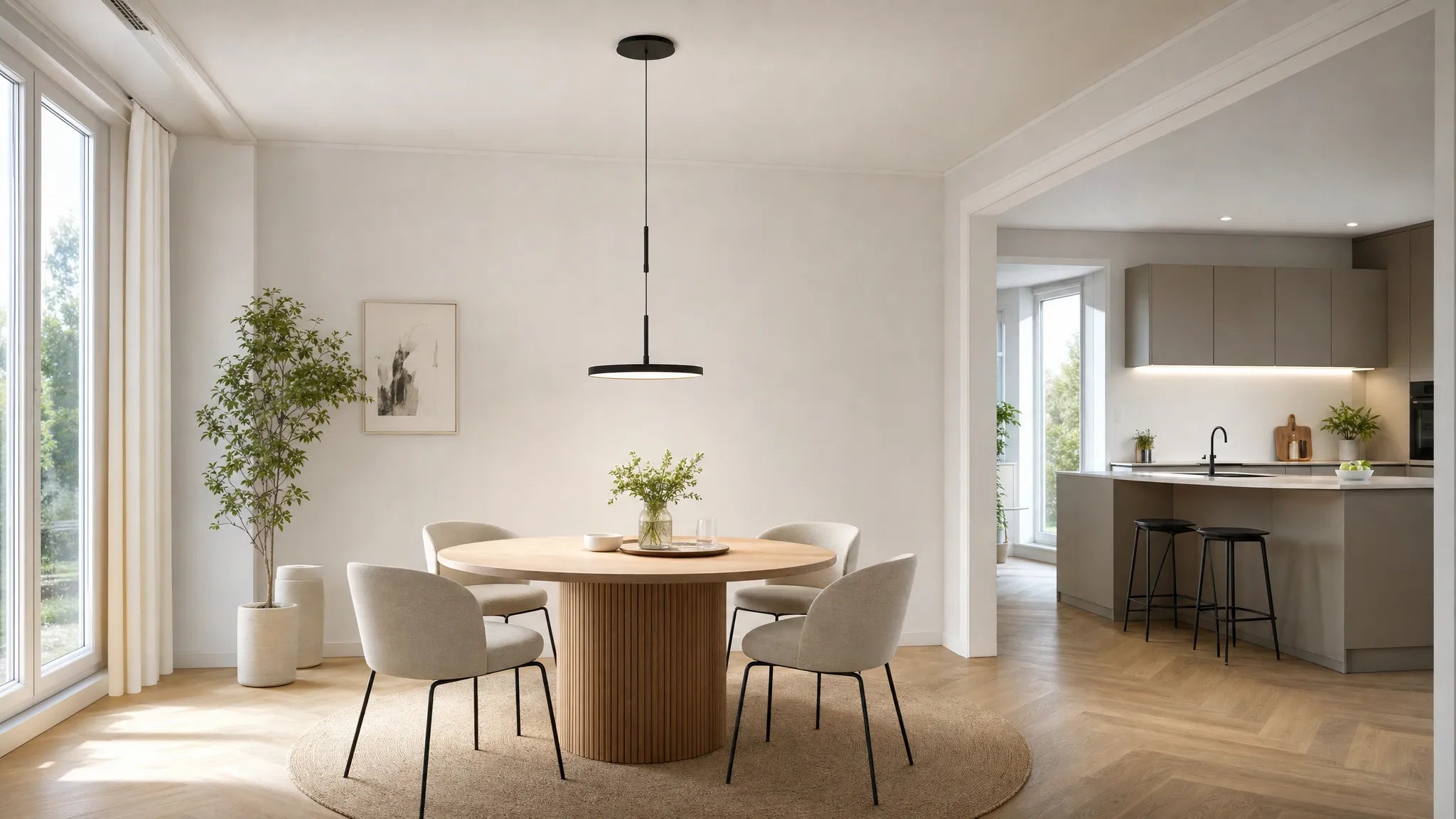
An example: In the dining area, you want enough light on the table when setting and clearing away. While eating, the same brightness often seems too matter-of-fact. A dimmable ceiling lamp or pendant light above the table solves this problem elegantly. It remains the central light source, but adapts to the mood.
The effect is even more noticeable in the living room. Full brightness helps when cleaning, reading or playing with children. Dimmed light creates calm in the evening and makes materials, colors and furniture appear softer. Particularly in modern interiors with stone, glass, metal or dark surfaces, dimming prevents the room from appearing too harshly lit.
Dimmability is therefore an important planning tool for interior designers and renovators. It ensures that a lighting concept not only looks good in photos, but also works in everyday life.
LED, dimmer and drivers: What you should pay attention to technically
Dimming classic light bulbs was relatively easy. With modern LED lights, the technology is more complex, but much more efficient. The European Commission points out the issue energy efficient light sources points out that LEDs are now the central standard for efficient lighting. However, with dimmable LEDs, compatibility is very important.
The most important terms are quickly explained:
| Technology | Typical use | What to pay attention to? |
|---|---|---|
| Trailing edge dimmer | Common with modern LED lights | Often the better choice for many LED drivers, but check compatibility |
| Phase control dimmer | Older installations, some halogen or certain transformers | Not automatically suitable for modern LEDs |
| DALI | Architecture, new building, sophisticated lighting planning | Very precise, but usually requires more planning |
| Smart dimming | App, voice control, radio standard | Convenient, but dependent on the system |
| Integrated dimmer | Remote control, touch or light switch | Easy if no wall dimmer installation is desired |
The most common mistake when purchasing is assuming that “LED” and “dimmable” mean the same thing. Therefore, always pay attention to the manufacturer’s information on dimmability. If an external wall dimmer is to be used, it must also match the light.
The LED driver plays a central role in permanently installed LED ceiling lights. It regulates the power supply to the LEDs. If the driver is not dimmable or not compatible with the existing dimmer, even the nicest wall switch won't help. For high-quality designer lights, it therefore makes sense to clarify which type of dimming is intended before purchasing.
Brightness, light color and dim-to-warm: That makes the difference
Many buyers first focus on the shape of the lamp. This is understandable, because a ceiling lamp visibly shapes the room. However, three technical values are at least as important for everyday life: lumens, Kelvin and color rendering.
Lumen describes the brightness. The larger the room and the darker the walls, floors or furniture, the more light output is required. A dimmable ceiling lamp can therefore be more powerful as long as it can be easily turned down. This means you have reserves for cleaning, work or dark winter days.
Kelvin describes the color of light. Warm white light around 2700 to 3000 Kelvin looks homely and pleasant. Neutral white light around 3500 to 4000 Kelvin appears more objective and is more suitable for kitchens, work areas or modern bathrooms. Very cool light can quickly appear uncomfortable in living spaces.
Dim-to-warm is particularly exciting. When dimming, the light not only becomes darker, but also warmer. This effect is similar to the behavior of classic incandescent lamps and is very pleasant for living rooms, bedrooms, dining rooms and hotel-like interiors. If you want a particularly homely atmosphere, you should include this function in your selection.
Color rendering is also relevant. A high CRI value, often CRI 90 or higher, makes colors appear more natural. This is particularly important for dining tables, art, textiles, wooden surfaces and high-quality materials.

Room by room: Where a dimmable ceiling lamp makes the biggest difference
Living room
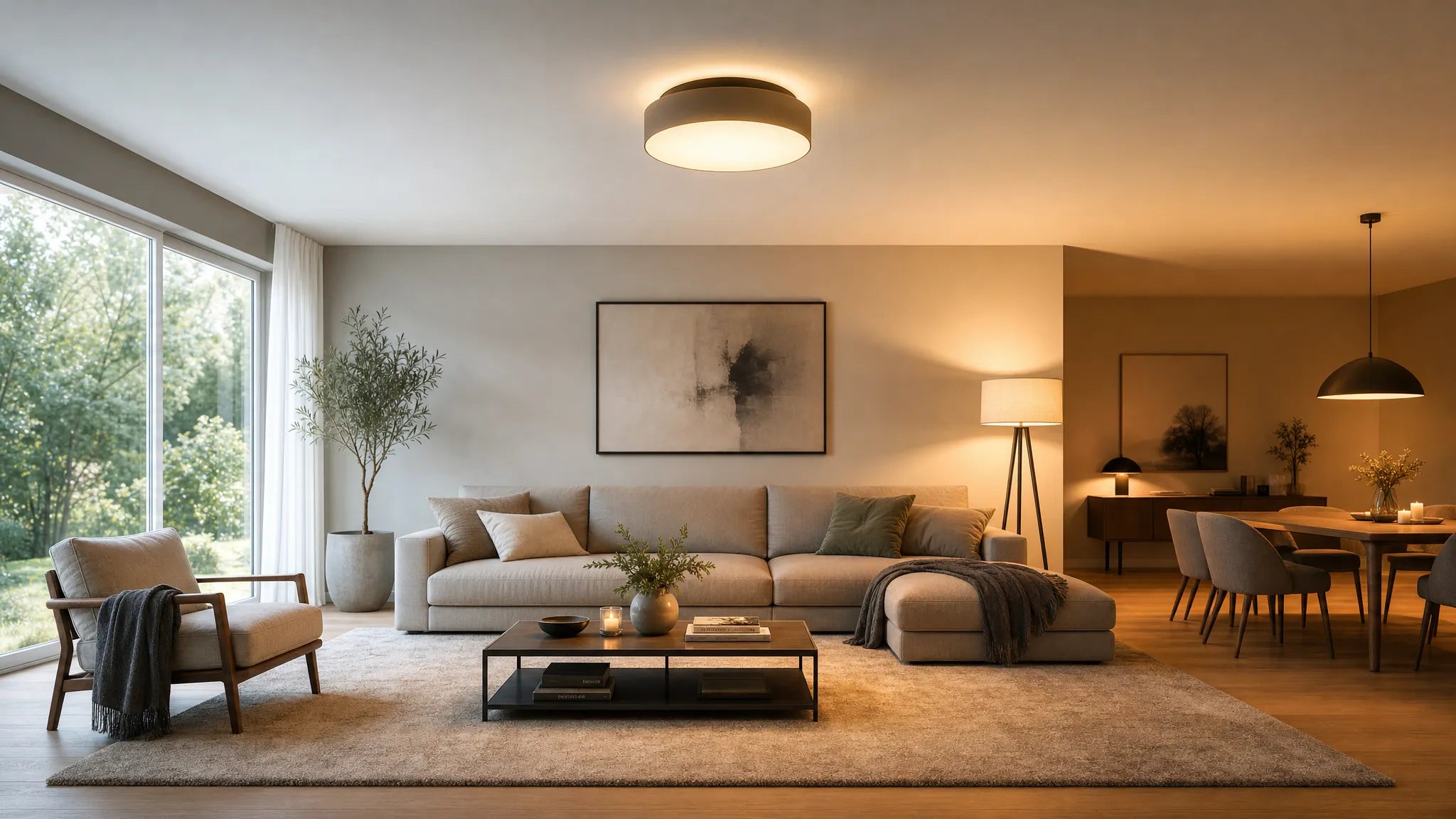
A dimmable ceiling lamp almost always makes sense in the living room. Although it does not automatically replace a complete lighting concept, it does make basic lighting significantly more flexible. It can be dimmed significantly for movie nights, remain a little brighter for guests and use full power for everyday situations.
If there is no ceiling connection or you deliberately prefer indirect light, one can Dimmable ceiling floodlight as an alternative to ceiling lamps be interesting. However, the advantage of a real ceiling lamp is that it is centrally located and does not require any floor space.
Dining room
Dimming is particularly worthwhile above the dining table. Light that is too bright takes away the atmosphere of a dinner, while light that is too dark makes serving and conversation tiring. A dimmable pendant or ceiling light allows for both: clear brightness when needed and soft light while eating.
With pendant lights, the mounting height also comes into play. A lamp should neither dazzle nor disturb the view over the table. If the ceiling height is unusual, an adjusted cable length can be crucial.
bedroom
Light is often underestimated in the bedroom. Many people need sufficient brightness in the morning, and the light should be calming in the evening. A dimmable ceiling lamp makes this change easy. Warm, dimmable light that doesn't directly glare is particularly pleasant.
For bedrooms, matt shades, indirect light or lights with diffuse coverage are often better than very selective, hard light sources. Dimming enhances this comfort, but does not replace the correct distribution of light.
Kitchen
Function is important in the kitchen. Work surfaces need sufficient brightness, especially when cutting, cooking and cleaning. A dimmable ceiling lamp is worthwhile if the kitchen is also a living room or dining area. In a purely work kitchen, a constantly bright ceiling light can be sufficient, supplemented by under-cabinet lights.
Dimming almost always makes sense in open kitchens. After cooking, the ceiling light can be turned down so that the kitchen area doesn't look like a work zone while you relax in the living area.
Hallway and entrance area
Dimming is not a must in the hallway, but it is often pleasant. At night or early in the morning, dimmed light is much more pleasant than full brightness. In representative entrance areas with high ceilings, gallery spaces or designer lights, a dimmable ceiling lamp can also greatly improve the first impression.
Design and proportion: Why dimming alone is not enough
A dimmable ceiling lamp is only really worthwhile if it fits the room. Lights that are too small get lost in large rooms, and lights that are too big can overwhelm low ceilings. The position is also crucial. The lamp can deliberately be centered above a dining table; in the living room it should match the furniture and not just the middle of the room.
When choosing, pay attention to these points:
- Room height: Flat ceiling lights are suitable for low rooms, pendant lights and chandeliers need more distance.
- Materials: Glass, metal, fabric, acrylic or natural materials change the lighting effect and style.
- Radiation: Direct light is functional, indirect light appears softer and more homely.
- Freedom from glare: A bright dimmable light should remain comfortable even at full power.
- Scaling: In large rooms, several points of light often appear more harmonious than a single, extremely bright light.
Customization is a big advantage, especially with chandeliers and pendant lights. At BUYnBLUE Suitable lights can be adjusted free of charge, for example in terms of cable length, canopy or color. This is particularly helpful with high ceilings, unusual room layouts or specific interior concepts.
Is a dimmable ceiling lamp worth it financially?
Dimmable ceiling lamps are often a little more expensive than simple models. There may also be costs for a suitable wall dimmer or professional installation. Nevertheless, the investment is often worthwhile because a good dimmable light covers several usage situations.
Financially, you shouldn't just look at the purchase price. A poorly fitting luminaire is often replaced, supplemented or compensated for with additional lamps. A high-quality dimmable ceiling lamp, on the other hand, can last longer because it adapts to different moods, seasons and interior design ideas.
When it comes to power consumption, the following applies: Dimmed LED light usually uses less energy than full power, but the savings are not always exactly proportional to the visible brightness. The greater advantage therefore usually lies in comfort and better use of space, not in a dramatic reduction in electricity costs.
When is a dimmable ceiling lamp not worth it?
Not every room needs dimming. If you only switch on a light briefly and always need the same brightness, a non-dimmable model may be sufficient. This applies, for example, to small storage rooms, basement rooms or purely functional additional areas.
Even if your budget is very small, it sometimes makes more sense to invest in good lighting quality first rather than in a simple lamp with a weak dimming function. Flicker-free light, appropriate brightness, good color rendering and a harmonious design are more important than a dimmer that is rarely used in everyday life.
Caution is also advised if an existing electrical installation is very old. Old dimmers are not automatically LED compatible. In this case, you should clarify whether an exchange is necessary before purchasing. For safety reasons, work on 230-volt installations should be carried out by qualified personnel.
Buying checklist: How to choose the right dimmable ceiling lamp
Before purchasing, simple prioritization helps. Don't just think about which lamp looks nice, but also what task it should fulfill in the room.
| Question | Why it is important |
|---|---|
| Should the lamp be the main light or mood light? | The brightness and beam angle depend on this |
| Will an existing wall dimmer be used? | Luminaire, driver and dimmer must be compatible |
| Which light color suits the room? | Warm white looks homely, neutral white looks more functional |
| Is glare an issue? | Particularly important over sofas, beds, dining tables and kitchen islands |
| Does the size match the proportions of the room? | Design only looks high quality if the scaling is right |
| Is an adjustment necessary? | Cable length, canopy or color can be crucial for special rooms |
If you are unsure, a lamp with a clearly documented dimming function and high-quality workmanship is usually a better choice than a cheap model with unclear technology. When it comes to designer lights, it's not just how they look when switched on that counts, but also how they fit into the room when dimmed.
Frequently asked questions about dimmable ceiling lamps
Can every LED ceiling lamp be dimmed? No. An LED ceiling lamp must be expressly marked as dimmable. In addition, LED drivers and dimmers must be compatible, otherwise flickering, humming or limited dimming may occur.
Do I need a special switch for a dimmable ceiling lamp? That depends on the model. Some lights are controlled via a wall dimmer, others via remote control, app, touch function or a normal switch with integrated dimming levels.
Does a dimmable ceiling lamp make sense in the living room? Yes, it is particularly worthwhile in the living room. The space is used for many situations, from bright everyday light to cozy evening light. Dimming makes central lighting significantly more flexible.
Which is better, warm white or neutral white? Warm white is usually more pleasant for living rooms and bedrooms. Neutral white can be useful in the kitchen, work areas or bathroom. If you want maximum flexibility, you can look for lights with changeable light colors.
Does a dimmed LED ceiling lamp use less electricity? Generally yes, but the savings are not always exactly proportional to the visible brightness. The main benefit is usually comfort, atmosphere and better adaptation to different situations.
What to do if the dimmable ceiling lamp flickers? This is often due to an incompatible combination of light, driver and dimmer. Check the manufacturer's instructions and have a suitable LED dimmer installed by qualified personnel for permanently installed lights.
Conclusion: Dimming is worthwhile if light is part of the living concept
A dimmable ceiling lamp is particularly worthwhile in rooms that need to do more than just be bright. Living rooms, dining rooms, bedrooms, open kitchens and representative entrance areas benefit significantly from flexible brightness. What is crucial, however, is that technology, lighting quality, design and spatial proportions fit together.
If you are planning a high-quality dimmable ceiling, pendant or chandelier solution for your home, see BUYnBLUE modern lights for sophisticated living areas. The curated selection, free customization options, free worldwide shipping, and 14-day returns make it easier to choose a light that not only looks beautiful, but truly fits your space.