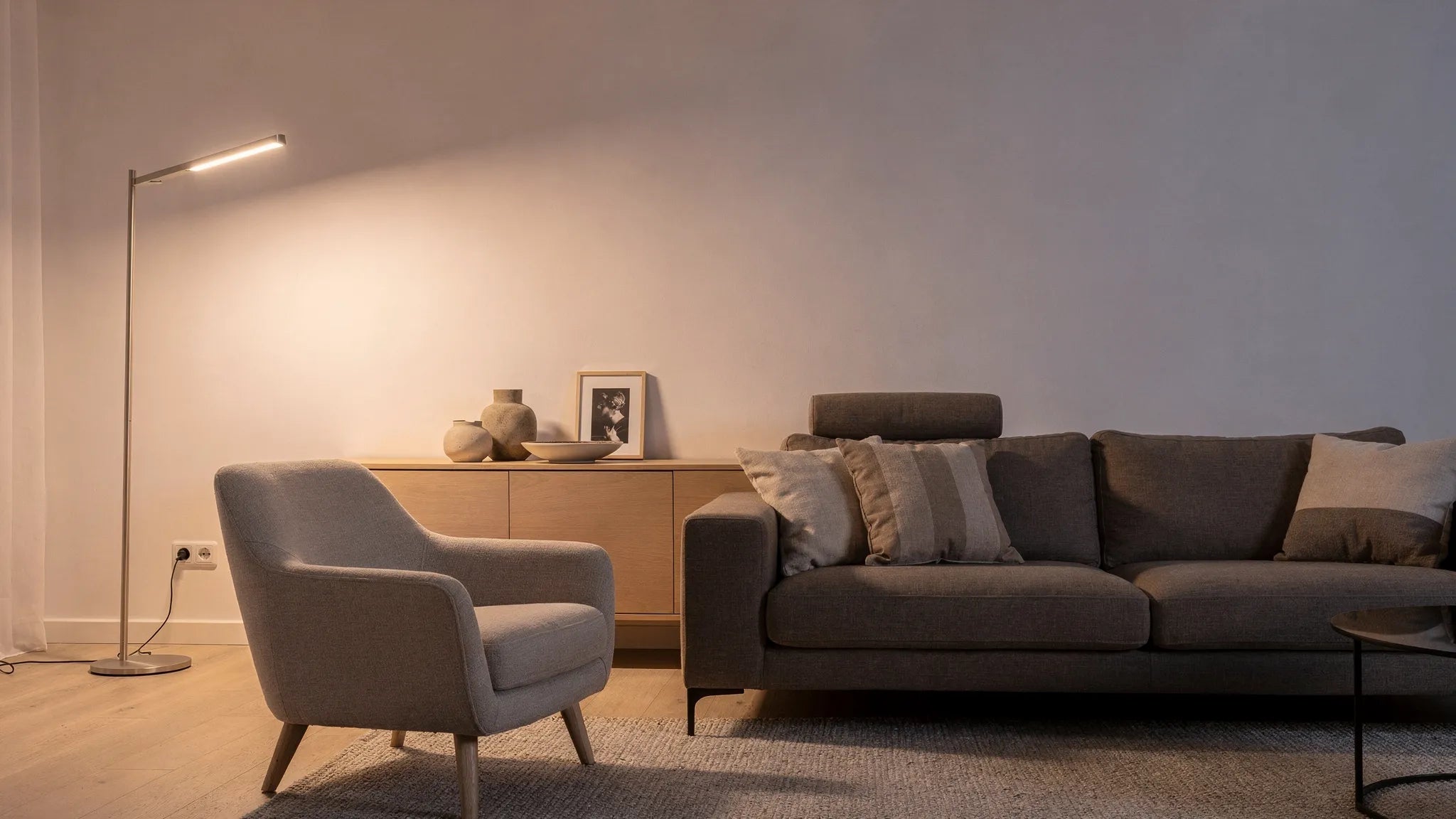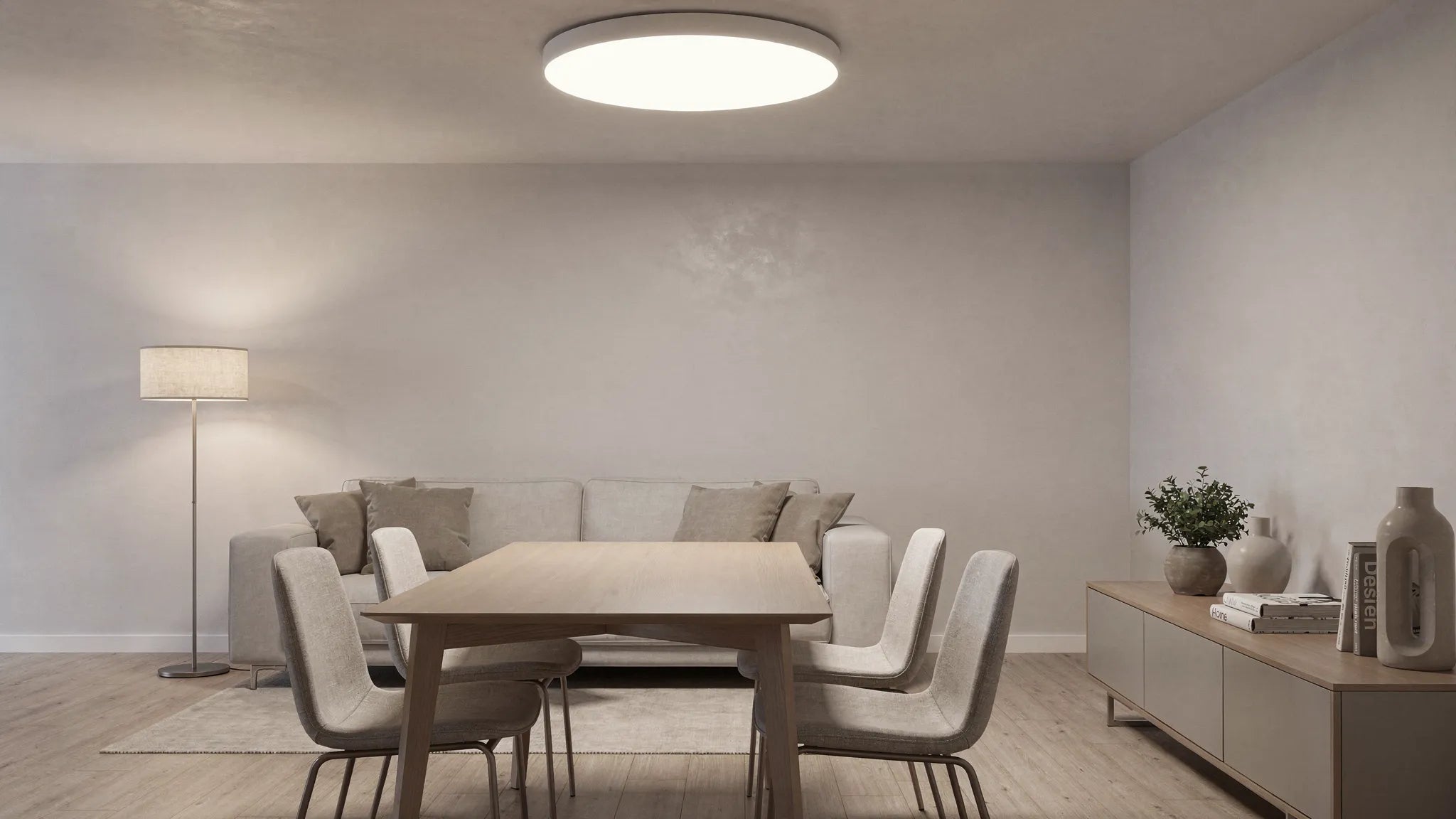
Dimmable LED ceiling light: This is what really matters
A dimmable LED ceiling light is often the most practical light source in the room: bright when cleaning, pleasant when having dinner, quiet when relaxing. Nevertheless, many disappointments arise precisely here because “dimmable” on the packaging does not automatically mean that the light works continuously, flicker-free and matches the existing electrical installation.
Who after one LED ceiling light dimmable You should therefore not only pay attention to design and price. The interaction between the LED module, driver, dimmer, light output, color temperature and installation location is crucial. This guide shows what is really important before hanging the new light on the ceiling.
Why “dimmable” is so important for LED ceiling lights
Ceiling lights usually provide the basic lighting of a room. This is exactly why dimmability is particularly worthwhile: a single brightness is rarely ideal in everyday life. In the morning the kitchen needs clear, bright light. In the evening, the living room can appear softer. In the bedroom, the lamp is intended to calm rather than activate.
A good dimmable LED ceiling light fulfills three tasks at the same time. It provides sufficient brightness when full power is required. It can be dimmed down enough to make the room appear cozy. And it remains quiet, without flickering, humming or abrupt jumps in brightness.
The most important point: LEDs do not simply regulate “less power” like old incandescent lamps. LED technology needs suitable electronics. Therefore, the quality of dimming depends heavily on whether the luminaire, LED driver and dimmer are compatible with each other.
The most important question: integrated LED or replaceable light source?
Before thinking about dimmer types, you should know what type of LED ceiling light you are purchasing.
In a ceiling light with a replaceable bulb, such as E27, E14 or GU10, the dimming technology is partially located in the bulb. The light source must then be expressly marked as dimmable. A non-dimmable LED lamp cannot be subsequently converted into a good dimmable solution using a dimmer.
In a ceiling light with an integrated LED module, LED chips and drivers are built into the light. Here the entire lamp must be designated as dimmable. It is also important which type of control is supported, for example wall dimmer, remote control, app, push-dim or DALI.
| Variant | advantage | What you should pay attention to when dimming |
|---|---|---|
| Replaceable LED bulb | Bulbs can be changed later | Only use dimmable lamps and check the minimum load of the dimmer |
| Integrated LED module | Flat design, even light, often modern functions | Check compatible driver and supported control type |
| Smart ceiling light | Dimming, scenes and sometimes color temperature via app or remote control | Do not also dim using an unsuitable wall dimmer |
| Pendant or chandelier with LEDs | Strong design focus, good for dining table or high rooms | Plan the cable length, ceiling rose, driver and control together |
If you already have a wall dimmer, compatibility is particularly important. Not every integrated LED ceiling light works with every existing dimmer.
Dimmer types: What goes with which LED ceiling light?
Dimmer technology is the most common reason for problems. A high-quality light can flicker if the dimmer doesn't fit. Conversely, a good dimmer can do little if the LED driver is not designed for this type of dimming.
| Dimmer type | Typical use | Advantages | Potential tripping hazards |
|---|---|---|---|
| Phase control | Older installations, some dimmable LED bulbs | Widely used | LEDs can tend to flicker or hum |
| phase section | Lots of modern LED bulbs and electronic drivers | Often quieter and more LED friendly | Still not compatible with every light |
| Push dim | Modern integrated LED lights | Operation via buttons, often convenient | Requires appropriate wiring and drivers |
| 0-10V or DALI | New building, architecture, larger lighting concepts | Can be planned very precisely and professionally | Usually additional control lines and specialist planning are required |
| App, remote control or smart system | Smart ceiling lights | Scenes, schedules, often color temperature control | Usually do not use wall dimmers additionally unless approved |
For many private living spaces, a modern trailing edge dimmer is the obvious solution if the luminaire is approved for it. Systems like DALI can be interesting for high-quality new buildings, open living areas or professional lighting concepts because they can be precisely controlled and neatly combine several lights.
A simple rule applies to smart LED ceiling lights: If the light dims via an app, radio remote control or internal controller, it should generally be permanently supplied with voltage. A classic wall dimmer in front of it can lead to malfunctions unless the manufacturer explicitly allows this combination.
Brightness: Why full performance is still important
A dimmable lamp is often bought because it is supposed to be comfortable. Nevertheless, it should be bright enough at full power. If you plan on too few lumens, you can make the lamp darker, but you can never make it brighter.
Lumen describes the amount of light that a lamp emits. Lux describes how much light reaches a surface. When planning your living space, a rough guide is sufficient: multiply the room area by the desired basic brightness and plan a reserve for indirect light, dark walls or large room heights. You can also find a detailed calculation in BUYnBLUE-Guide to LED lighting and lumens per square meter.
| space | Rough orientation for basic light | Dimming function particularly useful for |
|---|---|---|
| Living room | approx. 100-150 lux | Movie night, guests, quiet evening atmosphere |
| bedroom | approx. 100-150 lux | Wake up, read, relaxed evening |
| Kitchen | approx. 200-300 lux as basic light, additional illumination of work surfaces | Cooking, eating, night light function |
| hallway | approx. 100 lux | Orientation in the evening, reception light |
| bathroom | approx. 200-300 lux, plan mirror separately | Morning routine, wellness mood |
| Home office | Approx. 300 lux as room light, additionally illuminating the workplace | Video calls, concentrated work, break light |
Not only the maximum brightness is important, but also the lowest dimming level. Some LED ceiling lights can only be reduced by around 30 percent. This is often too bright for a cozy evening atmosphere. Good solutions create lower dimming values, but still have a stable and even effect.

Light color: warm white, neutral white or adjustable?
The light color is given in Kelvin. It has a major influence on whether a room appears homely, clear or cool. For living spaces, warm white light between 2700 and 3000 K is usually the most pleasant choice. Neutral white light around 3500 to 4000 K can be useful in kitchens, bathrooms and work areas because it appears more objective and fresh.
There are three typical variants of dimmable LED ceiling lights:
- Fixed light color: For example, the lamp has 3000 K and only gets brighter or darker.
- Dim to warm: When dimmed down, the light becomes warmer, similar to a classic light bulb.
- Tunable White or CCT control: The color temperature can be adjusted separately, for example from warm white to neutral white.
Dim-to-warm is ideal for living rooms, bedrooms and dining areas because the light automatically becomes more comfortable when dimmed. Tunable White is well suited for multifunctional rooms, such as kitchen-living rooms or home offices, where clear activity is required during the day and a warm atmosphere in the evening.
The color rendering should also be correct for design and living spaces. The CRI value, also known as Ra, describes how natural colors appear under a light source. CRI 80 is standard for many residential lights. If you want materials, art, wood, fabrics or food to look particularly beautiful, CRI 90 or higher is the better choice.
Flickering and humming: The underestimated quality characteristics
An LED ceiling light can look good at first glance and still be a nuisance in everyday life. Typical signs of poor dimming quality are visible flickering, a quiet whirring in the dimmer, jumps in brightness when adjusting or an afterglow after switching off.
Flickering is often caused by unsuitable combinations of dimmer and LED driver. If the minimum load is not met, it can also cause problems. Many older dimmers were designed for incandescent and halogen lamps, which had significantly higher wattages. Modern LEDs use much less energy, allowing the dimmer to run outside of its optimal working range.
The international standard IEEE Std 1789-2015 addresses potential health effects of light flickering and recommendations for reduction. For private purchases, this means: Low flicker is not a luxury detail, but a real comfort criterion, especially in rooms in which you spend a long time.
A simple practical test is the slow motion function of the smartphone. Film the switched-on light in different dimming levels. If strong dark streaks wander through the image, this can be an indication of problematic flickering. This test does not replace measurement technology, but it does help to identify noticeable problems early.
Energy efficiency: Dimming saves, but does not replace good planning
LEDs are significantly more efficient compared to old incandescent and halogen lamps. Nevertheless, it is worth taking a look at the energy labeling. The European Commission provides information about eco-design and energy requirements for light sources in the EU.
Dimming can reduce power consumption, but not always linearly. What matters is the efficiency of the LED, the quality of the driver and how often the light actually runs at full power. An oversized lamp that is almost always dimmed can be comfortable, but should not be completely inappropriately planned. A luminaire with sufficient reserve, good light distribution and sensible dimming range is better.
Also pay attention to the standby consumption of smart ceiling lights. This is usually small, but can add up with many devices in the household. Smart systems offer convenience advantages such as schedules, scenes and automatic shutdown.
Light distribution and glare: Not every bright light is pleasant
A dimmable LED ceiling light should not only be bright, but also pleasant. Flat LED panels or very compact ceiling lights in particular can cause glare if the LEDs are visible at certain points or the diffuser shines too brightly.
Opal covers, indirect light components or well-shielded LED modules are often more pleasant for living spaces. Flat ceiling lights work well in low rooms if they have a wide beam and brighten the room evenly. In high rooms, a decorative ceiling light alone may not create enough depth. There, a combination of ceiling light, wall light and accent light usually has a higher quality effect.
The wall color also influences the effect. Dark walls absorb light, light walls reflect it. If a room has dark furniture, matt surfaces or high ceilings, the lamp should provide more light reserve.
Which dimmable LED ceiling light suits which room?
In the living room, the ceiling light should be flexible. It serves as basic light, but must not remain the only light source. A dimmable ceiling light in warm white or with a dim-to-warm function creates the basis. In addition, floor lamps, table lamps or wall lights provide depth and coziness. If you would like to plan more atmosphere, it is worth taking a look at the guide indirect lighting in the living room.
Dimmability is practical in the kitchen, but work lighting remains indispensable. A ceiling light can illuminate the room evenly, while under-cabinet lights or pendant lights above the island specifically illuminate work surfaces. Neutral white light can be more pleasant when cooking, warm white light when eating.
A low minimum brightness is particularly important in the bedroom. If the ceiling light remains too bright in the evening, it will hardly be used in everyday life. Warm white light, gentle dimming and, if necessary, a remote control or bed switch significantly increase comfort.
In addition to the quality of light, protection areas and IP protection must also be taken into account in the bathroom. Not every ceiling light is suitable for damp rooms. Before purchasing, you should check in which zone the light will be installed. You can find out more about this in BUYnBLUE-Guide to Bathroom lamp and IP protection class.
A dimmable ceiling light is ideal in the hallway if it is intended to serve as an orientation light. A low dimming value is particularly pleasant in the evening or at night. However, in long hallways, a single central light can create unsettling shadows. Multiple light points or additional wall lights often look more inviting.
Assembly and electrical installation: Planning early saves trouble
Fixed ceiling lights are always about electrical safety. Before working on the installation, switch off the power and check that there is no voltage. If you are unsure, a qualified electrician should take over. This is particularly true for old building cabling, multiple switching points, bathroom installations or new dimmer solutions.
For renovations and new buildings, it is worth planning dimming early. Then suitable buttons, control cables, DALI solutions or separate lighting circuits can be taken into account. If you only notice after painting and setting up that the light needs a different control, you often pay twice.
Mechanical details are also important. Check the ceiling material, load capacity, drilling points and the size of the ceiling rose. If the ceiling is low, a flat light usually makes sense. In high rooms, a pendant light or chandelier can work better, especially if the light point is to be above a table or seating area.
BUYnBLUE offers a free customization service for chandeliers and pendant lights, for example for cable length, ceiling rose or color. This is particularly helpful if the room height, connection position or furnishings do not fit standard dimensions.
Purchase checklist: These points should be clear before ordering
Before you choose a dimmable LED ceiling light, consider these questions:
- Is the lamp expressly marked as dimmable?
- Which type of dimming is supported, for example trailing edge, remote control, app, push dim or DALI?
- Does the light fit the existing wall dimmer or does the dimmer need to be replaced?
- Is the maximum lumen output sufficient for the room size, ceiling height and wall colors?
- How far can the light be dimmed?
- Which light color suits the use of the room?
- Is the color reproduction high enough for furnishings, food, art or bathroom mirrors?
- Is there any information about low flicker, noise development and minimum load?
- Is the light suitable for the installation location, especially in the bathroom or in damp rooms?
- Do the size, installation height, design and light distribution match the room effect?
If you clarify these points in advance, you can avoid the most common bad purchases: too little light, the wrong dimmer, unpleasant light color or a lamp that looks nice but is not comfortable in everyday life.
Common mistakes with dimmable LED ceiling lights
The first mistake is buying by watts. With LEDs, watts primarily say something about consumption, not about the actual brightness. The decisive factors are lumens, light distribution and room size. If you want to classify watts and lumens more precisely, read the BUYnBLUE-Guide Watt and lumen, what's the difference?.
The second mistake is assuming that every dimmer works with every LED. Particularly in older apartments, dimmers are often not suitable for LEDs or only work at a minimum load that modern LEDs cannot achieve.
The third mistake is too cool a light color in the living area. 4000 K can be useful in the kitchen or workspace, but quickly appears matter-of-fact in the living room. For cozy rooms, warm white is usually the safe choice.
The fourth mistake is a single ceiling light as a complete lighting concept. Even if the lamp is dimmable, it does not replace accent or zone lighting. A room appears more high-quality when ceiling light, side light and indirect accents work together.
Frequently asked questions
Can I dim any LED ceiling light? No. The lamp or the LED lamp used must be expressly marked as dimmable. In addition, LED drivers and dimmers must be compatible.
Which dimmer is best for LED ceiling lights? Modern trailing edge dimmers often work well with suitable LED lights. However, for integrated or smart lights, another control such as remote control, app, Push-Dim or DALI can be provided. The manufacturer’s information is crucial.
Why is my dimmable LED ceiling light flickering? Common causes are an unsuitable dimmer, a lower than minimum load, an incompatible LED driver or a non-dimmable lamp. Several different bulbs on one dimmer can also cause problems.
Which light color is ideal for a dimmable LED ceiling light? For living rooms and bedrooms, 2700 to 3000 K is usually pleasant. 3500 to 4000 K can make sense for kitchens, bathrooms and work areas. Lights with dim-to-warm or adjustable color temperature are particularly flexible.
Is a smart LED ceiling light better than a classic wall dimmer? Not always. Smart lights offer scenes, schedules and often color control. Classic wall dimmers are intuitive and independent of the smartphone. It is important not to combine both systems without checking.
Do I need an electrician for installation? If a light is permanently connected to the ceiling and you have no experience with electrical installations, a specialist electrician is the safe choice. Professional support is particularly recommended for bathrooms, old buildings or new dimmers.
Conclusion: The best dimmable LED ceiling light is planned, not advised
A dimmable LED ceiling light is really good when technology and home comfort go together. Pay attention to compatible dimming, sufficient lumens, pleasant light color, good color rendering, low-flicker behavior and a light distribution that suits the room.
At BUYnBLUE You will find a curated selection of modern designer lights for different living areas, made from high-quality materials and with a focus on timeless design. If a pendant light or chandelier suits your room better instead of a classic ceiling light, adjustments such as cable length, ceiling rose or color can be tailored to your needs free of charge.
Discover modern lighting BUYnBLUE and choose a solution that is not only dimmable, but really fits the space, style and everyday life.