LED lamps in the test: These criteria really count
A good LED lamp test does not start with the question of which lamp is “the best”. What matters is whether the LED lamp fits the room, use and furnishings. A bright kitchen light can appear unpleasant in the bedroom. An elegant spotlight can perfectly emphasize a work of art, but can be too harsh as sole room lighting. And a beautiful designer lamp quickly loses value in everyday life if it flickers, dazzles or distorts colors.
This is exactly why LED lamps should not only be evaluated based on wattage, design or price. Anyone who is renovating, refurnishing or planning a lighting concept for a home should know some technical and practical criteria. They help you to read product descriptions correctly, compare lights and avoid making bad purchases.
What an LED lamp test should really check
Many comparisons focus on measurable data such as brightness, power consumption and lifespan. This is important, but not enough. Light is always a question of atmosphere. What counts in living spaces are visual comfort, color rendering, freedom from glare, material quality and the question of how a lamp integrates into everyday life.
You should also differentiate between LED bulbs and LED lights. A light source is the replaceable “bulb”, while a light means the complete product, for example a pendant light, spot, desk lamp or ceiling light. If you would like to find out more basic information before buying, the guide explains Buy an LED lamp: This is how you find the right model the most important selection criteria in detail.
For a practical LED lamp test, you should pay particular attention to these points:
| criterion | Why it matters | Typical checkpoint |
|---|---|---|
| brightness | Determines whether the room is functionally lit | Compare lumens and room size |
| light color | Influences mood, concentration and coziness | Choose a Kelvin value that suits the room |
| Color rendering | Makes colors appear natural or distorted | CRI/Ra, ideally 80+ or 90+ |
| Photograph | Decide on accent, surface or work light | Beam angle, diffuser, shadow casting |
| Dimmability | Makes light flexible for everyday life and the evening mood | Check compatibility and continuous dimming |
| Flickering and noises | Affects visual comfort and impression of quality | Smartphone test, buzzing, humming |
| Processing | Affects durability and design quality | Material, cooling, cables, connections |
| Energy efficiency | Reduces electricity costs and heat generation | Check lumens per watt and EU energy label |
1. Brightness: Rate lumens instead of watts
With older light bulbs, the wattage was a useful indication of brightness. This no longer works reliably with LED lamps because modern LEDs can have very different levels of brightness with the same wattage. The crucial value is lumens. It describes the visible luminous flux.
As a rough guide, living rooms and bedrooms usually require less light than the kitchen, bathroom or work area. For comfortable basic lighting, several soft light sources are often sufficient, while work surfaces should be illuminated in a much more targeted manner. A single, very bright ceiling lamp is not automatically better than a well-coordinated combination of basic light, accent light and functional light.
In the test you should therefore not only ask: “Is the lamp bright enough?” Better: “Is the light bright enough where I need it?” Especially for desks, kitchen islands or reading areas, the position of the light source is often more important than the maximum lumen rating.
A targeted desk lamp makes sense for the office area. The Baseus LED desk lamp is a suitable example of this because it is designed for the office area, offers three different light levels and, according to the product description, does not need to be supplied with an external power source. These are exactly the points that would be relevant in an LED lamp test for the workplace: light levels, flexible use and sufficiently directed light.
2. Light color: Kelvin determines the effect
The light color is given in Kelvin. It has a major influence on whether a room appears warm, functional, fresh or cool. Warm white light is often perceived as cozy, while neutral white light appears more functional. Very cool, daylight-like light can be useful in work areas, but can quickly appear restless in living spaces.
Typical areas are:
| Kelvin range | Effect | Suitable rooms |
|---|---|---|
| 2,200 to 2,700 K | very warm to warm white | Bedrooms, living rooms, lounge areas |
| 3,000K | warm but clearer | Dining room, hallway, modern living areas |
| 3,500 to 4,000 K | neutral white | Kitchen, bathroom, home office |
| 5,000K and more | very bright and objective | Workshop, technical work areas |
A good test result does not mean that an LED lamp has the highest Kelvin value. It means that the light color matches the usage. Warm light is usually more pleasant for a dining room because food, wood and textiles appear softer. For a dressing table, work area or kitchen, more neutral light can be more helpful because details are more clearly visible.
Also pay attention to whether several lights in the same room have the same or a harmonious light color. A mixture of 2,700 K and 4,000 K can be used deliberately, but can quickly appear inconsistent if created by chance.
3. Color rendering: CRI is more important than many people think
Color rendering describes how natural colors appear under a light source. The most well-known value is the CRI or Ra value. Many everyday lights are CRI 80 or higher. This is often sufficient for living rooms. However, if you want to present art, high-quality materials, textiles, natural stone, wooden surfaces or food in an attractive way, you should look for CRI 90 or higher.
A low color rendering value is not always immediately noticeable. It's only in everyday life that you notice that skin tones appear pale, that a sofa looks different than it does in daylight, or that red and brown tones lose depth. That's why a color rendering check is part of every serious LED lamp test.
This can be tested in practice with familiar objects: place a colored piece of clothing, a piece of wood, a book cover or fruit under the lamp and compare the effect with daylight. The article is worthwhile for in-depth technical checks on CRI, driver quality and workmanship Design lamp LED: CRI, drivers & processing checked quickly.
4. Light pattern: Not every LED lamp distributes light equally
Two LED lamps with the same number of lumens can have completely different effects. The reason is the photo. A narrow beam angle focuses light and sets accents. A wide beam angle distributes light more evenly. Diffused lights create soft transitions, while spots create clear beams of light and stronger contrasts.
This point is particularly important for interior design and renovation. A room appears more valuable when light creates different levels. Basic lighting provides orientation, accent lighting emphasizes architecture or decoration, functional lighting supports specific activities.
A spot is ideal if you want to highlight certain objects, wall surfaces or zones. The LED Spot Light Modern fits into this category because spotlights are particularly suitable for illuminating objects or illuminating rooms in a space-saving and unobtrusive manner. When testing, you should pay attention to the beam angle, glare and positioning.

5. Glare, flicker and dimming: test comfort in everyday life
Technical data often appears convincing on paper. In everyday life, however, visual comfort is crucial. An LED lamp can be bright, efficient and beautiful, but still be annoying if it dazzles or flickers.
Glare occurs when the light source falls directly into the eye or creates contrasts that are too strong. Dining tables, sofas, beds and workstations are particularly critical. During the test, sit in the usual positions in the room and look not just at the lamp, but at the effect in the field of vision. Good lights direct light to where it is needed without emitting an unpleasant glow.
Flicker is harder to detect. Some people react with tired eyes or headaches without immediately noticing the cause. A simple quick test is the smartphone camera: point the camera at the switched-on lamp. If strong streaks move across the image, this may be an indication of flickering. This test does not replace a laboratory measurement, but is a useful first impression.
Dimmability is also part of the test. Check whether the lamp dims really smoothly, whether it remains stable at low brightness and whether there are any noises. A buzzing or humming noise can indicate an unfavorable combination of LED driver, dimmer and light.
6. Energy efficiency: Classify the label correctly
LED technology is fundamentally much more efficient than classic incandescent or halogen lamps. Nevertheless, there are big differences between LED lamps. Energy efficiency is now rated in the EU with a label from A to G. The scale has been rearranged so that particularly efficient products can be identified more clearly. Information about this is provided by the European Commission on energy efficient light sources ready.
When taking the test, you shouldn't just look at the letter. The decisive factor is the ratio between light output and power consumption, i.e. lumens per watt. A high efficiency lamp saves electricity, produces less heat and can be more economical in the long run.
At the same time, the most efficient lamp is not automatically the best choice for every room. If the light color, color rendering or light image are not correct, a good efficiency value is of little use. The best LED lamp test always considers energy consumption together with light quality.
7. Workmanship, warmth and driver quality
When it comes to LED lights, it's not just the LED module that's important. The housing, cooling, cables, connections and drivers also influence the quality. The driver converts the current so that the LED can work reliably. Inferior drivers may flicker, produce noise, or shorten lifespan.
Thermal management is also relevant. Although LEDs do not get as hot as halogen lamps, they still generate heat. High-quality lights dissipate this heat in a controlled manner via material and construction. When testing after a long period of operation, pay attention to whether housing parts become extremely hot or whether materials become unpleasantly deformed, discolored or smell.
When it comes to designer lights, the tactile quality is also important. Are components sitting cleanly? Do transitions appear precise? Is the surface even? Is a pendant light hanging straight? Can the cable length be adjusted appropriately? Such details determine whether a lamp appears high-quality in the room.
8. Assembly and adaptability: Often underestimated
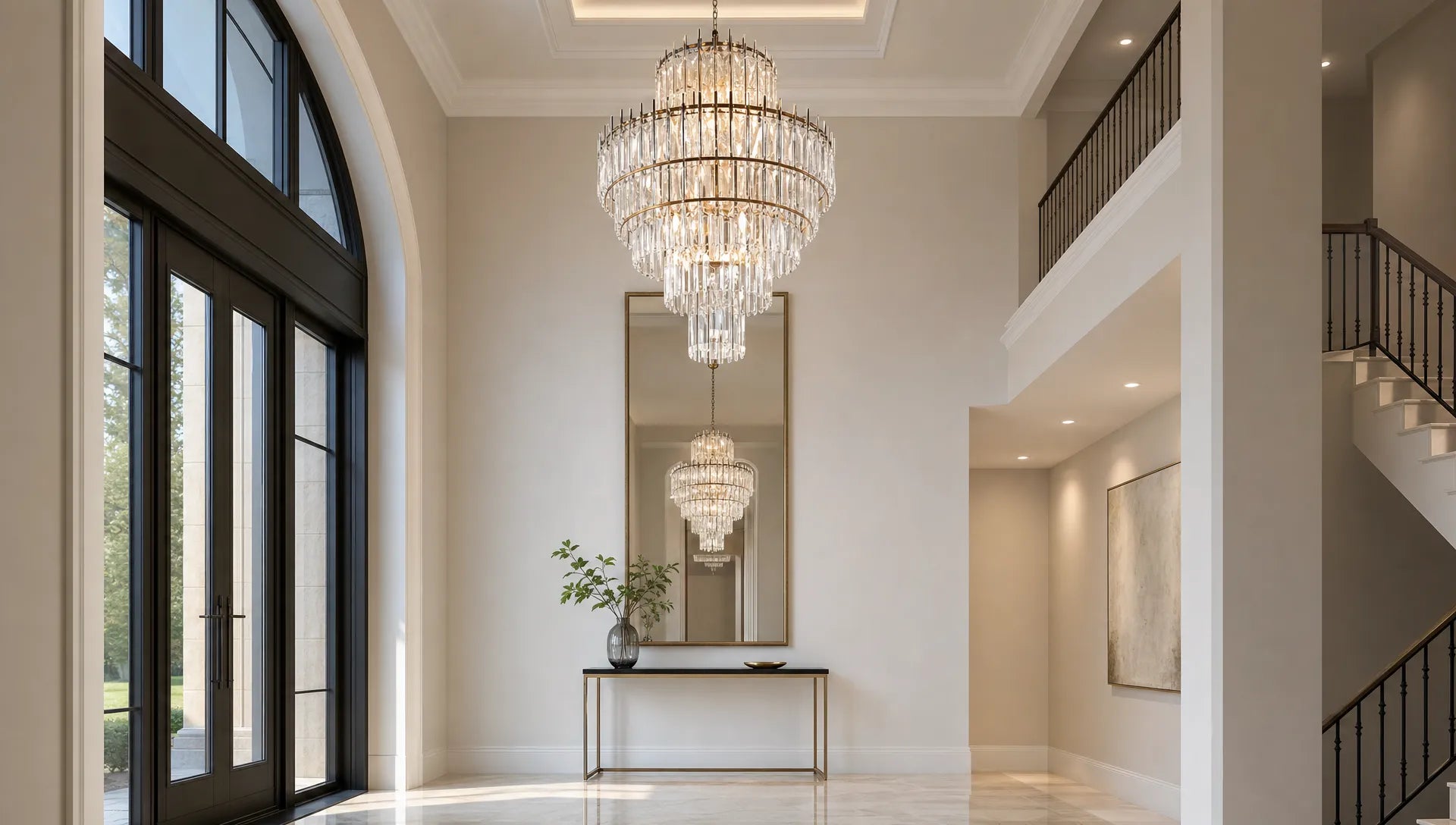
An LED lamp test does not end when you switch it on. Installation is a key quality factor, especially for pendant lights, chandeliers and ceiling lights. A lamp can be technically convincing but not work in the room if cables are too short, the shape of the canopy doesn't fit or the light source is not at the right height.
This is particularly relevant in old apartments, high ceilings, open living areas, dining tables or stairwells. A solution that can be adapted to the room situation is worthwhile. BUYnBLUE According to the offer description, offers free adjustment for chandeliers and pendant lights, for example in terms of cable length, canopy or color. For planners, renovators and interior designers, this point is often just as important in practical testing as lumens or Kelvin.
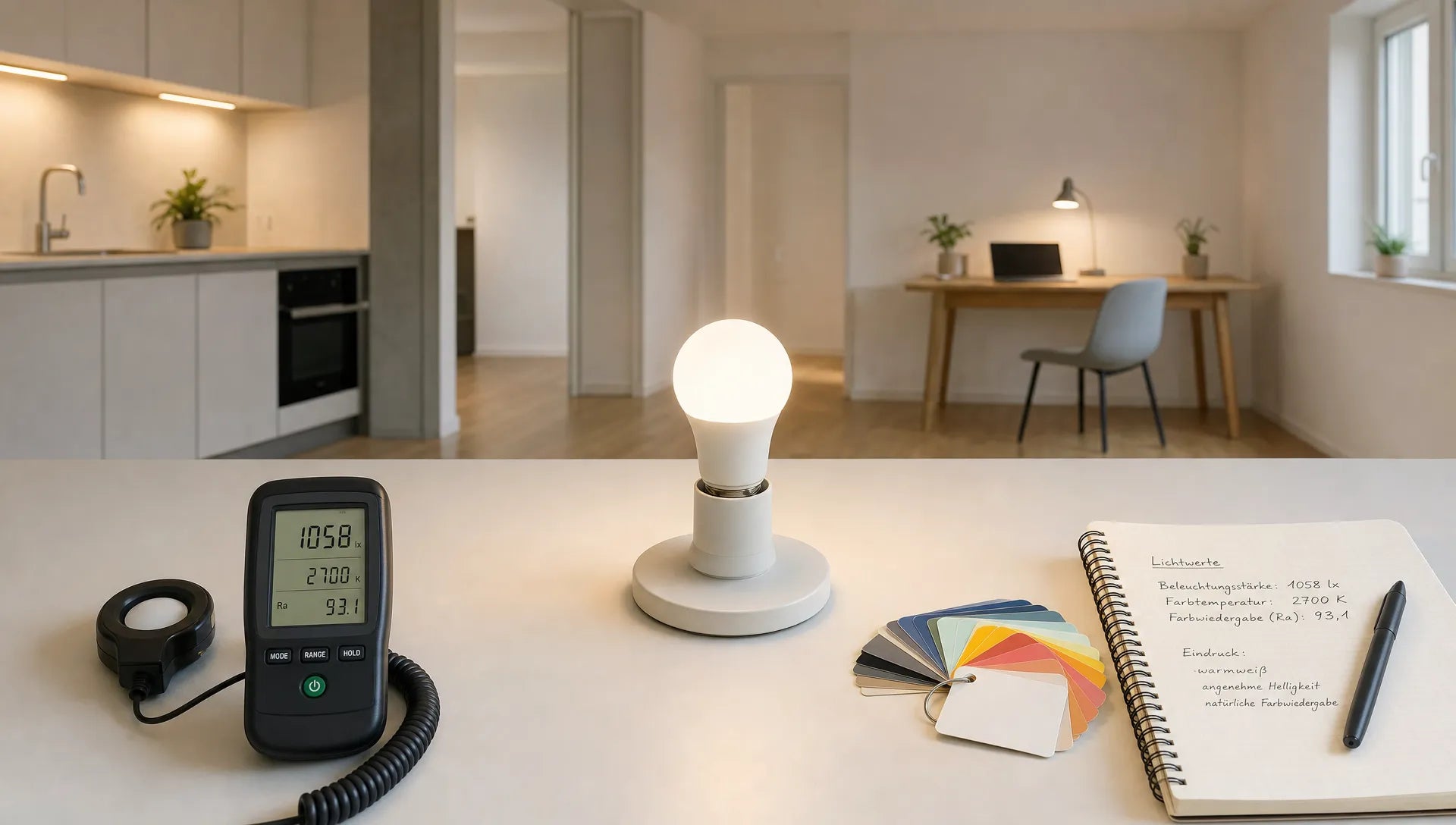
A simple LED lamp test for at home
You don't have to own a light lab to meaningfully evaluate an LED lamp. With a structured approach, many weaknesses can be identified early. If possible, test the lamp in the evening when no daylight will distort the result. If possible, also assess it during the day when it is switched off so that the design and material effect are visible.
A sensible order is:
- Check spatial effect: Just switch on the new LED lamp and observe whether the room appears balanced, too dark or too contrasty.
- Test usage zones: Sit at the dining table, sofa, bed, desk or kitchen countertop and check the light from real angles.
- Compare color effect: Consider skin tones, wood, fabrics, plants and colored objects compared to daylight.
- Try dimming: Test all brightness levels and listen for flickering, noise, and color changes.
- Evaluate glare: Do not look directly at the light source, but check whether it is disturbing from normal sitting or standing positions.
- Control heat and processing: Leave the light on for some time and then check the material, stability and heat development.
It is best to write down the results directly. Especially when you equip several rooms or compare different models, impressions quickly become blurred.
Which criteria are particularly important for each room
Not every room has the same requirements for LED lamps. That's why a test should always be usage-related. What counts in the living room is atmosphere, dimmability and a pleasant interaction of several light sources. In the dining room, the height of the pendant, freedom from glare and color rendering are crucial. In the kitchen, the focus is on brightness, freedom from shadows and neutral light colors.
In the bedroom, light should be soft, low-glare and rather warm. In the bathroom, it's important to have a clear view from the mirror and good color reproduction. In the home office, sufficient brightness, a low-interference light pattern and flexible light levels are important. Consistent orientation and good integration into the architecture are crucial for hallways and entrance areas.
For architects and interior designers, this means: One test winner for all rooms rarely makes sense. A lighting concept that combines several types of luminaires and measures each LED lamp based on its specific task is better.
Common errors in LED lamp testing
A common mistake is to only pay attention to maximum brightness. Too much light can make rooms uncomfortable and cause glare. Buying based on design alone without checking light data is just as problematic. A light can look impressive when switched off, but appear too harsh, too cold or too dark when switched on.
The service life should also be classified realistically. Manufacturers often specify them under defined test conditions. In everyday life, heat, switching cycles, driver quality and mounting environment influence actual durability. That’s why processing is an important test criterion.
Another mistake is to evaluate individual lights in isolation. Light works in interaction. A pendant light above the dining table, spotlights on the wall and indirect light on the shelf can work better together than a single strong ceiling light.
Conclusion: The best LED lamp test is room-related
An LED lamp test is really helpful when it combines technical data with real use. Lumens, Kelvin, CRI, efficiency and dimmability are important metrics. But it is only in the room that you can see whether an LED lamp is pleasant, functional and convincing in terms of design.
Anyone planning light for a modern home should therefore not look for a blanket test winner. It is better to define for each room what task the light should fulfill. LED lamps can then be compared in a much more targeted manner.
Frequently asked questions
What is more important in an LED lamp test, lumens or watts? Lumen is more important because this value describes the actual brightness. Watt only shows power consumption. For a fair comparison, you should look at both values and also check the photo.
Which light color is best for living spaces? Warm white light between around 2,700 and 3,000 Kelvin is often preferred for living spaces. It looks cozy and goes well with wood, textiles and home accessories.
How do I recognize good color rendering? Pay attention to the CRI or Ra value. For many living areas, CRI 80 is solid, but for high-end interiors, art, dining tables or dressing rooms, CRI 90 or higher is often a better choice.
How do I test if an LED lamp flickers? A simple tip is the smartphone camera test. If strong streaks or wandering patterns are visible, flicker may be present. Additionally, you should pay attention to tired eyes, headaches or buzzing noises.
Are dimmable LED bulbs always better? Dimmable LED lamps are more flexible, but only better if the dimmer, driver and luminaire are compatible. Test particularly low dimming levels because this is where flickering or noise occurs most often.
Select modern LED lights specifically
If you don't just want to compare LED lamps technically, but also want to choose them to suit your room, style and use, it's worth taking a curated look at high-quality designer lighting. At BUYnBLUE You will find modern lights for different living areas, with a focus on materials, design and harmonious integration into contemporary interiors.
Particularly practical for demanding projects: According to the offer, chandeliers and pendant lights can be adjusted free of charge, for example in terms of cable length, canopy or color. This means that a good test result also turns into a lamp that really fits in the real room.